
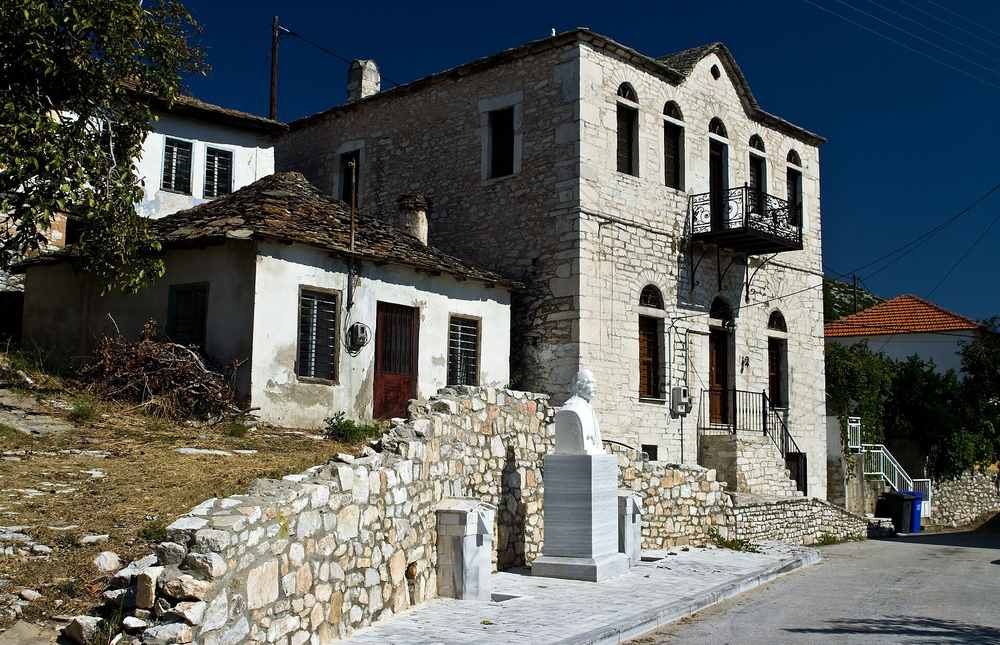
Theologos is a mountain village in the green south of Thassos, set in a valley of olive, cypress and plane trees. Stone houses with slate roofs and tall whitewashed chimneys line one long main street that climbs the slope. The village served as the island capital during Ottoman rule, and that past still shapes its lanes, its church and its calm character. Travellers reach Theologos by a mountain road that turns inland from the coast, well clear of the beaches. Spit-roast kid, local honey and slow village afternoons define the visit here. Plan a mountain day, a taverna lunch and a walk along the old street with My Greece Tours.
Theologos rewards travellers who want history and mountain calm rather than sand and sunbeds. The village keeps a traditional pace, and its landmarks record the story of the island capital that once governed Thassos. The sections below cover the location, the Ottoman past, the slate-roofed architecture, the church of Agios Dimitrios, the tavernas and the mountain road that leads here. Each heading answers a single question with concrete detail, so a visit fits neatly around lunch, a museum stop or an afternoon walk. Read on for practical routes up from the coast, then match the village to a wider island plan with our Thassos tours.
Where is Theologos in Thassos?
Theologos sits in the southern interior of Thassos, a mountain village set above the south coast. A road climbs inland from the resort of Potos, reaching the village through a green valley of olive and cypress trees.
Theologos lies in the south of Thassos, set back from the shore in a fold of the island mountains. The village fills a long green valley planted with olive, cypress and plane trees. Ridges rise on both sides, and the settlement follows the valley floor rather than a coastal bay. This inland position once kept the village hidden from sea raiders who worked the Aegean. The nearest resort, Potos, sits on the south coast, and the road up to Theologos turns off there. Drivers gain height quickly and trade the beach for pine slopes and cooler mountain air. The change of landscape marks the village as a place apart, distinct in mood from the busy southern resort strip along the water. Olive terraces and pine woods cloak the slope above.
The valley setting gives Theologos a shape unlike the coastal towns of Thassos. The main street runs for more than a kilometre along the slope, following the contour rather than a grid. Houses step up the hillside on either side, and gardens, vines and fruit trees fill the gaps between them. Water runs down from the higher ground, feeding the greenery that keeps the village cool through summer. Springs and shade made this a practical place to settle far from the malarial coast of earlier times. The mountain wall behind the village blocks the harshest heat and holds the evening cool. This green, sheltered basin explains why the settlement grew inland rather than beside a harbour on the open sea. Cool nights and steady spring water rewarded the early settlers.
Distances from the coast stay short, and that keeps Theologos within easy reach of a beach holiday. The drive up from Potos takes a quarter of an hour on a steady mountain road. Limenaria and the west-coast resorts sit a similar distance away by car across the southern flank of the island. The village works well as a half-day trip from any southern base, paired with a swim before or after the climb. Signposts on the coast road point the way, and the route needs no special vehicle beyond a normal hire car. This balance of mountain calm and coastal access makes Theologos a natural stop on a wider tour of southern Thassos and its shore. Coast roads on both flanks feed the single mountain turning inland.
Location also sets the village apart from Panagia and Potamia in the island north-east. Those hill villages sit above Golden Beach on the far side of the mountains, a longer drive from the south. Theologos anchors the southern cluster of inland settlements and pairs most easily with the south and west coasts. A traveller basing in Potos or Pefkari finds the village closest of all the mountain settlements. This southern position shaped its history too, since the old capital needed a central, defensible seat above the island farmland. The green valley delivered exactly that, tucked between the summit ridges and the sea yet screened from both by the surrounding wooded slopes. The southern coast towns of Potos and Limenaria sit closest to this inland seat above the farmland.
What is the history of Theologos as the island capital?
Theologos served as the capital of Thassos during Ottoman rule. Its inland, defensible valley kept residents safe from coastal raids, and the village grew into the administrative and religious heart of the island for centuries.
Theologos held the role of island capital through the long Ottoman period on Thassos. Coastal raids made the open shore dangerous, so islanders governed from a sheltered mountain seat instead. The valley gave defence, water and farmland within a short walk, all the elements a capital needed to endure. Officials, priests and leading families settled along the main street and built the stone houses that still stand. The village grew into the administrative and religious centre of the island, drawing trade and produce from the surrounding land. Its churches, schools and captains gave it weight beyond a farming settlement. This history explains the scale of the old street and the quality of its houses, which speak of a village that once ran the whole of Thassos from the hills.
Ottoman rule linked Thassos for a spell to the governor of Egypt, and that tie left marks on Theologos. Grants and privileges flowed to the island, and the village prospered as the seat of local self-government. Community elders met here to settle disputes, gather taxes and manage the island olive and honey trade. The wealth of that era funded the tall stone houses, the church and the schoolhouse that visitors still see. Sea captains from the village owned ships that traded across the northern Aegean and beyond. Their earnings raised the grandest of the mansions and paid for the fine bell tower. The village kept its central role until the modern harbours grew and administration shifted down to the coast at the port of Limenas.
Community records and the folklore museum keep this administrative past in view for visitors today. Documents, tools and household goods on display trace how the village governed itself and earned its living. Olive presses, looms and kitchen gear show the daily economy behind the capital status. The museum sits in an old village house, so the setting itself carries the history alongside the exhibits. Guides and labels explain the offices that once met in Theologos and the families that led them. A short visit turns the quiet street into a readable record of island government under Ottoman rule. This layer of meaning rewards travellers who look beyond the tavernas and read the village as the former seat of Thassos. Labels in plain language guide first visitors through the rooms.
Decline as a capital came gently, without a single dramatic break in the record. Safer seas let people return to the coast, and the ferry ports drew commerce down from the hills. Administration followed the trade, and Limenas took over the formal role of island capital in the modern age. Theologos held its churches, its festivals and its farms, and so it survived as a living village rather than a ruin. Families kept the houses, worked the olive groves and passed the old skills down the generations. The result is a mountain village that still looks and works today as it did at its height. Visitors read the whole arc of that story simply by walking the length of the street. Olive groves and feast days carry the rhythm forward.
What does the architecture of the main street look like?
The main street runs for over a kilometre, lined with stone houses under slate roofs and tall whitewashed chimneys. Gardens, vines and plane trees fill the gaps, and the buildings step up the green valley sides.
Stone is the signature of Theologos, worked into houses that have stood for generations. Local grey stone forms the walls, quarried from the mountains that ring the valley. Roofs carry heavy slate slabs rather than the terracotta tiles of the coast, a mark of the mountain building tradition. Tall whitewashed chimneys rise above the rooflines, painted bright against the grey stone and green slopes. Wooden balconies and shuttered windows break the walls, shaded by vines trained across the fronts. The houses sit close along the street yet each keeps a garden or a yard behind. This mix of stone, slate and whitewash gives the village a unity that the coastal towns of Thassos rarely match along a single continuous street. Grey walls and bright chimneys repeat the whole way up.
The main street itself is the spine of the whole settlement and the best route to read it. The lane runs for more than a kilometre along the valley, curving with the contour of the slope. Houses line both sides, and side paths climb away to gardens and higher homes on the hill. Plane and mulberry trees shade the route, and springs and troughs mark old gathering points. A walk from end to end passes the church, the museum, the school and the grandest mansions in turn. No single square dominates, since the street plan spreads village life along its length. This linear form suits the narrow valley and gives every stroll a clear beginning, middle and end. Benches, springs and shade trees mark natural pauses along the climb.
Chimneys deserve a closer look, since they carry the identity of the village skyline. Each stone house tops its slate roof with a tall, square, whitewashed chimney that stands well above the ridge. The height drew smoke clear of the living rooms and marked the wealth and pride of the household below. Whitewash keeps the stone bright and picks the chimneys out against the wooded slopes behind. Rows of them along the street form a rhythm that photographers return to again and again. The design is practical first, built for hard mountain winters and wood-fired kitchens. Yet the effect is also decorative, and the chimneys have become the emblem that sets Theologos apart from every other village on the island. Villagers still light wood stoves beneath them.
Gardens, water and greenery weave through the stone to soften the whole village. Vines climb the house fronts, and fig, walnut and citrus trees fill the yards behind the walls. Channels carry spring water down the slope, feeding the gardens and cooling the air along the street. This greenery is no accident, since the valley setting was chosen for its springs and shade. The planting keeps the village cool in summer and screens the houses from the worst of the sun. Flowers spill over walls and balconies through the warm months, adding colour to the grey and white. The blend of hard stone and living garden gives Theologos its settled, lived-in feel, a working village rather than a preserved museum piece. Water troughs cool the shaded lane at noon.
Which landmarks stand in Theologos village?
Theologos centres on the church of Agios Dimitrios with its tall stone bell tower. A folklore museum, a preserved captain’s mansion and an old nineteenth-century schoolhouse survive along the street, recording the village at its height.
The church of Agios Dimitrios stands at the heart of Theologos and anchors the village street. Its tall stone bell tower rises above the rooflines and serves as a landmark from far down the valley. The stonework matches the houses around it, tying the church into the fabric of the settlement. Inside, icons and woodwork record the faith that held the community together through the centuries of Ottoman rule. The church remains in use, and its bells still mark the hours and the feast days for the village. A courtyard and shade trees give a quiet pause on any walk along the street. As the religious centre of the former capital, Agios Dimitrios carries the same weight for the village that a cathedral holds for a town.
The folklore museum records daily life in the old capital and rewards a short stop. Housed in a traditional village dwelling, the museum sets its exhibits within authentic stone rooms. Farm tools, looms, kitchen gear and household goods trace how families lived and worked here. Displays cover the olive harvest, the honey trade and the crafts that supported the mountain economy. Photographs and documents add faces and dates to the objects on show. The setting itself teaches alongside the printed labels, since the house survives as a period piece. A visit turns the quiet street into a legible record of the village at its height as the seat of the island. Guides on the spot fill in the stories behind the tools and the rooms.
A preserved captain’s mansion survives from the nineteenth century and shows the wealth of the sea trade. Village captains owned ships that traded across the northern Aegean, and their earnings raised grand stone homes. The mansion stands taller and finer than the working houses around it, with carved details and generous rooms. Its scale records the reach of Theologos when the village funded fleets and governed the island. Stone walls, slate roofs and a proud chimney mark it as the finest house on the street. The building anchors the upper stretch of the village and rewards a closer look on any walk. It stands as physical proof that this mountain settlement once held real wealth and standing across the whole of Thassos. Carved doorways mark the finest house.
The old schoolhouse survives from the nineteenth century and completes the run of village landmarks. Education mattered to the leading families, and they funded a solid stone school along the main street. The building trained village children through the era when Theologos ran the island from the hills. Its classrooms and hall record a community that valued learning alongside trade and farming. The school sits among the church, the mansion and the museum, so a single walk gathers the civic story. Together these buildings map the offices of the old capital, from worship to learning to government. A visitor who links them in one stroll reads the full working life of the village. Signposts and the folklore museum help place each building in its proper part of the story.
What food do the tavernas of Theologos serve?
Theologos tavernas are known for spit-roast kid and lamb cooked slowly over coals. Local honey, olive oil and village sweets round out the menu, drawing diners up from the coast for a mountain lunch.
Spit-roast meat is the reason travellers drive up to Theologos in the first place. Kid and lamb turn slowly over wood coals until the outside crisps and the meat falls from the bone. The tavernas along the street built their name on this slow-cooked mountain roast. Charcoal, patience and simple seasoning carry the dish, with no need for heavy sauces. Diners smell the roasting meat long before they reach the tables under the plane trees. Portions come generous, matched with village bread, salad and local wine. The result draws a steady stream of visitors up from the coast at lunchtime, especially at weekends. A meal of spit-roast kid in the shade of the street is the classic Theologos experience and the anchor of any visit.
Local honey ranks among the prized products of the village and its wooded surroundings. Bees work the pine forests and wild herbs of the southern mountains, giving the honey a dark, resinous depth. Jars sold along the street carry the flavour of the slopes straight to the visitor. The honey sweetens the yoghurt, pastries and spoon sweets served in the tavernas after a roast lunch. Beekeeping has supported village families for generations and still forms part of the local economy. A pot of Thassos pine honey makes a fitting gift to carry home from the mountains. The product ties the food of Theologos directly to the forested valley that surrounds it, a taste rooted in the land rather than shipped in from elsewhere on the island.
Olive oil and garden produce fill out the taverna menus alongside the roast and the honey. Olive groves cloak the valley slopes, and the village presses its own oil for the kitchen and the table. Salads, pulses and slow-cooked vegetable dishes lean on that oil and on garden vegetables grown nearby. Cheese, bread and village wine complete a spread built almost entirely from the surrounding land. This close link between farm and table gives the food an honesty that packaged menus rarely match. Diners taste the valley in the oil, the herbs and the vegetables on the plate. For a fuller picture of island cooking and its regional dishes, see our guide to Thassos food and its mountain and coastal traditions. Bread, cheese and village wine complete the spread.
Village sweets and simple desserts close a Theologos meal on a mountain note. Spoon sweets, walnut pastries and honey-soaked cakes draw on the fruit, nuts and honey of the valley. Preserved fruits from village gardens turn up in jars on the taverna shelves. A small coffee and a sweet in the shade round off lunch before the drive back to the coast. These traditional desserts carry the same farm-to-table logic as the savoury dishes. Nothing here strains for novelty, and the pleasure lies in honest, familiar flavours done well. The sweet course leaves visitors with a last taste of the mountain valley and often a jar or two bought to carry the flavour home. Such simple endings suit the unhurried pace of the village street.
How do visitors reach the village from the coast?
Visitors reach Theologos by a mountain road that climbs inland from the south coast resort of Potos. A hire car or an organised tour is the practical way to arrive, since bus links to the village stay limited.
The mountain road from Potos is the main route up to Theologos and the simplest to follow. The turning leaves the south coast at the resort of Potos and climbs steadily inland through the pines. The drive gains height on a well-surfaced road that needs no special vehicle beyond a normal car. A quarter of an hour of steady driving brings travellers from the beach to the village street. The route rewards the effort with widening views back over the wooded slopes towards the sea. Signposts on the coast road point the way, so navigation stays straightforward for first-time visitors. This short, scenic climb is the classic approach and the reason the village pairs so neatly with a southern beach base for the day.
A hire car gives the most freedom for a visit and suits the mountain setting of the village. Own transport lets travellers choose their own hour, linger over lunch and stop for views on the drive. Parking sits at the edge of the village, from where the main street runs on foot. The flexibility of a car also allows a swim on the coast before or after the mountain trip. Drivers can pair Theologos with the west coast or the southern beaches in a single relaxed day. For rates, routes and pick-up points across the island, see our guide to Thassos car rental and its practical booking advice. A car turns the village from a fixed excursion into a stop shaped entirely around the traveller.
An organised tour offers the easy alternative for those who prefer not to drive the mountain road. Coach and minibus trips run up from the southern resorts, taking the strain of the climb and the parking. A guide adds the history of the old capital, the church and the captain houses along the way. Tours often pair the village with a taverna lunch, so the spit-roast meal comes built into the day. This route suits families, older visitors and anyone keen to leave the driving to a local expert. Booking ahead secures a seat in the busy summer months when demand runs high. For guided options that fold Theologos into a wider island itinerary, our Thassos tours set out the day trips on offer.
Public buses reach the village on a thin timetable, so most travellers plan around a car or a tour instead. Services from the coast run only a handful of times, and connections rarely suit a relaxed lunch and return. A bus visit works for the determined, but the sparse schedule leaves little room to linger in the village. Taxis run up from the resorts and give a fixed-price alternative for a small group. Cycling the climb suits only strong riders, given the height gained on the mountain road. For most visitors the choice comes down to a hire car or a booked tour. Either option turns the trip into an easy half-day, with the village street, the church and a taverna lunch all comfortably within reach.
Why does the village feel cooler and quieter than the coast?
Theologos sits high in a wooded mountain valley, so it stays cooler and calmer than the beaches. The village keeps a traditional pace away from the resorts, drawing travellers who prefer history and shade to sand.
Altitude and shade keep the village cooler than the beaches through the heat of summer. The valley sits well above sea level, where mountain air brings relief from the coastal heat. Plane trees, vines and gardens line the street and throw shade across the stone houses. Spring water runs down the slopes, cooling the air and feeding the greenery along the lane. Evenings turn fresh as the mountain draws the day heat away, unlike the warm coast below. Visitors who wilt on the sand find the village a comfortable retreat at midday. This natural cool, built from height, water and trees, is a large part of why travellers climb up from the shore for lunch and an afternoon in the shade. Stone walls hold the night cool into the morning.
Quiet defines the village in a way the busy resorts of the coast cannot match. No large hotels or beach bars crowd the street, and the pace stays gentle throughout the day. Villagers go about their work, tavernas fill and empty at mealtimes, and the lane falls silent between. The absence of nightlife and traffic leaves birdsong and running water as the main sounds. This calm draws travellers who want to slow down and read a place rather than party. Families, walkers and older visitors find the peace a welcome change from the crowded shore. A morning here feels unhurried, shaped by the street, the church and the tavernas rather than by a packed beach schedule of sunbeds and water sports. Church bells and cockerels set the daily rhythm here.
Tradition survives in Theologos because the village kept working after the tourists arrived on the coast. Farming, beekeeping and craft still shape daily life alongside the taverna trade. Festivals, church feasts and family gatherings follow the old calendar rather than the resort season. This living continuity gives the village an authenticity that purpose-built resorts lack entirely. Visitors sense a real community at work, not a stage set arranged for their benefit. The stone houses hold families, the gardens grow food, and the church still gathers the village. Travellers keen to base near this calm can compare mountain and coastal options in our guide to where to stay in Thassos and its range of villages and resorts. Farmers, beekeepers and taverna cooks still shape the working village week.
The contrast with the beaches is the whole point of a trip up to Theologos. A morning on the sand and an afternoon in the mountains give two very different sides of the island in one day. The village pairs naturally with a coastal base, adding history and shade to a beach holiday. Nearby Panagia offers a second mountain village for travellers keen to compare the hill settlements of Thassos. Together the two show how island life climbed inland long before the resorts grew along the shore. This blend of coast and mountain, sand and stone, is what makes southern Thassos rewarding. Theologos supplies the quiet, green, historic half of that balance, a short drive yet a world away from the beach. Cool air and quiet lanes seal the contrast.
Frequently Asked Questions
Is Theologos worth visiting on a Thassos holiday?
Theologos rewards a half-day trip for travellers who want history and mountain calm beside their beach time. The village offers stone architecture, the church of Agios Dimitrios, a folklore museum and famous spit-roast tavernas. A short drive from the southern coast makes the visit easy to fit into any island holiday.
How long does a visit to Theologos take?
A visit to Theologos usually fills a half-day, built around a walk along the main street and a taverna lunch. Allow an hour to stroll the village, see the church and the museum, then time for a slow spit-roast meal. Most travellers pair the trip with a morning or afternoon on the nearby southern beaches.
What food is Theologos known for?
Theologos is known for spit-roast kid and lamb, cooked slowly over wood coals in the tavernas along the street. Local pine honey, village olive oil and traditional sweets round out the menus. Diners drive up from the coast for this mountain lunch, which draws its flavours from the surrounding valley farms and forests.
Was Theologos really the capital of Thassos?
Theologos served as the capital of Thassos through the long Ottoman period on the island. Its sheltered inland valley kept residents safe from coastal raids and gave water and farmland close at hand. The village ran island government, trade and worship until modern harbours drew administration down to the coast at Limenas.
How do you get to Theologos without a car?
Public buses reach Theologos on a thin timetable, so a booked tour or a taxi suits travellers without a car. Organised trips run up from the southern resorts and often include a guide and a taverna lunch. Taxis offer a fixed-price ride for small groups, while the sparse bus service leaves little room to linger in the village.
Which is better to visit, Theologos or Panagia?
Theologos and Panagia each reward a visit, and the choice depends on your island base. Theologos suits travellers staying on the south and west coasts, with its spit-roast tavernas and capital history. Panagia sits above Golden Beach in the north-east, closer for visitors on that side. Seeing both gives the fullest picture of mountain Thassos.