
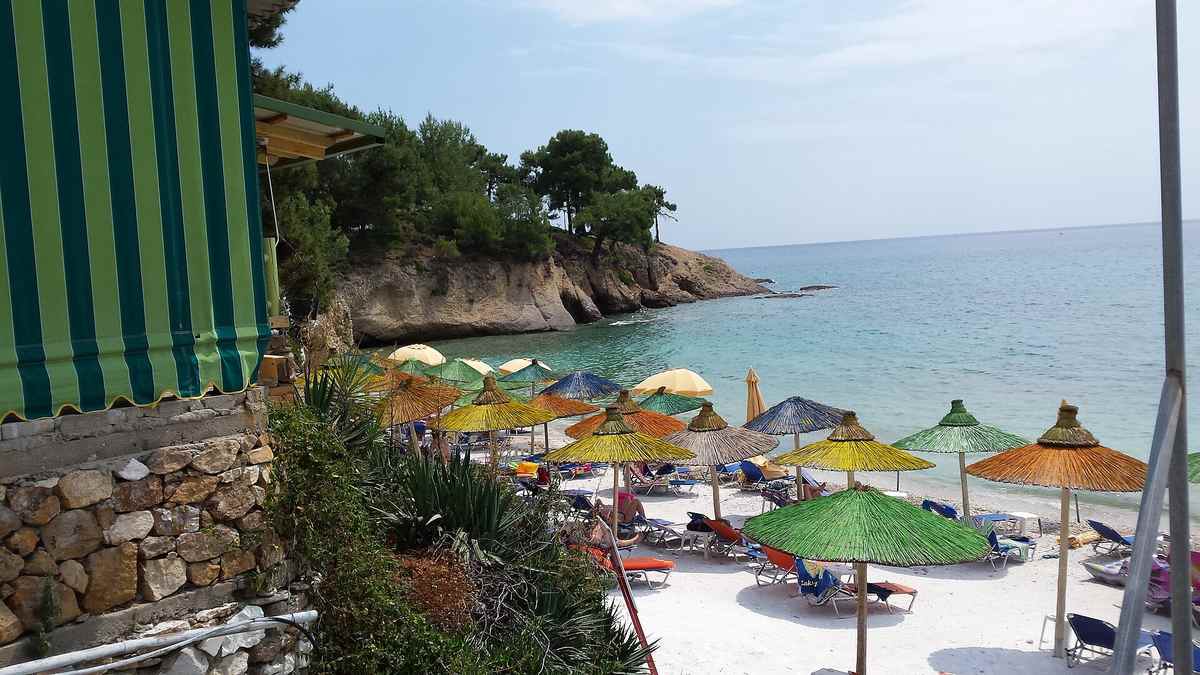
Potos is a lively resort on the southwest coast of Thassos, and it ranks among the island’s main holiday bases. A long beach of sand and pebble runs the length of the seafront. A palm lined promenade backs the shore, and it carries tavernas, bars, shops and hotels along its length. Families settle here by day, drawn by water that shelves gently from the sand. The evening scene turns social, giving Potos one of the busiest nightlife stretches on Thassos. Boat trips leave the resort for the coast, and a mountain road climbs inland toward older villages. This guide sets out the resort in full, mapped for your trip with My Greece Tours.
Potos works as a base for the wider south coast of Thassos, close to quiet bays and busy strips alike. The sections below cover the resort’s setting, its beach, and the social evening scene that fills the promenade. They also trace the walk to Pefkari, the boat trips that leave the harbour, and the climb to Theologos in the hills. Practical notes follow on getting around and finding a room before high summer fills them. Each section answers one question and links onward to the pages you need next. Plan the whole island around this resort with Thassos tours and build a route that fits your dates.
Where does Potos sit on the coast of Thassos?
Potos sits on the southwest coast of Thassos, one of the island’s main holiday bases. The resort faces open water, backed by hills, with the ring road linking it to the other coasts.
Potos lies on the southwest shoulder of Thassos, the green island off the coast of northern Greece. The resort grew from an old fishing and marble settlement, and tourism now drives its daily life. A wide bay frames the village, with the sea on one side and forested slopes rising behind. The ring road that circles the island passes close, so drivers reach the west and east coasts without doubling back. That setting gives the resort calm water for most of the season, since the surrounding land shelters the bay. Potos suits travellers who want a settled base rather than a single stop on a longer route.
The village stretches along the shore in a long, low line rather than climbing a hillside. A main road runs behind the beach, carrying the traffic that arrives from the ring route. Shops, bakeries and car hire desks line this strip, so daily errands stay within a short walk. Behind the front, quieter lanes hold apartments and family run rooms among the pines. The layout keeps the sea in view from most of the resort, and it puts the sand within reach of every base. Potos reads as a compact resort, easy to cross on foot, yet wide enough to spread its crowds along the promenade during the evening.
Thassos itself shapes how Potos feels through the year. The island keeps its pine forests close to the coast, so shade sits near the sand along the front. Marble from local quarries once left the harbour here, and white stone still shows in walls and paving. The mainland port of Keramoti lies across a short stretch of sea to the north, feeding the island with ferries. Potos gains from that link, since supplies and visitors reach the south coast within a day of leaving Kavala. The resort thus combines an island setting with steady access, a balance that keeps it full from late spring onward and busy well past the peak weeks.
Distances from Potos stay short, which is part of its appeal as a base. Limenaria, the largest town on the south coast, sits a short drive west along the shore road. Pefkari beach lies about one kilometre to the north, an easy walk past the headland. Theologos, the old mountain capital, stands around ten kilometres inland by a climbing road. These fixed points let visitors plan days without long drives, whether the aim is a market, a beach or a village taverna. Potos works as the hub of the southern coast, close to enough variety that a week rarely repeats the same stretch of sand or the same evening table.
What is the beach at Potos like?
The beach at Potos is a long stretch of sand and fine pebble, roughly two kilometres end to end. Water shelves gently from the shore, staying shallow and clear, which suits families and weaker swimmers.
The shore at Potos runs for roughly two kilometres, one of the longest beaches on the south coast. Sand meets fine grey pebble at the waterline, and the mix keeps the seabed firm underfoot. Palm trees and tamarisks edge the promenade, throwing shade across the front through the hottest hours. The water reads clear and green over the pale bed, and it deepens slowly enough for children to wade well out. Sunbeds and umbrellas cover the central stretch, while the ends stay quieter for anyone seeking room. It ranks among the beaches of Thassos as a broad, flat arc rather than a hidden cove. The length rewards a full day on the sand rather than a quick swim between stops.
Facilities line the whole front at Potos, which sets it apart from the wilder coves elsewhere. Beach bars serve drinks to the sunbeds, and showers and changing points sit at regular breaks. Watersports operators work the central stretch, offering pedal boats, canoes and rides towed behind a launch. The gentle gradient makes the water safe for early swimmers, and lifeguards watch the busiest section in peak weeks. Tavernas stand steps from the sand, so lunch never means a long walk inland. That blend of open beach and full service explains why families return to the same stretch year on year. Potos delivers a resort beach in the proper sense, equipped for a whole day without a car.
Shade shapes the day on the Potos front more than on most island beaches. The planted palms and the natural pines throw cover from mid morning, so a base near the back stays cool. Morning brings the calmest water, before the afternoon breeze lifts a light chop across the bay. The seabed stays pale and even, which keeps the shallows warm and bright under the sun. Snorkellers find rock only at the far ends, where the sand gives way to low reef. The centre suits swimming and floating rather than exploring, a plain sandy basin with room to spread. Potos therefore favours slow beach days over active ones, though the watersports fill any gap.
Timing changes the character of the beach across the season. Late spring keeps the sand open, with warm water and only a scatter of early visitors. High summer fills the central sunbeds by mid morning, and the promenade behind hums until late. The quieter weeks of autumn bring back the calm, while the sea holds its heat into the cooler months. Weekends draw day trippers from Limenaria and the inland villages, so arriving early secures a front row spot. Potos handles these swings well, since its length absorbs the crowds that would overwhelm a smaller cove. The beach stays workable even at the peak, a rare trait on an island of tight, pretty bays.
Why is Potos known for its nightlife?
Potos holds one of the busiest evening scenes on Thassos. Bars and tavernas line the promenade, filling after sunset with music, drinks and diners. The social crowd runs from families early to a livelier bar trade late.
The promenade at Potos turns into the resort’s stage once the sun drops. Tables spill from the tavernas onto the front, and the smell of grilled fish drifts along the shore. Bars set out cushions and low seats facing the water, and the lights of the bay draw an early crowd. The pace stays relaxed through dinner, with families and couples filling the seafront strip. Later the music lifts and the younger visitors gather at the busier bars near the centre. Potos carries this rhythm through the whole summer, rather than for a single festival week. The result is a resort that feels awake after dark, yet rarely tips into the scale of a city club district.
Variety keeps the Potos evening broad rather than narrow. Quiet ouzeris serve mezze to older visitors who prefer a long, slow meal. Cocktail bars mix drinks for a mixed crowd that drifts along the front between venues. Music bars run later, trading in pop and dance without the ticketed feel of a large club. The short distances let visitors move between venues on foot in one night, since the strip sits along a single shore. That walkable layout defines the scene, a chain of small venues rather than one giant floor. Potos suits groups who want choice close at hand, and it spares them the taxi rides that longer resorts force.
Food anchors the Potos night as firmly as the bars do. Fish tavernas plate the local catch, and grill houses turn out lamb, chicken and the island’s own dishes. Prices sit lower than the glossier islands, which keeps eating out a nightly habit rather than a treat. Bakeries and gelato counters stay open late, feeding the slow walk along the promenade after dinner. The mix means the evening centres on the table first and the bar second, a Greek pattern rather than a party one. Potos holds that balance well, since its tavernas outnumber its clubs along the front. Diners set the tone, and the resort keeps a family face even at its busiest hour.
Season and setting shape how loud the Potos night runs. High summer brings the peak, when the front fills and the bars trade until the small hours. Spring and autumn quieten the scene to tavernas and a scatter of open bars, better suited to couples. The open front keeps the noise spread along the shore rather than trapped in one square. That layout lets late venues run without swamping the rooms set back among the pines. Potos therefore serves two crowds at once, lively near the water and calm a street behind. Visitors pick their base to match, close in for the buzz or back a lane for the quiet.
How does Pefkari beach sit next to Potos?
Pefkari lies about one kilometre north of Potos, an easy walk past the headland. A sandy, pine backed bay and a campsite sit there, quieter than the main resort yet close enough to share its services.
Pefkari sits just north of Potos, close enough to reach on foot along the coast. A low headland separates the two bays, and a short path links them past the pines. The beach at Pefkari runs shorter than the main resort strip, curved and backed by dense forest. Clear water and a blue flag mark it out for cleanliness, a draw for swimmers and divers. A dive centre works from the bay, using the calm, sheltered water off the point. The pace stays gentler than at Potos, with fewer bars and a quieter front. Visitors often split their days between the two, the long resort beach by turn and the pine cove next door.
The campsite at Pefkari gives the bay a different crowd from the hotels of Potos. Pitches sit under the pines, steps from the sand, drawing campers and vans through the summer. That base suits travellers on a lighter budget, close to the resort yet cheaper to stay. Shade covers most of the beach, since the forest reaches almost to the waterline. Tavernas edge the sand for lunch, though the choice stays smaller than along the Potos front. The bay works as an annex to the resort, sharing its services while keeping its own calm. Campers walk to Potos for the nightlife, then return to the quiet of the trees to sleep.
Walking links Potos and Pefkari more naturally than driving. The coast path rounds the headland in under twenty minutes, passing rock and pine on the way. Cars share a short stretch of the main road, but the walk stays flatter and more direct. That closeness lets a base at either point reach both beaches without a car at all. Pefkari draws the divers and the campers, while Potos holds the shops and the busier front. The pairing gives the south coast two moods within sight of each other, calm and lively side by side. Visitors gain from choosing a room between them, within reach of the sand and the evening strip alike.
Beaches spread on beyond Pefkari for anyone willing to travel a short way. San Antonio sits close by, a small cove with clear water off the same coast. Psili Ammos and Rosso Gremos lie a short way on, reached by the ring road or a boat. Each keeps its own character, from open sand to steep rock plunging into deep water. The cluster turns Potos into a launch point for a run of southern beaches rather than a single shore. Drivers reach them within minutes, while boats trace the coast from the harbour by the resort. That spread rewards a longer stay, since the south coast holds enough sand to fill a full week.
What boat trips leave from Potos?
Potos serves as a departure point for boat trips around Thassos. Day cruises trace the coast to remote beaches and sea caves, while shorter runs reach nearby bays that stay hard to visit by road.
The harbour by Potos sends boats out along the south coast through the season. Day cruises circle part of the island, stopping to swim at coves that no road reaches. Smaller launches run shorter hops to the nearby beaches, dropping swimmers for an hour on the sand. A Thassos boat trip from here often takes in sea caves and the clear water off the headlands. Longer sailings include lunch aboard, grilling fish while the boat drifts off a quiet bay. The calm south coast suits these outings, since the sheltered water stays flat through the morning. Booking a Thassos boat trip turns the resort into a launch point for the coast that stays out of reach on foot.
Routes from Potos split by length and aim. The full day cruise loops toward the wilder corners of the coast, well beyond the reach of a short walk. Half day trips stay closer, dropping anchor off a string of southern beaches for a swim and a snack. Private charters carry small groups to a chosen cove, away from the fixed schedules. The boats leave in the morning while the sea lies flat, returning before the afternoon wind rises. That timing shapes every trip, since the south coast calms early and roughens later. Potos gives each of these outings a base, close to the moorings and the ticket desks along the front.
Sea caves and hidden coves draw the longer cruises from Potos. Boats nose into gaps in the rock where the water glows pale over white marble beds. Swimmers drop straight from the deck into water far deeper than the resort shallows. The bare cliffs of the south coast rise straight from the sea, a contrast to the flat sand at the base. Guides point out the marble seams that gave the island its old trade in white stone. These stops fill the parts of a visit that a beach day cannot reach. Potos puts them within a morning’s sail, turning the harbour into the gateway for the rugged edge of the coast.
Boats also connect Potos with the rhythm of the wider island. Sailings tie the south coast to the beaches of the east and the west without the drive around the ring road. Sunset cruises run late in the day, tracing the shore while the light drops behind the hills. Family trips keep to calm water and short hops, matched to younger passengers. The harbour stays busy through summer, loading swimmers, snorkels and picnic bags at the quay. That traffic marks the resort as a working base for the sea, not only a beach to lie on. Potos rewards a day afloat as much as a day on the sand, and the two fill a stay together.
How do you reach Theologos from the resort?
A mountain road climbs inland from Potos to Theologos, the old capital of Thassos, about ten kilometres away. The route rises through pine forest to a stone village of slate roofs and narrow lanes.
The road to Theologos leaves Potos and climbs steadily into the hills behind the coast. Pine forest closes over the route as it rises, and the sea drops away below. The village stands around ten kilometres inland, the old capital of the island through the years of Ottoman rule. Stone houses with slate roofs line the single long street, set among gardens and plane trees. A visit to Theologos trades the beach for mountain air and a slower village pace. Tavernas here grill goat and lamb over wood, a menu built on the hills rather than the sea. The drive rewards a spare afternoon, pairing the coast at the base with the old heart of Thassos above it.
Theologos rewards a slow wander once the road ends. The main street runs long and narrow, following the valley rather than a grid. Old mansions and a white bell tower mark the years when this village governed the whole island. Springs feed fountains along the way, and gardens spill fruit trees over the stone walls. The pace stays rural, with a scatter of tavernas and shops rather than a resort strip. Visitors climb here for the history and the cooking, not for sand or bars. The contrast with the coast sharpens the trip, since the mountain village keeps a face that the beaches lost to tourism long ago.
The drive itself forms part of the appeal. The road switches back through the forest, opening views over the south coast and the sea beyond. Lay bys let drivers pause where the trees break for a clear look down to Potos. The air cools with the climb, a relief from the heat on the sand below. Goats graze the slopes, and the smell of pine and herbs fills the higher bends. A hire car or a scooter handles the route with ease, though the turns ask for care. The half hour climb turns the journey into a scenic run rather than a simple transfer between two points.
Theologos pairs well with the other inland stops above the south coast. Kastro, a near abandoned village higher in the hills, sits within reach for the adventurous. Old olive mills and marble quarries dot the slopes between the coast and the peaks. Walking trails link the villages for those who prefer the route on foot. The mountains hold the island’s history more plainly than the rebuilt resorts along the shore. A day inland balances a beach holiday, adding depth to a stay based at the coast. Theologos anchors that side of the island, the clearest window on the Thassos that came before the tourists.
How do you get around and stay in Potos?
Rooms and hotels at Potos fill early in high summer, so book ahead. The ring road links the resort to both coasts, and hire cars or scooters make the wider island easy to reach.
Beds at Potos range from big seafront hotels to small rooms among the back lanes. The larger hotels line the shore, trading on sea views and pools close to the sand. Family run studios sit a street or two back, cheaper and quieter under the pines. Guidance on where to stay in Thassos weighs the resort against the calmer bases along the coast. Potos suits visitors who want the beach, the shops and the evening strip within a short walk. The rooms fill early once summer peaks, since the resort ranks among the busiest on the island. Booking ahead secures both the price and the position, close to the sand or back in the quiet.
A car opens the rest of Thassos from a base at Potos. The ring road circles the island in a single loop, linking every coast within an hour or so. Hiring through Thassos car rental turns the resort into a launch point for beaches, villages and mountain roads. Scooters handle the shorter hops for those content to stay near the south coast. Buses also call along the shore road, connecting Potos with Limenaria and the capital at set times. The compact resort needs no car for its own beach and bars, kept within a short walk. Wheels matter most for the days spent exploring, when the far beaches and the inland villages come into range.
Getting to Potos in the first place runs through the island’s ferry links. Boats cross from Keramoti on the mainland to Limenas in the north within a short sailing. A longer route ties Kavala to Skala Prinos on the west coast, closer to the southern resorts. From either port the ring road carries drivers down to Potos within the hour. Hire desks at the ports and in the resort put a car in reach on arrival. The transfer stays simple, since the island keeps its roads short and its ports well linked. Potos sits far enough from the north port to feel remote, yet close enough to reach without a long haul.
Timing a stay at Potos rewards a little planning. High summer packs the resort, filling the beach, the tavernas and the rooms at once. Late spring and early autumn keep the warmth while thinning the crowds, the pick for a calmer visit. The sea holds its heat well past the peak, long after the busiest weeks have passed. Booking early matters most in the busiest weeks, when the seafront hotels sell out first. A base here works for families by day and couples by night, since the resort carries both. Potos rewards the traveller who plans around the season, close to the sand yet open to the whole of the island beyond.
Frequently Asked Questions
Where is Potos on Thassos?
Potos sits on the southwest coast of Thassos, one of the island’s main holiday resorts. The ring road links it to both the west and east coasts. Limenaria lies a short drive west, while the north port of Limenas stands within an hour by road.
Is Potos good for families?
Potos suits families well by day. The beach shelves gently from the sand, staying shallow and clear for young swimmers. Sunbeds, showers and tavernas line the front, so a full day needs no car. The evening turns social along the promenade, yet the rooms set back among the pines stay calm.
How far is Pefkari from Potos?
Pefkari lies about one kilometre north of Potos, an easy walk past the headland. The bay holds a sandy, pine backed beach and a campsite, quieter than the main resort. A blue flag marks its clean water, and a dive centre works from the sheltered point. Visitors often split their days between the two.
What is there to do near Potos?
Potos works as a base for the south coast. Boat trips leave the harbour for remote coves and sea caves. A mountain road climbs to Theologos, the old capital, about ten kilometres inland. Nearby beaches include Pefkari, San Antonio, Psili Ammos and Rosso Gremos, each within a short drive or sail.
Does Potos have nightlife?
Potos holds one of the busiest evening scenes on Thassos. Tavernas and bars line the promenade, filling after sunset through the summer. The pace runs from family dinners early to a livelier bar trade late, spread along the shore rather than packed into one square. The scene stays lively across the season.
When should you book a room in Potos?
Rooms and hotels in Potos fill early in high summer, so booking ahead secures both price and position. July and August pack the resort hardest, when the seafront hotels sell out first. Late spring and early autumn keep the warmth while thinning the crowds, the calmer window for a stay.