
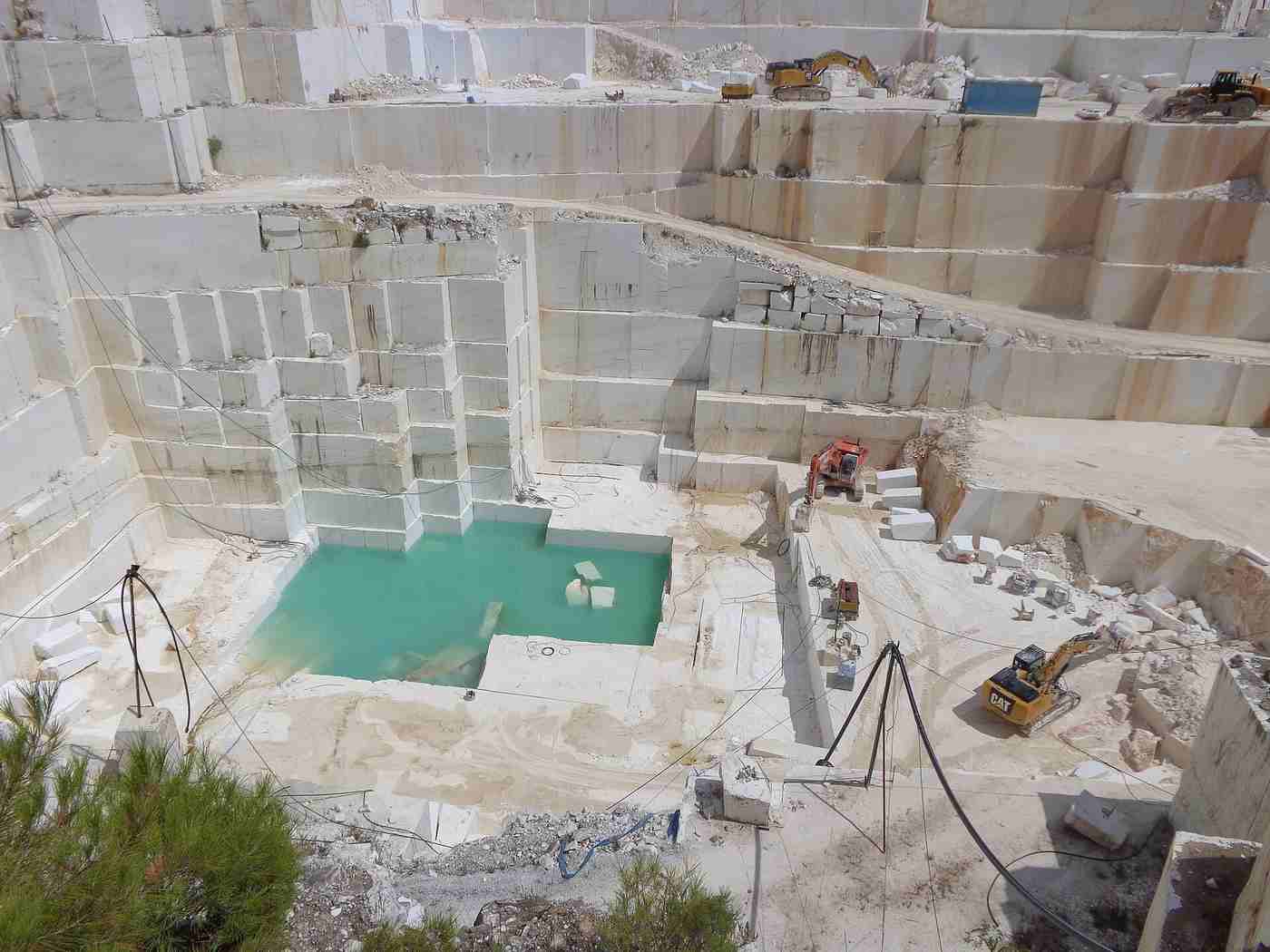
Thassos marble is the pure white dolomitic stone that has defined the Greek island of Thassos for almost three thousand years. Quarrymen have cut this bright, crystalline rock from the hills and coast since the seventh century BC, and the trade in it made the ancient city one of the richest in the northern Aegean. The stone shows an unusually high whiteness, a fine sugary grain and a soft glow that sets it apart from the grey and veined marbles of the mainland. Geology, ancient quarrying, modern extraction, sculpture and export all trace back to this single material. A tour of the island with My Greece Tours brings the marble story to life, and the wider range of Thassos tours ties the quarries to the beaches and ruins they created.
White marble runs through every chapter of the island’s past, from the Roman columns shipped across the empire to the dazzling tailings that still turn certain shores snow-white today. The stone links the geology of the land to the art, wealth and reputation of ancient and modern Thassos alike. The sections below explain what Thassos marble is, how it formed, where the ancient quarrymen cut it at Aliki, how the modern industry extracts and processes it, how sculptors and builders used it, how the local artist Polygnotos Vagis drew on it, and how a visitor can see the marble across the island. Planning stays simple with the range of island tours that reach the quarries, the museums and the marble-coloured coast.
What is Thassos marble and what makes it special?
Thassos marble is a pure white dolomitic marble quarried on the Greek island of Thassos, prized for its bright, almost snow-white colour, fine crystalline grain and high light reflectance, ranking among the whitest and most sought-after natural stones in the world.
Thassos marble stands out first for its exceptional whiteness, a clean bright tone with little of the grey clouding or dark veining that marks many other marbles. Dolomite, the calcium-magnesium carbonate mineral that forms the bulk of the rock, gives the stone its pale body and its slightly crystalline sparkle in strong light. Quarrymen and traders have valued this brightness since antiquity, when the marble already carried a reputation across the Greek world. Buyers today rank Thassos White among the whitest natural stones on the market. The colour holds steady across large blocks and slabs, a rare quality that suits both ancient sculpture and modern cladding. Purity of tone remains the single feature that defines the material.
Grain and texture set the stone apart as clearly as its colour does. Fine, even crystals pack together to give a sugary, slightly granular surface that catches and scatters daylight. Light striking a polished face of Thassos marble penetrates a short way into the crystals before it reflects, lending the stone a soft inner glow rather than a hard mirror shine. Sculptors prized this translucency, which lends carved flesh and drapery a lifelike softness. Masons found the even grain easy to work in any direction without splitting along hidden veins. Reflectance measured on the best grades reaches very high values, which explains its use in bright interior surfaces. Texture and translucency together give the marble its lasting appeal.
Dolomitic composition separates Thassos marble from the calcitic marbles of quarries such as Carrara or Pentelicon. Magnesium in the crystal lattice makes the stone slightly harder and more resistant to weathering and acid attack than pure calcite marble. Blocks cut on the island therefore hold a crisp edge and a bright surface longer once they are exposed to rain and sun. Hardness of this order also lets the stone take a fine polish that lasts. Builders across the centuries have chosen it for floors, thresholds and facings that must stay white under heavy wear. Chemistry as much as colour underpins the reputation of the island’s stone. The dolomitic body is the quiet reason the marble endures.
Reputation built over millennia keeps Thassos marble in demand from sculptors, architects and quarry firms alike. Ancient writers already praised the white stone of the island, and Roman builders shipped it the length of the Mediterranean. Modern quarries on the same hills still export blocks and slabs to markets across the world under the name Thassos White. The stone links the island’s deep past to its working present in an unbroken line. Its story runs alongside the history of Thassos itself, which the marble trade helped to shape. Visitors who understand the material read the whole island differently. Fame earned in antiquity still drives the trade in this brilliant white rock.
How did Thassos marble form in the island’s geology?
Thassos marble formed when ancient seabed limestone and dolostone were buried, heated and squeezed deep in the earth over hundreds of millions of years, recrystallising into a hard, pure white metamorphic rock now exposed across much of the island’s mountainous core.
Seabed sediments laid down in a warm ancient ocean supplied the raw material of the marble. Layers of lime mud and dolomitic ooze, built from the shells and chemistry of shallow tropical seas, piled up over immense spans of time. Burial under later rock pressed these carbonate beds deep into the crust of the earth. Heat and pressure at depth then drove the slow change from soft sediment into hard stone. The original grains dissolved and grew again as tight interlocking crystals. Marble is, in the plainest terms, limestone and dolostone reborn under the weight of mountains. The island’s brilliant white rock began its life on a long-vanished sea floor.
Metamorphism, the transformation of rock by heat and pressure without melting, turned the buried carbonate into marble. Temperatures and stresses tied to the building of mountain chains recrystallised the calcite and dolomite into the even, sugary grain seen today. Impurities that would darken the stone were largely driven off or concentrated elsewhere, leaving the body of the rock strikingly pure. Recrystallisation of this kind is what gives every true marble its crystalline sparkle. On Thassos the process ran cleanly enough to produce some of the whitest stone known. The dolomite-rich chemistry survived the change, so the finished marble kept its magnesium content. Deep-earth transformation is the engine behind the island’s famous whiteness.
Uplift and erosion finally brought the marble from far underground to the surface of the island. Tectonic forces that raised the mountains of the northern Aegean carried the buried rock slowly upward across geological ages. Rain, wind and rivers then stripped away the softer material above, laying the white stone bare on hillsides and along the coast. Thassos sits on a broad dome of these ancient crystalline rocks, marble among them. Exposure of the beds is what let the earliest islanders find and cut the stone at the surface. Whole ridges and headlands on the island consist of this pale marble. Erosion delivered the buried treasure into the hands of the first quarrymen.
Geological maps show marble spread widely through the crystalline core of Thassos, not confined to a single vein. Bands of the white dolomitic stone run through the island’s mountains alongside schist and gneiss, the other metamorphic rocks of the massif. Quarry sites cluster where the purest and most accessible marble reaches the surface, near the coast and on the lower slopes. Distribution this broad meant the ancient city never lacked stone to cut and sell. The same geology feeds the modern quarries that still work the hills. Rock formed on an ancient seabed now underpins the economy of a Greek island. Geography and geology together made Thassos a marble island to its foundations.
Where was Thassos marble quarried in antiquity?
Ancient quarrymen cut Thassos marble at several coastal sites, above all at Aliki on the south-east coast, where twin headlands preserve worked faces, half-finished columns and loading points from more than a thousand years of extraction and seaborne export.
Aliki on the south-east coast holds the most famous ancient marble quarries on Thassos. Two low headlands flanking a double bay carry the cut faces, steps and channels left by centuries of extraction. Quarrymen worked the stone here from the Archaic age onward, first for local temples and later for export across the Roman world. The site pairs a working quarry with a sheltered anchorage, so blocks could be loaded straight onto ships. A visit to the ancient quarry at Aliki reveals the smooth sawn walls and the beds where columns were cut free. The twin promontories remain one of the clearest ancient industrial landscapes in Greece. Aliki is where the island’s marble trade shows itself most plainly.
Working faces at Aliki still bear the marks of ancient tools across the pale stone. Straight vertical cuts show where masons split blocks from the living rock with wedges and picks. Half-finished column drums and unfinished blocks lie where the quarrymen abandoned them, some cracked in the cutting. Steps and ramps carved into the headland let crews move stone down toward the water. Channels and holes mark where timber and rope once levered heavy pieces free. Traces of this kind turn the quarry into an open record of ancient stoneworking. The rock itself preserves the daily labour of the men who cut it.
Seaborne trade gave the Aliki quarries their reach far beyond the island. Blocks and roughed-out pieces were lowered to the shore and loaded onto merchant ships in the twin bays. Vessels carried Thassos marble to cities around the Aegean and, in Roman times, across the wider Mediterranean. Shipwrecks found off the coast, their holds full of marble cargo, show how the trade sometimes ended in disaster. Export by sea explains why quarries clustered on the coast rather than inland. The stone earned the ancient city wealth that paid for its walls and temples. Ships turned a local rock into an international commodity.
Other ancient quarry sites worked the marble at scattered points around the coast and hills. Extraction points near Cape Vathy, Saliara and other headlands supplemented the great quarries at Aliki. Local demand for temples, walls, statues and inscriptions kept many small workings busy across the island. Marble cut nearby built the public monuments of the ancient capital at Limenas. Quarrying on this scale ran for well over a thousand years without a long break. The spread of sites shows how central the stone was to every part of island life. Ancient Thassos was, in effect, one large marble works fringed by the sea.
How is Thassos marble extracted and processed today?
Modern quarries cut Thassos marble with diamond wire saws and chain cutters into large rectangular blocks, which are trucked to plants for sawing and polishing, while the fine waste dust washes down to whiten nearby beaches such as Saliara.
Diamond wire saws and chain cutters have replaced the wedges and picks of the ancient quarrymen. Steel cables studded with industrial diamond beads slice through the marble to free huge rectangular blocks from the working face. Cutters mounted on rails trim the blocks square before machines lift and tip them onto the quarry floor. Extraction of this kind wins far larger and cleaner pieces than any hand method could. Modern quarries on Thassos work the same hills the ancients did, using the same pure white beds. The scale of the machinery matches the scale of the modern market. Technology has changed, yet the stone and its brilliance remain the island’s own.
Processing plants turn the rough quarry blocks into the finished slabs and tiles that reach world markets. Large gang saws and diamond wire frames cut each block into thin, even sheets. Polishing lines then grind and buff the surfaces until the marble shows its full white glow and soft translucency. Cutting and polishing of this kind prepares Thassos White for floors, walls, kitchen surfaces and cladding. Buyers across Europe, the Middle East and beyond order the stone by the container. The island exports a material whose reputation reaches back to antiquity. Modern industry keeps the ancient trade alive under a new name.
Marble dust and fine tailings are the striking by-product of the whole operation. Sawing and grinding produce vast quantities of pale powder and small chippings that quarries must manage. Rain and runoff carry this bright waste down streams and slopes toward the sea. Beaches near the quarries turn dazzling white where the fine marble sand settles along the shore. The best-known example is Marble Beach (Saliara), whose gleaming pebbles and sand come straight from the industry above. White shores of this kind are an accidental gift of the marble trade. Tailings that begin as waste end as some of the island’s most photographed coast.
Environmental care shapes how the modern industry handles its scars and its dust. Spent quarry faces leave broad terraces cut into the hillsides, visible from land and sea. Firms manage runoff and settling ponds to limit the marble powder that reaches streams and beaches. Regulation seeks to balance a valuable export against the landscape and waters of a tourist island. Quarries, beaches and villages share the same slopes, so the trade sits close to daily life. The economy of Thassos still leans on the stone, as it has for centuries. Modern extraction weighs profit, heritage and nature on the same white hillsides.
How was Thassos marble used in ancient art and architecture?
Ancient builders and sculptors used Thassos marble for temples, statues, sarcophagi, altars and inscribed stelae, working its bright translucent surface into carved figures and public monuments that stood in the island city and travelled by ship across the Greek and Roman world.
Temples and public buildings of ancient Thassos rose largely from the island’s own marble. Columns, walls, thresholds and pavements of white stone framed the sanctuaries, the market square and the streets of Limenas. The ruined civic centre still shows this pale stone at every turn, from statue bases to inscribed slabs. A walk through the ancient agora reveals how completely marble shaped the built city. Bright stone gave the town a gleaming face above its harbour. Architecture on this scale consumed marble from the local quarries year after year. The city built itself, quite literally, out of the ground it stood on.
Sculptors found in Thassos marble an ideal medium for carved figures and reliefs. The fine even grain let them cut sharp detail without the stone splitting along veins. Translucency in the surface lent skin, hair and drapery a soft, lifelike glow under sunlight. Statues of gods, athletes and citizens, carved from the white stone, filled the sanctuaries and public spaces of the ancient city. Reliefs on gates and monuments showed guardian deities in the same bright marble. Carving of this quality carried the island’s stone into the front rank of Greek sculpture. The material and the art rose together on Thassos.
Inscribed stelae and grave monuments spread the use of marble into daily and civic life. Laws, treaties, honours and lists of citizens were cut into upright white slabs and set up in public. Funerary reliefs and sarcophagi in the same stone marked the tombs of the wealthy. Lettering of this kind survives sharp on the hard dolomitic surface after two thousand years. Writing carved in marble gave the ancient city a lasting public memory. Historians read the island’s politics and society straight from these stones today. The marble served as page as well as monument for ancient Thassos.
Export carried Thassian sculpture and building stone far beyond the island itself. Roman patrons in particular prized the white marble for columns, statues and sarcophagis in distant cities. Ships loaded at Aliki and other coastal quarries spread the material across the Mediterranean. Finds of Thassos marble turn up in Roman sites well away from the Aegean. Demand of this reach made the stone a true international product in antiquity. Wealth flowed back to the island from every block that sailed away. Ancient Thassos exported not just rock but its own bright artistic reputation.
Who was Polygnotos Vagis and how does he connect to Thassian stone?
Polygnotos Vagis was a Thassos-born sculptor of the twentieth century who worked mainly in America, carving stone and bronze into simplified natural forms; a museum in his home village of Potamia holds his works and honours the island’s long bond with sculpture.
Polygnotos Vagis was born in the mountain village of Potamia on Thassos before he emigrated to the United States as a young man. Growing up on a marble island, surrounded by ancient quarries and carved stone, shaped his early eye for form. Vagis trained and worked for most of his life in New York, yet he kept a lifelong tie to his birthplace. Sculpture became his craft in a country far from the Aegean. The boy from a marble village grew into a recognised modern artist abroad. His story links the ancient stone tradition of Thassos to the art of the twentieth century. Roots in the island stayed with him across the ocean.
Carved stone and bronze forms define the sculptor’s mature style. Vagis simplified animals, birds, human heads and abstract shapes into smooth, rounded volumes that suggest the essence of a living thing. Natural themes and quiet, brooding forms run through much of his work. Stone in his hands recalls the pebbles and boulders of a coast rather than the polished statues of antiquity. Simplicity of this kind placed him among the modern sculptors who sought pure form. The material discipline of carving tied his modern art back to the ancient craft of his island. Vagis reworked an old tradition in a new century.
The Polygnotos Vagis Museum in Potamia gathers the artist’s work in his home village. Sculptures, drawings and personal pieces that he bequeathed to Thassos fill its rooms. A visit to the Polygnotos Vagis Museum sets his modern forms against the deep stone heritage of the island. The collection returned to Thassos after his death, honouring the wish of an artist who never forgot his origins. Villagers and visitors alike find in the museum a bridge between ancient quarry and modern studio. The house of his art stands in the mountains that gave the world its marble. Potamia keeps the memory of its most famous son.
The link between Vagis and Thassian stone runs deeper than biography alone. An island that had exported sculpture in antiquity produced, in him, a sculptor of international standing once more. His return of his life’s work to Thassos closed a long circle between the marble land and the carver’s art. Heritage of this kind gives the island a living claim on the tradition of stone. Visitors who pair the quarries with the museum grasp the full arc of that story. The material and the maker meet in the mountain village of Potamia. Vagis stands as the modern heir of a very ancient island craft.
How can visitors see Thassos marble across the island today?
Visitors can see Thassos marble at the ancient quarries of Aliki, on the dazzling white shore of Saliara Marble Beach, among the ruins of the ancient city at Limenas, and in the museums that hold the sculpture and finds cut from the island’s stone.
Aliki on the south-east coast is the first place to meet the island’s marble face to face. The twin headlands carry the ancient quarries, their sawn walls and half-cut columns open to walkers among the pines. A ruined early Christian basilica of white marble crowns one promontory above the sea. Swimming in the double bay beneath worked quarry faces joins nature and history in one visit. The site pairs archaeology, geology and a clear-water beach on a single walk. Aliki shows both how the ancients cut the stone and why they chose the coast. No other spot brings the marble story together so completely.
Marble Beach at Saliara reveals the stone in its most dazzling modern form. Fine white pebbles and sand, washed down from the quarries above, turn the shore and the shallows a brilliant pale colour. Bright water and gleaming stone make the cove one of the most photographed beaches on Thassos. Walking the shingle here means treading on the by-product of the island’s marble trade. The whiteness that ships once carried across the sea now lines a swimming beach. Contrast of white stone and blue water draws visitors all season. Saliara turns the industry’s waste into a memorable day by the water.
Ancient Limenas lets visitors read the marble as the raw material of a whole city. Columns, statue bases, inscribed slabs and paved courts of white stone fill the agora and the ruins around the harbour. The acropolis above the town shows marble walls, gates and foundations climbing the hillside. Ruins of this kind put the quarried stone back into its ancient civic setting. Walking the old streets, a visitor sees where every block from Aliki finally went. The city stands as the grandest single use of the island’s marble. Limenas is the stone’s ancient destination made visible.
Museums complete the marble tour by sheltering the finest carved stone indoors. The Archaeological Museum in Limenas holds sculpture, reliefs and inscriptions cut from the island’s marble across the centuries. The Vagis Museum in Potamia carries the tradition into modern art. Seeing polished statues and sharp inscriptions under a roof, then the raw quarries by the sea, joins the two ends of the story. A guided island tour can thread quarry, beach, ruins and gallery into one day. Displays of this kind let visitors trace the marble from bedrock to finished art. Museums give the white stone of Thassos its final, human meaning.
Frequently Asked Questions
What is Thassos marble?
Thassos marble is a pure white dolomitic marble quarried on the Greek island of Thassos in the northern Aegean. Dolomite, a calcium-magnesium carbonate mineral, gives the stone its bright body and fine crystalline sparkle. The marble stands out for an exceptionally high whiteness, an even sugary grain and a soft translucency that lets light sink a little way into its surface before it reflects. Quarrymen have cut this stone since the seventh century BC, and traders have prized it ever since. Ancient builders used it for temples, statues and inscriptions, while modern firms export polished slabs under the name Thassos White. The dolomitic chemistry also makes the stone harder and more weather-resistant than many calcitic marbles, so it keeps its bright surface far longer than most.
Why is Thassos marble so white?
Thassos marble owes its whiteness to its almost pure dolomitic composition and to the clean way it recrystallised deep in the earth. Formed from ancient seabed limestone and dolostone, the rock was buried, heated and squeezed during the building of mountains until its grains dissolved and grew again as tight interlocking crystals. Impurities that would darken the stone were largely driven off or concentrated elsewhere, leaving a strikingly pure white body with little grey clouding or dark veining. The fine even crystals scatter daylight rather than absorb it, which deepens the bright effect. Reflectance on the best grades ranks the stone among the whitest natural marbles known, while the magnesium in the dolomite resists staining and acid weathering, keeping the polished surface clean and bright.
Where can I see the ancient marble quarries on Thassos?
The best place to see the ancient marble quarries is Aliki, on the south-east coast of the island. Two low headlands flanking a double bay carry the worked faces, cut steps and half-finished columns left by more than a thousand years of extraction. Straight vertical cuts show where masons split blocks from the living rock, while abandoned drums and channels mark the daily labour of the quarrymen. A ruined early Christian basilica of white marble crowns one promontory above the sea, and a sheltered cove lets visitors swim beneath the ancient faces. Smaller ancient workings survive at coastal points such as Cape Vathy. Aliki, however, gathers archaeology, geology and a clear-water beach in one easy walk among the pines.
Why are some Thassos beaches so white?
Certain Thassos beaches gleam bright white because they lie below active or former marble quarries. Sawing and grinding the stone produce vast quantities of pale marble dust and small chippings, and rain and runoff carry this fine waste down slopes and streams toward the sea. Where it settles along the shore, the marble sand and pebbles turn the beach and the shallow water a dazzling pale colour. The best-known example is Saliara, widely called Marble Beach, whose gleaming shingle comes straight from the industry above. The whiteness that ancient ships once carried across the Mediterranean now lines a swimming cove for visitors. The vivid contrast between white stone and deep blue water makes these shores among the most photographed on the island.
Is Thassos marble still quarried and exported?
Thassos marble is still quarried and exported today from modern workings on the same hills the ancients used. Diamond wire saws and chain cutters slice huge rectangular blocks from the pure white beds, replacing the wedges and picks of antiquity. Trucks carry the blocks to processing plants, where gang saws cut them into thin slabs and polishing lines bring out the stone’s full white glow. Buyers across Europe, the Middle East and beyond order Thassos White for floors, walls, kitchen surfaces and cladding. The trade keeps an ancient industry alive under a new commercial name and remains an important part of the island’s economy. Spent quarry faces leave broad terraces on the hillsides, and firms manage runoff to limit the escaping marble dust.
Which sculptor is connected with Thassos marble?
The sculptor most closely tied to Thassos in modern times is Polygnotos Vagis, born in the mountain village of Potamia before he emigrated to the United States. Growing up on a marble island, surrounded by ancient quarries and carved stone, shaped his eye for form, and he became a recognised sculptor in New York. Vagis worked stone and bronze into smooth, simplified natural shapes, reducing animals, birds and human heads to quiet rounded volumes. He bequeathed his life’s work to Thassos, and the Polygnotos Vagis Museum in Potamia now gathers his sculptures and drawings in his home village. The collection sets his modern forms against the deep stone heritage of the island, closing a long circle between ancient quarry and modern studio.