
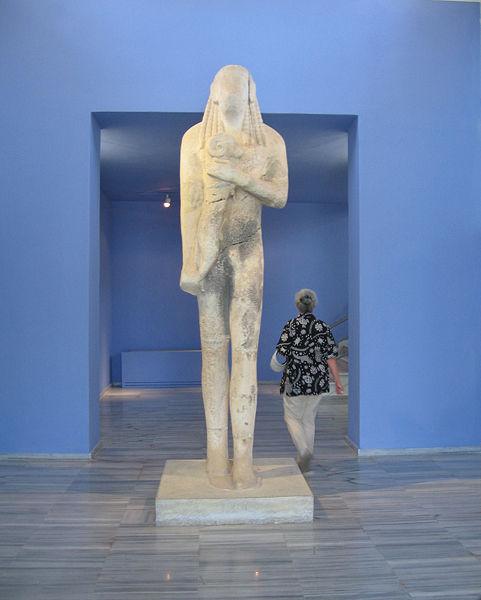
The Archaeological Museum of Thassos stands in Limenas, the island capital, a short walk from the harbour and the ruins of the ancient city. The building gathers finds excavated across Thassos, from the town itself to the rural sanctuaries in the hills. Sculpture, pottery, coins, inscriptions and jewellery fill its galleries, and the marble worked here came from the island’s own quarries. The best-known piece is a colossal Archaic kouros, a striding youth carrying a ram, about three and a half metres tall and left unfinished. The collection reads as a portrait of one wealthy Greek city, traced from prehistory to the Roman era. This guide walks through the museum, its star exhibit and its setting beside the agora, prepared with My Greece Tours.
This museum rewards a slow visit rather than a quick look, and it pairs naturally with the Ancient Agora next door. The sections below cover what the museum is, where it sits in Limenas, the marble kouros carrying a ram, the range of the collection, the history it traces, and how to combine it with a wider island trip. Each answer opens with the key fact, then fills in the detail behind it. Practical notes on the entrance fee, the setting and nearby sites appear throughout, so the guide works for a first visit. Our Thassos tours place the museum inside a full day around Limenas and the ancient city.
What is the Archaeological Museum of Thassos?
The Archaeological Museum of Thassos is the island’s main museum, set in Limenas beside the Ancient Agora. It displays finds from the ancient city and the countryside, tracing Thasos from prehistory to the Roman era.
The Archaeological Museum of Thassos serves as the central store of the island’s excavated past. The galleries hold objects lifted from the ancient city of Thasos and from rural sites across the island. Sculpture in local marble sits beside painted pottery, coins struck by the city, carved inscriptions and small votive gifts. The collection belongs to one place and one long story, which makes it easier to read than a museum drawn from distant regions. Visitors move from prehistoric layers through the Archaic and Classical city to the Roman town that followed. The building stands within the archaeological zone of Limenas, so the exhibits and their find-spots share a single compact setting near the sea.
The museum grew out of the long excavations that the French School at Athens has carried out on Thassos alongside the Greek archaeological service. Digging in the agora, the sanctuaries and the cemeteries produced far more material than any open-air site could show. The museum gives that material a roof, order and labels, turning scattered finds into a connected account. Rooms group objects by theme and by period, letting a marble head, a grave stele and a coin hoard each explain part of the ancient economy. The result is a portrait of a single Greek polis, shown through the things its people carved, traded, dedicated and buried over successive centuries.
The Archaeological Museum of Thassos works on two levels for a traveller. On the surface it presents fine marble sculpture, the kind of art that first drew collectors to the island. Below that it documents how a Greek city funded such work, through marble quarrying, gold from the mainland opposite and a busy wine trade. Labels connect each object to its find-spot, so a dedication names the sanctuary it came from and a coin names the mint. This gives the visit a clear thread: every case adds a fact about Thasos rather than a loose curiosity. A short tour of the rooms leaves you able to explain how the ancient town made its money.
First-time visitors sometimes expect a large national collection and find instead a focused island museum. That focus is its strength. The building is modest in scale, which means the highlights stay in view rather than getting lost among endless cases. A visit fits comfortably into a morning in Limenas, leaving time for the agora, the old harbour and lunch nearby. The entrance fee is small, and the museum sits at the heart of the town, steps from the excavated centre. Reading the ancient city and its museum together, in one compact area, is the way the site is meant to be understood, and it makes Thasos far easier to picture.
Where is the Archaeological Museum of Thassos located?
The Archaeological Museum of Thassos sits in Limenas, the island’s capital and main port, on the north coast. It stands beside the Ancient Agora, inside the archaeological zone of the ancient city.
The museum occupies a central spot in Limenas, the lively capital that locals also call Thassos Town. The town grew directly on top of the ancient city, so ruins surface between modern streets and the museum stands among them. From the entrance it is a short, level walk to the old harbour, the cafes on the waterfront and the excavated centre. This position matters: the finds inside were dug from the ground steps away, not shipped in from elsewhere. Seeing the objects and then the trenches they came from gives the visit a rare sense of place. Limenas makes an easy base, with the museum, the agora and the seafront all within one walkable district.
The building rises next to the Ancient Agora, the open civic square at the core of ancient Thasos. That location is deliberate, keeping the display within the space it describes. Behind the town the acropolis hill carries the old walls, the theatre and the sanctuaries, and the citadel there gave up the great kouros. The museum therefore sits at the meeting point of the low city and the high city, gathering finds from both. A visitor can study a statue indoors, then climb toward the ridge to see where such works once stood. The compact geography of Limenas turns the museum, the agora and the acropolis into a single connected route rather than three separate stops.
Reaching the museum is simple once you are on Thassos. Limenas is the island’s northern gateway, where the main ferries dock, so arrivals step off the boat close to the ancient centre. The museum stands within the town, reachable on foot from the port and the central square. Cars can be left in the town, since the archaeological area is best seen on foot. The flat streets suit a relaxed walk between the museum, the harbour and the ruins. Placing the collection in the capital, rather than in a remote building, means most itineraries pass its door, and a visit slots easily into a day already spent exploring the heart of the island.
The setting also explains what the museum contains. Standing in the old city, its strongest holdings come from the agora, the nearby sanctuaries and the town cemeteries. Grave stelae, votive offerings and public inscriptions all travelled a short distance from trench to case. This tight link between find-spot and display is unusual and valuable. It lets the museum reconstruct districts of the ancient town almost street by street, matching objects to the buildings that held them. For a traveller, that means the labels keep pointing back outside, to a wall or a foundation still visible in Limenas. The museum and the living ruins form two halves of one lesson about the ancient city.
What is the marble kouros carrying a ram?
The museum’s most famous piece is a colossal Archaic kouros, a striding nude youth carrying a ram on his shoulders. Carved from island marble and about three and a half metres tall, the statue was left unfinished.
The kouros is the image most visitors come to see. It shows a young man striding forward, a ram held across his shoulders, in the stiff frontal pose of Archaic Greek sculpture. The figure stands about three and a half metres high, far larger than life, and was cut from marble quarried on Thassos itself. The type is known as a kriophoros, a ram-bearer, a form later linked with the god Hermes as protector of flocks. Carved for a sanctuary of Apollo, the statue was meant to stand as a grand dedication. Its scale alone shows the marble, labour and confidence the Archaic city could pour into a single religious gift.
What makes the piece rare is that it was never finished. The surface still carries the marks of the sculptor’s tools, and parts of the body remain rough, caught partway between block and figure. Ancient makers seem to have abandoned the work before the final smoothing, perhaps because the marble flawed or the commission changed. That accident turned the kouros into a lesson in method. A visitor can read the stages of carving directly, from blocked mass to emerging limb, in a way a polished statue hides. Few Archaic works display their own making so openly. The unfinished ram-bearer therefore teaches how monumental sculpture was cut on the island, step by patient step, straight from the quarry.
The statue also anchors the museum’s story about marble. The stone came from Thasos’s own quarries, the same beds that made the island wealthy and gave its buildings their bright white walls. Working a block of this size, then moving it, took real organisation, from the cutting face to the sanctuary. The kouros stands as proof of that industry at full stretch. Around it the galleries show smaller marbles, heads and reliefs, that place the giant in a longer tradition of Thasian carving. Seeing the ram-bearer beside these later works makes the island’s craft legible across time. The single statue turns an abstract fact, that Thasos lived by marble, into something you can stand beneath.
The kouros was recovered from the island’s citadel, where it had been broken and reused in a later wall. Piecing it back together was part of the long excavation of the ancient city. Today it commands its own space in the museum, given room so its height reads properly. Standing at its base is the clearest way to grasp the ambition of Archaic Thasos. The ram across the shoulders, a gift for the god, ties the statue to the sanctuaries that shaped island life. No other object in the collection captures so much in one form: marble, faith, wealth and the unfinished hand of the maker, all held in a single striding youth.
What can visitors see in the collection?
The galleries hold marble sculpture, painted pottery, struck coins, carved inscriptions, grave stelae, jewellery and votive offerings. Together they cover Thasos from prehistoric settlement through its Archaic and Classical peak to the Roman town.
Sculpture forms the backbone of the display. Beyond the great kouros, the rooms hold statues, portrait heads and carved reliefs in gleaming local marble. A figure of Aphrodite and a head identified with Alexander the Great show how the island’s workshops kept pace with wider Greek and later trends. Funerary stelae, carved to mark graves, line part of the collection and preserve the names and images of ordinary Thasians. This body of stone, cut mainly from island quarries, is the museum’s clearest boast. It proves that Thasos was not only a marble source for others but a centre that carved the stone into finished art of high quality at home.
Pottery fills the cases between the sculpture. Painted vases, plain household jars and imported wares track what the islanders made, used and bought across the sea. Fine painted cups sit beside storage jars that once held the wine Thasos was famous for. The clay tells a trading story that the marble cannot: links with other Greek cities, tastes that changed over time and the daily habits of the kitchen and the table. Stamped wine-jar handles are a special strength, since the stamps name officials and let historians date the trade. Reading the pottery, a visitor sees past the grand statues to the working port that paid for them.
Coins, inscriptions and jewellery round out the picture. The city struck its own coins, and the museum’s cabinet shows the designs that carried Thasian silver across the region. Inscriptions in stone record laws, honours and accounts, giving the ancient town a voice in its own words. Small finds in gold and bronze, along with beads and pins, show the personal wealth that marble and trade produced. These smaller objects reward slow looking. A single decree can fix a date, a coin can prove a trade route, and a piece of jewellery can hint at a household. Together they turn the museum from a hall of statues into a full record of civic and private life.
Votive offerings from the sanctuaries form the collection’s spiritual layer. Worshippers left gifts at the shrines of Herakles, Dionysos, Artemis and Poseidon, and the excavated dedications now sit in the museum. Figurines, small vessels and carved plaques show which gods the islanders honoured and how. Set beside the grave stelae, these offerings frame the two poles of ancient life, the temple and the tomb. The range on display, from prehistoric tools to Roman marbles, lets a visitor trace the island across a very long span in one visit. Each category, sculpture, pottery, coins and votives, adds another line to the same continuous account of Thasos.
How does the museum tell the history of ancient Thasos?
The museum arranges finds in order, from prehistoric settlement through the island’s founding by colonists from Paros to its wealthy Archaic and Classical city and the later Roman era.
The story starts before the Greek city. Prehistoric tools and pottery in the early rooms show that people lived on Thassos long before the first colonists arrived. From there the display turns to the founding of the Greek town by settlers from Paros, who crossed the Aegean to claim the island’s gold and marble. These newcomers built the city whose ruins fill Limenas today. The museum uses their earliest objects to mark that turning point, when a native island became a Greek polis. Setting prehistory and colony side by side lets a visitor see the join, the moment when Thasos entered the wider Greek world and began the record the rest of the museum continues.
The heart of the collection covers the Archaic and Classical city at its height. Wealth from marble, from mainland gold and from the wine trade paid for temples, walls and sculpture, and the finest objects here date from that peak. The great kouros, the marble heads and the best pottery all belong to this confident age. Inscriptions from the period record a busy, organised state with laws, magistrates and overseas contacts. The museum lets these objects speak for a city that ranked among the richer powers of the northern Aegean. Walking this stretch of the display is like walking through the years when Thasos mattered most, funding art on a scale its marble made possible.
The display then follows Thasos into the Roman era. Under Roman control the island kept working, and its art and inscriptions shifted with the times. Roman portrait heads, later marbles and inscribed stones show a town that maintained its quarries and its port under new masters. The change is one of style and rule rather than a sudden break, and the museum shows continuity as clearly as change. Objects from this phase prove that Thasos stayed a producing, trading community well beyond its Greek prime. Following the rooms in order, a visitor watches one place adapt across the ages while its marble industry carried on.
This ordered layout is what turns the museum into a history rather than a gallery. Each room hands on to the next, so the visit builds from first settlement to Roman town without a gap. The through-line is the island itself: its marble, its harbour and the sanctuaries that anchored its faith. Every object was found on Thassos, which keeps the account local and coherent, one city examined in depth. That depth is the reward. A traveller leaves able to sketch the whole arc of ancient Thasos, from Parian colony to Roman port, and to match each chapter to ruins still standing outside in Limenas.
How do you visit the museum and the Ancient Agora together?
The museum charges a small entrance fee and stands beside the ruins, so it pairs naturally with a walk through the agora next door. Seeing both together explains the finds and their setting in one visit.
The obvious partner to the museum is the Ancient Agora, the open square that lies right beside it. The agora was the civic and religious centre of ancient Thasos, ringed by stoas, altars and public buildings, and its ruins now spread in the grass. Objects in the museum, from inscriptions to statue bases, were dug from this very ground. Walking the agora after the galleries lets a visitor set each display back in place, matching a marble head to the sanctuary or a decree to the square. The two sites work as one exhibit, indoors and out. Doing them in a single visit is the way the ancient city is meant to be read.
A practical order helps. Starting in the museum gives the background, the kouros, the pottery and the story of the colony, before you step outside into the ruins. The entrance fee is small, and a ticket to the archaeological area covers the walk through the ancient city. From the agora the route can carry on to the old harbour, the walls and the theatre on the acropolis hill above. The whole circuit sits within Limenas and needs only comfortable shoes and a little time. Seeing the finds first, then the find-spots, keeps the visit logical and stops the ruins from reading as anonymous stone. This pairing is the core of a day in the ancient capital.
Timing rewards a little planning. The museum offers shade and cool rooms, which suit the hottest part of the day, while the open agora is kinder in the softer morning or late-afternoon light. Combining the two lets a visitor duck indoors when the sun is high and explore the ruins when it drops. The compact layout means no transport is needed between them; the museum door and the agora edge almost touch. Bringing water and a hat makes the outdoor half easier in summer. Treating the museum and the agora as one linked stop, rather than two chores, turns a short walk into a full and satisfying look at ancient Thasos.
The pairing also fits families and first-time visitors well. Children who find rows of cases dull often wake up among the open ruins, where they can walk the same streets the objects came from. Adults gain the reverse benefit, reading the labels indoors and then recognising the buildings outside. Neither half takes long, so the combined visit rarely fills more than a morning. Adding a coffee at the old harbour afterwards rounds the outing off. The lesson holds throughout: the Archaeological Museum of Thassos and the agora explain each other, and the small fee for the pair buys one of the clearest windows into an ancient Greek city in the northern Aegean.
How does the museum fit into a wider Thassos trip?
The museum works best as one stop in a fuller island trip, combined with the ruins of Limenas, easy transport links, a base in the north and the beaches that ring the coast.
Thassos is reached by a short ferry from the mainland near Kavala, and details on how to get to Thassos make the crossing simple to plan. Boats land at Limenas or at Skala Prinos on the west coast, both a short drive from the capital. The museum sits in Limenas, so arrivals by the main ferry step off almost at its door. A car or the island bus then opens the rest of Thassos. Fitting the museum into the first hours on the island, while you are already in the port town, saves backtracking later. The collection makes a natural opening chapter before the beaches and mountain villages.
A base in the capital keeps the museum, the agora and the harbour within a stroll, and guidance on where to stay in Thassos sets out the options around the island. Staying in Limenas suits travellers who want culture and nightlife on the doorstep, while quieter resorts spread down the coast. From any of them the museum is an easy half-day trip by car or bus. Planning a night or two in the north puts the ancient city, its museum and the best tavernas within reach on foot. The choice of base shapes how often the capital, and its museum, fall naturally into the daily route.
Thassos is loved above all for its coast, and a tour of the beaches of Thassos balances a morning of history with an afternoon by the sea. Golden Beach, Paradise and the marble-white coves of the west lie a short drive from Limenas. Pairing the museum with a swim gives a full, varied day: ancient marble indoors, then the same white stone shining under the water outside. The island rewards this mix of culture and beach rather than one alone. Slotting the museum between the ferry and the shore lets a visitor understand Thasos before diving into its clearest pleasures. The stone that built the ancient city still frames its finest bays.
The museum earns its place by tying the whole island together. Every village, quarry and beach on Thassos belongs to the story the collection tells, from the marble underfoot to the wine once shipped from the port. Seeing the finds first gives the rest of the trip a frame: a cove is no longer only pretty but part of an ancient economy. This is why the museum rewards an early visit, before the beaches and mountains fill the days. Booking a guided day through our island tours ties the museum, the agora and the coast into one planned outing, and makes a small, focused collection the key to the whole of Thasos.
Frequently Asked Questions
Is the Archaeological Museum of Thassos worth visiting?
The museum rewards any visitor interested in ancient Greece. It gathers the island’s finest finds, led by the colossal marble kouros carrying a ram, in one compact building beside the agora. A short visit explains how Thasos grew rich on marble, gold and wine, and it sets the ruins of Limenas in a clear historical frame.
How much does entry to the museum cost?
Entry carries only a small fee, in line with other state museums in Greece. A single ticket often covers both the museum and the neighbouring archaeological area, so the collection and the ancient agora can be seen together for modest cost. Checking the current price before a visit is wise, since state museum rates are set nationally.
What is the most famous exhibit in the museum?
The colossal Archaic kouros carrying a ram is the standout exhibit. Carved from island marble and standing about three and a half metres tall, the striding youth was made for a sanctuary of Apollo and left unfinished. Its rough surfaces reveal how such statues were cut, making it both a highlight and a lesson in ancient craft.
Where did the marble in the museum come from?
Most of the sculpture was carved from marble quarried on Thassos itself. The island’s bright white stone built its ancient city and supplied workshops far beyond it. Certain pieces also use marble from Paros, the mother-city of the colony. This local stone is the thread that links the museum, the quarries and the wealth of ancient Thasos.
How long should a visit to the museum take?
A focused visit usually takes under an hour, since the museum is modest in size and its highlights stay easy to find. Allowing extra time lets you read the labels properly and link each object to the ruins outside. Combined with a walk through the adjoining agora, the museum fills a comfortable half-day in Limenas.
Can you visit the museum and the Ancient Agora on the same trip?
The museum and the Ancient Agora stand next to each other in Limenas, so a single visit easily covers both. Seeing the finds indoors and then the square where they were dug gives the fullest picture of ancient Thasos. The pairing needs only a short walk and forms the core of a day in the capital.