
Tiryns is a fortified Bronze Age citadel on the Argolid plain of the Peloponnese, a short drive from Mycenae and close to the town of Nafplio. It ranked among the great centres of the Mycenaean world, its low hill crowned by walls of astonishing scale. Massive stone ramparts wrap the summit, pierced by long corbelled galleries and store-passages built into their thickness. A ramp climbs to the gates and to a palace with a megaron throne hall at the top. Greek myth tied these walls to the Cyclopes and made the site the home of the hero Heracles. Plan a powerful Argolid citadel tour with My Greece Tours.
Tiryns and Mycenae share a single listing as a UNESCO World Heritage property, and the two citadels reward being seen together on one Argolid loop. A lower town once spread around the fortress hill, while the megaron, the galleries and the great ramp survive to walk today. The sections below cover where Tiryns sits, its Cyclopean walls, its palace and myth, and how it pairs with the wider region. For the sister site, our Mycenae travel guide sets the fortress in the fuller story of the Bronze Age Argolid.
Where is Tiryns in the Argolid?
Tiryns stands on a low rocky hill in the Argolid plain of the Peloponnese, near the town of Nafplio and a short drive from Mycenae. Its position links it naturally to the other great sites of the region.
Tiryns occupies a modest limestone ridge rising from the flat farmland of the Argolid, close enough to the sea to have watched over the coastal approaches in the Bronze Age. The town of Nafplio lies a short distance to the south, and the citadel of Mycenae sits a short drive to the north, which places Tiryns squarely in the heart of the Argive plain. This central footing gave the fortress control over the roads that crossed the region, and it explains why builders raised such heavy defences on so small a hill. The setting today feels open and agricultural, with orchards and fields pressing close to the base of the ancient walls.
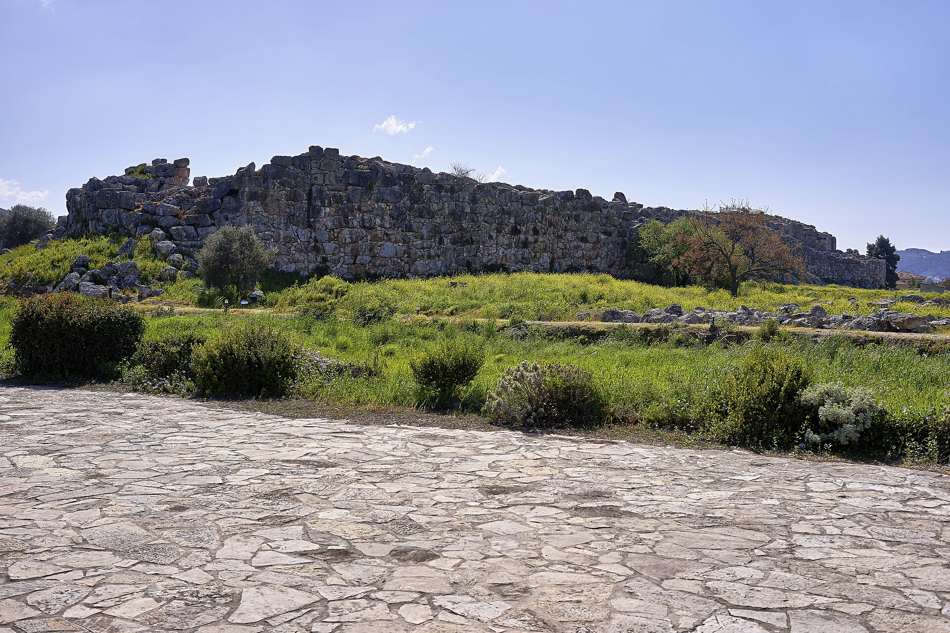
The sheer bulk of the ramparts rises with real drama out of the surrounding green.
The location makes Tiryns easy to fold into a tour of the Argolid rather than a detour on its own. A visitor can stand on the summit and read the whole plain, tracing the low hills that carried the roads between the Mycenaean strongholds and the line of the coast where ships once landed. The palace of Mycenae lies within easy reach across the fields, and the theatre and sanctuary of Epidaurus wait to the east. This clustering of monuments in one compact plain is part of what draws travellers to the region.
Tiryns anchors the southern end of that circuit, a short pause between Nafplio and the greater fortress up the road, yet a stop that holds its own astonishing weight in stone. The flat ground keeps the driving short, folding the citadel into a wider day. A tomb nearby at Dendra gave up the bronze Dendra panoply, the finest Mycenaean armour yet found.
What makes the Cyclopean walls of Tiryns famous?
The Cyclopean walls of Tiryns rank among the finest in Greece, built from huge unshaped blocks fitted together without mortar. They reach enormous thickness and hide long corbelled galleries and store-passages set deep within the stone.
The defining feature of Tiryns is its masonry, a wall of boulders so large that later Greeks believed only the Cyclopes could have lifted them. These blocks were laid without mortar, wedged and packed so that their own weight held the line. In places the rampart swells to a thickness that dwarfs a standing figure. The technique gave the term Cyclopean masonry its name, and the ramparts of Tiryns are counted among the very best surviving examples in the whole of Greece. Walking below them, a visitor feels the scale in the body rather than the guidebook, the stone rising sheer and rough overhead.
This raw, unfinished power is the first thing that strikes anyone who arrives, and it sets Tiryns apart even among the mighty fortresses of the age. Those fortresses fell together in the Bronze Age collapse that ended the Mycenaean world.
The most remarkable trick of the Tiryns walls lies hidden inside their bulk. Where the ramparts run thickest, the builders opened long corbelled galleries and store-passages within the stone itself, roofed by courses that step inward until they meet in a pointed vault. These dim tunnels once sheltered stores and gave covered movement along the defences. They survive well enough to walk through today, cool and shadowed after the glare of the plain. The same corbelled method that shaped these passages links Tiryns to the great engineering of the region, echoing the Cyclopean walls that ring the sister fortress up the road.
To pass through a gallery at Tiryns is to touch Bronze Age building at its most confident and inventive. The vaults show how the builders turned raw defensive bulk into sheltered space carved deep inside the wall.
How does Tiryns relate to Mycenae?
Tiryns and Mycenae were both leading centres of the Mycenaean world, standing close together on the same Argolid plain. They share a single UNESCO World Heritage listing, and their walls, gates and palaces reflect one shared building tradition.
Tiryns and Mycenae belong to the same chapter of history, two crowning strongholds of the culture that takes its name from the greater of the pair. The Mycenaean civilization raised both fortresses in the same age and the same spirit, ringing their hills with Cyclopean walls and setting a palace on each summit. The two sites sit a short drive apart on the Argolid plain, near enough that a traveller can walk one in the morning and the other after lunch. This closeness was no accident: the plain held such centres, and Tiryns and Mycenae stood as the mightiest of them, guarding the roads and the coast between them across the height of the Bronze Age.
Seeing the two hills so near on the same plain drives home how tightly this world packed into one stretch of the Peloponnese.
The bond between the two fortresses is formal as well as historical. Tiryns and Mycenae share a single listing as a UNESCO World Heritage property, recognised together as the fullest surviving expression of Mycenaean power and building. Seeing them in one visit lets the differences speak: the celebrated Lion Gate guards the entrance to the northern citadel, while Tiryns answers with its ramp, its galleries and its deep vaulted passages. Each site sharpens the reading of the other, and together they trace the reach of a world that ruled this plain long before the age of classical Greece.
To visit one without the other leaves the picture half-drawn, and the shared listing marks them as two halves of a single story. For anyone drawn to the Bronze Age, the pairing is the natural way to grasp its scale.
What can you see at the palace of Tiryns?
A great ramp climbs to the gates of Tiryns and up to a palace crowning the citadel. Its heart is a megaron, a throne hall with a central hearth, the ceremonial core of the Mycenaean stronghold.
The approach to the palace is a monument in itself, a broad ramp that curves up the flank of the hill to the fortified gates. This ramp forced any visitor or attacker to climb slowly beneath the walls, exposed to the defenders above. It delivers the modern traveller to the heart of the citadel by the same route the ancients took. Beyond the gates the ground rises to the summit, where the foundations of a palace still map out its plan of courts, corridors and halls.
Walking this upper level, a visitor moves through the working centre of a Bronze Age power, the place where the ruler held court, stored wealth and governed the plain spread out below the walls on every side. The climb shows how the citadel worked, from the guarded ramp to the halls above.
At the core of the palace stands the megaron, the throne hall that formed the ceremonial heart of every great Mycenaean house. A columned porch opened into a hall with a central hearth, where a ruler received guests and conducted the business of the citadel in the flicker of the fire. The same layout crowns the sister fortress up the road, and comparing the two throne halls deepens the visit. The palace of Mycenae shows the identical scheme carried out on its own commanding summit. At Tiryns the megaron sits within the tightest ring of Cyclopean stone in the region.
The seat of power and the mightiest wall in the whole plain stand together, a pairing that makes the citadel’s purpose plain at a glance.
How do you tour Tiryns with Mycenae in the Argolid?
Tiryns pairs naturally with Mycenae, Nafplio and Epidaurus on a tour of the Argolid. Its central position and modest size let travellers add it to a day exploring the region’s Bronze Age and classical sites.
Tiryns rewards travellers who treat the Argolid as a single rich circuit rather than a set of separate errands. The citadel sits between the town of Nafplio and the greater fortress to the north, so it slots easily into a route that also takes in the theatre and sanctuary of Epidaurus to the east. Its compact scale is part of the appeal: a visitor can walk the ramp, the galleries and the palace in an hour, then move on to the next site with the plain still fresh in mind. Most travellers come by hire car, which gives the freedom to link the strongholds and the seaside town at a comfortable pace.
A well-planned Mycenae day trip from Athens can fold Tiryns into the same journey.
The nearby town of Nafplio makes the ideal base or lunch stop for a day built around Tiryns. Its harbour, its stepped lanes and its fortress crown reward an afternoon after a morning among Cyclopean walls. A stay in Nafplio lets travellers reach every site in the plain within a short drive. A full Argolid day might climb the ramp of Tiryns, cross to the palace of Mycenae, then close at the theatre of Epidaurus, three ages of Greece gathered in one small plain.
Tiryns earns its place in that circuit not as a footnote but as a peer, a fortress whose walls and galleries give another powerful glimpse of the Mycenaean world at the height of its confidence. Pairing it with Nafplio rounds out the day, ancient stone in the morning and a lived-in harbour town by evening.
Frequently Asked Questions
How close is Tiryns to Mycenae and Nafplio?
Tiryns sits in the middle of the Argolid plain, a short drive from both Mycenae and the town of Nafplio, which makes it easy to visit alongside either. The citadel lies just south of the greater fortress and just north of the harbour town, so all three fall within a compact stretch of the same plain. A traveller can walk the walls of Tiryns and reach the palace of Mycenae in a short onward drive, or drop down to Nafplio for lunch and a stroll by the water. This closeness is the reason tours of the Argolid so often gather the sites into one full day rather than spreading them across separate trips.
A hire car gives the most freedom to move between them, though the distances stay small enough that the whole circuit feels unhurried. Tiryns works best as one stop among a cluster, its central footing turning it into a natural pivot between the fortress up the road and the sea town below.
Are the Cyclopean walls of Tiryns safe to walk?
The citadel of Tiryns is open to visitors, and its ramp, gates and galleries are laid out for people to walk through today. The great ramp carries you up to the summit along the ancient approach. Corbelled galleries built into the thickness of the walls survive well enough to enter, cool and shadowed after the heat of the plain. Sturdy shoes help on the worn stone, and the surfaces can be uneven where the ground has held the tread of ages. A careful step is wise inside the darker passages. The open summit rewards the climb with a wide view over the whole Argolid, the fields and roads and distant hills that the fortress once guarded.
Walking the walls of Tiryns brings the scale of Cyclopean masonry home in a way no photograph manages, the rough boulders rising sheer overhead as you pass beneath them into the heart of the Bronze Age stronghold.
Why is Tiryns linked to the hero Heracles?
Greek myth wove Tiryns deep into the story of Heracles, naming the citadel as the home from which the hero set out on his famous labours. The same legends held that no human hand could have raised such walls, and so they credited the Cyclopes, the one-eyed giants of myth, with lifting the vast boulders into place. This double thread of story, the giant builders and the resident hero, gave Tiryns a place in Greek imagination out of all proportion to its modest hill. To stand beneath the ramparts is to see why the tales took hold: the stones are so large that legend felt like the only fitting explanation for them.
That mythic weight sits alongside the hard history of a Bronze Age power centre, so a visit reads on two levels at once. Tiryns offers both the real fortress of the Mycenaean age and the storied home of Heracles, and the two readings deepen each other for anyone who climbs the ancient ramp to the summit.