
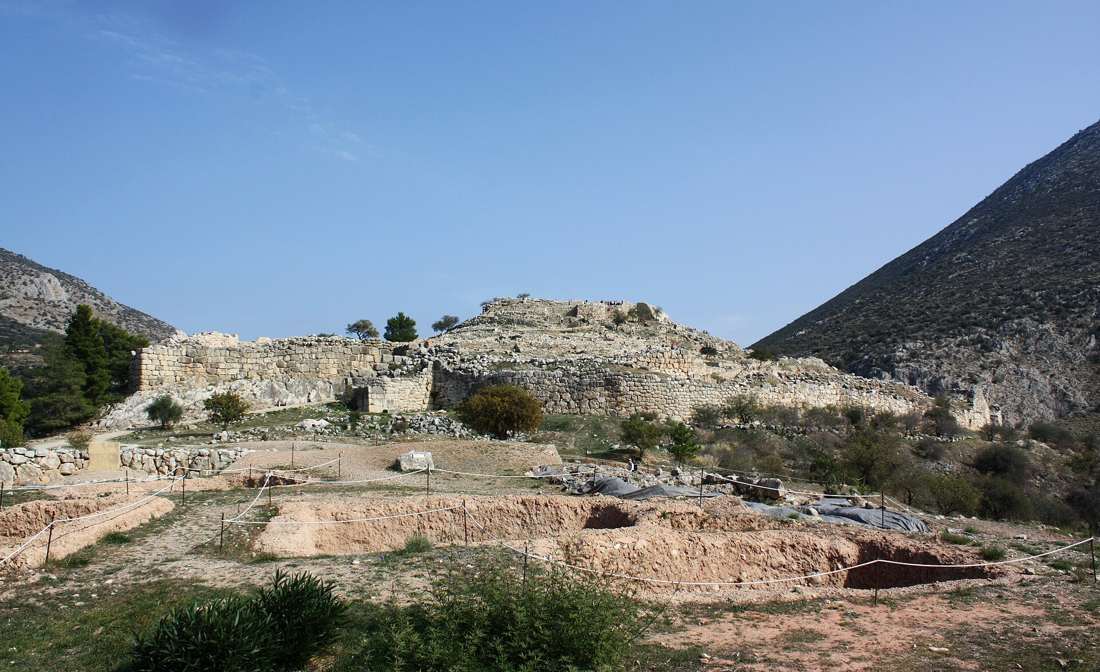
Grave Circle B is the older of the two royal grave circles at Mycenae, lying just outside the walls of the citadel a short distance from the Lion Gate. It holds shaft graves and simpler cist graves where early rulers were buried with pottery, weapons, jewellery and gold objects, though with less gold than the later circle set inside the walls. A carved face mask of electrum, an alloy of gold and silver, came from its earth. The circle records the rise of the Mycenaean elite before the citadel reached its full power, a quieter marker of a growing capital. Trace the deeper story of Mycenae’s kings with My Greece Tours.
Grave Circle B sits away from the crowds, near the great tholos tombs beside the road below the citadel, less visited than the famous circle within the walls. Its shaft graves and cist graves belong to an earlier stage of the site, before the walls and the Lion Gate rose to their known form. The finds now rest in museums at the site itself and in Athens. The sections below cover where the circle lies, what it held, how it differs from the circle inside the walls, and how it fits a full Mycenae travel guide across a single visit.
Where does Grave Circle B lie at Mycenae?
Grave Circle B lies just outside the walls of the citadel of Mycenae, a short distance from the Lion Gate and close to the great tholos tombs beside the road. It sits apart from the busier circle within the walls.
Grave Circle B rests on the lower ground below the citadel of Mycenae, beyond the line of the fortifications rather than within them. Its position marks it out at once from the more famous royal cemetery inside the walls, which visitors meet soon after passing through the Lion Gate. The circle lies near the great tholos tombs that stand beside the road running up to the site, so it fits naturally into a walk between the car park and the gate. This outer setting reflects the age of the graves, dug before the walls enclosed the hilltop in the form seen today.
The spot keeps a quiet, open feel, set among the slopes and stone of the Argolid landscape that shaped the whole settlement of Mycenae.
The walk to Grave Circle B rewards travellers ready to step a little aside from the main route through the ruins. Its place beside the tholos tombs ties it to the wider funeral landscape spreading below the citadel, where the rulers of Mycenae marked their dead across a long span of time. The Cyclopean walls rise close by, throwing the older, humbler circle into contrast with the later strength of the citadel above it. Standing here, a visitor reads the site in reverse order of its growth, from the early graves on the outer ground upward to the mighty defences that came afterward.
The circle grounds the whole story of Mycenae in a single quiet, telling place at the foot of the hill. Its outer position keeps it calm even at busy hours on the site.
What was found in the Grave Circle B shaft graves?
The graves held early rulers of Mycenae buried with pottery, weapons, jewellery and gold objects. A carved face mask of electrum, an alloy of gold and silver, ranked among the finest finds, marking the wealth of the emerging elite.
Grave Circle B contains shaft graves alongside simpler cist graves, a mixed cemetery that gathered the early rulers of Mycenae over time. The dead were laid to rest with pottery, weapons and jewellery, and with gold objects that spoke to their rank and reach. The most striking discovery was a carved face mask of electrum, an alloy of gold and silver, a rare object that placed a lasting face over a buried ruler. These grave goods carry the same message as the burials inside the walls, though on a plainer scale: that the leaders of Mycenae drew wealth and craft to themselves long before the citadel reached its height.
The objects give a close, human view of a rising power at the dawn of its greatest age.
The wealth in the graves ties directly to the growth of the wider Mycenaean civilization that spread across the Argolid and beyond. Weapons among the finds point to a warrior elite, while the gold and the electrum mask reveal trade and skill reaching Mycenae from a distance. The grave goods span the shaft graves and the humbler cist graves alike, so the circle preserves a full range of standing within the early ruling group. The finds now sit in museums at the site and in Athens, where their detail can be studied at close hand.
Together they let a visitor picture the people who shaped Mycenae in its formative years, before the great walls and gates announced the capital to all who approached. The mix of graves within one circle shows a ruling group already marking rank in death.
How does Grave Circle B differ from Grave Circle A?
Grave Circle B is older and lies outside the walls, while Grave Circle A is later and stands inside them near the Lion Gate. Circle B holds less gold, marking an earlier, humbler stage of Mycenae’s royal wealth.
The two royal grave circles of Mycenae belong to different moments in the site’s rise, and their settings tell that story plainly. Grave Circle B is the older, resting on the outer ground below the citadel, dug before the walls enclosed the hilltop. Its counterpart, Grave Circle A, came later and stands inside the walls close to the Lion Gate, brought within the fortified heart of the citadel as the settlement grew in power. This shift in position, from outside the defences to within them, mirrors the wider growth of Mycenae from a local stronghold toward a Bronze Age capital. The older circle stayed on the outer ground as a fixed marker of the early years.
The later circle was drawn inside the walls as the citadel gained its strength.
The wealth in the two circles differs as clearly as their placing. Grave Circle B holds less gold than the later Grave Circle A, a sign that it belongs to an earlier, humbler stage of Mycenae’s royal fortune. The finer, richer burials inside the walls came once the citadel had gathered greater reach and resources. Even so, Circle B carries its own treasures, above all the electrum face mask that ranks among the memorable objects from the whole site. Reading the two circles side by side lets a visitor watch Mycenae grow, from the modest early graves on the outer slope to the dazzling royal burials later drawn within the great walls.
The lesser gold of the older circle is not a lack but a stage, the honest measure of a power still gathering its strength.
How does Grave Circle B fit a visit to Mycenae?
Grave Circle B suits travellers who want the quieter, older layer of the site. It pairs naturally with the nearby tholos tombs and the citadel above, giving a fuller reading of how Mycenae grew across the Bronze Age.
A visit to Mycenae runs richer when Grave Circle B forms part of it rather than a footnote. The circle lies on the walk up from the road, beside the great tholos tombs, so it slots into the route without a detour. Reaching it early, before the citadel itself, lets a traveller follow the site in the order of its growth, from the older outer graves to the later walls and gates on the hill above. The Tomb of Clytemnestra, one of the fine tholos tombs nearby, makes a natural next stop, binding the outer burials into a single sweep of royal funeral ground below the citadel.
Walking the graves and tombs together sets the early rulers in their own landscape and prepares a visitor for the fortified heart above.
Grave Circle B also draws travellers who prefer the quieter corners of a famous site. It sees fewer visitors than the circle inside the walls, so it offers space to pause and read the early story of Mycenae in peace. From here a full route can climb to the citadel and its defences, then descend to the secret cistern cut deep beneath the walls. The finds from the circle, held in museums at the site and in Athens, complete the picture indoors once the ground has been walked. Taken together, the outer graves, the tombs and the citadel let a single visit trace Mycenae’s arc from early stronghold to Bronze Age capital.
The quiet of the outer circle gives a welcome pause in a full day on the site, a place to stand and gather the story before the climb.
Why does Grave Circle B matter to Mycenae’s story?
Grave Circle B records the rise of the Mycenaean elite before the citadel reached its height. Its early graves help trace the growth of Mycenae from a local stronghold into a Bronze Age capital that ruled the Argolid.
Grave Circle B holds a quiet but central place in the long story of Mycenae. Its shaft graves and cist graves belong to an early stage, when the rulers of the settlement were gathering wealth and standing but had not yet raised the great walls that later marked the citadel. The grave goods, from pottery and weapons to gold and the electrum mask, show an elite already reaching outward for trade and craft. The circle therefore captures a beginning, the moment a local stronghold in the Argolid began its climb toward the power that would define the Bronze Age. It gives the site a starting point, a root from which its later grandeur can be traced.
The lesser gold here, set against the richer circle inside the walls, reads as an early rung on the same long climb.
The value of Grave Circle B lies in how it completes the arc of Mycenae’s growth. Read against the later Grave Circle A inside the walls and the mighty defences above, it shows where the whole enterprise started, on the outer slope in humbler graves. This early evidence lets visitors and scholars alike follow the settlement’s rise step by step into a Bronze Age capital. The objects it yielded, now studied in the Mycenae archaeological museum and in Athens, keep that early chapter alive and legible. Without the outer circle, the story of Mycenae would open too late, missing the formative years when its rulers first laid the ground for everything that followed on the hill.
The quiet graves on the outer slope hold that missing first chapter in plain view.
Frequently Asked Questions
Is Grave Circle B worth visiting alongside the main citadel?
Grave Circle B rewards the short extra stop, and its place on the walk up makes it easy to include. The circle lies just outside the walls near the great tholos tombs beside the road, so it falls naturally into the route between the car park and the Lion Gate. Reaching it repays travellers who want the older layer of the site, the early shaft graves and cist graves that predate the famous walls above. It stays quieter than the circle inside the fortifications, offering room to pause and read the early story of Mycenae in peace.
Pairing it with the tholos tombs and then climbing to the citadel builds a fuller picture of how the settlement grew across the Bronze Age. A visit that skips the outer circle misses the beginning of the tale, the humbler graves from which the later royal splendour rose. For travellers drawn to the full depth of Mycenae, Grave Circle B is well worth the short walk aside.
What is the electrum mask found in Grave Circle B?
The electrum mask is a carved face mask found among the burials of Grave Circle B, made of electrum, an alloy of gold and silver. It ranks among the memorable objects recovered from the whole site of Mycenae. Placed over a buried ruler, the mask gave a lasting face to one of the early leaders laid to rest in the outer circle. Its material marks the wealth and craft the emerging elite of Mycenae could command, drawing precious metal and skilled work to themselves long before the citadel reached its height.
The mask sits within a wider group of grave goods from the circle, alongside pottery, weapons, jewellery and other gold objects, though the circle held less gold overall than the later Grave Circle A inside the walls. The finds from the circle now rest in museums at the site and in Athens, where the mask can be seen and studied at close hand as evidence of the early Mycenaean rulers.
How old is Grave Circle B compared with the rest of Mycenae?
Grave Circle B is the older of the two royal grave circles at Mycenae, belonging to an early stage of the site before the great walls enclosed the hilltop in their known form. Its shaft graves and cist graves hold rulers from the formative years of the settlement, when Mycenae was growing from a local stronghold in the Argolid toward a Bronze Age capital. This makes the circle earlier than Grave Circle A, which was later drawn inside the walls near the Lion Gate, and earlier than the strongest phase of the fortifications above. The circle therefore captures the beginning of the site’s rise, before the citadel gained its full power and ceremony.
Its finds, from gold objects to the electrum face mask, show an elite already reaching for wealth and standing at that early point. Reading Grave Circle B first, then climbing to the later walls and circle, lets a visitor follow Mycenae’s growth in the order it actually happened.