
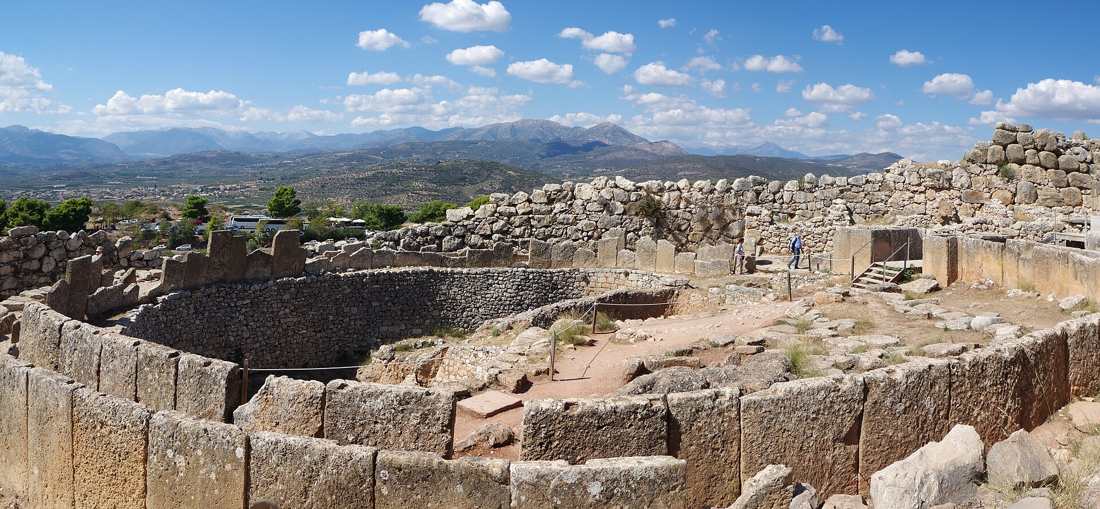
Grave Circle A is a royal cemetery of deep shaft graves lying inside the walls of the citadel of Mycenae, just beyond the great gateway. A double ring of upright stone slabs marks the circle, which held the bodies of men, women and children of the early ruling house. The graves belong to the dawn of the Mycenaean world and rank among the most celebrated finds in Aegean archaeology. Their position within the fortress, close to the entrance, shows the honour paid to the buried rulers by later generations. Trace the shaft graves of the Argolid citadel with My Greece Tours.
The circle sits on the slope of the citadel, framed by a low double ring of slabs that once carried carved markers above the graves. It was first laid out beyond the earliest fortifications and later brought inside the expanded Cyclopean walls, a change that placed the royal dead within the protected heart of Mycenae. The sections below cover the location of the circle, its structure, the burials it held, the story of its discovery and its place in a citadel visit, drawn together in our Mycenae travel guide.
Where is Grave Circle A within the citadel of Mycenae?
Grave Circle A stands inside the walls of the citadel of Mycenae, on the rising ground just beyond the Lion Gate. The ring of shaft graves sits within the fortified heart of the ancient royal stronghold.
Grave Circle A greets visitors almost at once, resting on the slope a short climb up from the main entrance to the citadel. The great carved gateway opens onto a ramp, and the ring of graves lies to the right of that path, wrapped by the massive Cyclopean walls of the stronghold. This placement is one of the striking features of Mycenae, since royal shaft graves inside a fortress are unusual in the Aegean world. The circle looks out over the plain of the Argolid, the same fertile lowland the rulers of Mycenae once commanded.
Its footing within the walls, rather than beyond them in an outer field, tells its own story about how the citadel grew across the generations. The circle joins the gateway as one of the first sights on any tour of the site.
The wider setting sharpens the meaning of the circle’s position on the slope. Just below stands the carved Lion Gate, the ceremonial way into the fortress, and the circle sits close by it on the rising ground beyond. This nearness was no accident of terrain. The royal dead were kept close to the very threshold of the citadel, in full view of everyone who passed through the gateway into the heart of the stronghold. The arrangement bound the living rulers to their ancestors and made the graves a public statement of dynasty and power.
Standing on the ramp today, a visitor reads the whole layout in a single glance, the gateway, the circle and the massive walls locked together as one deliberate composition raised at the very entrance to the royal stronghold.
How is Grave Circle A built and marked out?
A double ring of upright stone slabs bounds Grave Circle A, enclosing a group of deep shaft graves cut into the rock. The parallel slabs once carried a covering, forming a formal boundary around the royal burial ground.
The circle takes its shape from two concentric rings of upright limestone slabs set a short distance apart. These parallel walls of stone once supported horizontal slabs across the gap, roofing the narrow ring and marking the sacred ground of the burials with a clear, formal edge. The enclosed space holds a cluster of shaft graves, deep rectangular pits sunk into the rock, each cut to receive one or more bodies laid at the bottom. The graves were closed over and topped at ground level, and the richest of them carried carved stone markers standing above them. The whole design reads as a considered monument rather than a plain field of pits.
This bounded precinct set the royal dead apart from the ordinary ground of the citadel and gave their resting place a lasting architectural frame.
The structure survives today in good enough condition to be read plainly on the ground, its double ring still tracing a clear circle on the slope. Set beside its older neighbour, Grave Circle B outside the walls, the built ring of Circle A shows a step toward grander, more formal royal burial. The upright slabs mark the boundary the ancient builders intended, and the graves within kept their contents sealed until the ground was reopened in the age of modern excavation. Visitors walking the edge of the circle today can trace the ring of stone and picture the covered precinct as it once stood.
This was a carefully designed enclosure, raised to hold and honour the founders of the ruling line at the very core of the fortress.
Who was buried in the shaft graves of Grave Circle A?
The shaft graves held men, women and children of the early ruling house of Mycenae, laid to rest with weapons of bronze and rich offerings. The burials mark the founding rulers of the citadel’s royal line.
The graves of the circle received the bodies of men, women and children drawn from the ruling house at the dawn of the Mycenaean age. The dead were laid in the deep pits with weapons of bronze at their sides, along with vessels and personal ornaments that spoke of high rank. Warriors went to the grave equipped with swords and daggers, while the burials of women and children carried offerings of their own. This mix of ages and sexes points to a family group, a dynasty gathering its members into one honoured precinct rather than a cemetery of unconnected warriors.
The care taken over the burials, and the wealth committed to the ground with them, mark these as the graves of rulers whose standing set them apart from the wider population of the early citadel. Among the gold laid with them was the funerary Mask of Agamemnon.
The objects placed in the graves have shaped how the whole early period of Mycenae is understood, and the full scale of that hoard belongs to the treasures unearthed at Mycenae. The burials themselves tell of a society ordered around a warrior elite that prized display in death as in life. Bronze weapons, fine drinking vessels and worked ornaments accompanied the dead into the shaft graves, a signal of rank meant to endure. The presence of children among the buried underlines the dynastic reading, a ruling family binding its generations into a single sacred ring.
These are the founders whose descendants raised the Cyclopean walls and the great gateway, and whose resting place was later enclosed within the growing fortress as a mark of continuing respect.
How was Grave Circle A discovered?
Heinrich Schliemann excavated the shaft graves of Grave Circle A in the later nineteenth century, uncovering the buried rulers and their famous gold funerary masks. The dig brought the early Mycenaean world to sudden worldwide attention.
The graves of the circle were opened by Heinrich Schliemann in the later part of the nineteenth century, in a dig that became one of the landmark excavations of Aegean archaeology. Working within the walls of the citadel, he cleared the shaft graves and lifted from them a wealth of gold, silver and bronze that stunned the world of his day. Among the finds were the celebrated gold funerary masks laid over the faces of the dead, including the one he named the Mask of Agamemnon after the legendary king of Mycenae. The excavation seemed to reach back to the heroic age of Greek myth.
It fixed Grave Circle A in the public mind as a place where legend and buried fact appeared to meet on the same ground.
The excavator behind the discovery has his own place in the story of the site, told in full on our page devoted to Heinrich Schliemann. His work at the circle raised questions that scholars still weigh, above all the naming of the finest mask for Agamemnon, the king who leads the Greeks in the old epic of the Trojan War. The masks and other precious goods date to a period well before the traditional age of that war, so the romantic labels sit uneasily with the archaeology. The tension takes nothing from the importance of the dig itself. Schliemann drew the early Mycenaean rulers out of the ground and recovered the gold laid over their faces.
He set the study of the Bronze-Age Aegean on a wholly new and firmer footing that later scholars have built upon ever since.
Why is Grave Circle A a highlight of a Mycenae visit?
Grave Circle A ranks among the most important discoveries in Aegean archaeology, revealing the wealth of the early Mycenaean rulers. Its position by the Lion Gate makes it a first and lasting highlight of the citadel.
Grave Circle A rewards a visit on more than one level at once, which is why it stands among the leading sights of the citadel. The ring lies close to the entrance, so visitors meet it early and read it against the gateway and the great walls that frame it. Its bounded shape survives clearly on the ground, letting the eye trace the double ring of slabs and the pits within. The circle also carries the weight of its discovery, the moment when the gold of the early rulers came to light and the buried Mycenaean world stepped into modern view.
Few spots on any Greek site pack this much archaeology and story into so small a space, a designed royal precinct set within the walls of one of the most storied strongholds of the ancient Aegean.
The finds from the graves now rest mostly in the National Archaeological Museum in Athens, where the gold masks and other precious goods draw crowds of their own. Closer to the site, the on-site collection at the Mycenae archaeological museum sets the circle in the fuller context of the citadel and its history. Seeing the empty graves on the slope and then the objects that came from them, a visitor grasps the reach of the early Mycenaean rulers and the artistry of their craftsmen. Grave Circle A repays the climb through the gateway with a rare directness that few ancient sites can match.
It joins a real place, a real dig and a lasting body of finds into one continuous story, and it stands out as one of the defining experiences of any tour of Mycenae.
Frequently Asked Questions
How much time should you spend at Grave Circle A on a citadel visit?
Grave Circle A sits right at the start of the climb, just beyond the Lion Gate, so most visitors reach it soon after entering the citadel. A stop of a quarter of an hour or so lets you walk the edge of the double ring and look down into the shaft graves. The pause also lets you take in the position of the precinct against the walls and the gateway. The circle rewards a slower look than its small size suggests, since so much of the early history of Mycenae is bound up in this one bounded space.
Pairing the visit with the on-site museum deepens the experience, as the graves stand empty on the slope while the objects lifted from them are shown nearby. Standing here first sets the tone for the rest of the citadel. It makes sense to give the circle its due before pressing on up the ramp toward the palace and the higher ground of the fortress above.
Are the finds from Grave Circle A still kept at Mycenae?
The most celebrated finds from Grave Circle A, above all the gold funerary masks, are held today in the National Archaeological Museum in Athens rather than at the site itself. The graves on the citadel slope stand empty, their contents lifted long ago in the great excavation of the later nineteenth century. The on-site collection at Mycenae still shows a rich body of material from the citadel and helps set the circle in its wider context, so a visit to the site loses none of its meaning. Travellers often choose to see both, walking the empty ring on its slope by the Lion Gate and then viewing the gold and other precious goods in Athens.
The pairing brings the story full circle. The place where the rulers were buried and the objects committed to the ground with them can each be understood the better for the other, across the short distance that now separates them.
What is the difference between Grave Circle A and Grave Circle B at Mycenae?
Mycenae holds two royal grave circles, and they differ in date and in setting. Grave Circle A lies inside the fortified citadel, just beyond the Lion Gate, enclosed by the expanded Cyclopean walls that were built out to bring the older graves within the stronghold. Its double ring of upright slabs frames a group of rich shaft graves opened in the great excavation of the later nineteenth century. Grave Circle B stands outside the walls, on lower ground beyond the fortress, and belongs to a slightly earlier phase of the same early Mycenaean world.
Both are cemeteries of deep shaft graves that held members of the ruling house with weapons and offerings, so the two circles read as stages in a single royal burial tradition. The move to enclose Circle A within the walls, while Circle B remained outside, shows the rising honour paid to the founding rulers as the citadel grew across the generations.