
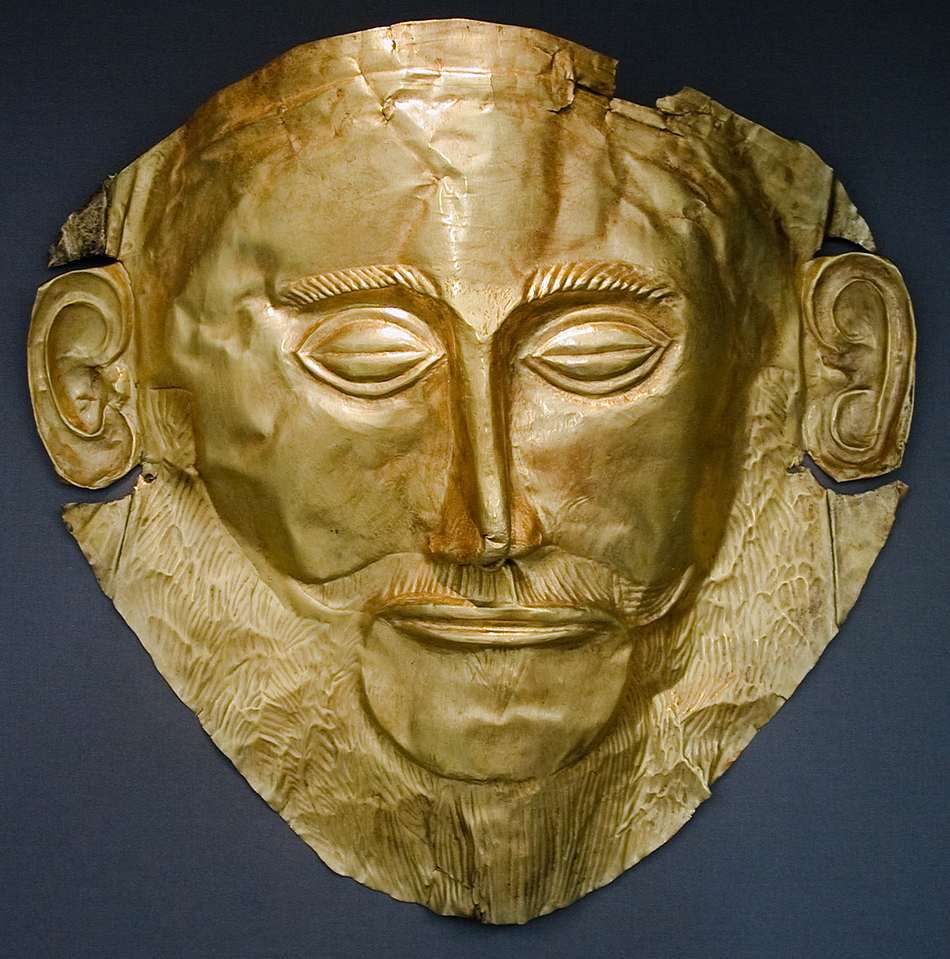
The Mask of Agamemnon is a funerary mask of beaten gold and the most famous single object ever recovered from Mycenae. It shows a bearded man’s face with closed eyes, a straight nose and finely worked ears, all hammered from one sheet of gold. Heinrich Schliemann lifted it from a shaft grave in the citadel and read the face of a legendary king into it, though the mask is far older than any date proposed for the Trojan war. That gap makes the famous name a romantic misnomer rather than a record of fact. Plan a visit to see the golden face and the citadel that produced it with My Greece Tours.
The mask belongs to a small set of gold masks that once covered the faces of the dead in the shaft graves of the citadel. Its serene expression and skilled goldwork made it the enduring image of Bronze Age Greece, reproduced in books, posters and museum halls the world over. This page keeps to the object itself: how it was found, why the name stuck, what it looks like and where you can see it today. The sections below cover those points in turn, and our Mycenae travel guide places the golden face within a full day on the archaeological site.
What is the Mask of Agamemnon from Mycenae?
The Mask of Agamemnon is a funerary mask of beaten gold from Mycenae, showing a bearded man’s face with closed eyes, a straight nose and finely worked ears, hammered from one sheet of gold to cover a dead face.
The mask reads as a portrait cast in metal, though it was made for the dead rather than the living. A single sheet of gold was hammered into the shape of a human face. A full beard frames the mouth, closed eyes sit below arched brows, and a straight nose rises between ears worked in careful detail. The gold catches light with a soft, even glow that has kept its shine across the centuries. It was one of a set of such masks laid over the faces of men buried in the shaft graves of the citadel. Each one marked rank and wealth, pressed directly onto the body at the moment of burial.
The craft on show speaks to a court that could command skilled goldsmiths and the raw metal to keep them busy.
The making of the mask sits at the heart of Bronze Age Mycenaean art, which prized worked gold above almost every other material. Rather than casting the face in a mould, the goldsmith raised it from a flat sheet by patient hammering. The nose, brows and beard were coaxed into relief without breaking the thin metal. The closed eyes give the face its calm, inward look, the quality that has drawn viewers for generations. The mask was not meant to be a likeness in the modern sense but a dignified covering, a golden face to carry a leader into death.
That blend of practical burial custom and high craft is exactly what makes the object so telling about the people who buried their dead this way.
How did Schliemann find the mask at Mycenae?
Heinrich Schliemann uncovered the mask in a shaft grave of Grave Circle A inside the citadel during his excavations in the later nineteenth century. It was one of a set of gold masks laid over the faces of the dead.
The mask came to light inside the walls of the citadel, in the cluster of shaft graves now known as Grave Circle A. The graves lay just past the main gate, sunk deep into the rock and packed with gold, weapons and rich goods buried alongside the dead. Digging to the bottom of the shafts brought up gold masks laid over the faces of the men interred there, the metal still bright after its long burial. The most striking of them, the bearded face with closed eyes, became the object the world would know as the Mask of Agamemnon.
Its find spot inside the fortified heart of the site tied it firmly to the ruling class who once held power there. The grave circle sat close to the great gate, so the buried wealth greeted anyone crossing into the citadel.
The excavation was directed by Heinrich Schliemann, who had dug at Troy and came to Mycenae chasing the heroes of Homer. Working in the later nineteenth century, he sank his trenches into the grave circle and drew out a hoard that stunned the museums of Europe. The gold masks were among the finds that made his name, and the bearded face caught his imagination at once. His methods were rough by later standards and his readings ran ahead of the evidence, yet the find reshaped how scholars pictured early Greece. The masks proved that a wealthy, organised society had flourished on the Greek mainland long before the classical age.
The bright gold, the fine craft and the scale of the buried wealth forced Europe to take the Greek Bronze Age seriously. The bearded face became the emblem of that revelation.
Why is the Mask of Agamemnon called by that name?
Schliemann linked the mask to Agamemnon, the legendary king of Mycenae, but the object is far older than any date proposed for the Trojan war. The name is a romantic misnomer that has stuck through long habit rather than proof.
The name comes straight from Schliemann’s hopes rather than from any inscription or record. He had come to Mycenae to find the world of Homer. The bearded gold face appeared, and he tied it to Agamemnon, the legendary king who led the Greeks against Troy. The identification thrilled the public and gave the mask an unforgettable title. Later study, though, placed the shaft graves and their masks well before any date suggested for the Trojan war. The man behind the gold, whoever he was, could not have been the Homeric king. The name records a nineteenth-century dream of connecting archaeology to legend, not a verified fact about the person buried there.
Schliemann wanted his heroes made real, and the golden face gave that wish a shape it has never quite lost in the public mind.
The label endures despite that gap, and museums keep it because the world knows the object by no other name. Scholars are careful to call it a misnomer, a romantic tag rather than a true identity, while still using it for clarity. The true owner of the face remains unnamed, one of the powerful men laid in the grave circle at the height of the citadel’s wealth. That uncertainty adds to the mask’s pull, and the calm golden face keeps its secret. The mask stands as the enduring image of Mycenae and of the goldsmiths who served its rulers. Its title, borrowed from legend, covers a real but nameless Bronze Age man.
Guides and scholars now hold both truths together: the celebrated name on the label, and the honest admission that the man beneath the gold will likely stay unknown.
Where can you see the Mask of Agamemnon today?
The original mask is a treasure of the National Archaeological Museum in Athens, displayed among the gold finds from the shaft graves. Copies are shown at the archaeological site of Mycenae itself so visitors can see the face on location.
The genuine mask sits in the National Archaeological Museum in Athens, at the centre of its collection of finds from the shaft graves. There it stands among the other gold masks, cups, weapons and ornaments drawn from Grave Circle A, giving visitors a full sense of the wealth buried inside the citadel. The bearded golden face is one of the museum’s signature pieces, and crowds gather around its case to study the calm, closed-eyed expression up close. Seeing it beside the hoard makes clear that it was never a single showpiece but part of a whole burial culture built on worked gold. The Athens display remains the place to meet the true object face to face.
The gallery keeps the mask under careful light, and visitors linger over the closed eyes and beard that carry the fame of the citadel.
At the site itself, faithful copies let travellers picture the mask in the setting that produced it. A small Mycenae archaeological museum stands beside the ruins. It shows reproductions of the golden face alongside genuine finds from the excavations, so a visit to the citadel still delivers the sense of the discovery. Standing near Grave Circle A with the copy in view helps join the object to its find spot in a way the Athens gallery cannot. For the wider hoard, the cups, daggers and ornaments from the graves, the account of the treasures unearthed at Mycenae follows the full range of gold.
Seen together, the true mask and the copies on site let a traveller trace the object all the way from its find spot on the citadel to its place of honour in the national gallery.
Why does the Mask of Agamemnon matter to Mycenae?
The mask matters as the enduring image of Mycenae and of Bronze Age Greek goldwork. Its calm golden face, high craft and tangled history bind together art, burial custom and legend in one small, unforgettable object.
Few single objects carry a whole civilisation the way this mask does. The calm golden face has become shorthand for Mycenae and for the Bronze Age world of the Greek mainland, printed in schoolbooks and museum guides across the world. It fixes in one image the wealth of the citadel, the skill of its goldsmiths and the customs that laid gold over the faces of the dead. The mask turns an abstract, distant age into something a viewer can meet directly. Here is a human face rendered in bright metal by hands at work more than three thousand years ago, and the effect on a modern viewer is immediate.
That power to stand for an entire era explains why it draws crowds in Athens and why its copy anchors a visit to the site.
The mask also holds a lesson about how archaeology and legend twist together. Its false name keeps the memory of Schliemann’s Homeric quest alive, while its true date and unknown owner remind viewers to weigh evidence against romance. The object sits at the meeting point of hard fact and old story, and it rewards both the scholar and the dreamer. Seeing the golden face on a trip through the Argolid, whether in the Athens museum or in copy at the citadel, gives the whole landscape of Mycenae a human centre. It is the one small thing that makes the vast, silent ruins feel, for a moment, personal and alive.
A traveller who studies the calm gold face keeps a stronger memory of the site than any wall or gate alone. A single object stands in for an entire lost world.
Frequently Asked Questions
Is the Mask of Agamemnon really the face of Agamemnon?
No, the mask does not show the face of the Homeric king, despite the name that Schliemann gave it. He dug at Mycenae hoping to find the world of Homer, and when the bearded gold face appeared he tied it to Agamemnon, the legendary leader of the Greeks against Troy. Later study placed the shaft graves and their masks well before any date proposed for the Trojan war, so the man behind the gold lived long before the events Homer describes. The name is best understood as a romantic misnomer, a nineteenth-century wish to link the find to legend rather than a record of who was buried there.
The true owner remains unnamed, one of the powerful men laid in the grave circle at the height of the citadel’s wealth. Museums keep the famous title because the world knows the object by no other name, while making clear that the identity is legend, not proven fact.
What is the Mask of Agamemnon made of and how was it made?
The mask is made of beaten gold, worked from a single sheet of the metal into the shape of a human face. Rather than casting it in a mould, the goldsmith raised the features by patient hammering, coaxing the straight nose, the arched brows, the closed eyes and the full beard into relief without breaking or tearing the thin gold. The ears were worked in careful detail at either side, and the surface still holds a soft, even shine after its long burial. This raising technique lay at the heart of Mycenaean goldwork, which prized worked gold above almost every other material and kept skilled craftsmen busy for the ruling class.
The result was never meant to be a portrait in the modern sense but a dignified golden covering for the face of a dead leader. The craft on show reflects a court wealthy enough to command both the raw metal and the skilled hands needed to shape it so finely.
How do I include the Mask of Agamemnon in a trip to Greece?
You can meet the mask in two places, and a good trip takes in both. The genuine object sits in the National Archaeological Museum in Athens, at the centre of its collection of gold finds from the shaft graves, so a museum visit in the capital lets you study the real face up close among the wider hoard. To see the mask in the setting that produced it, travel on to the archaeological site of Mycenae in the Argolid, where faithful copies stand in the small museum beside the ruins and near the grave circle where the originals were found.
Pairing the two gives the object its full weight: the true gold in Athens and the find spot on the citadel walls. A day trip or short tour through the Argolid can join Mycenae with other sites nearby, so the golden face becomes the human centre of a wider journey through the Bronze Age landscape rather than a single stop seen in isolation.