
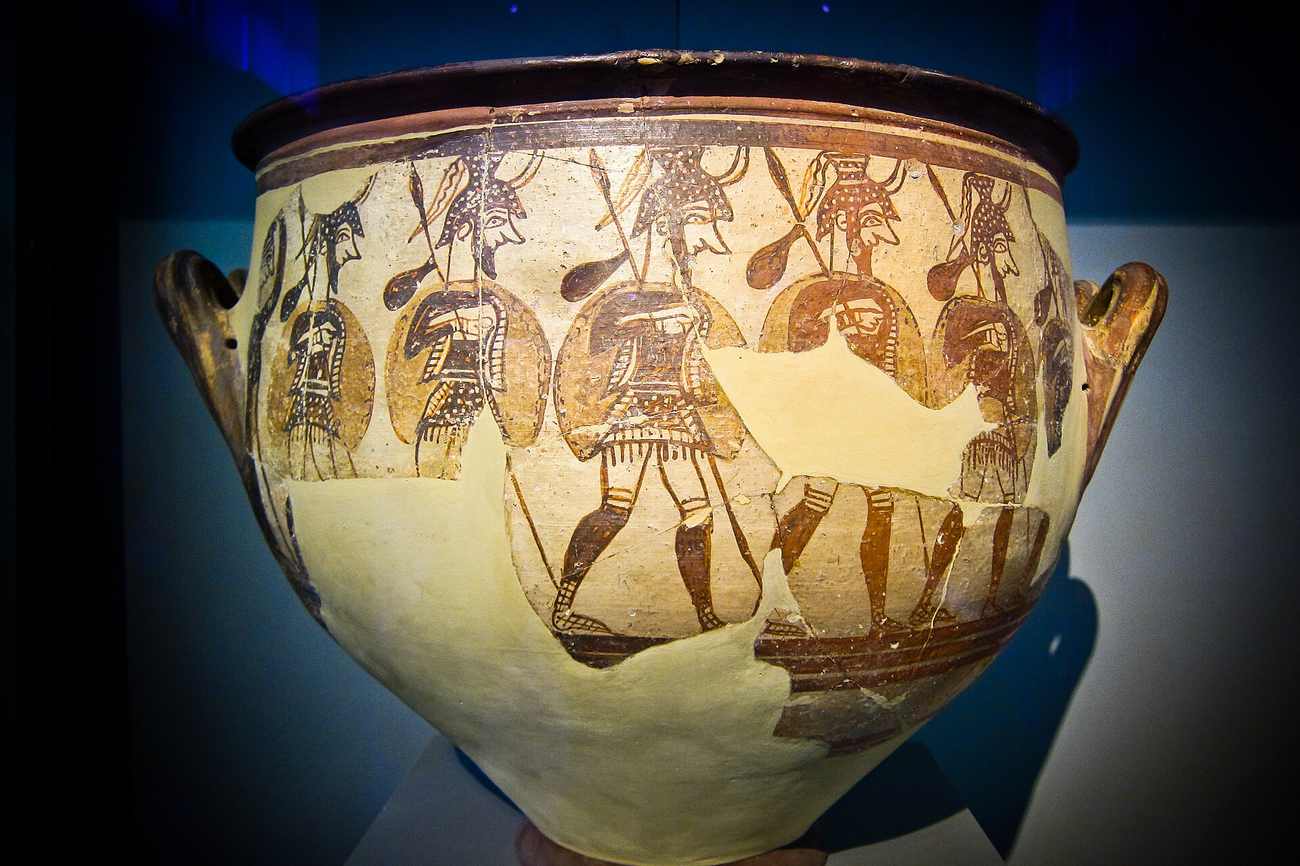
The Warrior Vase is one of the best-known works of Mycenaean art, a painted pottery krater found at the citadel of Mycenae. Heinrich Schliemann discovered it near the great fortress, and it dates to the late Bronze Age. The vessel is a large mixing bowl for wine. Painters covered it with a file of helmeted soldiers marching off to war, all bearing spears, shields and packs, while a woman raises her hand in farewell at one end. That single human scene has made the krater an emblem of the Mycenaean world. Explore this famous vase and the citadel that produced it with My Greece Tours.
The Warrior Vase rewards a closer look than most museum pieces, because it carries a story rather than a pattern. Its marching men, their armour and the woman waving them away turn a mixing bowl into a portrait of a warlike age. The sections below cover where and how the krater was found and what its painted scene shows. They also trace how it fits the wider story of Mycenaean pottery and where the original stands today. Set the vase in its full context with our Mycenae travel guide, which ties the citadel, its art and its tombs into one clear picture.
Where and how was the Warrior Vase found at Mycenae?
Heinrich Schliemann discovered the Warrior Vase near the citadel of Mycenae during his work at the site. The painted krater dates to the late Bronze Age and ranks among the best-known objects the excavations there brought to light.
The Warrior Vase came out of the ground at Mycenae itself, the fortified hill in the northeast Peloponnese that gave its name to a whole civilisation. Heinrich Schliemann, the excavator most closely tied to the site, found the krater near the citadel while working through its remains. The vessel dates to the late Bronze Age, the closing stretch of the Mycenaean world, and it quickly stood out from the other pottery around it. Where most finds carried patterns or plain glaze, this one carried people. That difference marked it at once as something exceptional. Here was a painted scene of human figures rather than the usual bands and spirals.
The krater has held that special place ever since among the treasures recovered from the great fortress of Mycenae.
The find sits within the wider record recovered from Mycenae, a citadel whose tombs and buildings gave up gold, weapons and pottery in remarkable quantity. The krater takes its meaning from that setting, painted for a society that raised massive walls and buried its dead with armour and blades. Anyone tracing the story of the site can follow it from the shaft graves through to the surviving buildings, and the vessel belongs to the everyday life that filled the space between them. Visitors who want to see where such objects were used can walk the palace of Mycenae. This is the hall complex at the summit of the citadel.
Wine was poured there from mixing bowls much like this painted krater, at feasts held within the fortified walls.
What does the painted scene on the Warrior Vase show?
The Warrior Vase shows a file of helmeted soldiers marching off to war, each carrying a spear, a shield and a pack. At one end a woman raises her hand in a gesture of farewell to the departing men.
The main scene reads clearly across the centuries. A line of soldiers marches over the body of the krater, all facing the same way, dressed and equipped alike. Each man wears a helmet and carries a spear over his shoulder. A round shield sits on his arm and a pack hangs behind him, the full kit of a fighter setting out from home. The figures step forward in unison, a column on the move rather than a battle in progress. At the end of the file stands a woman, her hand raised in a gesture of farewell as the men leave her behind.
That small human moment lifts the vessel above a simple record of weapons and turns it into a scene of leaving, loss and departure for war.
The detail on the marching men matters as much as the story they tell. Their helmets, body armour and gear match other evidence for how Mycenaean warriors were equipped, so the painter drew from the real world rather than from imagination alone. That accuracy makes the krater a source as well as a picture, a vivid record of a society organised around fighting. The way the soldiers and their kit are shown lines up closely with the study of Mycenaean civilization as a warlike, well-armed culture. The vase gives a human face to that broad picture. It shows not just the arms a warrior carried but the moment of parting.
Sending armed men off to war brought that grief to the households of the citadel.
Why is the Warrior Vase important in Mycenae’s art?
The Warrior Vase counts among the best-known works of Mycenaean art because it captures a rare human scene, not a pattern. Its bold, simple figures and warlike subject make it a defining image of the whole Mycenaean age.
The importance of the Warrior Vase rests on its subject far more than on its size. Where most surviving Mycenaean vessels carry abstract decoration or repeated motifs, this krater carries a story with people in it, a column of soldiers and a woman seeing them off. That choice of subject is rare, and it gives the piece a weight that plain patterned pottery cannot match. The scene speaks directly of a warlike society, one that armed its men and sent them out to fight, and it does so in a single glance. This quality has kept the vessel at the front of any account of the period.
The work shows how the people of the citadel saw themselves and what they valued in the world they built. The marching soldiers wear the tusk-plated headgear preserved in the boar’s tusk helmet of the age.
The krater also holds a firm place in the broader story of the period’s craftsmanship. It belongs to the tradition of Mycenaean art, the painting, metalwork and carving produced across the citadels of the age. The krater stands out even within that rich body of work. The vessel gathers the themes of war, ritual and daily life into one object. It joins the gold and the architecture as a marker of what this civilisation achieved. For visitors it offers a way into the whole culture through a single painted scene. Behind the walls and tombs, it shows, stood a people who chose to tell their own story in paint.
That human choice is why the vase has become an emblem of the Mycenaean age itself.
How does the Warrior Vase fit the story of Mycenaean pottery?
The Warrior Vase belongs to a late stage of Mycenaean vase painting, marked by bold, simple figures. Its clear column of soldiers shows a style that favoured strong outlines and readable human scenes over fine detail or dense decoration.
The krater sits at a particular point in the long development of Mycenaean pottery. Its figures are bold and simple, drawn with strong outlines and little fussy detail, and that plainness marks a late stage in the tradition of vase painting on these vessels. Earlier work in the period could be intricate, packed with spirals and marine motifs. The Warrior Vase moves in a different direction. It favours clear, direct images that a viewer reads at once. The line of marching men is easy to follow across the surface, each figure repeated in near-identical form. That repetition and clarity are the hallmarks of the phase the vessel represents.
It was a moment when painters told their stories in broad, confident strokes rather than in delicate ornament.
Seeing where the krater falls in that story helps explain both its look and its lasting fame. The mixing bowl was made to hold and pour wine, a working vessel for the feasts of the citadel. Its painter still used the broad body as a surface for a scene of departure for war. That pairing of everyday use and ambitious subject is part of what makes it stand out among surviving finds. Travellers who want to see this and related objects laid out in order can plan a trip through the Mycenae archaeological museum. There the pottery of the site is gathered in sequence.
The shift toward these bold, late figures can then be traced clearly from one case to the next across the whole collection.
Where can you see the Warrior Vase today?
The original Warrior Vase is kept in the National Archaeological Museum in Athens, the country’s main museum of ancient art. There it stands among the finest finds from Mycenae as one of the collection’s celebrated pieces.
The original krater no longer stands at Mycenae itself but in the National Archaeological Museum in Athens. That museum holds the country’s greatest gathering of ancient art, and the Warrior Vase sits within it as one of the treasures drawn from the citadel. Placing the vessel there sets it beside other famous finds of the same age. The gold, the weapons and the fine metalwork all came out of the tombs. A visitor can read the vase against that wider haul from the site. The move from the hill to the capital is common for the most important objects.
They are protected and displayed together in the capital, where the greatest number of people can study them and see the painted scene up close for themselves.
Seeing the vase in Athens works well alongside a visit to the citadel where it was found. Travellers often pair the two on the same trip. The best-known tombs at Mycenae include the shaft graves of Grave Circle A. These gave up the gold now shown in the same Athens museum. The objects and their original home stay linked across the two places. Standing before the krater after walking the site brings its marching soldiers into much sharper focus, since the very walls they were painted within still rise on the hill today. Planning both together makes the most of the story.
Our guide on how to visit Mycenae sets out the practical steps for pairing the citadel with the museum in Athens on a single trip.
Frequently Asked Questions
Who found the Warrior Vase and when does it date from?
Heinrich Schliemann, the excavator most closely tied to Mycenae, discovered the Warrior Vase near the citadel during his work at the site. The painted krater dates to the late Bronze Age, the closing stretch of the Mycenaean world, and it stands among the best-known objects the excavations brought to light. What set it apart from the moment of its finding was its subject: where most pottery from the site carried patterns or plain glaze, this vessel carried people, a file of armed men and a woman waving them off. That difference marked it at once as exceptional, a painted human scene rather than the usual decoration.
The find belongs to the wider record recovered from Mycenae, a citadel whose tombs and buildings gave up gold, weapons and pottery in remarkable quantity, and the krater has held its special place among those treasures ever since it came out of the ground.
Why is the Warrior Vase called an emblem of the Mycenaean age?
The Warrior Vase has become an emblem of the Mycenaean age because it gives a rare human scene from a world otherwise known through walls, tombs and abstract pottery. Its painted column of helmeted soldiers, marching off to war with spears, shields and packs, speaks directly of a warlike society that armed its men and sent them out to fight. The woman raising her hand in farewell adds the note of leaving that turns a record of weapons into a scene of departure and loss. The soldiers’ helmets, armour and kit match other evidence for how Mycenaean warriors were equipped, so the vessel works as a source as much as a picture.
That mix of accuracy and feeling, drawn in bold and simple figures, captures what the civilisation valued in a single glance. No other surviving object sums up the outlook of these citadel-builders so plainly, which is why the krater stands for the whole age.
What kind of vessel is the Warrior Vase and what was it for?
The Warrior Vase is a krater, a large mixing bowl used to hold and pour wine at feasts. Vessels of this shape were working pottery, made for the tables and halls of the citadel rather than for display alone, and the men of Mycenae would have drawn wine from bowls much like it. What lifts this particular krater above its everyday purpose is the scene painted across its broad body: a file of helmeted soldiers marching off to war while a woman waves farewell. The painter used the working surface of a wine bowl as the ground for an ambitious human subject, pairing daily use with a story of departure for battle.
Its bold, simple figures place it at a late stage of Mycenaean vase painting, when painters favoured strong outlines and readable scenes. That blend of function and meaning is part of why the vessel stands out so sharply among the finds recovered from the citadel.