
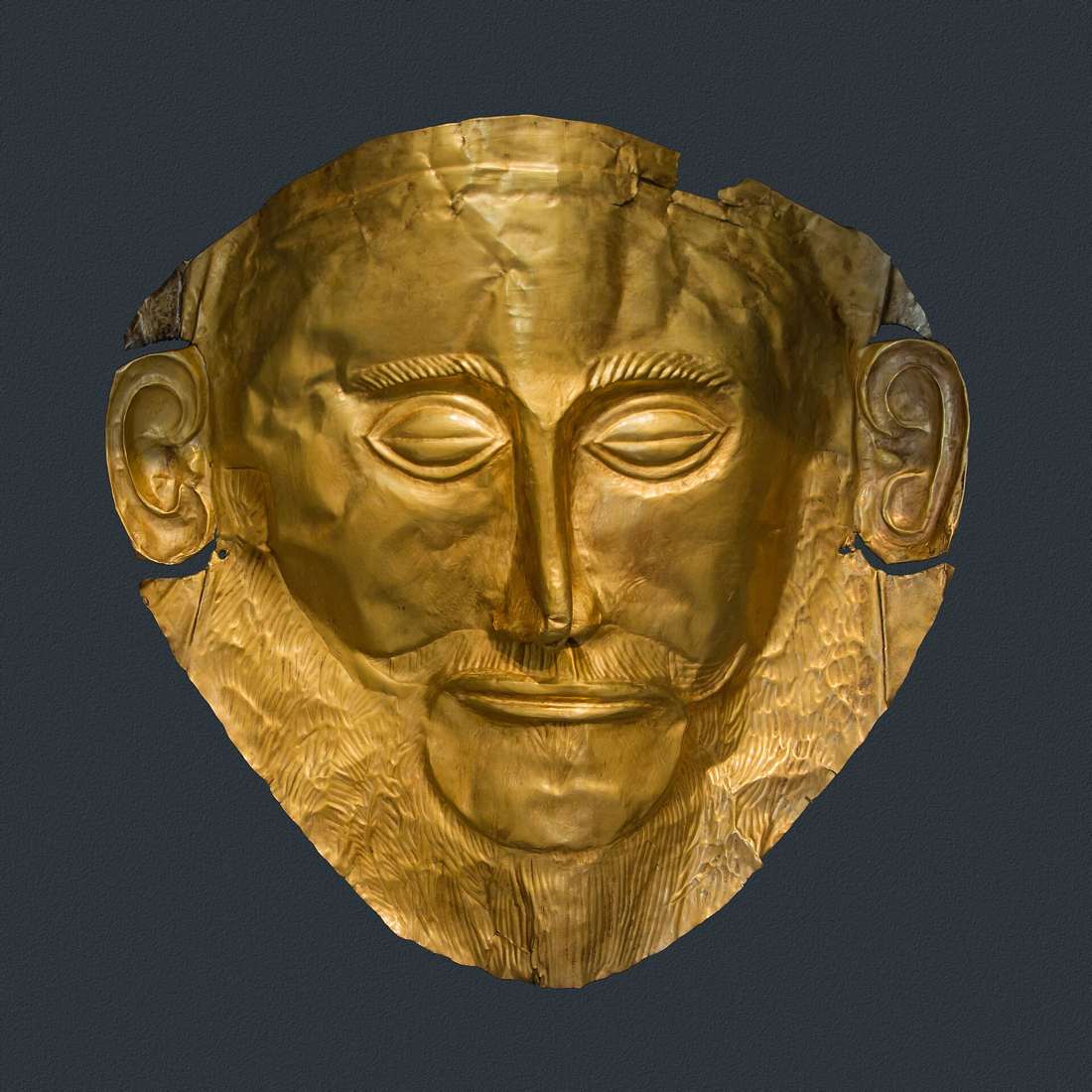
Agamemnon stands as the legendary king of Mycenae in Greek myth, the commander who led the Greek forces against Troy in the war told by Homer. He was the son of Atreus and the brother of Menelaus, born into a dynasty stained by murder and revenge across generations. Myth ties his name to the shaft graves on the hill and to the great beehive tomb below the citadel, giving a face to the Bronze Age power that once ruled here. His story runs from a terrible sacrifice at the fleet’s departure to his own killing on his return, a chain of doom that shaped later Greek tragedy. Meet the myth behind the ruins with My Greece Tours.
Agamemnon belongs to myth, not to a documented reign, yet his name is stamped across the most famous finds at the site. The gold mask from the shaft graves and the huge tomb on the approach road both carry his name because early excavators chose to give it, though neither can honestly be tied to him. The sections below cover his place in the house of Atreus, his part in the Trojan War, his murder and its aftermath, and how his legend colours a modern visit through our Mycenae travel guide.
Who was Agamemnon, king of Mycenae?
Agamemnon is the legendary king of Mycenae in Greek myth, the commander of the Greek forces in the Trojan War told by Homer. He was the son of Atreus and the elder brother of Menelaus, king of Sparta.
Agamemnon rules Mycenae in the world of myth as the most powerful of the Greek kings, the figure the poets place at the head of the whole expedition against Troy. Homer names him the leader to whom the other kings answer, a man whose authority rests on the wealth and reach of Mycenae itself. His father was Atreus and his brother was Menelaus, king of Sparta, whose wife Helen becomes the cause of the war. The bond between the two brothers ties Mycenae and Sparta together at the heart of the legend.
Agamemnon is drawn as proud and commanding, sometimes harsh, a ruler whose choices carry the weight of a kingdom and set the great story of the Trojan War in motion. His authority over the other kings is the thread from which the whole epic hangs. His brother Menelaus of Sparta was the wronged husband whose loss drew Mycenae into the war.
The link between Agamemnon and Mycenae is a link of myth rather than record, and that distinction matters at the site. No inscription names him, no document fixes a reign, and the poems that carry his story were shaped long after the palace on the hill fell silent. What survives is the pairing of a legend with a real place, so that the ruins on the citadel gain a human face through him. Visitors who climb to the palace terrace can picture the throne room of the poems while knowing the history stands apart from the tale.
Understanding this gap between the epic king and the archaeological remains is part of what makes the myth of Mycenae so absorbing to explore on the ground. The tension between poem and excavation gives every step across the site a second meaning.
How does Agamemnon fit the cursed house of Atreus?
Agamemnon belonged to the house of Atreus, a dynasty marked by murder and revenge across generations. The curse passed down his family line drives the killings and counter-killings that run through his own story and beyond it.
The house of Atreus stands in Greek myth as the family most heavily burdened by inherited doom, and Agamemnon inherits both its throne and its curse. His father Atreus fed a monstrous revenge to his own brother, and that crime set a pattern of blood answered by blood down the generations. Agamemnon and Menelaus grow up inside this shadow, and the poets treat their fortunes as bound to the family’s guilt. The Treasury of Atreus, the vast beehive tomb on the approach to the citadel, carries the dynasty’s name even though it cannot be assigned to any single king.
The building and the legend meet in a name, giving the myth a monument that visitors can still walk into today. That meeting of stone and story is exactly what draws travellers up the approach road to see it for themselves.
The curse works through Agamemnon rather than around him, turning each act of the story into a further link in a chain of vengeance. His killing of his daughter, his own murder on his return, and the revenge that follows all read as the family doom unfolding step by step. Greek tragedy later seized on this material because it dramatised how one house could be destroyed from within by its own past. The wider setting of the Mycenaean civilization gives the legend its Bronze Age backdrop of citadels, gold and warrior kings. Standing among the ruins, a traveller sees where myth placed this cursed line, even as the real palace keeps its own separate and quieter story.
The two threads sit side by side on the same hill, one drawn from the poets and one dug from the ground.
What was Agamemnon’s role in the Trojan War?
Agamemnon led the Greek forces against Troy as their supreme commander in the war told by Homer. To gain a fair wind for the fleet, myth says he sacrificed his daughter Iphigenia, an act that set his doom in motion.
The Trojan War gives Agamemnon his defining role, the overall commander of the Greek kings who sail to bring Helen back from Troy. His brother Menelaus is the wronged husband, but it is Agamemnon whose rank places him at the head of the fleet. The poets describe a vast gathering of ships held back at the harbour by contrary winds, unable to cross to Troy. Myth says he answered this crisis with a terrible choice, sacrificing his own daughter Iphigenia to win a fair wind for the crossing. The act secures the voyage but plants the seed of his ruin, giving his wife a reason for the revenge that waits at home.
From the first, his command is shadowed by the price he pays to begin it.
Homer places Agamemnon at the centre of the war’s tensions once the fighting reaches Troy, above all in his bitter quarrel with the great warrior Achilles. That clash over honour and spoil drives much of the poem and shows a commander whose pride can cost his own side dearly. The war grinds on for ten years before the city finally falls, and Agamemnon returns home as the victor. His journey ends at the citadel where the Lion Gate still guards the entrance, the great carved threshold the myth imagines him passing on his fatal homecoming. The gate survives as the site’s most striking monument, and the legend hangs it firmly to the returning king of the epics.
Passing beneath the carved lions, a visitor stands on the very threshold the poets imagined for his doomed homecoming.
How was Agamemnon murdered, and how was he avenged?
Agamemnon returned to Mycenae after the fall of Troy and was murdered by his wife Clytemnestra and her lover Aegisthus. His son Orestes later killed the pair in revenge, carrying the family’s cycle of blood one generation further.
Agamemnon’s homecoming turns the moment of triumph into the moment of his death, the sharpest twist in his whole legend. He sails back to Mycenae expecting a hero’s welcome after ten years of war and the fall of Troy. Waiting for him is his wife Clytemnestra, who has never forgiven the sacrifice of their daughter Iphigenia and has taken Aegisthus as her lover during the long absence. Together the pair strike him down inside his own palace, and the returning king dies at the hands of his household rather than the enemy.
The myth locates this killing on the citadel of Mycenae, so the ruins carry the memory of a homecoming that ends in blood rather than the rest the king had earned abroad. The palace terrace becomes the scene of a betrayal hatched during his long years at Troy. His queen, Clytemnestra, waited at Mycenae to avenge their sacrificed daughter.
The revenge that follows keeps the family curse turning, as the next generation answers the killing in kind. Orestes, the son of Agamemnon and Clytemnestra, grows up to avenge his father by killing both Aegisthus and his own mother. That act of matricide became one of the darkest and most debated themes of Greek tragedy, weighing a son’s duty to a murdered father against the horror of killing a parent. The story shows why the house of Atreus stood as the great myth of inherited doom. Set among the shaft graves and the palace terrace, where treasures unearthed at Mycenae once lay with the buried dead, the legend gains a stage of stone that visitors can still walk.
The bare ground of the citadel becomes the setting of the darkest chapter in the whole family saga.
How does Agamemnon shape a visit to Mycenae today?
Agamemnon gives the ruins their human face, his name attached to the great tomb and the gold mask found in the shaft graves. Knowing the myth turns the citadel from bare stone into the setting of Homer’s epic story.
Agamemnon shapes the modern visit above all through the names early excavators pinned onto the finest discoveries at the site. A gold funerary mask lifted from the shaft graves was called the Mask of Agamemnon, and the greatest beehive tomb was named the Tomb of Agamemnon, yet neither can honestly be tied to him. Both names came from a wish to match a legendary king to the wealth pulled from the ground, and both have stuck ever since. Understanding this lets a visitor enjoy the romance of the labels while keeping the history clear.
The mask and the tomb are genuine Bronze Age treasures whose true owners are unknown, and the epic name they carry belongs to myth rather than to any proven grave. The romance of the labels survives even once the honest caveat is understood.
The legend rewards a traveller who arrives knowing the story behind the stones, turning a walk through the ruins into a walk through Homer’s world. A base in Athens puts the whole site within easy reach, and a Mycenae day trip from Athens often pairs the citadel with the nearby theatre of Epidaurus for a full day in the Argolid. Standing at the Lion Gate or inside the great tomb, a visitor can hold both truths at once: the real Bronze Age power that raised these walls, and the mythical king whose doomed homecoming the poets set here. That double vision is what gives Mycenae its lasting pull on the imagination.
The stones supply the fact, the legend supplies the drama, and a good visit holds both together at once.
Frequently Asked Questions
Was Agamemnon a real historical king of Mycenae?
Agamemnon belongs to Greek myth rather than documented history, and no evidence confirms him as a real king. His story survives through Homer and later poets, works shaped long after the palace on the hill fell silent, and no inscription or record names him or fixes a reign. What the site offers instead is a real Bronze Age citadel matched to a legendary ruler, so the ruins gain a human face through him without proof that he ever lived. The famous names attached to the finds add to the confusion.
A gold mask from the shaft graves was called the Mask of Agamemnon, and the greatest beehive tomb was named the Tomb of Agamemnon, yet early excavators chose those names, and neither object can be tied to him. The honest position is to treat Agamemnon as the mythical face of Mycenae, powerful in legend and central to the site’s meaning, while the true owners of the mask and the tomb remain unknown.
Why is the great tomb at Mycenae called the Tomb of Agamemnon?
The great beehive tomb on the approach to the citadel carries Agamemnon’s name because early excavators chose to give it, not because any evidence links the king to the grave. The tomb is a genuine Bronze Age monument, a vast domed chamber built into the hillside and among the finest of its kind ever raised in Greece. Its scale and craft suggested a royal burial, and the legend of Agamemnon offered the most famous king the site could claim, so the two were joined by name. The same wish to match myth to treasure gave the gold mask from the shaft graves its own Agamemnon label.
Neither name can honestly be sustained, since the true occupants are unknown and the poems that carry the king’s story were composed long after these graves were sealed. Visitors gain the most by enjoying the romance of the name while keeping the fact clear that the tomb belongs to a real dynasty whose members history cannot name.
What happened to Agamemnon’s family after his death?
Agamemnon’s death did not end the family’s cycle of blood; it drove it onward through the next generation. His wife Clytemnestra and her lover Aegisthus, who had killed him on his return from Troy, ruled Mycenae until his son Orestes came of age. Orestes then avenged his father by killing both Aegisthus and his own mother, an act of matricide that became one of the darkest themes in Greek tragedy. The playwrights weighed a son’s duty to a murdered father against the horror of killing a parent, and Orestes was shown pursued by guilt for the deed. His daughter Iphigenia had already been sacrificed before the fleet sailed, the first blow that set the whole tragedy turning.
Taken together, the fates of Agamemnon, Clytemnestra, Iphigenia and Orestes show why the house of Atreus stood in Greek myth as the supreme example of a family destroyed from within by its own inherited curse.