
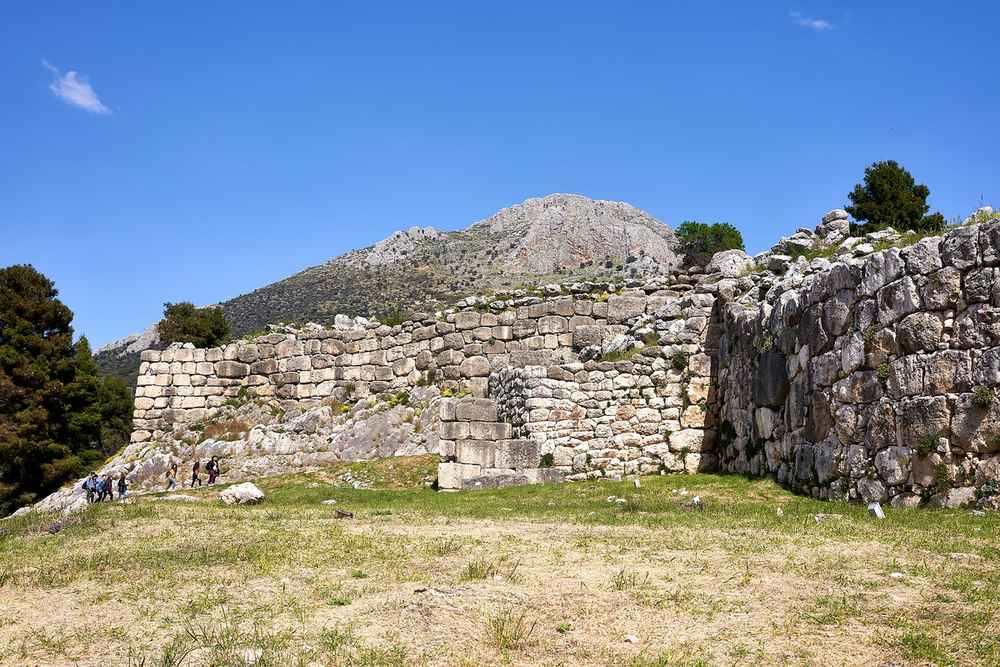
A Mycenae day trip from Athens reaches the Bronze Age citadel of legendary King Agamemnon, with its famous Lion Gate, Cyclopean walls and beehive royal tombs, in under two hours. Make it simple with a guided day trip or skip-the-line tickets from My Greece Tours and see far more of the Peloponnese in your day. Plan the whole trip with Greece Tours.
This legendary excursion is one of the most rewarding in the Athens travel guide. The sections below cover whether it is worth it, how to get there, the Lion Gate, what else to see, costs and the best way to visit.
Is Mycenae worth a day trip from Athens?
Yes, Mycenae richly rewards the journey. The Bronze Age citadel was the centre of the Mycenaean civilisation and the legendary home of King Agamemnon, leader of the Greeks at Troy. A UNESCO World Heritage Site, it preserves the iconic Lion Gate, massive Cyclopean walls, royal shaft graves and the great beehive tomb known as the Treasury of Atreus.
For anyone drawn to ancient history and Greek myth, Mycenae is one of the most evocative day trips from the capital. Set on a rugged hilltop in the Peloponnese, the citadel was the dominant power of Late Bronze Age Greece, giving its name to the entire Mycenaean civilisation that flourished from around 1600 to 1100 BC, centuries before the classical age of Athens. In legend it was the seat of King Agamemnon, who led the Greek armies against Troy in Homer’s epics, and standing within its walls brings those ancient stories vividly to life.
Recognised as a UNESCO World Heritage Site, the archaeological area preserves astonishing remains: the monumental Lion Gate, the only surviving monumental sculpture of Bronze Age Greece, the colossal Cyclopean walls built from boulders, the royal shaft graves where Heinrich Schliemann unearthed dazzling gold treasures, and the magnificent domed Treasury of Atreus. An excellent on-site museum displays the finds. Combined with the dramatic landscape and the powerful sense of antiquity, it makes a profound and memorable excursion. It pairs naturally with other Peloponnesian sights in the Nafplio day trip guide. Reaching it is straightforward.
How do you get from Athens to Mycenae?
Mycenae is about 120 kilometres from Athens, roughly a 1.5 to 2 hour drive via the A7 motorway toward Corinth and Tripoli. There is no direct train; independent travellers usually drive or take a KTEL bus to Nafplio and then a local taxi or bus. The easiest option is an organised full-day tour that often combines Mycenae with Nafplio and Epidaurus.
Getting to Mycenae takes a little planning, but the routes are well established and the distance is manageable for a day. By car, the journey covers around 120 kilometres on good roads: you follow the A7 motorway out of Athens toward Corinth and Tripoli, then take the exit toward Nafplio and Mycenae, with the drive taking roughly one and a half to two hours each way and parking available at the site. Public transport is less direct, as there is no train to the site itself; the usual approach is to take a KTEL intercity bus from Athens to the nearby town of Nafplio or Argos, then continue by local bus or taxi to the village of Mykines beside the ruins, a journey that can take two and a half to three hours overall depending on connections.
For most visitors, the simplest and most rewarding choice is an organised full-day coach tour from Athens, which handles all the transport and a guide, and very often bundles Mycenae with the elegant town of Nafplio and the great theatre of Epidaurus into a single day. Whichever you choose, an early start makes the most of the day. The wider routes are explained in the getting around Athens guide. The Lion Gate is the unforgettable highlight.
What is the Lion Gate at Mycenae?
The Lion Gate is the monumental main entrance to the citadel of Mycenae, built around 1250 BC. Above its huge stone lintel sits a relief of two lionesses flanking a central column, the only surviving monumental sculpture from Bronze Age Greece. Set within the massive Cyclopean walls, it remains one of the most iconic images of ancient Greek archaeology.
The single most famous sight at Mycenae, and one of the great icons of ancient Greece, is the imposing Lion Gate that guards the entrance to the citadel. Constructed around 1250 BC, it consists of two enormous upright stone jambs spanned by a colossal lintel, above which a triangular slab carries a carved relief of two lionesses, or possibly lions, standing on either side of a central column in a heraldic, symmetrical pose. This relief is celebrated as the only monumental piece of sculpture to survive from Bronze Age Greece, and its commanding presence still impresses visitors as they pass beneath it just as the Mycenaeans did three and a half thousand years ago.
The gate is set into the citadel’s astonishing fortifications, the so-called Cyclopean walls, built from limestone boulders so vast and tightly fitted that later Greeks could not believe human hands had raised them, attributing the work instead to the mythical one-eyed giants, the Cyclopes, from which the term “Cyclopean masonry” derives. Walking through the Lion Gate and along these mighty walls is the defining experience of a visit. It connects the visitor directly to the world of Homer’s heroes. The citadel holds much more besides. The wider site rewards exploration.
What else can you see at Mycenae?
Beyond the Lion Gate, Mycenae preserves the royal palace ruins on the hilltop, Grave Circle A where Schliemann found gold treasures including the so-called Mask of Agamemnon, the underground cistern, and outside the walls the great beehive tombs, above all the Treasury of Atreus. The excellent on-site Archaeological Museum displays pottery, frescoes, jewellery and replicas of the finds.
The Lion Gate is only the beginning, for the citadel and its surroundings are rich with remarkable remains. Once inside the walls, you can climb through the ruins to the summit, where the foundations of the royal palace and its great hall, or megaron, command sweeping views over the Argive plain to the sea. Just inside the gate lies Grave Circle A, the royal burial ground where the German archaeologist Heinrich Schliemann excavated a series of shaft graves in 1876 and uncovered a hoard of gold objects, including the famous death mask he dramatically attributed to Agamemnon, now a star exhibit in the National Archaeological Museum in Athens.
Deeper in the citadel, a hidden stairway descends to an underground cistern that secured the fortress’s water supply. Outside the walls stand the monumental beehive tombs, or tholos tombs, the grandest being the Treasury of Atreus, a vast domed chamber of perfectly fitted stone whose soaring corbelled roof was the largest of its kind for over a thousand years. The site’s modern Archaeological Museum gathers pottery, frescoes, jewellery, tablets and replicas that bring the Mycenaean world to life. Together these make for a full and fascinating visit. The greatest treasures now reside in the National Archaeological Museum. Planning the practical details keeps it smooth.
How much time and money does the trip take?
You need around two hours at the citadel, tombs and museum, so a full day covers the journey, Mycenae and often a second site. Site admission is modest, with reductions and a combined ticket including the Treasury of Atreus and museum. Allow for transport or tour costs, wear sturdy shoes, and bring water and sun protection for the exposed, shadeless ruins.
A little practical planning ensures a comfortable and rewarding visit to Mycenae. To explore the citadel, climb to the palace, descend to the cistern, visit the great beehive tombs and see the on-site museum at a relaxed pace, allow around two hours at the site itself, which means a full day from Athens once you add the travel time, often with room for a second stop. Admission to the archaeological site is modest and includes the Treasury of Atreus and the museum on a single ticket, with the usual reduced rates for students, seniors and the young, and free-entry days at certain times of year. Beyond tickets, budget for your transport, whether fuel and tolls by car, bus and taxi fares, or the price of a guided tour.
The ruins sit on an open, rocky hillside with very little shade and uneven, sometimes steep stone paths and steps, so it is essential to wear sturdy, comfortable shoes and to carry water, a hat and sunscreen, especially in the hot months. Spring and autumn offer the most pleasant weather and thinner crowds. The village of Mykines below the site has tavernas for lunch. With these basics covered, the day runs smoothly. Families managing a busy schedule will find the Athens with kids guide useful. Choosing how to visit shapes the experience.
What is the best way to do a Mycenae day trip?
An organised tour is the easiest way, combining hotel pick-up, a guide and usually Nafplio and Epidaurus in one full day. Driving suits independent visitors who want flexibility and to linger, while bus-plus-taxi via Nafplio is the budget route. For depth, comfort and the most sights in a day, a guided full-day tour is the best choice for first-time visitors.
The ideal way to visit Mycenae depends on your priorities and how much else you want to see. For most first-time visitors, an organised full-day coach tour is the standout option, because it removes all the logistics, includes an expert guide who brings the Bronze Age citadel and its myths to life, and very often combines Mycenae with the beautiful seaside town of Nafplio and the famous theatre of Epidaurus, delivering three major Peloponnesian highlights in a single, well-paced day. Drivers who prefer independence gain complete flexibility over timing and route, can pause at the Corinth Canal on the way and linger as long as they like at the ruins, though they take on the navigation and driving.
Budget-conscious travellers and rail-and-bus enthusiasts can reach the area by KTEL bus to Nafplio and continue by local bus or taxi, accepting longer journey times and less time on site. Whichever route you choose, starting early beats both the heat and the larger crowds, and combining Mycenae with Nafplio or Epidaurus makes for a far richer day than the citadel alone. Book skip-the-line tickets and tours in advance to secure your day. The questions below cover the points visitors ask most.
Frequently Asked Questions
How far is Mycenae from Athens?
Mycenae is about 120 kilometres south-west of Athens in the Peloponnese, roughly a 1.5 to 2 hour drive via the A7 motorway toward Corinth and Tripoli. There is no direct train, so independent visitors usually drive, take a bus to Nafplio and continue by taxi, or join an organised day tour.
What is Mycenae famous for?
Mycenae is famous as the Bronze Age citadel of legendary King Agamemnon and the centre of the Mycenaean civilisation. Its highlights are the iconic Lion Gate, the only monumental sculpture from Bronze Age Greece, the massive Cyclopean walls, the royal shaft graves where gold treasures were found, and the great beehive Treasury of Atreus.
Can you combine Mycenae with Nafplio and Epidaurus?
Yes, Mycenae is very often combined with Nafplio and Epidaurus on a single full-day trip from Athens, as the three sites lie close together in the Argolid region of the Peloponnese. Many organised tours include all three with a guide, making for a rich day of ancient history and scenery.