
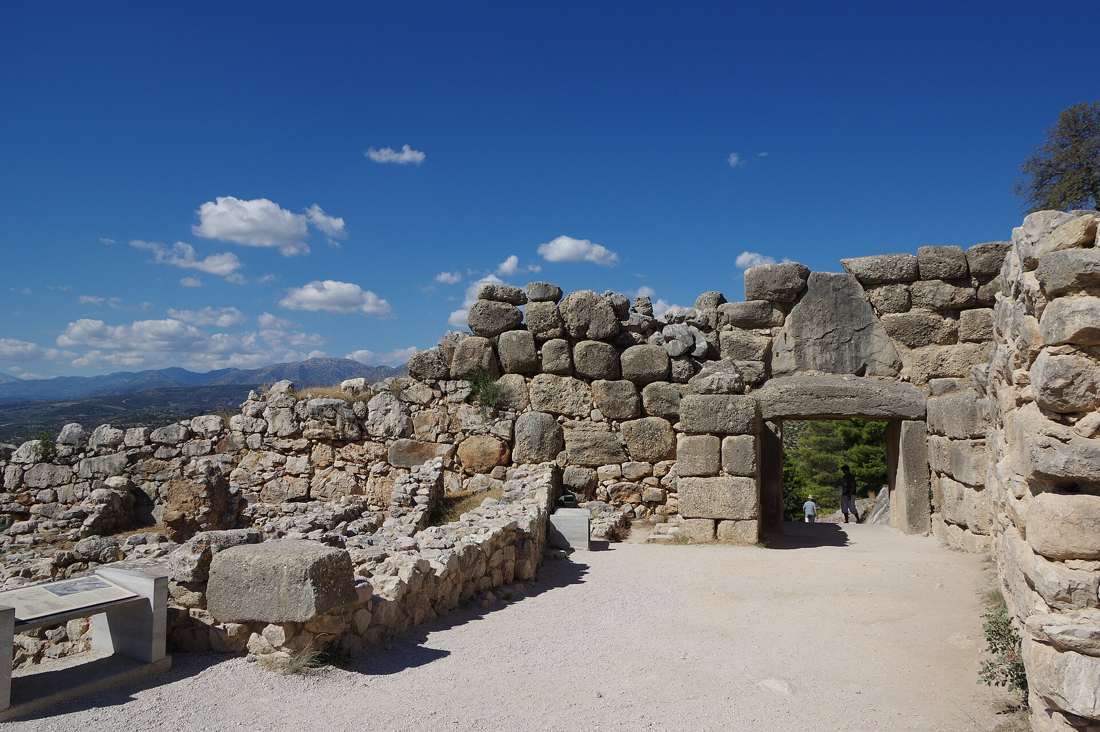
The Lion Gate is the main entrance to the Bronze Age citadel of Mycenae, set in the Argolid region of the Peloponnese in southern Greece. A triangular limestone slab above the lintel carries two lions or lionesses flanking a central column, the emblem of Mycenaean art and power. This relief is the oldest known monumental sculpture in Europe. Massive stone blocks in the Cyclopean style frame the doorway, and a walled ramp with a defensive bastion leads up to the threshold. The gate rewards travellers who want to stand where a powerful Bronze Age kingdom once guarded its heart. Plan your visit to the Argolid with My Greece Tours.
The Lion Gate stands at the north-west corner of the fortification wall, its huge lintel of enormous weight and once closed by wooden doors. The heads of the two animals, now lost, were carved separately and probably faced outward toward the approaching visitor. The gate sits near the modern town of Mykines, a short drive from Nafplio and reached as a day trip from Athens. The sections below cover where the gate lies, how it was built, what the lion relief means, its place in the wider excavation story, and how to see it today. Our Mycenae travel guide places the gate within the whole citadel.
Where does the Lion Gate stand at Mycenae?
The Lion Gate stands at the north-west of Mycenae’s fortification wall, in the Argolid region of the Peloponnese. A walled ramp climbs to the threshold, with a defensive bastion set beside it to guard the main approach into the citadel.
The Lion Gate marks the principal way into the Bronze Age citadel of Mycenae, cut through the north-west stretch of the great fortification wall. A walled ramp rises toward it, funnelling anyone who approached into a narrow, controlled passage overlooked from above. Beside the gate stands a bastion, a projecting block of masonry that let defenders guard the exposed right side of an attacker climbing the ramp. This arrangement turned the entrance into a piece of military engineering as much as a doorway, forcing visitors and enemies alike to move slowly under the eyes of the wall. The citadel occupies a hill in the Argolid, a fertile region of the eastern Peloponnese.
The gate opens the whole enclosed world of palace, grave circle and terraces that the Mycenaean rulers held behind their stone.
The setting shapes the drama of arrival at Mycenae. The Lion Gate lies near the town of Mykines, and the landscape of low hills and olive-covered slopes has changed less than the ruins themselves. Travellers reach the site on a short drive from Nafplio, the harbour town that makes a natural base for the Argolid, or as a longer day trip from Athens. The Mycenae day trip from Athens pairs the citadel with other classical sights nearby. Stand before the gate and you look up the same ramp that chariots and armies once climbed. The lions above the lintel meet your eye today exactly as they met theirs. The approach still teaches its lesson in power.
The wall presses close on the left and the bastion rises on the right, so the arrival feels deliberate before the citadel opens ahead.
How were the Lion Gate and its walls built?
The Lion Gate was built in the Late Bronze Age from massive stone blocks in the Cyclopean style. A single lintel of enormous weight spans the opening, topped by a triangular limestone slab, and wooden doors once closed the passage.
The Lion Gate belongs to the Cyclopean tradition of Mycenaean building, a style named by later Greeks who believed only the giant Cyclopes could have moved such enormous stones. The doorway is framed by great blocks set with little mortar, their sheer mass holding the structure firm. Across the top runs a single monolithic lintel of enormous weight, one of the heaviest worked stones in the whole citadel. Above the lintel the builders left a triangular gap, a relieving triangle that carried the crushing weight of the wall outward to the jambs rather than down onto the beam.
This same engineering logic runs through the site’s defences, and the vast circuit of Cyclopean walls shows the scale of labour the rulers of Mycenae could command.
The triangular space was not left bare but filled with a carved limestone slab, turning a structural necessity into the most famous sculpture of the Bronze Age. The gate opening was closed by wooden doors, pivoting on sockets still visible in the stone. A bar could be dropped across to seal the citadel at night or under threat. The same builders raised the great tholos tombs that ring the site beyond the walls. The huge beehive chamber of the Treasury of Atreus shows their mastery of the corbelled vault on a monumental scale.
The Lion Gate gathers all of this skill into one threshold: brute engineering to carry the weight, careful masonry to shape the passage, and a single sculpted panel to crown the entrance with meaning.
What does the lion relief above the Lion Gate mean?
The relief shows two lions or lionesses flanking a central column, carved on a triangular limestone slab above the lintel. It stands as the emblem of Mycenaean art and power and the oldest known monumental sculpture in Europe.
The carved slab above the Lion Gate presents a balanced, heraldic scene: two powerful animals rear up on either side of a central column, forepaws resting on the base beneath it. Scholars read the beasts as lions or lionesses, and the column is thought to stand for the palace, the ruling house, or a divine presence guarding the citadel. The composition is symmetrical and deliberate, an early example of the paired-animal motif that Bronze Age art shared across the eastern Mediterranean. The roots of this visual language reach back into the palace cultures of the Aegean.
The contrast drawn out in our guide to the Minoan and Mycenaean worlds helps explain how the mainland rulers took older motifs and turned them toward their own display of strength.
The heads of the two animals are now lost, and their absence carries its own clue to how the relief was made. The heads were carved separately, perhaps from a different and finer material, and fixed into the slab so they could turn to face outward at the approaching visitor. A traveller climbing the ramp would have met the direct gaze of the beasts rather than their profiles, a calculated piece of theatre at the point of entry. The relief has become the single image most people carry away from Mycenae, reproduced on tickets, book covers and museum walls.
It marks the moment when the mainland Greeks first raised monumental sculpture over a doorway, announcing a kingdom that wanted every arrival to feel the weight of its authority.
Who uncovered the Lion Gate and the story of Mycenae?
The German archaeologist Heinrich Schliemann worked at Mycenae in the late nineteenth century, drawing world attention to the citadel. The Lion Gate had long stood partly visible, but his digging exposed the grave circle and treasures that made the site.
The Lion Gate never wholly vanished. Its massive lintel and lion relief stayed partly above ground through the centuries, a known landmark long before systematic archaeology arrived. Serious excavation came with the German archaeologist Heinrich Schliemann, who worked at Mycenae in the late nineteenth century after his celebrated campaigns at Troy. His trenches inside the walls uncovered a circle of shaft graves rich with gold masks, weapons and ornaments. These finds stunned the public and tied the ruins to the heroic world of Homer’s epics. The discoveries turned Mycenae into the type-site of an entire Bronze Age civilisation, and the gate became the face of that culture.
The gold poured out in such quantity that the citadel named the whole age. The Lion Gate stood over it as the proven entrance to a kingdom the poets had only sung about. Through this same gate the captive prophetess Cassandra was led to her death inside the citadel.
Later archaeologists refined and corrected the early picture, dating the citadel’s phases and mapping the palace, houses and tombs across the hill. The gate is now understood as one element in a planned fortress rather than an isolated wonder, its ramp, bastion and wall forming a single defensive scheme. The wider Argolid holds other monuments that fill out the age, and the great theatre and sanctuary at Epidaurus lie within an easy drive for travellers building a route through the region. Each fresh season of digging has sharpened the plan of the citadel without ever displacing its front door from the centre of attention.
Study of Mycenae continues, yet the Lion Gate keeps its place at the heart of the story, the threshold through which every visitor, ancient and modern, first enters the world the Mycenaean kings built.
How can you visit the Lion Gate at Mycenae today?
The Lion Gate opens the archaeological site of Mycenae near the town of Mykines in the Argolid. A short drive from Nafplio reaches it, and travellers also see it on a longer day trip from the capital, Athens.
A visit to the Lion Gate begins at the entrance to the archaeological site of Mycenae, set on its hill near the modern town of Mykines. The gate is the first great structure you meet. Passing beneath its lintel carries you straight into the enclosed citadel, with the grave circle just inside the wall and the palace terraces rising beyond. The walk climbs to the summit for views over the Argolid plain, then drops to the underground cistern cut deep into the rock. An on-site museum gathers finds from the excavations, showing the pottery, weapons and jewellery once carried through the gate.
Sturdy shoes help on the uneven ancient surfaces, and shade is scarce, so the cooler hours suit the climb best. Allow a couple of hours for the gate, the grave circle and the museum.
Most travellers reach Mycenae by car, which gives the freedom to link it with the other sites of the Argolid at their own pace. Nafplio lies a short drive away and makes a comfortable base, its harbour and fortresses offering an easy evening after a day among ruins. The citadel also works as a longer day trip from Athens, combined with the Corinth Canal, Epidaurus or the coastal towns of the peninsula. Guided tours add the layers of myth and history that the bare stones cannot tell, from the legend of Agamemnon to the engineering of the walls. A guide can trace the shaft graves, the ramp and the relief into a single story.
Every approach ends at the Lion Gate, the fixed point of the visit and the doorway that gives the whole citadel its name and its enduring face.
Frequently Asked Questions
Why is the Lion Gate called the oldest monumental sculpture in Europe?
The Lion Gate holds this title because its carved relief is the earliest surviving example on the European continent of large-scale sculpture made as a fixed architectural feature rather than a small, portable object. The triangular limestone slab above the lintel, showing two lions or lionesses flanking a central column, was cut and set as part of the gate itself in the Late Bronze Age. Earlier Aegean cultures produced fine frescoes, seals and figurines, yet nothing on this scale worked directly into a building had survived from mainland Europe before it. The relief measures a substantial expanse of stone and was designed to be read from a distance by anyone climbing the approach ramp.
Its heraldic, symmetrical composition also marks an early moment in European sculpture, a deliberate public image rather than a private treasure. For these reasons the gate stands as a milestone in the history of art as much as a milestone in the story of Mycenae and its Bronze Age rulers.
What happened to the heads of the lions above the gate?
The heads of the two animals on the Lion Gate relief are missing today, and their loss is one of the intriguing details of the monument. The bodies, forelegs and the central column were carved from the single triangular limestone slab, but the heads were made separately and attached, perhaps worked from a different and finer material than the surrounding stone. This separate crafting let the sculptor turn the heads so they faced outward, meeting the eyes of a visitor walking up the ramp toward the gate rather than showing a flat profile. The attached heads have not survived the long centuries since the citadel fell, leaving smooth sockets and the powerful bodies without their faces.
Their absence has fuelled debate over whether the beasts were lions or lionesses and exactly how they were finished. Even without the heads, the relief keeps its commanding balance, and the empty space where they once turned outward still hints at the theatrical effect the Mycenaean builders wanted every arrival to feel.
How does the Lion Gate fit into a wider trip through the Argolid?
The Lion Gate sits at the heart of one of Greece’s richest regions for ancient sites, so it rarely stands alone on an itinerary. The citadel of Mycenae lies near the town of Mykines, a short drive inland from the harbour of Nafplio, which most travellers use as a base for exploring the Argolid at an unhurried pace. From there the great theatre and healing sanctuary of Epidaurus lie within easy reach, along with the coastal towns and beaches of the peninsula. The whole region also connects to the capital, since Mycenae is a popular day trip from Athens, often combined with the Corinth Canal on the way.
A well-planned route might pair the Bronze Age citadel with the classical theatre, then close the day beside the sea at Nafplio. The Lion Gate makes the natural first stop and lasting image of such a trip, the monumental doorway that introduces the Mycenaean world before the rest of the Argolid unfolds around it.