
The Minoans and Mycenaeans were the two great Bronze Age civilisations of Greece, the peaceful, artistic Minoans of Crete and the warlike Mycenaeans of the mainland. Plan tickets and tours through My Greece Tours.
The two are central to understanding the Palace of Knossos. The sections below cover who they were, their differences, their art and writing, the Mycenaean takeover of Knossos, their timelines and how the two were linked.
Who were the Minoans and Mycenaeans?
The Minoans were the first advanced civilisation of Bronze Age Europe, based on Crete with their palace at Knossos, while the Mycenaeans were the later Bronze Age Greeks of the mainland, centred on fortified citadels such as Mycenae, Tiryns and Pylos.
The Minoans and the Mycenaeans were the two great civilisations of Bronze Age Greece, and understanding the difference between them is key to understanding Knossos. The Minoans, named by Sir Arthur Evans after King Minos, were the earlier of the two, a sophisticated civilisation that flourished on the island of Crete with its centre at the palace of Knossos, and is regarded as the first advanced society in Europe.
The Mycenaeans were a later Bronze Age civilisation based on the Greek mainland, centred on powerful citadels such as Mycenae, Tiryns and Pylos. They were Greek-speaking and are the people of the Homeric legends of the Trojan War. The Minoans came first and deeply influenced the Mycenaeans, who later rose to dominance and eventually took control of Crete and Knossos itself.
The two names themselves are modern conventions. Evans coined Minoan from the legendary King Minos, while Mycenaean comes from Mycenae, the citadel that Heinrich Schliemann excavated. Neither people called themselves by these names, but the labels usefully mark the two halves of the Aegean Bronze Age, the island civilisation and the mainland one. Our guide to the Minoan civilization at Knossos covers the Minoans in depth.
Geography underlies the whole comparison. The Minoans grew up on a large, fertile island in the middle of the sea lanes, which made them natural traders and seafarers looking outward across the Mediterranean. The Mycenaeans grew up on a rugged mainland of separate valleys and rival strongholds, which bred a competitive, martial society of independent kingdoms. Island and mainland shaped island-people and mainland-people, each in its own image, and much of the difference between the two civilisations follows from this simple fact of place.
What was the difference between the Minoans and Mycenaeans?
The Minoans were a relatively peaceful, artistic and sea-trading civilisation focused on palaces and nature, while the Mycenaeans were a more warlike, militaristic people of fortified citadels, warrior kings and conquest.
The Minoans and Mycenaeans are often contrasted as two very different kinds of civilisation, though the picture is partly shaped by interpretation. The Minoans appear to have been relatively peaceful, refined and outward-looking, a sea-based trading civilisation whose unfortified palaces, like Knossos, suggest they felt secure, and whose art celebrates nature, ceremony and elegance rather than warfare. Their power lay in trade and the sea.
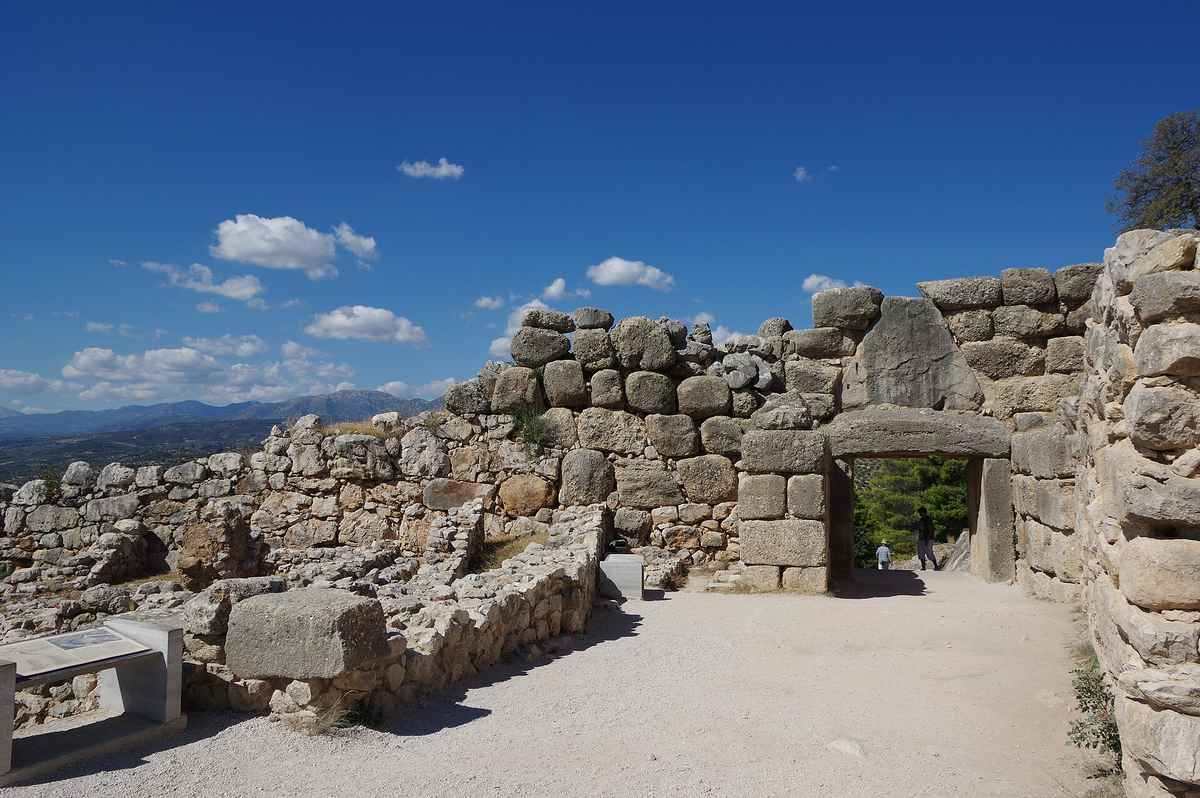
The Mycenaeans, by contrast, were a more warlike and militaristic people. They built massive fortified citadels with cyclopean walls, were ruled by warrior kings, buried their dead with weapons and gold masks, and are remembered for conquest and the legends of the Trojan War. Their art, while influenced by the Minoans, includes far more scenes of war and hunting than the Cretan tradition allowed.
The settings sharpen the contrast. Minoan palaces sat open in the landscape, unwalled and reached by processional courts, trusting the sea and the fleet for defence. Mycenaean centres crouched behind gates and ramparts on high ground, like the Lion Gate at Mycenae, built for a world of raids and rivalry. This difference between the artistic, sea-trading Minoans and the warlike, fortress-building Mycenaeans is one of the most striking in the ancient world.
Burial customs tell the same story. The Mycenaeans buried their warrior elite in deep shaft graves and later in great beehive tombs, sending them to the next world with gold masks, swords, daggers inlaid with hunting scenes and hoards of weapons. Minoan burials, by contrast, favoured communal tombs and ritual vessels over arms, matching a culture that prized ceremony and craft above the display of martial power.
How did Minoan and Mycenaean art and writing compare?
Mycenaean art and writing were heavily influenced by the Minoans, who came first. The Mycenaeans adopted Minoan artistic styles and adapted the Minoan Linear A script into Linear B to write an early form of Greek.
In art and writing, the Mycenaeans owed a great deal to the Minoans, who were the more advanced and earlier civilisation. The Mycenaeans adopted and adapted Minoan artistic styles, techniques and motifs, so that much Mycenaean fresco painting, pottery, metalwork and jewellery shows clear Minoan influence, the result of contact, trade and eventually Mycenaean control of Crete.
The most important borrowing was writing. The Minoans used a script known as Linear A, which remains undeciphered, to write their own language. The Mycenaeans adapted this script into Linear B, modifying its signs to write an early form of Greek, and it is Linear B tablets, found at Knossos and mainland sites, that record the Mycenaean world of palace administration.
The decipherment of Linear B in the mid-twentieth century, by Michael Ventris and John Chadwick, proved decisively that the language behind it was Greek. That breakthrough confirmed the Mycenaeans as early Greek-speakers and, by contrast, underlined how separate the Minoans were, since their Linear A resisted the same methods and still hides a non-Greek tongue. The scripts thus became the clearest single marker of the divide between the two peoples.
The tone of the art, however, diverged. Minoan painting delights in dolphins, lilies, saffron-gatherers and leaping bulls, a world of nature and ceremony, whereas Mycenaean art leaned toward war, hunting and the warrior aristocracy, with boars’-tusk helmets and battle scenes. Borrowed techniques served different tastes. Our guide to Linear B at Knossos covers the scripts in detail.
The two scripts also reveal what each people wrote about. The undeciphered Linear A of the Minoans appears on tablets, seals and religious offerings, hinting at both administration and cult. The Linear B of the Mycenaeans, once cracked, turned out to be almost entirely administrative, listing sheep, grain, chariots, weapons and workers. The Greek-speaking clerks of Knossos and Pylos kept ledgers, a fitting record for a bureaucratic, militarised society.
Even where styles were shared, purpose set them apart. A Minoan fresco of a bull-leaper celebrates grace and ritual daring; a Mycenaean version of the same technique might frame a lion hunt or a march of warriors. The Mycenaeans took the Cretan visual language and bent it toward the values of a warrior court, so that borrowed form carried new content.
How did the Mycenaeans take over Knossos?
The Mycenaeans took control of Knossos in the later Bronze Age, as shown by the Linear B tablets written in Greek found at the palace, which prove that Greek-speakers ran its administration in the final palatial phase.
A pivotal moment in the relationship between the two civilisations was the Mycenaean takeover of Knossos in the later Bronze Age. The decisive evidence is the archive of Linear B tablets found at the palace, written in an early form of Greek, which shows that in its final period Knossos was administered by Greek-speaking Mycenaeans rather than the earlier Minoans.
Scholars debate exactly how this came about. One view is that the Mycenaeans conquered a Minoan Crete already weakened by earthquakes and the effects of the Thera volcanic eruption; another is that they came to dominate it more gradually through trade, influence and alliance. Either way, Mycenaean control of Knossos marked the end of independent Minoan power.
The takeover fits a wider pattern of the mainland overtaking the island. As Minoan sea power faltered, the Mycenaeans inherited the trade routes, the palace bureaucracy and even the prestige of Knossos, running the great Cretan centre as one of their own. The absorption of Crete into the Mycenaean Greek world completed the reversal of the earlier balance. Our guide to the fall of Knossos covers this decline.
The change is visible in the finds as well as the tablets. In its final phase Knossos shows Mycenaean-style pottery, warrior burials with weapons, and the Greek record-keeping of Linear B, all signs of a new ruling culture layered over the Minoan palace. The Cretan building continued, but the hands that governed it had changed, and the island that once led the Aegean now answered to the mainland.
When did the Minoans and Mycenaeans flourish?
Minoan civilisation flourished on Crete through the earlier and middle Bronze Age, roughly the third and first half of the second millennium BC, while the Mycenaeans rose on the mainland in the later Bronze Age and dominated the Aegean after the Minoan palaces fell.
The Minoans came first by a wide margin. Their palatial civilisation was already building great centres like Knossos, Phaistos and Malia in the early second millennium BC and reached its height in the centuries that followed, long before the mainland developed comparable palaces. For much of that time Crete was the most advanced society in the Aegean.
The Mycenaeans rose later, gathering wealth and power on the mainland during the middle of the second millennium BC, the era of the rich shaft graves at Mycenae with their gold masks. Their dominance peaked after the collapse of the Minoan palaces around the mid-fifteenth century BC, when they took over Knossos and the trade networks that Crete had once controlled.
Both civilisations then declined at the close of the Bronze Age, in the wider collapse that swept the eastern Mediterranean around the twelfth century BC. The Mycenaean palaces fell, writing was lost, and Greece entered the so-called Dark Ages. The memory of both peoples, however, survived in myth and later fed the world of Homer. Our guide to King Minos covers the legendary side of that memory.
The overlap between the two matters as much as the sequence. For a long stretch of the second millennium BC the Minoans and Mycenaeans existed side by side, trading, competing and borrowing, before the balance tipped. Their histories are best pictured not as two separate blocks but as an early Minoan lead giving way to a later Mycenaean dominance, with a long middle period in which both were active players across the Aegean, sharing goods, styles and ideas even as they competed for the sea.
How were the Minoans and Mycenaeans linked?
The Minoans and Mycenaeans were linked through trade, cultural influence and eventually Mycenaean rule over Crete, so the two form a single connected story that runs from Minoan dominance to Mycenaean succession across the Bronze Age Aegean.
Far from being entirely separate, the Minoans and Mycenaeans were closely linked through centuries of contact. They traded with each other across the Aegean, and the Mycenaeans absorbed a great deal from the older, more sophisticated Minoan civilisation, in art, writing, religion and palace administration, before eventually coming to rule Crete and Knossos themselves. The relationship moved from influence to domination over the course of the Bronze Age.
Together, the Minoans and Mycenaeans form the great Bronze Age background to ancient Greece. The memory of these lost civilisations, the powerful sea-king Minos at Knossos and the warrior kings of Mycenae, survived in the myths and legends, from the Minotaur and the labyrinth to the heroes of the Trojan War, that the later classical Greeks inherited.
Religion offers one clear thread of continuity. Minoan cult centred on goddesses, sacred bulls, peak sanctuaries and libation rituals, and much of this passed to the Mycenaeans, whose Linear B tablets already name gods later worshipped in classical Greece. In taking over Crete, the mainlanders took over its gods as well, carrying Minoan sacred practice forward into the religion of the Greek world. The double-axe, the horns of consecration and the goddess with upraised arms all found echoes in later Greek worship.
The link also runs forward into classical Greece. The Mycenaean Greeks who absorbed Minoan Crete were the ancestors of the later Greeks, and elements of Minoan religion, art and myth passed through them into the world of the city-states. The goddess figures, the bull symbolism and the memory of a sea-king at Knossos all survived in altered form, so the Minoan legacy did not vanish but was carried onward by their successors.
Understanding the two and their connection brings the deep history of Knossos and Greece to life. What you walk through at Knossos is not one lost world but two: the elegant Minoans who built and decorated the palace, and the Mycenaean Greeks who later took it over and left their Linear B records in its ruins. Plan your visit and tours through our Palace of Knossos guide.
Frequently Asked Questions
What is the difference between the Minoans and the Mycenaeans?
The Minoans and Mycenaeans were the two great Bronze Age civilisations of Greece. The Minoans came first, a sophisticated, relatively peaceful and artistic sea-trading civilisation based on Crete with their palace at Knossos, regarded as the first advanced society in Europe; their unfortified palaces and nature-loving art suggest a secure, outward-looking culture.
The Mycenaeans were a later, more warlike civilisation of the Greek mainland, based on fortified citadels like Mycenae, ruled by warrior kings and remembered for the legends of the Trojan War. The Mycenaeans were deeply influenced by the Minoans, adopting their art and adapting their script into Linear B to write Greek, and eventually took control of Crete and Knossos.
Did the Mycenaeans conquer the Minoans?
The Mycenaeans came to control Knossos and Crete in the later Bronze Age, ending independent Minoan power, but whether this was an outright conquest is debated. The decisive evidence is the Linear B tablets found at Knossos, written in an early form of Greek, which show that in its final period the palace was administered by Greek-speaking Mycenaeans.
One view is that the Mycenaeans conquered a Minoan Crete already weakened by earthquakes and the effects of the Thera volcanic eruption; another is that they gained control more gradually through trade, influence and alliance. Either way, Mycenaean rule marked the absorption of Minoan Crete into the Mycenaean Greek world.
Were the Minoans Greek?
The Minoans were not Greek in the way the Mycenaeans were. They were the earlier civilisation of Bronze Age Crete and spoke their own, non-Greek language, written in the still-undeciphered Linear A script, so their origins and language remain uncertain and a subject of study.
The Mycenaeans, by contrast, were Greek-speaking, and adapted the Minoan script into Linear B to write an early form of Greek. When the Mycenaeans took control of Knossos in its later period, Greek speakers ruled the palace, as the Linear B tablets show. So while the Mycenaeans were early Greeks, the Minoans were a distinct, earlier people whose language and origins are not fully known.
Which came first, the Minoans or the Mycenaeans?
The Minoans came first. Their palatial civilisation on Crete was already flourishing in the early second millennium BC, building and rebuilding great centres such as Knossos long before the mainland developed comparable palaces. For centuries Crete was the leading power of the Aegean, and Minoan influence spread widely across the islands and coasts.
The Mycenaeans rose later on the Greek mainland, absorbing Minoan art, writing and administration as they grew, and only overtook Crete in the later Bronze Age. The order of the two, Minoans first and Mycenaeans second, is central to understanding why so much of Mycenaean culture, including its script, is built on Minoan foundations.
Are the Mycenaeans the people of Homer’s poems?
Yes. The Mycenaeans are generally regarded as the historical people behind the heroes of Homer’s Iliad and Odyssey, composed centuries later. The poems remember a age of warrior kings ruling from fortified citadels, waging the Trojan War, which broadly matches the Mycenaean world of Mycenae, Pylos and Tiryns known from archaeology.
The match is not exact, since Homer wrote long after the Bronze Age collapse and mixed memory with imagination. Even so, details such as boars’-tusk helmets and great palace halls echo real Mycenaean finds, so the epics preserve a distorted recollection of the mainland civilisation that had earlier absorbed Minoan Crete.