
The Minoan Atlantis theory suggests that Plato’s lost Atlantis was inspired by the advanced Minoan civilisation, devastated around the Thera eruption. Plan tickets and tours through My Greece Tours.
This famous theory adds intrigue to the story of the Palace of Knossos. The sections below cover what the theory is, the link to the Thera eruption, the evidence for it, the arguments against and what it means for Knossos.
What is the Minoan Atlantis theory?
The Minoan Atlantis theory proposes that Plato’s legend of Atlantis, an advanced island civilisation that sank into the sea, was inspired by the real Minoan civilisation of Bronze Age Crete and Thera.
The theory ranks among the most intriguing ideas in archaeology. Atlantis comes from the Greek philosopher Plato, who wrote of a powerful, wealthy island civilisation. In his account, a single day and night of catastrophe destroyed it and sank it beneath the sea. The theory reads this tale not as pure invention but as a memory of something real. That real thing, its supporters say, was the Minoans.
The Minoans fit the outline of Plato’s Atlantis in three main ways. They were a sophisticated, sea-based Bronze Age people, centred on Crete and the nearby island of Thera. They built grand palaces, made fine art and ruled the waves with a strong fleet. Then they suffered a sharp decline around the time of a colossal volcanic eruption on Thera. An advanced sea power, brought low by disaster, is exactly what Plato describes.
Plato tells the tale in two of his dialogues, the Timaeus and the unfinished Critias. In them, an Egyptian priest passes the story to the Athenian statesman Solon, who brings it back to Greece. Plato thus frames Atlantis as a very old memory carried through Egypt. Supporters of the Minoan theory seize on this frame. It offers, they say, a route by which a real Bronze Age disaster could reach a Greek writer many centuries later.
The theory therefore treats the legend as history in disguise. On this view, the grandeur and sudden fall of the Minoans passed down the generations by word of mouth. Over centuries the story grew and shifted. By the time it reached Plato, it had become the myth of Atlantis. Our guide to the Minoan civilization at Knossos covers the real culture, and the next section covers the Thera eruption.
How is the Thera eruption linked to the Minoan Atlantis theory?
The colossal eruption of Thera, modern Santorini, sits at the heart of the theory: it destroyed a thriving Minoan island town and damaged Crete, echoing Plato’s account of Atlantis sinking in a sudden catastrophe.
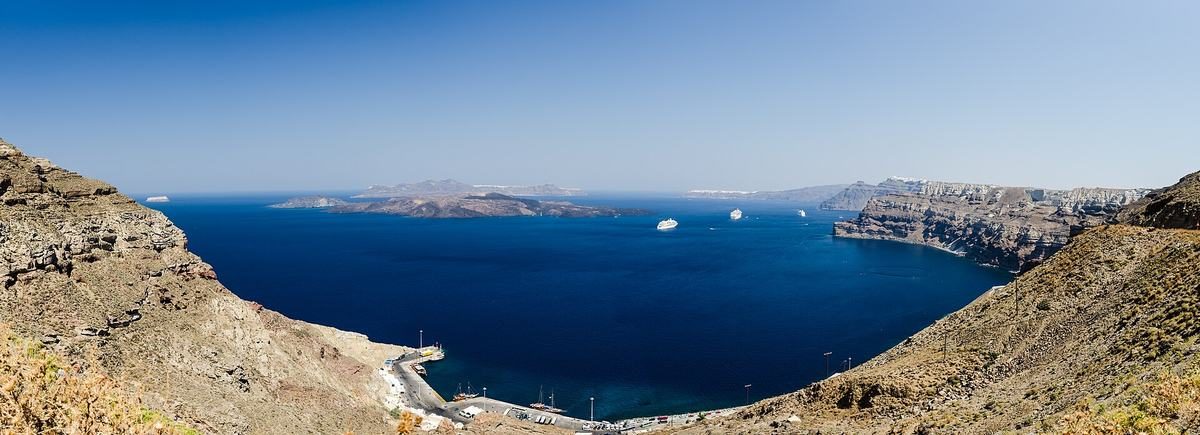
The Thera eruption was one of the largest in human history. The volcano blew its centre apart and left the ring of cliffs that make the Santorini caldera today. It buried the Minoan town at Akrotiri under metres of ash. That town, well built and painted with fine frescoes, vanished in the blast. Its people fled beforehand, since no bodies have been found in the ruins, but their whole world was gone.
The eruption reached far beyond the island. Ash fell across the sea, and giant waves, or tsunamis, struck the coasts of Crete. Ships, harbours and coastal towns along the north shore would have suffered badly. The Minoan fleet and trade, the base of the island’s wealth, took a heavy blow. Crops may have failed under the ashfall, and famine could have followed a poor harvest. Supporters of the theory see in this a real disaster grand enough to lie behind the legend of a sea power destroyed.
Akrotiri itself is the star witness. The ash sealed the town like a lid, preserving houses two and three storeys high. Wall paintings survive in glowing colour, showing ships, fishermen, boxing boys and a spring landscape. Pots still stood on floors, and staircases still climbed between rooms. The town gives a full picture of Minoan life at the moment the eruption struck. No other Aegean site preserves as fully.
The parallel with Plato is the key point. Plato has Atlantis destroyed in a sudden catastrophe and swallowed by the sea. Thera saw an advanced island society wiped out in a violent event, its centre literally sinking as the caldera collapsed. The discovery of the preserved town at Akrotiri, a Minoan Pompeii, has made the idea all the more vivid. Our guide to the fall of Knossos covers the eruption’s effects, and the next section covers the evidence for the theory.
What is the evidence for the Minoan Atlantis theory?
The evidence is a set of parallels: the Minoans were an advanced, wealthy, sea-based power like Plato’s Atlantis, the Thera eruption destroyed an island society, and the Minoan decline followed soon after.
The first strand is the character of the Minoans. Plato paints Atlantis as advanced, rich, artful and powerful at sea. The Minoans match that portrait closely. They had grand palaces, running water, vivid frescoes and a dominant fleet. They wrote in their own scripts and kept careful accounts. They traded across the Aegean and beyond. Few other Bronze Age peoples fit Plato’s glowing description of Atlantis so neatly.
The second strand is the catastrophe. Plato’s Atlantis dies in a sudden, violent event. The Thera eruption gives a real-world example of an advanced island society destroyed at a stroke. The buried Minoan town at Akrotiri makes the point painfully concrete. Here is a Minoan settlement that really was wiped from the map in a single disaster, exactly the kind of event the legend describes.
Supporters add a further detail about the sea. Plato says that after Atlantis sank, the sea in that place became impassable, full of mud and shoals. Around Thera, floating rafts of pumice and a churned, ash-clogged sea would have followed the eruption for a time. To supporters, this odd detail reads like a real memory of a volcanic sea rather than a poet’s invention. Small touches like this, they argue, are what a distorted true story would keep.
The third strand is timing and transmission. The Minoan civilisation declined in the centuries after the eruption, which fits a story of a great power falling. Supporters argue the tale could have passed down long generations before Plato, perhaps through Egypt, as his own account claims. To them, these parallels are too numerous and too close to be chance. Our guide to the mysteries of the Palace of Knossos covers such puzzles, and the next section covers the arguments against.
What are the arguments against the Minoan Atlantis theory?
Critics note that Plato’s Atlantis differs from the Minoans in place, size and date: he set it in the Atlantic beyond Gibraltar, made it vast, and dated it thousands of years too early.
The location is the first problem. Plato places Atlantis beyond the Pillars of Hercules, that is, past the Strait of Gibraltar in the Atlantic Ocean. Crete and Thera lie in the Aegean, well inside the Mediterranean. The two settings are far apart. To make Atlantis the Minoans, one has to assume Plato, or his source, moved the whole civilisation across the map.
The size and date are further problems. Plato describes Atlantis as enormous, larger than Libya and Asia combined, and far bigger than Crete could ever be. He also sets it thousands of years before his own time, long before the Minoan period. The dates do not match. Critics point out that the Minoan decline came a couple of centuries after the eruption, which loosens even the disaster parallel.
The details of Plato’s Atlantis add to the mismatch. He describes a city of concentric rings of land and water, a vast canal, hot and cold springs, and elephants roaming the island. None of this fits Bronze Age Crete or Thera. No ringed capital, no canal and no elephants have ever turned up in Minoan archaeology. Where the theory leans on broad likeness, the fine print of the legend points away from the Minoans.
Supporters have replies to these points. They suggest a scribe mistranslated Egyptian numerals, so that hundreds became thousands and Plato’s dates ran far too early. They argue the “Atlantic” setting could be a later gloss on a tale that began in the Aegean. These defences are possible, but they require special pleading. Each one asks us to fix Plato’s text to make it fit, which weakens the case rather than proving it.
The deepest objection concerns Plato’s purpose. He presents Atlantis inside a moral and philosophical framework. It is a cautionary tale about a proud, powerful state that grew corrupt and was punished. That reads like a story built to teach a lesson, not a report of a real place. Many scholars therefore treat Atlantis as a fiction Plato invented, not a memory of the Minoans or anyone else. The next section covers what the theory means for Knossos.
What does the Minoan Atlantis theory mean for Knossos?
Whether or not it is true, the theory adds romance to Knossos, casting the Minoans as a possible real-world Atlantis and drawing attention to their genuine grandeur and dramatic fall.
The idea colours a visit to the palace. To walk through Knossos while picturing a lost Atlantis deepens the sense of wonder. The thought that this elegant, advanced culture might be the seed of the world’s most famous legend is hard to resist. The theory turns a fine ruin into the possible home of a mythic sea kingdom, and that spell is part of its appeal.
The theory also points to real facts, not just fancy. The Minoans truly were a remarkably advanced, wealthy and powerful sea-based people, the first great civilisation of Europe. They truly did suffer a sharp decline around the time of one of the greatest eruptions in history. Even setting Plato aside, the true story of the Minoans is as astonishing as any legend. The link to Atlantis simply lights it up.
The idea has value even as a teaching tool. It draws visitors to look harder at what the Minoans actually achieved. It prompts questions about how a great power can fall, and how a real disaster can turn into a myth over time. Whether the answer is yes or no, the asking is worthwhile. The Atlantis theory works as a door into the genuine, gripping history of Bronze Age Crete.
The honest verdict keeps the two apart. The connection to Plato stays speculative and contested, and it cannot be proved. Yet exploring Knossos with the Atlantis theory in mind does something valuable. It sends visitors looking not just at beautiful stones but at the story of a brilliant civilisation that really rose, dazzled and fell. That true story needs no embellishment to grip the imagination. Plan your visit and tours through our Palace of Knossos guide.
Who first proposed the Minoan Atlantis theory?
The Minoan Atlantis theory took shape in the early twentieth century, when scholars linked Plato’s tale to the newly excavated Minoans, and it gained ground after the excavation of Akrotiri on Thera.
The theory grew alongside Minoan archaeology itself. Only after Sir Arthur Evans uncovered Knossos did the world learn of a great, lost Aegean civilisation. That discovery gave the Atlantis legend a fresh candidate. Early writers soon suggested that Plato’s sunken sea power might be an echo of these newly found Minoans. The idea was in the air within a generation of the first digs.
A British scholar, K. T. Frost, set out the case early on. He argued that the sudden end of Minoan sea power, seen from Egypt, matched the fall of Atlantis rather well. To an Egyptian, the disappearance of the Cretan fleet from the trade routes would have looked like an island empire vanishing overnight. Frost’s article framed the argument that later writers would build on, tying Egypt, the Minoans and Plato into one chain.
The Greek archaeologist Spyridon Marinatos gave the theory its strongest push. He argued that the Thera eruption devastated Minoan Crete and lay behind its decline. Marinatos then excavated Akrotiri on Thera, revealing the buried Minoan town beneath the ash. His work turned a literary hunch into a full archaeological argument, tying the legend to a real, datable catastrophe on a real island.
The dating debate has since complicated Marinatos’s neat picture. Careful study showed that the eruption came well before the main collapse of the Minoan palaces. That gap of about a century or two weakens a direct cause-and-effect link between the blast and the fall. The eruption clearly hurt the Minoans, but it may not have been the single knock-out blow the early theory assumed. This is one reason many scholars now hold the Atlantis link at arm’s length.
Later writers carried the idea far and wide. Popular books, television films and documentaries fixed the Minoan Atlantis link firmly in the public mind. Some pushed it well beyond the evidence, into pure speculation. Serious scholars remain cautious, treating the parallels as suggestive rather than proven. The theory today sits between careful archaeology and popular myth-making, which is part of why it fascinates. Our guide to the Heraklion Archaeological Museum covers the finds behind the real story.
Frequently Asked Questions
Were the Minoans the lost city of Atlantis?
The idea that the Minoans were the lost city of Atlantis is a popular theory, but it is speculative and contested. The theory proposes that Plato’s legend of Atlantis, an advanced island civilisation destroyed in a sudden catastrophe, was inspired by the real Minoan civilisation of Bronze Age Crete and Thera, which declined dramatically around the time of a colossal volcanic eruption on Thera. Supporters point to the Minoans’ advanced, sea-based culture and the catastrophic eruption as close parallels. However, critics note that Plato placed Atlantis in the Atlantic beyond Gibraltar, described it as far larger and much older, and may have invented it as a moral parable. Many scholars regard Atlantis as fiction rather than a memory of the Minoans.
How is the Santorini eruption connected to Atlantis?
The colossal volcanic eruption of Thera, the island now called Santorini, is central to the Minoan Atlantis theory. This eruption, one of the largest in human history, destroyed the thriving Minoan town on Thera, burying it under volcanic ash, and is believed to have seriously damaged Minoan Crete through ash and tsunamis. Supporters of the theory see a powerful parallel between this real destruction of an advanced island society and Plato’s account of Atlantis being destroyed in a sudden catastrophe and sinking beneath the sea. The discovery of the remarkably preserved Minoan town at Akrotiri on Santorini, sometimes called a Minoan Pompeii, has strengthened the romantic appeal of linking the eruption, the Minoans and the legend of Atlantis.
Is the Minoan Atlantis theory true?
The Minoan Atlantis theory is unproven and remains a matter of debate rather than established fact. It is an appealing idea, supported by genuine parallels between Plato’s advanced, sea-based Atlantis destroyed in catastrophe and the real Minoan civilisation devastated around the Thera eruption. However, it faces serious objections: Plato placed Atlantis in the Atlantic beyond the Strait of Gibraltar, far from Crete, described it as vastly larger and existing thousands of years earlier than the Minoan period, and presented it within a moral, philosophical framework that suggests deliberate invention. Many scholars therefore regard Atlantis as a fictional parable created by Plato. The theory is popular and evocative, but it cannot be considered proven.
Where can you see the Minoan world linked to Atlantis?
You can see the Minoan world behind the Atlantis theory at three main places. The Palace of Knossos on Crete gives the fullest sense of Minoan grandeur, with its central court, grand staircase, frescoes and vast storerooms. This is the wealth and sophistication that made the Minoans a plausible Atlantis. The site of Akrotiri on Santorini shows the actual town destroyed by the eruption, preserved under ash with its streets, houses and painted walls intact. It is the closest thing to a real sunken city that the theory can point to. The Heraklion Archaeological Museum and the museum on Santorini hold the frescoes and finds from both sites. Visiting all three lets you weigh the theory against the real remains of the sea-based civilisation behind the legend.