
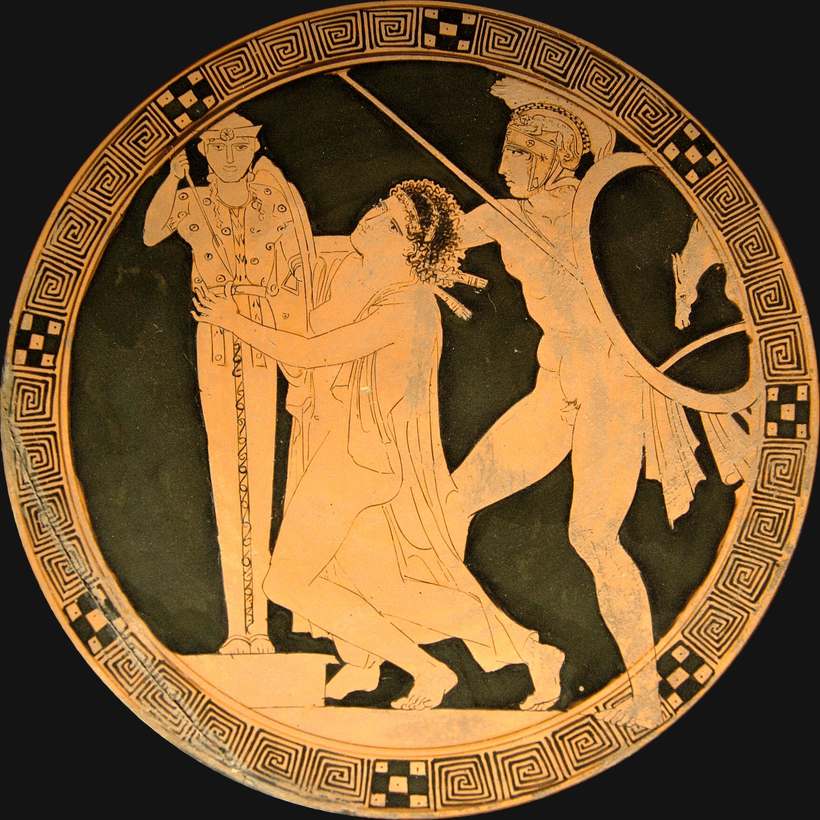
Cassandra was the Trojan prophetess whose tragic story ends inside the citadel of Mycenae. A daughter of King Priam of Troy, she received the gift of true prophecy from the god Apollo, yet the same god cursed her when she refused him, so that no listener would ever believe her warnings. She foresaw the destruction of her own city and could do nothing to prevent it. Carried off as a war-prize by the victorious Greek king, she was brought west across the sea to a doom she alone could see coming. Meet this haunting figure of Greek legend with My Greece Tours.
Cassandra draws the whole tragedy of fallen Troy into the blood-soaked halls of Mycenae. Her gift of doomed foresight, always true and never believed, makes her one of the most poignant figures in Greek myth, a prophetess who watched two cities crash toward ruin and could sway no one. The sections below cover who she was, how Apollo cursed her, how she came to Mycenae as a captive, her death within the palace, and how the playwright Aeschylus staged her fate. Set her story against the ancient stones themselves with our Mycenae travel guide.
Who was Cassandra, the prophetess brought to Mycenae?
Cassandra was a Trojan princess and prophetess, daughter of King Priam of Troy. Apollo granted her the gift of true prophecy, then cursed her so nobody would believe her warnings. She died a captive at Mycenae.
Cassandra stands among the most tragic figures in the whole body of Greek myth, a princess whose truest words fell always on deaf ears. She was born a daughter of Priam, the aged king of Troy, and grew up inside the greatest city of the eastern shore. That royal birth placed her at the very heart of the Trojan court, sister to the warrior Hector and to Paris, whose act would drag two peoples into ten years of war. Apollo, the god of prophecy and light, singled her out for a rare gift, the power to see events before they came to pass.
This divine favour set her apart from every mortal around her, marking her as a seer whose visions of the future were never once mistaken or false.
The gift became a curse the moment Cassandra refused the god who gave it. Her fate carried her out of Troy and toward the mainland power that had crushed her home, the citadel whose kings drove the long campaign against her city. That war, the great the Trojan War, forms the backdrop to everything that happened to her, from the fall of Troy to her last hours in a foreign palace. She entered the story of Mycenae not as a queen or a bride but as a prisoner, a woman of the losing side handed over to the winners.
Her presence bound the tragedy of the eastern city to the halls of the western kings, carrying the grief of Troy across the Aegean into the stronghold that had willed its destruction from the start.
How did Apollo curse Cassandra’s gift of prophecy?
Apollo gave Cassandra the power of true prophecy to win her favour. Her refusal of the god left him unable to take back the gift, so he cursed it instead, ensuring nobody would ever believe her accurate warnings.
The curse of Cassandra turns on a single act of refusal that no plea could undo. Apollo, drawn to the Trojan princess, offered her the gift of prophecy as the price of her affection, and she accepted the power while withholding what he sought in return. A god’s gift, once given, could not simply be recalled, so Apollo answered her refusal with a subtler and crueller punishment. The god left her the power to see the future exactly as it would unfold, then stripped that power of all its worth by decreeing that no listener would ever trust a word she spoke.
From that moment her prophecies were flawless and useless together, every one of them true and every one of them dismissed by the very people she tried to save from ruin.
This double bind shaped the whole of Cassandra’s tragedy. She could watch disaster approach in perfect detail yet stand powerless to turn a single mind against it, condemned to the loneliness of knowing while others mocked or ignored her. Greek storytellers found in this curse a haunting image of truth denied a hearing, of wisdom cast aside because the crowd would not listen. Her visions of the future ran parallel to the darker current of murder and revenge already flowing through the royal House of Atreus, the family into whose halls she was fated to be brought. Two doomed lines, the Trojan and the Argive, met in her person.
She carried the certain knowledge of what was coming, and the god’s curse guaranteed that her certainty would change nothing at all.
How did Cassandra come to Mycenae after the fall of Troy?
King Agamemnon claimed Cassandra as his captive and war-prize once Troy fell to the Greeks. He carried the Trojan princess back across the sea to Mycenae, his home citadel, where both their fates would end in blood.
The fall of Troy sealed Cassandra’s passage to Mycenae, turning the daughter of a king into the spoil of a conqueror. She had foreseen the destruction of her city and cried out her warnings in vain, watching the walls breached and the halls of Priam put to the sword while none believed the seer among them. With the sacking done, the victorious warlord took her as his personal captive, a living trophy carried off from the ruin of the eastern power. That warlord was Agamemnon, the commander of the whole Greek host and lord of the greatest mainland citadel.
He set the Trojan princess among his prizes and turned his ships homeward across the Aegean, bearing her toward the stronghold from which he had launched the long campaign against her people.
The homeward voyage brought Cassandra to a place she had never seen yet whose horror she would soon foretell. She arrived at the fortress gates as a foreign captive, a woman of the conquered led behind the chariot of the man who had destroyed her home. The great entrance she passed through was crowned by the famous Lion Gate, its carved beasts standing guard above the road into the citadel of the Argive kings. At that threshold her gift stirred one final time. She saw, with the terrible clarity that was her curse, the death waiting inside for the king and for herself.
She spoke her vision aloud at the very gates, and as ever the warning fell on ears that would not hear, drawing her onward into the palace toward the doom she alone perceived.
How did Cassandra die inside the palace at Mycenae?
Inside the palace at Mycenae, Queen Clytemnestra killed both Cassandra and Agamemnon. The queen struck down her returning husband and then the Trojan captive, adding the foreign princess to the bloodshed of the royal house.
The death of Cassandra came within the halls of the Mycenaean palace, at the hands of the woman who ruled there in the king’s long absence. She had foreseen this end at the gates and spoke of it plainly, yet the curse held to the last and no one moved to save her. The queen who waited inside was Clytemnestra, wife of the returning warlord and mistress of the citadel through the ten years of war. She had prepared a bloody welcome for her husband, nursing a grievance that had hardened into murderous resolve across the long seasons of his absence at Troy.
The Trojan captive walked into a trap already set, her prophetic warning ringing unheeded through a household bent on killing the very lord she had been dragged home to serve.
The queen struck down the king first, cutting the great commander of the Greeks down in his own palace on the day of his triumphant return. She then turned upon Cassandra and killed the Trojan princess as well, adding the captive seer to the slaughter of that terrible homecoming. The foreign woman thus perished far from Troy, in a hall she had entered only hours before, her true prophecy fulfilled to the letter and believed by no one until it was too late. Her murder deepened the crime and drew a further round of vengeance in its wake, the killing that would set Orestes on the path of retribution against his own mother.
Cassandra’s blood mingled with the king’s on the palace floor, one more stain on a royal house already steeped in generations of murder and revenge.
How did the playwright Aeschylus dramatise Cassandra’s fate?
The Athenian playwright Aeschylus staged Cassandra’s fate in his tragedy of Agamemnon. He gave her a searing scene at the palace gates, where she foretells the murders in vivid detail before walking knowingly to her death.
The playwright Aeschylus lifted Cassandra from the older legends and set her at the burning centre of his tragic stage. In his drama of the returning king he gave her a scene of extraordinary power, played out at the very threshold of the palace where her life would end. There the Trojan captive breaks her silence and pours out prophecy, naming the murder about to unfold within and the long history of bloodshed that stains the royal house. The chorus around her hears the words yet cannot grasp or credit them, dramatising the curse of Apollo in the plainest terms upon the stage.
She sees clearly, she speaks clearly, and clarity avails her nothing, the whole horror of her gift laid bare before the watching audience of the ancient theatre.
The scene rises to its climax as Cassandra chooses to walk into the palace fully aware of the death that waits inside. She foretells her own murder alongside the king’s, then steps across the threshold to meet it, a captive facing her end with open eyes. The playwright turned her doomed foresight into one of the most memorable moments of ancient drama, a study of truth spoken to those who will not listen. Her fate forms part of the wider tragic cycle of the Mycenaean civilization as the Greeks remembered it in myth, the blood-soaked story of the kings of the citadel.
Through the tragedy of Aeschylus, the Trojan prophetess entered the permanent repertoire of Greek theatre, her grief at fallen Troy and her doom at Mycenae bound together in verse for the generations that followed.
Frequently Asked Questions
Why could nobody believe Cassandra’s prophecies at Mycenae?
Nobody could believe Cassandra because of a divine curse laid upon her by Apollo. The god had granted her the true power of prophecy to win her favour, and when she refused him he could not simply take the gift back. Instead he cursed it, decreeing that her every prediction would be accurate yet dismissed by all who heard it. The result was a cruel double bind that followed her from Troy to Mycenae. She foresaw the fall of her own city and cried out warnings that went unheeded, then foresaw the murders waiting in the Argive palace and spoke of them at the gates, again to no effect.
The people around her heard clear, exact predictions and treated them as raving or madness. This is why her warnings changed nothing, either at Troy or in the citadel of the kings. The curse guaranteed that her truth, however plain, would always fall on ears sealed against it, leaving her powerless to alter a single event she foresaw.
What is the connection between Cassandra and the House of Atreus?
Cassandra connects to the House of Atreus through her captor, King Agamemnon, the ruling lord of that cursed royal line. The fall of Troy let him claim her as his war-prize and carry her back to Mycenae, the seat of the family. She thus entered the halls of a dynasty already steeped in generations of murder and revenge, from the grim feasts of its founders down to the quarrels of its later kings. Her arrival added the tragedy of fallen Troy to the family’s own long chain of bloodshed. Inside the palace, Queen Clytemnestra killed both Agamemnon and the Trojan captive, so Cassandra’s death became one more crime in the saga of the house.
Her murder helped drive the cycle of vengeance forward, contributing to the reckoning that later fell upon the queen and her line. A foreigner and an outsider, Cassandra is nonetheless woven tightly into the fate of the Atreid dynasty, her doom playing out entirely within its walls and among its people.
Is Cassandra a real historical figure or a character of myth?
Cassandra belongs firmly to the world of Greek myth rather than to recorded history. She appears as a prophetess of the legendary war at Troy, a daughter of the mythical King Priam blessed and cursed by the god Apollo. Her story sits alongside the other tales of gods, heroes and doomed royal houses that the Greeks told about their distant past, matters of legend rather than dated fact. That said, the myth attached itself to real places whose ruins still stand today. The citadel of Mycenae was a genuine Bronze Age stronghold, and its walls, gate and tombs survive on the hill above the plain.
Troy, too, corresponds to a real site on the eastern shore of the Aegean. Greek storytellers set their legendary prophetess against this backdrop of actual cities and fortresses, weaving her tragedy into places a visitor can walk today. Cassandra herself is a figure of poetry and drama, most memorably staged by the playwright Aeschylus, not a person known from any historical record.