
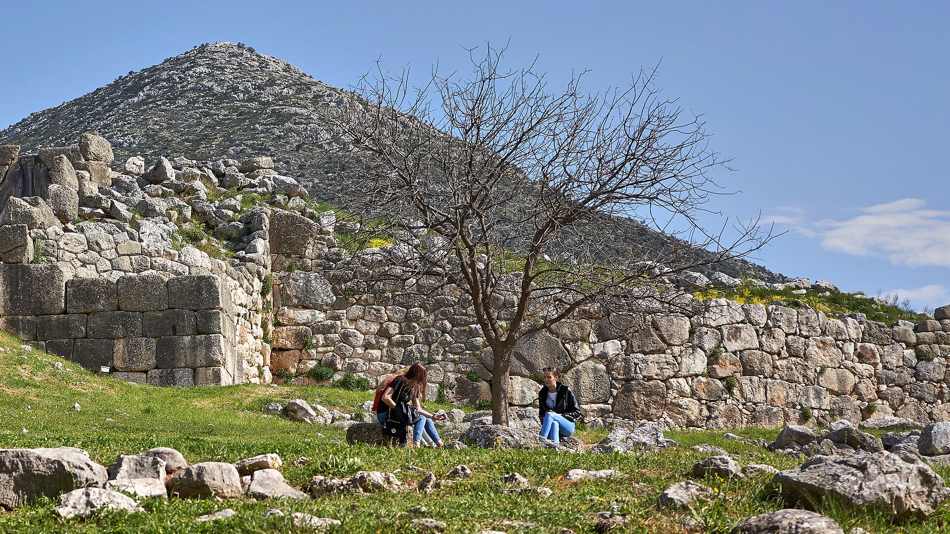
The House of Atreus is the doomed royal dynasty of Mycenae in Greek myth, a family pursued across generations by a curse of murder and revenge. Its story descends from Pelops and Tantalus and runs through the brothers Atreus and Thyestes into the reign of Agamemnon, king of Mycenae. Bloodshed answers bloodshed here, and each act of vengeance breeds the next, until the gods themselves step in to end the cycle. The myth binds the grey ruins on the hill to the darkest legends of the Greek imagination, and it shaped the great tragic drama of Athens. Step into this cursed royal saga with My Greece Tours.
The tragedy of this dynasty unfolds one generation at a time, and the pieces only make sense in order. A curse born of Pelops and Tantalus passes to a feud between two brothers, then falls on a king who sacrifices his own daughter, and finally on a son forced to avenge a murdered father. The sections below cover the origins of the curse, the feud of Atreus and Thyestes, the fall of Agamemnon, and the vengeance of Orestes. They also show how this dark myth ties to the stones you walk among today, laid out in our Mycenae travel guide.
Where does the curse on the House of Atreus begin?
The curse begins with Tantalus and Pelops, ancestors of the dynasty. Tantalus offended the gods, and Pelops won his bride through treachery that drew a dying man’s curse, planting the seed of doom that would follow the family for generations.
Tantalus, an early ancestor of the line, stood high in the favour of the gods and was welcomed to their table, yet he betrayed that trust in the worst possible way. His son Pelops carried the stain forward. Pelops won his bride in a chariot race by treachery, and the man he wronged cursed his house with his dying breath, calling ruin down on every generation that would follow. That curse settles over the dynasty like a shadow. It explains why the family cannot simply choose peace: the doom is inherited, passed from father to son alongside the crown of the citadel.
The tragic house that later rules from the hill of Mycenae is already marked before Atreus is even born, its fate written into the blood it shares.
The origin story matters because it sets the pattern for everything that follows in the myth. Each generation repeats the crime in a new form, and each victim becomes the cause of the next act of revenge. Pelops gives his name to the whole southern peninsula, the Peloponnese, so the family is tied to the land itself as firmly as it is bound to the throne. Visitors who climb to the citadel and pass beneath the Lion Gate walk directly into the setting of this inherited doom, the seat of a royal house that Greek storytellers made the very emblem of a cursed bloodline.
The grey stones give the legend a solid place to stand, and in turn the legend gives the stones their darkest and most enduring meaning for the traveller who arrives already knowing the tale.
What happened between the brothers Atreus and Thyestes?
Atreus and Thyestes were brothers locked in a bitter feud over the throne of Mycenae. In an act of monstrous revenge, Atreus served Thyestes a banquet made from the flesh of his own murdered sons, deepening the family curse.
Atreus and Thyestes were sons who inherited the curse and the rivalry that came with it, and their quarrel over the throne of Mycenae drove the myth to its cruellest point. The brothers wronged each other in turn, betrayal answering betrayal, until Atreus devised a revenge that the Greek imagination never forgot. He killed the sons of Thyestes, then served their flesh to their unknowing father at a banquet meant to look like reconciliation. The horror of that meal seals the family’s doom for another generation. It is a crime so grave that it draws down the anger of the gods and guarantees the vengeance still to come.
The feast at Mycenae becomes the black heart of the whole legend, the moment when the curse takes on its most terrible and unforgettable shape. That horror was the banquet Atreus laid before Thyestes, whose curse then bound the house of Mycenae.
The consequences of that banquet ripple straight into the next chapter of the story. Atreus fathers Agamemnon, the king who will lead Greece to war, while the wronged Thyestes fathers Aegisthus, who will one day take his own revenge on Atreus’s line. The curse thus splits into two branches of the same poisoned tree, each carrying the memory of the feast. The tragic dynasty that ruled from this citadel belonged to the wider Mycenaean civilization of the Late Bronze Age, and Greek storytellers chose to set their grimmest family tale within its high walls. The feud of the brothers explains why the throne of Mycenae carries such a heavy shadow.
The myth treats royal power here as a burden soaked in blood rather than a simple prize for the strongest man of the doomed line.
How did the curse reach King Agamemnon of Mycenae?
The curse reached Agamemnon, son of Atreus and king of Mycenae, who led the Greeks against Troy. To gain fair winds for the fleet he sacrificed his daughter Iphigenia, an act that set his own murder in motion.
Agamemnon inherited both the throne of Mycenae and the curse that clung to it, and he became the most powerful figure of his generation in the myth. Chosen to lead the combined Greek forces east, he stood at the head of the greatest army the legend describes. The gods demanded a terrible price before the fleet could sail, and Agamemnon paid it in full. He sacrificed his own daughter Iphigenia to win the winds that would carry the ships across the sea to war on the coast of Troy. That act repeats the pattern of the house, a child destroyed by a parent’s ambition, and it hardens the heart of his wife against him.
The king departs for a long war carrying a fresh crime, and the old curse now waits patiently for his return to the hill of Mycenae.
The war he led is the famous siege recounted through the Trojan War, and it kept Agamemnon away from his citadel for the length of a long campaign. The full story of the king himself, his power and his tragic homecoming, unfolds in the tale of Agamemnon, the ruler whose golden death mask once made him the face of Mycenae. In his long absence the seeds of vengeance grew quietly at home on the hill. His wife nursed her grief and her rage over the loss of Iphigenia, and the surviving branch of the cursed family patiently found its opening.
The stage was set for a homecoming that would end not in triumph but in blood, closing yet another loop in the long chain of revenge that binds the whole dynasty together across the generations.
Who killed Agamemnon on his return to Mycenae?
Agamemnon was murdered on his return to Mycenae by his wife Clytemnestra and her lover Aegisthus. She avenged the sacrifice of their daughter Iphigenia, while Aegisthus struck for the earlier crime committed against his own father.
Clytemnestra had waited through the long years of the war with a single purpose taking shape in her heart. The sacrifice of her daughter Iphigenia had turned her love for Agamemnon to cold hatred, and she prepared his welcome home as a trap. At her side stood Aegisthus, son of the wronged Thyestes, who carried his own claim to revenge for the crime once done to his father’s sons. The king returned in triumph to his citadel, and there the two struck him down inside his own palace on the hill. The murder answers the sacrifice of Iphigenia and the horror of the banquet in one stroke, folding two old wrongs into a single fresh crime.
The homecoming that should have crowned a victorious king instead adds another royal corpse to the long tally of the cursed house.
The killing did not end the cycle; it merely set the next act in motion, as every crime in this dynasty does. Clytemnestra and Aegisthus took the throne of Mycenae together, ruling the citadel while the murdered king’s children grew toward vengeance of their own. Near the great beehive tomb long called the Treasury of Atreus stands a second grand chamber, the Tomb of Clytemnestra, its very name tying the queen of the myth to the monumental architecture of the site. The ground of Mycenae itself seems to hold the memory of the deed within its stones.
Storytellers of Athens returned to this murder again and again, drawn by the figure of a queen who kills her own king and by a curse that still refuses to release its grip on the doomed family.
How did the story of the House of Atreus finally end?
Orestes, son of Agamemnon, avenged his father by killing Clytemnestra and Aegisthus. The Furies then pursued him for the crime of matricide until the gods intervened, judged him, and at last brought the family’s cycle of revenge to an end.
Orestes grew up under the weight of a murdered father and a duty of vengeance that the code of the myth placed squarely on his shoulders. In time he returned to Mycenae and struck down both Aegisthus and his own mother, Clytemnestra, answering his father’s murder as the pattern of the house demanded. Yet killing a mother is a crime the old powers cannot ignore. The Furies, ancient spirits of blood vengeance, rose to pursue Orestes and drove him near madness across the land, a living image of a curse that will not let a single crime rest unanswered. His torment shows the trap at the centre of the whole legend.
To honour one bond he had to break another, and the doom of the dynasty seemed ready to grind on into yet another generation of suffering. That final reckoning fell to Orestes, whose vengeance closed the long cycle.
The resolution comes not from more killing but from judgement, and this is what makes the ending remarkable within the myth. The gods intervened, put Orestes on trial, and at last lifted the ancient curse from the House of Atreus, breaking the endless chain of murder answering murder. That verdict closes the saga that began with Tantalus and Pelops and ran through the feast, the sacrifice and the queen’s revenge. The tragic house inspired the great dramatists of Athens, who staged these deeds before vast audiences and turned the family of Mycenae into the enduring emblem of inherited doom.
This deep well of legend is one reason the ruins draw travellers today, and it appears among the wider Treasury of Atreus stories that give the grey stones on the hill their lasting hold on the imagination.
Frequently Asked Questions
Who were the main figures in the House of Atreus myth?
The House of Atreus gathers a chain of tragic figures spanning generation after generation of the same cursed dynasty. It descends from Tantalus and Pelops, the ancestors whose crimes first drew the family curse down on the whole line. The rival brothers Atreus and Thyestes carry the feud forward, and their quarrel over the throne of Mycenae produces the horror of the cannibal banquet. Atreus fathers Agamemnon, the king who leads the Greeks to war and sacrifices his daughter Iphigenia, and Thyestes fathers Aegisthus, who seeks revenge on the rival branch of the family. Clytemnestra, Agamemnon’s wife, murders the king on his return with Aegisthus at her side.
Their son Orestes then avenges his father, is pursued by the Furies for the killing of his mother, and is finally judged and freed by the gods. Together these figures form the tragic family that Greek storytellers tied forever to the ruins of Mycenae.
Is the House of Atreus history or myth?
The House of Atreus belongs to Greek myth rather than recorded history, and it is best understood as legend woven around a real place. The story of the curse, the cannibal banquet, the sacrifice of Iphigenia and the pursuing Furies is the stuff of ancient storytelling, not documented events. What gives the myth its power is the way it attaches to the genuine ruins of Mycenae, a real citadel of the Late Bronze Age that once stood at the heart of a wider Mycenaean world. Greek poets and the great tragic dramatists of Athens set their darkest family saga within these very walls, so the grey stones and the legend grew together in the imagination.
Travellers who visit read the myth as the tragic soul of the site, a poetic layer that deepens the ruins without claiming to be a factual account of who lived and died on the hill.
Why is the House of Atreus so important to Greek tragedy?
The House of Atreus stands at the centre of Greek tragedy because its story offers everything the tragic form needs: inherited doom, terrible choices, and crimes that demand revenge. The great dramatists of Athens returned to this family again and again, staging the murder of Agamemnon, the vengeance of Orestes and the pursuit of the Furies before enormous audiences. The dynasty gave them a curse that binds one generation to the next, so a single crime could echo through fathers, sons and daughters across a whole cycle of plays. The tragic house also poses hard questions about justice, guilt and the limits of revenge, ending not in more killing but in a divine trial.
That combination made the family of Mycenae the defining subject of the tragic stage. It is one reason the ruins on the hill still carry such a heavy and lasting weight of story for the travellers who climb to them.