
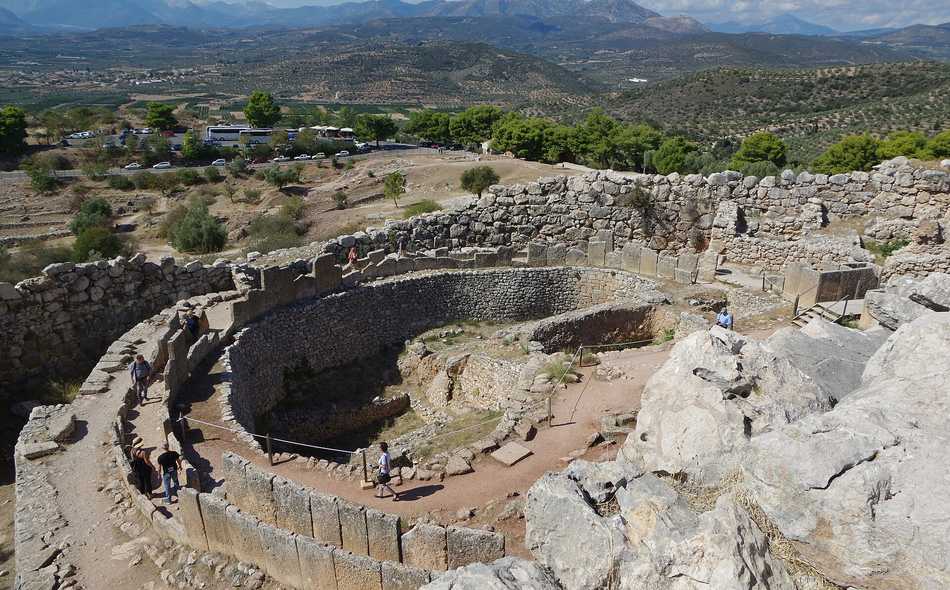
Thyestes stands among the darkest figures in the legend of Mycenae, a doomed prince of the royal house and the bitter rival of his own brother Atreus. Greek myth made the two sons of Pelops enemies from the start, locked in a struggle for the throne of the citadel that would end in horror. Thyestes seduced his brother’s wife, schemed for the kingship, and in return suffered a revenge so cruel that it passed into legend as one of the grimmest tales the Greeks ever told. Enter this world of feud, vengeance and lasting doom with My Greece Tours.
Thyestes binds the massive stones of Mycenae to a story of crime, curse and hereditary doom that shadows the whole royal line. His feud with Atreus, the monstrous banquet, the curse he laid, and the son he fathered to carry out its work all belong to the citadel’s darkest chapter. The sections below cover his origins in the house of Pelops, his quarrel with Atreus, the terrible feast, the curse and its long reach, and where his tale fits the ruins today. Set the whole legend against the walls themselves with our Mycenae travel guide.
Who was Thyestes in the royal house of Mycenae?
Thyestes was a doomed prince of the royal house of Mycenae, brother and bitter rival of Atreus. Both were sons of Pelops, and their feud over the throne gave rise to one of the most horrific tales in Greek legend.
Thyestes belongs to the tragic core of Mycenae’s royal myth, the generation whose crimes fixed the citadel’s darker fame in Greek memory. He was one of two sons born to Pelops, the great figure who gave his name to the whole southern peninsula of Greece and who had won his own kingdom through cunning and bloodshed. The two brothers, Thyestes and Atreus, inherited that violent legacy and turned it against each other. Their rivalry centred on the throne of Mycenae, the prize each believed his by right. The struggle between them ran far beyond ordinary ambition into treachery, adultery and murder.
That grim inheritance came straight from their father Pelops, whose own story of a rigged chariot race and a betrayed charioteer set a pattern of doom the sons would repeat and deepen.
The character of Thyestes stands defined by his rivalry rather than by any single heroic deed. Greek storytellers cast him as the schemer, the brother who reached for the throne through seduction and trickery rather than open combat. He seduced the wife of Atreus and used that betrayal to press his claim on the kingship of Mycenae. That act of treachery opened the feud in earnest and drew from Atreus the monstrous revenge that would define both their names forever. Thyestes thus stands as both aggressor and victim in the tale, the man whose scheming provoked a horror that fell in the end upon his own children.
His place in the legend is that of the doomed prince, caught in a cycle of crime and vengeance that neither brother could escape once it had begun.
How did the feud between Thyestes and Atreus begin?
The feud began as a struggle over the throne of Mycenae between the two sons of Pelops. Thyestes seduced the wife of Atreus and schemed for the kingship, turning brotherly rivalry into open treachery and lasting revenge.
The quarrel between Thyestes and Atreus grew from the oldest of causes, two brothers contending for a single throne. Both sons of Pelops held a claim on the kingship of Mycenae, and neither would yield it to the other. The rivalry might have stayed a matter of ambition had Thyestes not crossed a line that made reconciliation impossible. He seduced the wife of Atreus, an act of betrayal that struck at his brother’s honour and his household at once. That seduction was more than a private wrong. Thyestes used it as a lever in his scheming for the crown, weaving adultery and intrigue together in his bid to seize the throne.
The betrayal turned a contest over kingship into a blood feud, poisoning the bond between the brothers past any hope of healing.
The seduction of Atreus’s wife set the whole tragedy in motion and demanded an answer. Atreus, wronged in his marriage and threatened in his claim to the throne, would not let the treachery stand. His response would prove more terrible than the offence, a revenge that carried the feud to a depth of horror the seduction alone could never have reached. The two brothers now stood as sworn enemies, each bent on the other’s ruin. This poisoned rivalry sits at the heart of the wider tragedy of the House of Atreus, the doomed dynasty whose internal crimes and curses gave Mycenae so much of its legendary darkness.
From the feud of these two brothers flowed the murders, the curse and the hereditary doom that ran on through the generations of kings who followed them in the halls of the citadel.
What was the terrible feast that Atreus served to Thyestes?
Atreus took revenge by inviting Thyestes to a feast and secretly serving him the flesh of his own sons. Thyestes learned afterward what he had eaten, and that banquet became the crime that defined the whole royal house.
The revenge of Atreus stands among the most horrific acts in all of Greek legend, a deed so monstrous that its telling still chills. Atreus, wronged by the seduction of his wife and the scheming of his brother, chose a vengeance that struck at Thyestes through his own children. He killed the sons of Thyestes, prepared their flesh as food, and invited his unsuspecting brother to a feast of apparent reconciliation. Thyestes, believing the quarrel healed, sat at his brother’s table and ate. The horror lay in the moment of discovery.
Thyestes learned the truth of what he had consumed, that he had eaten the flesh of his own sons served by his brother’s hand, and the feast turned from a false peace into the blackest crime the royal house of Mycenae ever knew.
The grim banquet did more than avenge a single wrong. It fixed the house of Pelops in Greek memory as a family cursed with unnatural crime, where brother turned on brother in ways that broke the deepest human bonds. The feast became the byword for the doom that hung over the citadel, a horror repeated in tragedy and legend long after the age it was set in. This crime stands at the source of the murders that run through the later story of the royal line, including the killing of Agamemnon, the great warlord who would lead the Greeks to Troy.
From the feast flowed the curse, and from the curse flowed the chain of vengeance that dogged the family for generations, each killing answering the one before it in an unbroken sequence of blood.
What curse did Thyestes lay on the house of Mycenae?
On learning what he had eaten, Thyestes laid a lasting curse on the line of Atreus. That curse worked itself out through the generations, driving the chain of murders and betrayals that shadowed the royal house of the citadel.
The curse of Thyestes forms the engine that drives the whole later tragedy of the royal house. Struck with grief and horror at the feast, the wronged brother called down a lasting doom upon the line of Atreus, a curse meant to answer crime with crime for as long as the family endured. This was no idle cry of rage in the Greek imagination. A curse laid in such a moment carried real force in legend, binding the generations that followed to a fate they could not escape. The doom passed from father to son, working itself out through the descendants of Atreus in a pattern of vengeance that never rested.
Thyestes thus stands at the fountainhead of the misfortune that shadows the citadel, the man whose curse set the machinery of hereditary doom in motion.
The reach of the curse ran far beyond the two brothers who began the feud. It fell upon Agamemnon, the king of Mycenae, cut down on his return from Troy, and upon his queen Clytemnestra, who struck him down and was herself slain in turn by her own son. Each murder answered an older wound, and behind them all lay the curse Thyestes had called down at the feast. The doom he laid gave shape to the darkest legends of the House of Atreus, tying the crimes of one generation to the next in a single chain.
Greek tragedy returned to this cursed line again and again, drawn to the spectacle of a royal house destroying itself from within under the weight of the curse first uttered in the halls of Mycenae.
How does Thyestes connect to the later murders in the story of Mycenae?
Thyestes fathered Aegisthus, who later helped murder King Agamemnon. Through this son the doomed prince links directly to the killings that run through the royal house, carrying his curse into the next generation of the citadel’s tragedy.
Thyestes reaches into the later tragedy of Mycenae through the son he fathered, the child who would carry his father’s grievance into the next generation. That son was Aegisthus, born to Thyestes and destined to play a central part in the darkest of the royal murders. Where the father had laid the curse, the son would help fulfil its work in blood. Aegisthus grew up bound to the feud his father had begun, an heir not to a throne but to a quarrel and a doom. The scheming and betrayal that marked Thyestes passed on to his child, who took up the family’s cause of vengeance against the line of Atreus.
Through this son the doomed prince stands connected directly to the killings that define the citadel’s later legend, his curse given living form in the person of Aegisthus.
The role of Aegisthus made the curse of Thyestes real in the flesh. He became the lover of Clytemnestra, queen of Mycenae, and joined with her in the murder of Agamemnon on the king’s return from the Trojan War. That killing struck at the very head of the rival line, answering the ancient crime of the feast with fresh blood in the halls of the citadel. The chain of murders that runs through the later story of Mycenae traces back to Thyestes and the doom he set in motion. His place in that saga sits within the long history of Mycenae, from the founding myths down through the tragic kings and queens.
Thyestes stands at the source of it all, the doomed prince whose feud, feast and curse shaped the citadel’s grimmest legends for the generations that came after.
Frequently Asked Questions
Why is Thyestes remembered as one of the most doomed figures in Greek myth?
Thyestes carries the mark of doom more heavily than almost any other figure in the legend of Mycenae. His life turned on a single unspeakable horror, the feast at which his brother Atreus served him the flesh of his own sons. No ordinary misfortune matches that crime, and the Greeks returned to it again and again as the very image of a family destroying itself from within. Thyestes suffered the loss of his children in the cruellest way imaginable, then answered it with a curse that bound his whole line to further ruin.
He stands as both a victim of monstrous vengeance and the source of a lasting doom, a double role that fixes him at the tragic heart of the royal house. His feud with Atreus, the banquet, and the curse together made his name a byword for the horrors that could fall upon a cursed dynasty. For all these reasons Greek legend remembered Thyestes as a prince marked by doom from beginning to end.
What is the meaning of the curse Thyestes laid on the line of Atreus?
The curse of Thyestes was a lasting doom called down upon the descendants of his brother, meant to answer the horror of the feast with matching horrors in the generations to come. In Greek thought a curse uttered in such extreme grief carried binding force, shaping the fate of a whole family rather than a single man. The doom Thyestes laid worked itself out through the sons and grandsons of Atreus, driving each new act of murder and betrayal in the royal house. It fell most heavily on Agamemnon, cut down on his return from Troy, and on the killings that followed within the family.
The curse gave the tragedy of the House of Atreus its terrible shape, tying crime to crime across the generations in an unbroken chain. Greek storytellers used it to explain why one royal line should suffer so much self-inflicted ruin. The curse stands as the moral centre of the legend, the force that turns private feud into hereditary doom.
How is Thyestes connected to Aegisthus and the death of Agamemnon?
Thyestes was the father of Aegisthus, the son who carried his feud into the next generation and helped bring about the death of King Agamemnon. Through this child the doomed prince links directly to the most famous murder in the story of Mycenae. Aegisthus grew up heir to his father’s grievance against the line of Atreus, and he took up that quarrel as his own. He became the lover of Clytemnestra, the queen of Mycenae, and joined her in striking down Agamemnon when the king returned from the Trojan War. That killing answered the ancient crime of the feast, fulfilling in blood the curse Thyestes had first uttered.
The connection runs father to son, curse to killing, in a single chain that binds the earliest crime of the royal house to its later murders. Thyestes stands at the source, and Aegisthus stands as the living instrument through which his doom reached the head of the rival line at last.