
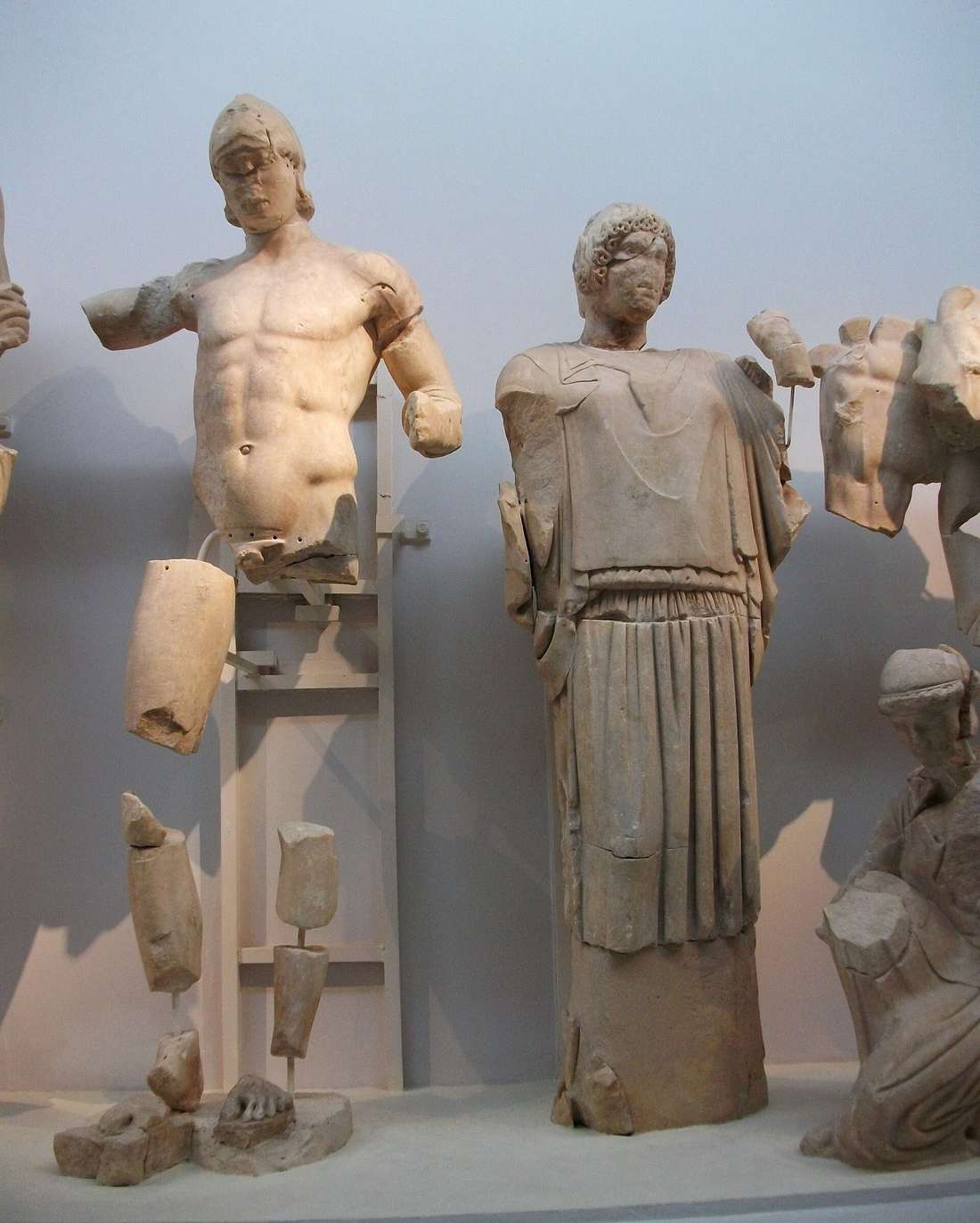
Pelops stands as the great ancestor of the royal house of Mycenae in Greek myth, the figure who gave the Peloponnese, the island of Pelops, its very name. A son of Tantalus, he won his bride Hippodamia by defeating her father Oinomaos in a deadly chariot race. That victory came through the treachery of the charioteer Myrtilus, whom Pelops then betrayed and killed. The dying Myrtilus cursed Pelops and all his descendants, planting the seed of doom that would haunt the line for generations. Enter this legendary dynasty and the age of gods and heroes with My Greece Tours.
Pelops binds the southern Greek mainland to the tragic story of Mycenae through the sons he fathered and the curse he earned. Legend made him a powerful king whose children, Atreus and Thyestes, carried the family into the halls of the great citadel, where their feud brought the curse to its terrible flower. The sections below cover his birth as a son of Tantalus, the fatal chariot race for Hippodamia, the curse of Myrtilus, the naming of the Peloponnese, and how his line reached Mycenae. Set the whole saga against the ancient ruins with our Mycenae travel guide.
Who was Pelops, the ancestor of the kings of Mycenae?
Pelops was the legendary ancestor of the royal house of Mycenae, a son of Tantalus who became a powerful king in the southern Greek mainland. His descendants ruled the great citadel and gave it its most famous kings.
Pelops belongs to the founding generations of Greek heroic myth, the age when gods dined with mortals and single families carried the weight of whole kingdoms. Legend named him the son of Tantalus, a king remembered for the terrible crime he committed against the gods at his own table. From that dark parentage Pelops rose to become a ruler in his own right, a figure whose deeds and marriage set the course of an entire dynasty. He crossed from the eastern lands into the Greek mainland and there carved out a kingdom in the south. His story runs at the root of the royal line that would in time hold the throne of Mycenae.
That descent marked him as the great forefather from whom the later kings of the citadel drew their claim to power.
The tradition placed Pelops at the head of the family that shaped the darker chapters of Mycenae’s legend. He was no minor figure in the tale but the source of a line, a man whose sons and grandsons carried his blood into the great halls above the plain of Argos. His descendants were remembered together as the house of Pelops, and the throne of Mycenae passed to them in the generations that followed. The full royal succession runs through the history of Mycenae, from the earliest kings down to the age of Pelops and his sons.
Pelops opens the chapter that gave the citadel its most tragic rulers, the forefather whose marriage and curse set the terms for everything the later kings would suffer within the walls of the ancient stronghold.
How did Pelops win Hippodamia in the deadly chariot race?
Pelops won his bride Hippodamia by defeating her father Oinomaos in a fatal chariot race. Oinomaos had killed every earlier suitor who tried, but Pelops secured his victory through the help and secret treachery of the charioteer Myrtilus.
Hippodamia was the daughter of Oinomaos, a king who guarded her with a cruel and deadly test. Any man who sought her hand had to race Oinomaos in his chariot, and the father, driving horses of unmatched speed, had cut down every suitor who tried and failed. The contest was a death sentence dressed as a courtship, and the toll of fallen young men stood as grim warning to any who came after. Pelops arrived to face this challenge and win the princess, knowing the price of defeat. He could not hope to beat the king’s swift horses by honest speed alone.
The hero turned to cunning and struck a secret bargain with the one man who could tip the race, Myrtilus, the charioteer who tended the king’s own chariot and steeds.
Myrtilus held the key to the whole contest, for he prepared the king’s chariot before the race began. Pelops won him over with a promise, and the charioteer betrayed his master by tampering with the vehicle so that it would fail at the crucial moment. During the race the king’s chariot broke apart, Oinomaos was thrown and killed, and Pelops crossed to victory and claimed Hippodamia as his bride. The triumph founded his fortune and his royal house, yet it was won by treachery rather than clean skill. This tainted victory sits near the root of the legendary House of Atreus, the dynasty whose later crimes gave Mycenae so much of its darker fame.
The chariot race opens the family saga on a note of blood and broken faith, foreshadowing the doom that would follow the line through the generations.
What was the curse of Myrtilus on the line of Pelops?
Pelops betrayed and killed Myrtilus after the race rather than honour their bargain. The dying charioteer cursed Pelops and all his descendants, planting a doom that would haunt the royal line and bring ruin to the kings of Mycenae.
Myrtilus had earned his reward, for his treachery handed Pelops both the race and the bride. The bargain struck between them promised the charioteer a rich prize for his part in the king’s death. Pelops, though, had no wish to honour a debt owed to a traitor, and he turned on the very man who had won him his throne. The hero killed Myrtilus, casting him down to his death rather than pay what he had promised. In his dying moment the charioteer pronounced a curse upon Pelops and upon every descendant who would spring from him. That curse became the hidden engine of the whole family tragedy.
It passed down through the blood like an inheritance no heir could refuse or escape once the dying man had spoken it.
The curse of Myrtilus reached far beyond the man who earned it, striking the sons and grandsons who never knew the charioteer. It set brother against brother and father against child through the generations, driving the crimes that stained the family name. The doom worked itself out most fully in the feud between Pelops’s sons, whose hatred carried the curse into the halls of Mycenae itself. That bitter quarrel pitted Thyestes against his own brother in a struggle for the throne, marked by betrayal and horror at the family table. The curse thus links the treachery of Pelops directly to the tragedies of the later kings.
What began as one man’s broken promise to a charioteer grew into a shadow over the entire dynasty, the unseen cause behind the bloodshed that would define the royal house of the citadel.
How did Pelops give his name to the Peloponnese?
Pelops gave his name to the Peloponnese, the island of Pelops, the great southern peninsula of Greece. He ruled widely across that land as a powerful king and left his name fixed to the region for all later ages.
The Peloponnese is the broad southern peninsula of the Greek mainland, joined to the north by a narrow neck of land. Its name means the island of Pelops, a lasting mark of how deeply the hero’s legend was tied to that whole region. Greek tradition held that Pelops ruled widely there after winning Hippodamia and his kingdom, spreading his power and his family across the southern land. The peninsula took his name from that reign, honouring him as the great forefather whose blood and rule shaped the region’s royal story.
To speak the name Peloponnese even today is to recall the hero of the chariot race, the ancestor whose descendants would hold the throne of Mycenae in the heart of that same land above the plain of Argos.
The naming tied the identity of the whole peninsula to a single legendary king. It fixed Pelops not merely as the founder of one royal house but as the figure who lent his name to the entire southern Greek world. That wide fame set the stage for the real achievements of the later Mycenaean civilization, the Bronze Age power whose citadels and gold rose across the same Peloponnese that carried his name. Myth and history met on the same soil. Pelops gave the land its name and its legendary forefather. The palaces, walls and tombs that survive today record the flesh-and-blood kingdoms that later flourished across the peninsula.
Chief among them stood Mycenae, the citadel whose royal line traced its descent straight back to the hero of the deadly race.
How did the sons of Pelops carry his line into Mycenae?
The sons of Pelops, Atreus and Thyestes, carried the family into the story of Mycenae, where their bitter feud brought the ancestral curse to its full flower. Through Atreus, Pelops became grandfather to Agamemnon and Menelaus.
Atreus and Thyestes were the sons who carried the blood of Pelops out of their father’s kingdom and into the halls of Mycenae. The two brothers came to the great citadel and there fell into a struggle for its throne, a feud driven by the very curse their father had earned from the dying Myrtilus. Their hatred ran deep and turned to horror, betrayal answered by betrayal until the family name stood stained by crimes that Greek storytellers never forgot. This quarrel between the sons of Pelops became the dark heart of the Mycenae legend, the moment when the ancestral doom worked itself out in full within the walls of the stronghold.
The feud settled at last with Atreus holding the throne, passing the rule of the citadel down to the next and most famous generation of the line.
Through Atreus the blood of Pelops reached the greatest kings the citadel would know. The elder son fathered Agamemnon, the warlord who would lead the Greeks against Troy in the age of the heroes, and Menelaus, whose wife Helen became the cause of that great war. Pelops thus stood as grandfather to the two brothers at the centre of the Trojan saga, his line reaching its height in their generation. From the chariot race to the halls of Mycenae, the family story runs as an unbroken chain, each king inheriting both the kingdom and the curse.
Pelops opened that chain as the forefather, and his grandsons closed it as the rulers whose deeds and doom gave the ancient citadel its most enduring place in the whole of Greek heroic legend.
Frequently Asked Questions
Why is Pelops called the ancestor of the kings of Mycenae rather than a king of the city himself?
Greek tradition placed Pelops one step back from the throne of Mycenae, as the forefather of the line rather than a ruler who sat in the citadel itself. He reigned in the wider southern mainland, the peninsula that took his name, and it was his sons Atreus and Thyestes who carried the family into the great stronghold above the plain of Argos. The word ancestor captures this founding role, the man whose blood and curse shaped the dynasty without his ever holding the city’s own crown. His descendants traced their standing straight back to him, measuring their claim against his marriage and his royal house.
The chariot-race victory that founded his fortune, and the curse of Myrtilus that doomed his heirs, both belong to him and pass down through the line to the later kings. For these reasons Greek legend cast Pelops as the great forefather, the source from whom the rulers of Mycenae drew their descent.
Is the story of Pelops history or myth?
The story of Pelops belongs firmly to myth rather than to recorded history. He was a legendary hero, a son of Tantalus who won his bride through a deadly chariot race and earned a curse from a dying charioteer. Such deeds mark the tale as the stuff of gods and doomed families rather than dated fact. The naming of the Peloponnese from his reign, the feud of his sons in the halls of the citadel, the whole inherited curse, all sit within Greek legend. That said, the myth grew up around real and important places.
The Mycenaean civilization was a genuine Bronze Age power, and the ruined walls, gate and tombs of its citadels still stand across the peninsula today. Greek storytellers reached back to a legendary forefather to explain the royal houses whose true origins lay beyond their memory. The result is a legend layered over real stone. Pelops is the mythical ancestor the Greeks gave to the kings of their oldest strongholds.
How is Pelops linked to Agamemnon and the Trojan War?
Pelops stood as the grandfather of Agamemnon, the great warlord who led the Greeks against Troy, and the family tree runs straight from the one to the other. Pelops fathered Atreus, and Atreus in turn fathered both Agamemnon and his brother Menelaus, whose wife Helen became the cause of the Trojan War. Through this line the blood of the chariot-race hero reached the two brothers at the very centre of the Trojan saga. The link also carries the ancestral curse forward. The doom that Myrtilus spoke over Pelops passed down through Atreus to his sons, colouring the tragedies that struck the royal house even as it reached the height of its power in the age of the heroes.
Pelops thus works as the founding figure of the whole Trojan-era dynasty, joining the earliest family legend to the kings of Mycenae who marched on Troy and to the war that would define the closing age of Greek heroic myth.