
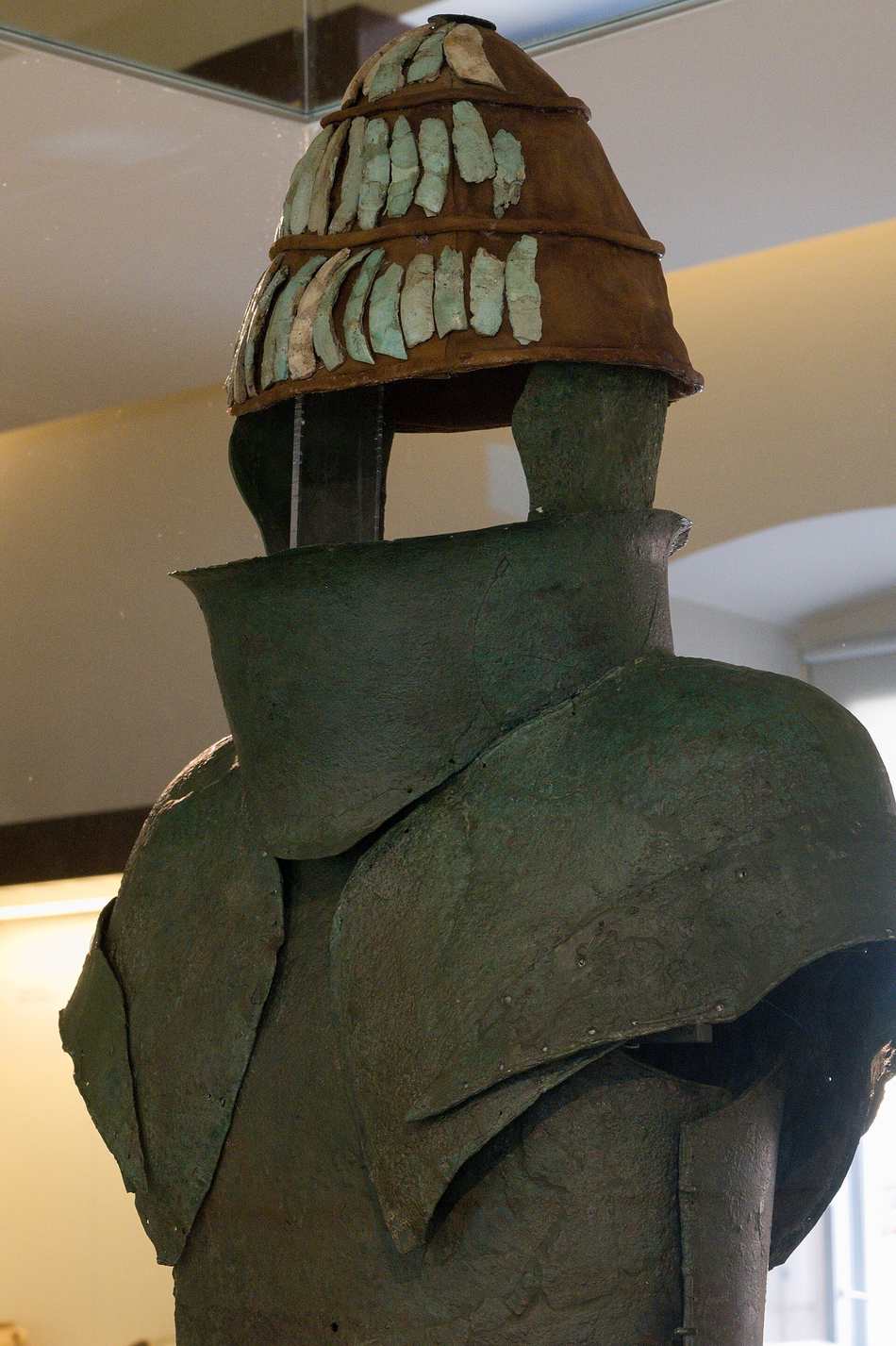
The Dendra panoply is a near-complete suit of Mycenaean bronze plate armour, one of the most important finds of Bronze Age Europe. Excavators unearthed it at Dendra in the Argolid, close to Mycenae, inside a chamber tomb near the ancient site of Midea. The armour dates to around the fifteenth century before the common era, when the war-gear of the elite was made to last. Curved bronze plates enclose the body, with a high neck-guard, shoulder pieces and hanging plates that shield the lower body. Worn with a helmet of boar’s tusks, it shows the smiths of that age at full stretch. Explore the war-gear of the heroes with My Greece Tours.
The Dendra panoply carries the visitor straight into the world of the Bronze Age warrior, the man who fought from a rolling chariot rather than on his own two feet. Its weight and shape point to a fighter shielded from neck to knee, a walking wall of bronze. Displayed today in the museum at Nafplio, it stands among the sites of the Argolid plain. The sections below cover its discovery at Dendra, its bronze plate construction, the chariot warfare it served, the boar’s tusk helmet worn with it, and its place among the finds of Mycenae. Set the whole picture against the ancient citadel with our Mycenae travel guide.
What is the Dendra panoply and where was it found near Mycenae?
The Dendra panoply is a near-complete suit of Mycenaean bronze plate armour found in a chamber tomb at Dendra in the Argolid, close to Mycenae. It ranks among the most important finds of Bronze Age Europe.
The Dendra panoply came to light in a chamber tomb at Dendra. This burial ground lies in the Argolid plain, close to Mycenae and beside the ancient stronghold of Midea. The tomb held the remains of a warrior of high rank, laid to rest with the full bronze armour that had shielded him through his years in life. Excavators recognised at once that the find was without equal, a suit of body armour surviving almost whole from the Bronze Age. The panoply belongs to the fifteenth century before the common era, an age when the citadels of the Argolid rose to power.
This one grave preserved what battlefields and centuries had stripped from every other warrior of the era, the complete war-dress of an elite fighter of the world of Mycenae.
The discovery reshaped what the modern world knew of early Greek warfare. Here was proof that the smiths of the Bronze Age could clothe a man in bronze from neck to knee. Such a feat had long been thought to belong only to a later age. The Dendra grave sat within the wider realm of the Mycenaean civilization, the Bronze Age power whose palaces, gold and armies commanded the Argolid and the seas beyond. The panoply gave that civilization a face in bronze, the war-gear of the fighting elite who served its kings.
Its findspot at Dendra, within sight of the great hill of Mycenae, ties the armour firmly to the heartland of the age of heroes and to the warlords remembered in later Greek legend.
How was the bronze plate armour of the Dendra panoply made?
The Dendra panoply is built from curved bronze plates that enclose the body, joined with a high neck-guard, shoulder pieces and hanging plates over the lower body. The design wrapped a warrior in overlapping metal from throat to thigh.
The panoply is a construction of hammered bronze, shaped into curved plates that fit around the torso and lock together to form a rigid shell. A tall collar rises to guard the neck and lower face, while broad pieces cap and protect the shoulders. Below the waist hang further plates, ring upon ring of curved bronze that swing with the wearer and shield the belly, hips and thighs. The whole suit closes around the body like a metal cocoon, leaving only the head, arms and lower legs to other gear.
The workmanship reveals smiths who understood how to beat bronze into three-dimensional armour, a craft demanding both skill and a steady supply of the metal, and it stands among the finest surviving work of Mycenaean art.
The making of such a suit tells a wider story about the wealth and reach of the age. Bronze was an alloy of copper and tin, and tin in particular travelled long distances by trade to reach the Argolid. To pour so much of it into one warrior’s armour marked that man as a figure of the highest rank. The panoply’s craft sits within the broader world of Mycenaean art, the metalwork, carving and fresco that adorned the palaces of the age. The armour is art turned to war, its curved plates as carefully worked as any ornament yet built to turn a spear-point.
Every plate had to be cut, hammered and fitted so the pieces moved together, a technical achievement that places the Dendra smith among the master craftsmen of Bronze Age Europe.
What kind of warfare was the Dendra panoply built for?
The weight and stiff shape of the Dendra panoply suit a warrior fighting from a chariot rather than marching on foot. The heavy bronze shell suited a fighter carried into battle, casting spears from the moving platform of a war-car.
The bulk of the panoply points away from the foot soldier and toward the chariot warrior. A man fully wrapped in curved bronze plates could not march far or move with speed, yet the same armour served a fighter who rode to battle standing in a war-car. From that rolling platform he could hurl spears at the enemy, shielded by metal that turned aside the answering blows. The chariot did the moving; the warrior did the fighting, sheathed in bronze from neck to knee. This reading fits the wider picture of Bronze Age warfare across the Argolid, where the chariot stood as the prestige weapon of the ruling elite.
The Dendra panoply thus embodies a whole way of making war, one built around the mobile fighting platform and the heavily armoured champion who rode upon it into the fray.
The chariot warrior of the Dendra type belonged to the fighting aristocracy of the Argolid citadels. Kings at Mycenae and at neighbouring Tiryns commanded such champions, men whose gold, bronze and war-cars set them far above the common levy. The panoply gives this elite a solid form. A warrior encased in its plates was a mobile fortress, dangerous at range with the spear and hard to bring down. The armour matches the grand scale of the palace strongholds themselves, huge walls housing rulers who could afford to arm their champions in full bronze.
To picture the Dendra warrior riding out from a citadel gate is to see the military might of the age made flesh, the chariot elite that gave the lords of the Argolid their command of the battlefield.
What was the boar’s tusk helmet worn with the Dendra panoply?
The Dendra warrior wore a boar’s tusk helmet with the bronze suit, a cap covered in rows of sliced boar tusks. This distinctive Mycenaean headgear completed the armour, shielding the head that the plates left bare.
The bronze plates of the panoply guarded the body but left the head to other protection, and here the warrior wore a helmet built from the tusks of the wild boar. Craftsmen sliced the curved tusks into small plates. They sewed them in overlapping rows onto a cap of leather or felt, so that a coat of gleaming ivory-like scales covered the whole head. The result was light, tough and unmistakably Mycenaean. This was a piece of headgear that spoke of the hunt as much as the battlefield, its full form demanding the tusks of dozens of boars. Paired with the Dendra plates, the helmet finished the picture of the fully armed champion.
The boar’s tusk helmet stands among the signature war-gear of the age and adds a striking crown to the bronze suit found in the grave.
The helmet also ties the Dendra find to the wider record of how the age pictured its own warriors. The same distinctive headgear appears in the art of the palaces, carved, painted and inlaid on prized objects that showed off the fighting elite. It survives on the celebrated Warrior Vase from Mycenae, where a file of soldiers marches out to war, and the fuller story of the gear runs through the boar’s tusk helmet as a type in its own right. To find such a helmet beside the bronze panoply confirmed that art and grave agreed.
The warrior of the Dendra tomb wore the very headgear that the palace craftsmen drew and carved, giving the modern eye a matched set, body and head both armoured in the manner of the Bronze Age champion.
Where is the Dendra panoply displayed and how does it fit the finds of Mycenae?
The Dendra panoply is displayed today in the archaeological museum at Nafplio, near the sites of the Argolid. It ranks among the key finds that reveal the war-gear and wealth of the world of Mycenae.
The panoply now stands in the archaeological museum at Nafplio, the coastal town that serves as a base for the sites of the Argolid plain. There the bronze suit is set up for the visitor to walk around, its curved plates, high collar and hanging skirts assembled as they would have sat upon a living warrior. Seeing it whole, rather than as scattered fragments, brings home just how completely a Bronze Age champion could be sheathed in metal. The Nafplio display places the armour within easy reach of the very ground where it was worn, a short journey from Dendra, from Midea and from the great citadel of Mycenae itself.
The finds of the region gain a further home in the on-site Mycenae archaeological museum, which gathers the smaller treasures of the citadel and its graves.
Within the wider record of the age, the Dendra panoply holds a place of the first rank. Where most graves yield weapons, jewellery or scattered pieces of armour, this one preserved the full defensive suit of an elite warrior. It stands alongside the gold masks, the carved gates and the great tombs as one of the defining discoveries of the Bronze Age Argolid. The armour turns the abstract idea of a warrior class into a solid, walkable object, the actual bronze that a champion of the world of Mycenae strapped on before battle.
To study the panoply is to look straight at the war-gear of the fighting elite who served the kings of the citadels, and to grasp how far the smiths of the fifteenth century before the common era had already carried the craft of armouring the human body.
Frequently Asked Questions
Why is the Dendra panoply such an important Bronze Age find?
The Dendra panoply matters because it survives almost whole, a rarity that no other Bronze Age site has matched for early Greek body armour. Most warrior graves of the age yield swords, spearheads or a stray plate of bronze, leaving the modern eye to guess at the full suit. The Dendra tomb instead preserved the complete defensive gear of an elite fighter, from the high neck-guard down to the hanging plates over the thighs. That completeness proved beyond doubt that the smiths of the fifteenth century before the common era could clothe a man in bronze from neck to knee. Such a feat was once thought to belong to a much later age.
The find reshaped the study of early warfare across the Argolid and beyond. It gave the abstract idea of a Bronze Age warrior a solid form in metal, letting the modern world weigh, measure and picture the actual armour that a champion of the age carried into battle.
Could a warrior really fight on foot in the Dendra panoply?
The weight and stiff shape of the Dendra panoply argue against long marches on foot, and most students of the armour read it as gear for a chariot warrior. A man wrapped in curved bronze plates from neck to knee carried a heavy load that would tire him fast and slow his stride over broken ground. The suit made far better sense on a fighter carried to battle in a war-car, who could stand behind his driver and cast spears while the plates turned the enemy’s blows. That does not mean the armour was useless once a warrior dismounted, for the same bronze shell would still guard him in close fighting near the chariot.
The design simply suited the mobile fighting platform of the age rather than the foot soldier of a marching column. The Dendra panoply thus fits a whole way of making war, one built around the chariot and the heavily armoured champion who rode it into the fray.
How does the Dendra panoply connect to the citadel of Mycenae?
The Dendra panoply comes from the same Bronze Age world that raised the great citadel of Mycenae, and its findspot lies only a short journey from that hill. Dendra sat within the Argolid plain, the heartland ruled from strongholds such as Mycenae, Tiryns and Midea, whose kings commanded the chariot elite the armour served. The warrior buried in the panoply belonged to that fighting aristocracy, a champion of the sort a citadel lord would send into battle. The armour therefore gives a human, martial face to the power that built the huge walls and the famous gate on the Mycenae hill.
It shows what the ruling class of the region wore to war, matching the scale of their palaces and tombs. To stand before the panoply is to picture the warriors who rode out from the citadel gates, the bronze-clad champions of a kingdom whose name still rings through the story of the age of heroes.