
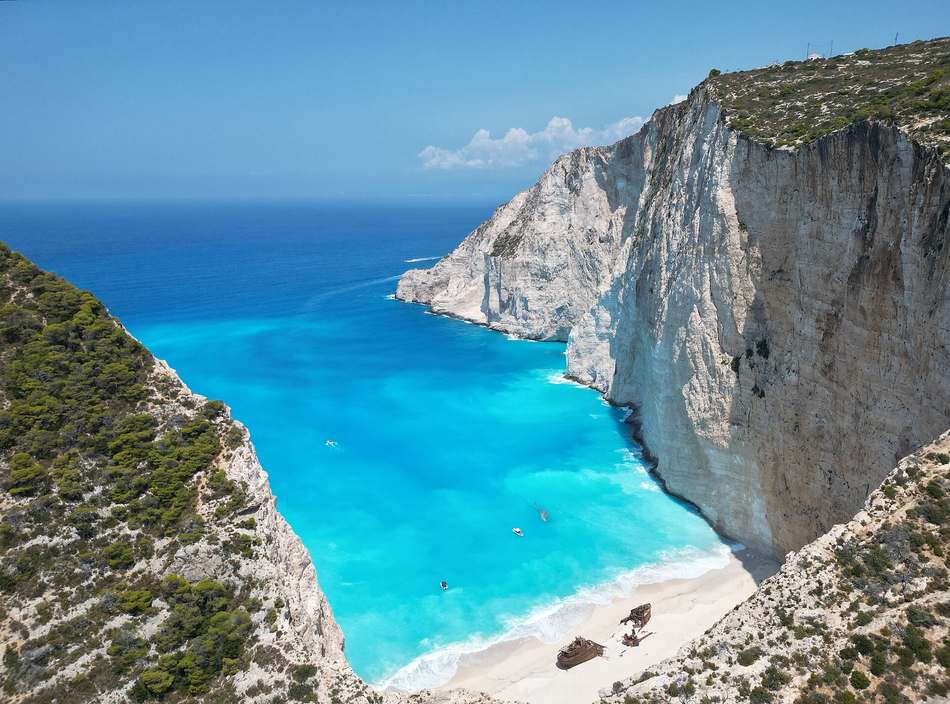
Navagio Beach is the most famous stretch of sand on the Ionian island of Zakynthos and one of the most photographed spots in all of Greece. It hides inside a sheltered cove on the rugged northwest coast, walled in by tall white limestone cliffs and reached only from the sea, with no road leading down to the sand. A rusting freighter lies half-buried on the pale shore, giving the cove its name, since Navagio means shipwreck in Greek. The water glows an intense turquoise against the white pebbled sand. Step into this glowing cove and the whole coast of Zante with My Greece Tours.
Navagio ties the wreck of the Panagiotis to the wider drama of the island’s northwest shore, its towering cliffs, its clifftop lookout and the boats that ferry travellers into the bay. The sections below cover the story of the shipwreck itself, how the cove earned its name, the way visitors reach the sand, the famous viewing platform on the cliff above, and the safety measures that shape a modern visit. Set the whole cove against the rest of the island with our Zakynthos travel guide, then read on for the details that make this bay unforgettable.
What is Navagio Beach on Zakynthos?
Navagio Beach, also called Shipwreck Beach or Smugglers Cove, is the most famous beach on Zakynthos. It sits in a sheltered cove on the rugged northwest coast, enclosed by tall white limestone cliffs and reached only from the sea.
Navagio Beach occupies a single sheltered cove carved into the rugged northwest coast of Zakynthos, an Ionian island off the western mainland of Greece. Tall white limestone cliffs enclose the bay on three sides, dropping straight to a shore of pale pebbled sand, while the fourth side opens onto the open sea. No road reaches the cove, so the only way in runs across the water by boat. That isolation gives the beach its extraordinary look, a bright ribbon of white sand and turquoise water framed by sheer white rock. The cove ranks as the single most photographed spot on the island and one of the best known in the country.
Travellers who explore the full range of Zakynthos beaches tend to place this one at the very top of the list.
The names attached to the cove tell part of its story. Navagio is the Greek word for shipwreck, a direct reference to the rusting hull that lies half-buried in the sand. Travellers also know it as Shipwreck Beach in English, a plain translation of the same idea. A third name, Smugglers Cove, points back to the vessel that ran aground here and the illegal cargo it was said to carry. Each name circles the same event, the grounding of a freighter on this remote shore. The water in the bay glows an intense turquoise, coloured by the white pebbled sand and the pale limestone of the cliffs and seabed.
That vivid colour, set against the rust of the wreck and the brilliant white of the rock, gives the cove the postcard image that draws travellers from across Greece and beyond.
The cove measures a compact stretch of white pebbled sand set at the base of cliffs that rise to a height of roughly two hundred metres. Those pale limestone walls belong to the same rugged geology that shapes the whole northwest shore of Zakynthos, a coast of headlands, sea caves and sheer drops. The white pebbles underfoot are worn fragments of that limestone, ground smooth by the sea over long spans of time. Their pale colour bounces light up through the shallow water, which is part of the reason the bay glows such a vivid turquoise.
The cove faces roughly northwest, open to the Ionian Sea, so the light shifts through the day as the sun tracks across the water and the cliffs cast their shade.
The name Zakynthos attaches to the whole island as well as its main town, and the Italian form Zante remains common in older maps and among visitors from abroad. The island ranks as one of the seven principal Ionian islands strung along the western edge of Greece. Its western flank, where the cove lies, presents a wall of cliffs to the open sea, while the eastern side slopes into gentler bays and the low ground around the town. That split between a wild west coast and a softer east shapes how travellers experience the island.
The cove belongs firmly to the rugged half, a pocket of white sand hidden in a coastline built for drama rather than easy access, which is exactly what has made it so widely known.
What is the story of the shipwreck at Navagio?
The wreck is the Panagiotis, a freighter that ran aground on the cove in the late twentieth century, reportedly while carrying smuggled goods. Storms drove the vessel into the bay, where its rusting hull lies half-buried in the sand.
The rusting hull on the sand belongs to the Panagiotis, a coastal freighter that met its end on this shore in the late twentieth century. The ship ran aground on the rocks off the northwest coast of Zakynthos and was driven ashore into the cove. Local accounts hold that the vessel was carrying smuggled goods at the time, a detail that gave rise to the third name of the beach, Smugglers Cove. Storms and heavy seas pushed the stricken freighter onto the pale sand of the bay, where the crew abandoned it. The hull came to rest half-buried in the shore, tilted on its side, and there it has stayed ever since.
The wreck turned an already beautiful cove into a place with a story, a ruin that anchors the whole scene.
Decades of salt, sun and sea have stripped the Panagiotis down to a skeleton of rust-brown steel, yet the hull still holds its shape against the white sand. The contrast between the corroded metal and the pale beach gives the cove its unmistakable character, the single feature that sets it apart from every other bay on the island. Boat tours that run along this coast usually pair the wreck with a stop at the Blue Caves, the sea grottoes near the island’s northern cape where the water turns a deep electric blue.
The two sights together define the northwest of Zakynthos, one a monument of rust and stranded steel, the other a natural gallery of light and colour worn into the coastal rock over long stretches of time.
The freighter measures a modest coastal vessel rather than a large ocean ship, which is why the hull fits so neatly into the small cove. Its story dates to the fifth of October in the year nineteen eighty, when the ship ran aground during a spell of stormy weather and poor visibility. The vessel had been built decades earlier and worked the trade routes of the region before its final voyage ended on this shore. Salt water and open air have since reduced the steel to a rust-brown shell, hollow and stripped of everything but its basic frame.
The hull now sits as a fixed landmark, the reference point that every photograph of the cove is built around and the reason the beach carries the name it does.
The wreck has become the single most recognised image of the whole island, reproduced on postcards, posters and travel features across the world. That fame brings a steady stream of travellers to both the cove and the clifftop above it through the warmer months. The hull rests on its side with its bow pointing inland, angled so that the aerial view from the platform frames it neatly against the pale sand. Photographers time their visits for the softer light of morning or late afternoon, when the sun sits lower and the colours in the bay deepen.
The ship draws not only sightseers but also documentary crews and film-makers, who have used the cove and its stranded freighter as a backdrop that needs no explanation to viewers anywhere.
How do visitors reach Navagio Beach in Zakynthos?
Visitors reach the cove only by sea, since no road leads down to the sand. Boat tours depart from Porto Vromi, Cape Skinari, Agios Nikolaos and the main port of Zakynthos Town, ferrying travellers into the sheltered bay.
The cove sits at the foot of sheer cliffs with no path or road down to the beach, so every visit begins on the water. Boat tours leave from four main points around the island and carry travellers into the sheltered bay. The closest departure runs from Porto Vromi, a small harbour on the west coast that lies nearest to the cove and offers the shortest crossing to the sand. Longer trips set out from Cape Skinari at the northern tip of the island, often combining the wreck with the sea grottoes along the way. Further options depart from Agios Nikolaos on the east coast and from the main port at Zakynthos Town in the south.
Each route ends in the same glowing bay beneath the white cliffs.
The choice of departure point shapes the whole outing. Short hops from the west coast focus on the wreck alone and leave more time on the sand, while longer sailings from the north or east turn the trip into a coastal cruise that takes in grottoes, headlands and open sea. Organised Zakynthos boat tours package these crossings with fixed departure times and set stops, an easy way to reach a beach that has no other access. Travellers who want to stand on the pale sand and touch the rusting hull must ride one of these boats, since the surrounding cliffs cut off every land approach.
The crossing itself, gliding in past the white rock walls toward the wreck, forms a memorable part of the experience rather than a mere means of getting there.
The crossing time depends heavily on the chosen harbour, with the run from Porto Vromi covering the shortest distance to the sand. Trips from the northern cape trace a longer route down the west coast, passing tall cliffs and open water before the cove comes into view. The boats used range from small local craft to larger tour vessels that carry groups on fixed schedules. Travellers should note that landing on the sand itself has at times been suspended, with operators anchoring offshore instead so passengers can view the wreck and swim near the boat rather than step onto the beach. Checking the current arrangement before booking avoids surprises.
The approach by sea, gliding in beneath the white cliffs, forms a highlight of the outing in its own right.
The exposed nature of the coast means sea conditions govern whether the crossing runs at all on a given day. Strong wind can whip up swell along the open shore, and operators cancel or reroute trips when the water turns rough. Calm mornings therefore offer the most reliable window for reaching the cove. Travellers prone to seasickness should weigh the longer routes from the north against the shorter hop from Porto Vromi, which spends less time in open water. The water calms inside the sheltered bay, protected on three sides by the encircling cliffs.
The contrast between the open crossing and the still, glowing water of the cove itself adds to the sense of arriving somewhere set apart from the rest of the coast.
Where is the famous viewing platform above Navagio?
A viewing platform sits high on the cliff above the cove and offers the classic aerial view looking straight down into the bay. The lookout lies near the village of Anafonitria in the northwest corner of the island.
The postcard image of Navagio, the one that shows the whole cove from above, comes from a viewing platform perched high on the clifftop. From this railed lookout the eye travels straight down the sheer white rock to the turquoise water, the pale crescent of sand and the tiny rust-brown shape of the wreck far below. The height turns the bay into a perfect aerial picture, the arrangement that has made the cove famous across Greece and around the world. The platform stands near the village of Anafonitria in the northwest corner of Zakynthos, reached by road across the high ground above the coast.
It gives travellers who prefer dry land the chance to see the cove without ever boarding a boat, a view that ranks among the most striking on the whole island.
The clifftop lookout draws its own steady stream of travellers, separate from those who ride the boats into the bay below. Reaching it means driving to the high inland ground above the northwest coast and following the signs from the village. The same corner of the island holds the monastery of Anafonitria, a historic religious site tied to the village that lends the lookout its name. The road journey through this quiet, hilly country adds context to the view, showing the rugged interior that backs the dramatic coast.
From the platform the sheer scale of the cliffs becomes plain, walls of pale limestone that dwarf the boats far below and explain at a glance why no path descends to the sand. The aerial view and the sea-level approach offer two very different ways to know the same famous cove.
The lookout sits at a height that places the whole cove beneath the viewer, a vantage that no sea-level approach can match. Reaching it means a drive of roughly forty minutes from Zakynthos Town across the hilly interior toward the northwest corner of the island. The final stretch follows a winding road up to the clifftop, where a railed platform marks the edge of the drop. A short walk from the parking area leads to the viewpoint itself. From the railing the sheer scale of the cliffs and the tiny size of the boats far below become plain at once.
The light on the wreck shifts through the day, with morning offering a clearer angle on the northern face of the cove before the afternoon sun moves overhead.
The high ground behind the lookout holds quiet farming country, olive groves and small villages that see far fewer travellers than the coast. The monastery near the village of Anafonitria ties the area to the island’s religious history and gives the clifftop viewpoint its regional name. Driving to the platform rewards travellers with views across the interior as well as the famous look down into the bay. The road can be narrow and winding in places, so an unhurried pace suits the journey. Parking near the viewpoint fills through the middle of the day in peak season, another reason to favour an early or late visit.
The combination of the aerial view and the rural drive gives a fuller picture of the northwest than the boat trip alone can offer.
What safety measures shape a visit to Navagio Beach?
The cove faces open sea and has no facilities, shade or lifeguard, so travellers bring their own water and shade. Rockfalls from the unstable cliffs have restricted access at times, and authorities manage visits for safety.
A visit to the cove demands planning ahead, because the beach offers nothing in the way of comforts. The bay faces the open sea and has no facilities at all, no shops, no shade and no lifeguard on the sand. Travellers carry their own water and their own sun protection, because the tall white cliffs bounce heat and light onto an exposed shore with no natural cover through the middle of the day. The absence of a lifeguard means swimmers rely on their own judgement in water that opens straight onto the sea.
These plain conditions form part of the cove’s wild character, a beach left almost untouched by the trappings that crowd more developed shores elsewhere across the island and the wider Ionian coast.
The white limestone cliffs that give the cove its beauty also pose a real hazard. Rockfalls from the unstable rock have at times reached the sand below and forced authorities to restrict access to the beach for the safety of visitors. Managed visiting arrangements shape how and when travellers can land in the bay, a response to the risk of falling stone from the towering walls. The cove tends to fill in the middle of the day, when boat tours from every departure point converge on the same small stretch of sand. Early or late crossings avoid the busiest hours and the fiercest sun.
For all these constraints, Navagio remains the defining image of Zakynthos and a highlight of any Ionian island trip, a cove where the wreck, the cliffs and the turquoise water combine into a single unforgettable scene.
The best window for a visit runs through the warmer half of the year, roughly from May to October, when boat tours operate on full schedules and the sea stays calm enough for the crossing. Late spring and early autumn bring smaller crowds than the peak of high summer while keeping reliable weather and full tour operation. Morning departures around the middle of the morning tend to meet the calmest water, before the afternoon wind builds along the exposed coast. The cove holds no facilities of any kind, so travellers pack water, sun protection and sturdy footwear for the pebbled sand.
Respecting posted rules and any managed access arrangement keeps the visit both safe and smooth, a small effort that protects both travellers and the fragile cove itself.
The pull toward crowding at midday reflects the way boat schedules from every harbour converge on the same narrow window. Spreading a visit to the edges of the day eases both the press of people and the strength of the sun on an unshaded shore. The lack of any shade, shop or lifeguard means self-reliance shapes the whole outing, from carrying water to judging the swim. Rock instability in the cliffs remains the most serious concern, and travellers should heed every posted warning and barrier without exception. The cove rewards respect for its wild character, offering in return a scene found nowhere else on the island.
The wreck, the white cliffs and the turquoise water together form the defining picture of Zakynthos and a fitting close to any tour of the Ionian coast.
Frequently Asked Questions
Why is Navagio Beach called Shipwreck Beach and Smugglers Cove?
All three names for the cove circle the same event, the grounding of a freighter on this remote shore. Navagio is simply the Greek word for shipwreck, a direct reference to the rusting hull of the Panagiotis that lies half-buried in the pale sand of the bay. Shipwreck Beach is the plain English translation of that same Greek word, used by travellers from abroad who visit the cove. The third name, Smugglers Cove, points back to the story of the vessel itself, which local accounts say was carrying smuggled goods when it ran aground in the late twentieth century. Storms drove the stricken ship into the sheltered bay, and there it has stayed.
Each name therefore fastens onto one part of the same tale, the wreck, its cargo and the cove that received it. Together they make the beach one of the most talked-about spots in the whole of Greece, a place defined as much by its story as by its striking turquoise water and white cliffs.
Can you reach Navagio Beach by car or only by boat?
The cove can be reached only by boat, since no road or path leads down to the sand. Sheer white limestone cliffs enclose the bay on three sides and drop straight to the shore, cutting off every land approach to the beach itself. Travellers who want to stand on the pale sand and touch the rusting hull must ride a boat tour, with departures from Porto Vromi on the west coast, Cape Skinari at the northern tip, Agios Nikolaos on the east coast and the main port at Zakynthos Town in the south. A car does play a part in one kind of visit, though.
The clifftop viewing platform above the cove, near the village of Anafonitria, is reached by road across the high inland ground of the northwest. From that lookout travellers see the whole bay from above without boarding a boat. The two experiences differ, one a sea-level landing on the sand reached only by water, the other an aerial view from the cliff reached by road.
When is the best time to visit Navagio Beach?
The cove is busiest in the middle of the day, when boat tours from every departure point around the island converge on the same small stretch of sand. Crossings timed for early morning or later in the afternoon avoid both the thickest crowds and the fiercest overhead sun, a real consideration on a beach with no shade and no lifeguard. The bay faces the open sea and offers no facilities, so travellers plan ahead and carry their own water and sun protection whatever the hour. Conditions on the water also matter, because the crossing runs along an exposed coast that can turn rough in strong wind.
The unstable cliffs add a further factor, since rockfalls have at times led authorities to restrict access to the sand. Checking on any managed visiting arrangements before setting out helps a trip run smoothly. For the clearest turquoise colour and the best light on the wreck, a calm day outside the peak midday rush gives the finest view of this famous cove.
Is Navagio Beach still open to visitors?
Access to the cove has shifted in recent years because of the risk of rockfall from the tall limestone cliffs that ring the bay. An earthquake in the early part of the twenty-twenties triggered fresh falls of stone onto the sand, and authorities responded by restricting how and when travellers can land on the beach. Swimming and stepping onto the sand itself have at times been prohibited for safety, with boat operators anchoring offshore so passengers can view the wreck and swim near the vessel rather than come ashore. The clifftop viewing platform above the cove stays open and offers the classic aerial view without any need to board a boat.
Arrangements can change from one season to the next, so travellers should check the current status with tour operators before booking a crossing. The cove remains the defining sight of Zakynthos whether admired from the water below or the cliff above, and boat tours along this coast continue through the warmer months.