
A Thessaloniki mythology tour is a guided walk or day trip that tells the Greek myths and legends tied to Thessaloniki, from the story of Thessalonike, the sister of Alexander the Great, to the gods of Mount Olympus. Tours across the rest of the country are listed on Greece Tours.
The sections below cover the tour formats, Thessalonike and the mermaid legend, the White Tower and the waterfront, the Rotunda and the Arch of Galerius, the myths in the Archaeological Museum, the gods of the ancient city, the coffee and mythology tour, Mount Olympus and Dion, the myths of Macedon, families, meeting points, the season and booking, with links into the Thessaloniki pages. The tours shown are checked on GetYourGuide and Viator.
What is a Thessaloniki mythology tour?
A Thessaloniki mythology tour is a guided walk that links the city’s streets, monuments and museums to the myths told about them. A licensed guide moves between archaeology and storytelling, turning a waterfront stroll into the tale of Thessalonike the mermaid.
Thessaloniki is the second largest city in Greece, the capital of Central Macedonia and the largest city of Greek Macedonia. It stands on the site of ancient Therma and takes its name from Thessalonike of Macedon, the half-sister of Alexander the Great. A Thessaloniki mythology tour treats that name as its opening story and builds the rest of the walk out of it; the wider route is mapped in the Thessaloniki walking tour.
The usual shape is simple. A small group meets in the centre, walks for about two hours, and stops at squares, monuments, markets and museum doors where a story belongs. The pace is easy and the route is short. A Thessaloniki mythology tour is built for walking and talking, not for covering ground, so the group stays inside the historic core and the old streets above it.
The person leading the walk is a licensed guide. On the Greek mythology walking tour the licence number is printed on the listing, and the tour runs in Greek, Spanish, Italian and English. Storytelling carries the facts: the guide explains how a myth survives in medicine, psychology, zoology, astrology, in sayings people still use, and in habits such as knocking on wood after bad news.
The cast is wide. The twelve gods of Olympus appear, so do Heracles and Achilles through the royal line of Macedon, Philip II, Olympias and Alexander, the mermaid Thessalonike, the giants of the Gigantomachy and the Egyptian gods who arrived with Roman soldiers and traders. A Thessaloniki mythology tour keeps each figure attached to a place, because the place is what makes the story stick.
A Thessaloniki mythology tour is not a lecture on ancient texts and it is not a museum visit on its own. Myths are told outdoors, where they were told, and the guide answers questions along the way. Nothing is invented to fill a gap: where sources disagree, the disagreement is the story. A Thessaloniki mythology tour is a route through a living city, so cafes, markets and commuters are part of the scenery.
- The name of the city and Thessalonike, the mermaid of the Aegean
- The White Tower and the warhorse Bucephalus
- The Rotunda and the emperor Galerius
- The Archaeological Museum and the wedding of Dionysus and Ariadne
- Ano Poli and the legends of the upper town
Which Thessaloniki mythology tour formats can you book?
Four formats cover nearly every Thessaloniki mythology tour on offer: the Greek mythology walking tour, the myths and legends walking tour, the coffee and pastries morning, and the Mount Olympus day trip. Each one uses storytellers rather than site guides.
The Greek mythology walking tour is the plainest version. It lasts two hours, runs in the city centre, carries a wheelchair-accessible label on its listing, and works through the myths that still shape everyday language. The guide holds an official licence and takes questions as they come, so the route of a Thessaloniki mythology tour bends towards whatever the group wants to know.
The Thessaloniki through Myths and Legends walking tour is the local-life version. It lasts two hours and caps the group at five travellers. It starts at the old port, gives Aristotelous Square, the Kapani market, the White Tower, Navarinou Square and the monument of Alexander the Great about fifteen to thirty minutes each, and ends at the statue of Alexander. Food, markets and family recipes are woven into the myths on this Thessaloniki mythology tour.
The coffee, pastries and mythology tour is the morning version. It lasts two hours, meets in front of the Rotunda, and includes Greek coffee and pastries with the storytelling. The group is small, the route is short, and the myths are told between bakery stops, which suits a first morning in the city before the heat builds.
The Mount Olympus mythology day trip is the long version. The relaxed viewpoint tour lasts about five hours and keeps the group to eight people. Full-day alternatives combine Mount Olympus with Dion and run for eight to ten hours, while a private hike on the mountain takes about eight hours. A Thessaloniki mythology tour of this kind leaves the city behind and follows the gods uphill.
Who was Thessalonike, and how does a Thessaloniki mythology tour tell her story?
Thessalonike was the daughter of Philip II and his Thessalian wife Nicesipolis, and the half-sister of Alexander the Great. A Thessaloniki mythology tour tells her twice: once as the queen who gave the city its name, and once as the mermaid of the Aegean.
Her name means Thessalian victory, and it commemorates her father’s win over the Phocians at the Battle of Crocus Field in Thessaly. One account says Philip ordered that she be called victory in Thessaly because she was born on the day of the battle. Her mother died soon after, and Olympias, Philip’s wife and Alexander’s mother, raised the girl alongside her own children.
History ties her to three of the strongest men in Macedon: daughter of Philip II, half-sister of Alexander, wife of Cassander. Cassander married her after the fall of Pydna and named the new city on the Thermaic Gulf after her. A Thessaloniki mythology tour tells her as queen of Macedon and mother of three sons, Philip, Antipater and Alexander. Her own son Antipater had her killed in 295 BC, and the sources give jealousy as the reason.
The legend is the part a Thessaloniki mythology tour returns to again and again. Alexander, in his search for the water of immortality, brought back a flask. In one version he washed his sister’s hair with it and made her immortal. In another he never told her what the flask held, and she poured it over a wild onion. When Alexander died she tried to drown herself, and instead became a mermaid who judges sailors.
Her question never changes: is King Alexander alive? The right answer on a Thessaloniki mythology tour is that he lives and reigns and conquers the world, and the ship sails on in calm water. Any other answer turns her into the raging Gorgon, and the crew goes to the bottom of the sea. A Thessaloniki mythology tour uses that exchange as a set piece, because it is the one myth in which the city speaks to strangers.

Which stories does a Thessaloniki mythology tour tell at the White Tower and the waterfront?
A Thessaloniki mythology tour uses the White Tower and the Nikis Street waterfront for the stories of Alexander the Great and his horse Bucephalus, the mermaid’s test of sailors, and the hero Achilles, from whom the Macedonian royal house claimed descent.
The tower also has a page of its own, with visiting details, in the guide to the White Tower of Thessaloniki. The building itself is a cylinder about 23 metres across and about 34 metres high, with six floors, a spiral ramp inside the outer wall, and a small turret on top. The Ottomans built it after they took the city, and it guarded the eastern end of the sea walls. For centuries it was a garrison and a prison, and it earned the name Tower of Blood.
At the end of the nineteenth century it was whitewashed by a convict in exchange for his freedom, and the name White Tower stayed even though the stone is now a buff colour. It stands on Nikis, the Victory road, and it has become the symbol of the city, which a Thessaloniki mythology tour treats as the front door of the waterfront. A Thessaloniki mythology tour stops here for the sea stories before moving inland.
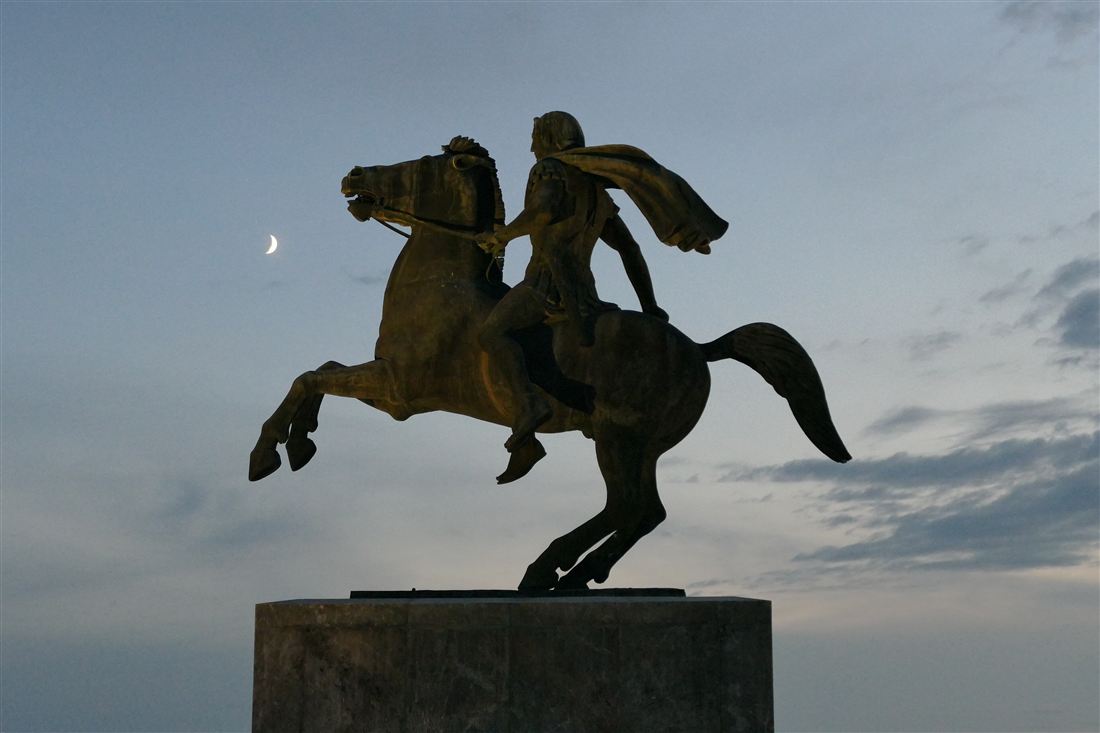
Bucephalus is the horse of Alexander, and his name means ox-head, after a brand on his thigh that looked like an ox’s head. Ancient writers describe a black coat with a large white star on the brow and a breed of the finest Thessalian strain. A dealer offered him to Philip II, and Alexander, then twelve or thirteen, won him by turning his head towards the sun so that he stopped fearing his own shadow.
Plutarch reports that Philip was so struck by the scene that he told the boy to look for a kingdom worthy of him, a line a Thessaloniki mythology tour repeats at the waterfront statue. Bucephalus carried Alexander through the campaigns and died in June 326 BC, at about thirty years old, after the Battle of the Hydaspes. Alexander founded a city and named it Bucephala after the horse. On the waterfront, a Thessaloniki mythology tour makes the link between the horse, the man and the sea that carried them.
- Bucephalus, the horse won by a boy who became king
- Achilles, claimed as an ancestor of the Macedonian royal line
- The mermaid’s question and the answer that saves a ship
- The tower’s years as a prison, told as the dark side of the waterfront
What does a Thessaloniki mythology tour show at the Rotunda and the Arch of Galerius?
At the Rotunda and the Arch of Galerius, a Thessaloniki mythology tour shows how Roman imperial power borrowed the language of myth and how pagan symbols were carried into Christian art: a victory wreath, a fruit garland, acanthus leaves and a mosaic dome.
The Rotunda was built around 306 AD for the emperor Galerius, who is thought to have intended it as his mausoleum. It is a cylinder 24.5 metres across, with walls more than six metres thick that have survived the earthquakes of the region, eight rectangular bays and a brick dome about 30 metres high at the peak. It is 125 metres from the arch, and a road once linked the two.
Galerius died in 311 AD and was buried elsewhere, and the building stood empty for decades before Theodosius the Great ordered its conversion into a church in the late fourth century. For more than twelve centuries it served as a church dedicated to the Archangels. It became a mosque with a minaret late in the sixteenth century, and when the city passed to Greece in the early twentieth century the building was reconsecrated, minaret and all.
The mosaics are the prize. The cupola and the barrel vaults were once covered in mosaic, and what a Thessaloniki mythology tour can still show includes a garland of fruit and evergreen branches in twenty-five sections, with white lilies, laurels, pears, grapes and pomegranates set around the lost image of Christ. Acanthus leaves, an ornament of Greco-Roman architecture read as a sign of enduring life, sit beside the Christian message. A Thessaloniki mythology tour points out that the old symbolism was not destroyed, only re-dated.
The Arch of Galerius is a triple gateway once carried on eight pillars, of which three survive. Its marble panels were carved between 298 and 299 AD and the monument was dedicated in 303 AD for the victory over the Sassanid king Narseh. One panel shows Galerius on horseback, lance forward, with an eagle carrying a wreath; another shows the imperial family at a sacrifice. The arch spans the line of the Via Egnatia, the Roman road that crossed the city, and a Thessaloniki mythology tour stops beneath it.
The Galerius precinct is the third stop. The palace stood to the south-west, with mosaic floors, an octagonal room and a hippodrome beside it, and the group hears how an imperial address was staged with gods in attendance. Thessaloniki mythology tours work well here because the remains are outdoors and free to see at any hour; the two monuments have their own pages, the Rotunda of Galerius and the Arch of Galerius, and the wider precinct is described at the Galerius Palace.
- The Rotunda as a mausoleum that became a church, then a mosque, then a church again
- The fruit garland of the dome and its reading as rebirth
- Galerius against Narseh, with Victoria’s wreath above
- The sacrificial panel and the tetrarchs shown as a single body
- The palace floor mosaics of the Galerius precinct
Which myths does a Thessaloniki mythology tour find in the Archaeological Museum?
In the Archaeological Museum of Thessaloniki, a Thessaloniki mythology tour finds the Derveni krater with Dionysus and Ariadne, the Derveni papyrus, the marble head of Serapis, a marble Dionysus and a stone inscription that names Queen Thessalonike herself.
The museum holds about fifty thousand objects from the prehistoric, archaic, classical, Hellenistic and Roman periods, drawn from the city and the wider region of Macedonia, and it has its own guide here: Archaeological Museum of Thessaloniki. The building was designed by Patroklos Karantinos, a new wing was added later, and the central galleries carry sculpture and architecture from the city and its sanctuaries. For a Thessaloniki mythology tour, those galleries are the first stop.
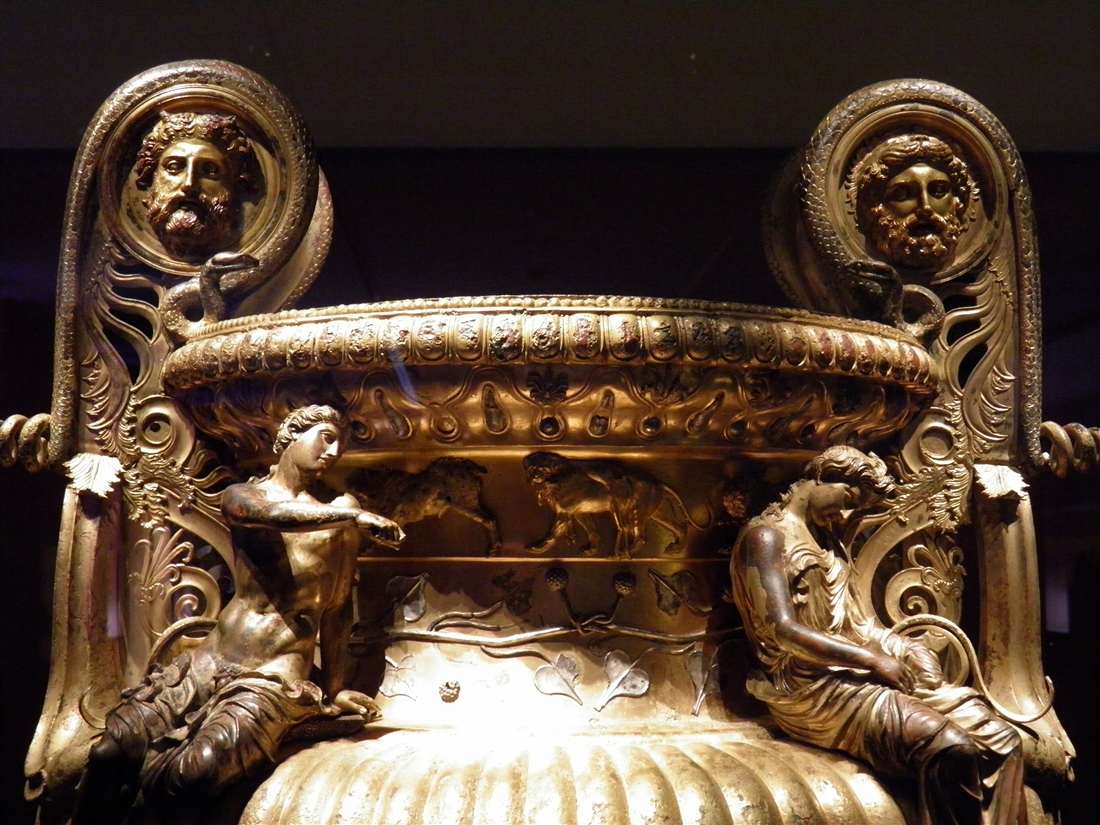
The Derveni krater is the centrepiece of a Thessaloniki mythology tour of the museum. It is a bronze volute krater, 90.5 centimetres tall and 40 kilograms in weight, made with about fifteen per cent tin, which gives it a golden sheen without a gram of gold. It was found in a tomb at Derveni and was used as a funerary urn for Astiouneios, son of Anaxagoras, from Larissa, and it held the burnt bones of a man aged about thirty-five to fifty and a younger woman.
On the belly runs a low relief frieze of Dionysus and Ariadne surrounded by revelling satyrs and maenads, and on the shoulders sit four statuettes: two maenads, Dionysus and a sleeping satyr. A warrior wears a single sandal, and scholars read him as Pentheus, as Lycurgus of Thrace, or as Jason of the Argonauts. A Thessaloniki mythology tour uses that uncertainty to show how myth travels through images.
The Derveni papyrus, carbonised in a funeral pyre, is the oldest surviving book in Europe, and its text deals with rites and the afterlife. Elsewhere in the galleries stand the marble head of Serapis from the second century BC, a marble Dionysus from the second century AD, a head thought to be a portrait of Alexander, gold diadems with Medusa heads, and the restored members of the city’s temple of Aphrodite.
The final case is the inscription reading to Queen Thessalonike, daughter of Philip. It is the plainest document in the museum and the strongest ending to a Thessaloniki mythology tour, because the woman who became a mermaid was a real queen with a real name on stone. That jump, from a carved name to a sea legend, is the whole argument of the walk.
Which gods were worshipped in ancient Thessaloniki?
Ancient Thessaloniki honoured Zeus, Demeter, Dionysus, Aphrodite, Heracles and the Muses, and it also made room for imported gods: Serapis, Isis and Anubis from Egypt, Cybele from Anatolia, the chthonic Kabeiroi, and Sabazios from Thrace. A Thessaloniki mythology tour follows those cults through the streets.
The Serapeion is the clearest case for any Thessaloniki mythology tour. It stood near Agios Minas Street, close to the western gate and the port, inside the sacred quarter of the ancient city. Excavations in the early twentieth century uncovered an inscription and parts of a sanctuary that the first excavator named the Serapeion, and the sanctuary seems to have run for about six centuries.
Two temples were found, and a Thessaloniki mythology tour uses their layout to explain how a mystery cult worked. Temple A has a rectangular plan; Temple B has a cella and a pronaos, with a raised semicircular niche for the cult statue and a bench for votive offerings. A vaulted chamber in the north-west corner, reached by an underground corridor and sealed in antiquity, was read as a crypt for mystery worship. Pebble mosaic floors, column bases, statues and offerings came out of the ground with it.
The site produced more than seventy Greek inscriptions, which gives this cult one of the richest documentary records in the city. Serapis was joined by Isis and Anubis, and a water basin points to purification rites. It gives a Thessaloniki mythology tour its firmest ground in a city of legends. The cult reached Thessaloniki in the third century BC and the sanctuary stopped working in the fourth century AD. A plaster model of the site is shown in the Archaeological Museum.
The Kabeiroi are harder to pin down and better for storytelling. They were chthonic deities with a mystery cult linked to Hephaestus, honoured on Lemnos and at Samothrace and at Thebes, where sailors called them the great gods in times of danger. Thessalonica is put forward as one of their cult places, and the link is read as the mystery cult that Paul warns against in his letters to the church there.
The physical traces are small but telling, and a Thessaloniki mythology tour points them out one by one. A relief of the god Kabiros survives on a capital from the Palace of Galerius, carved in the early fourth century, which shows how long the old gods held on in a Christianising city. Elsewhere the museum keeps restored members of the city’s temple of Aphrodite and a relief of Epona, a Celtic goddess of horses who arrived with the army.
- Serapis, Isis and Anubis at the Serapeion, with a crypt and a water basin
- The Kabeiroi, the great gods of the sailors, with a mystery cult
- Aphrodite, whose temple stood in the city and whose members are in the museum
- Dionysus, whose image fills the mosaics and the bronze krater
- Cybele and Sabazios, brought in from Anatolia and Thrace
What does the coffee, pastries and mythology Thessaloniki tour include?
The coffee, pastries and mythology Thessaloniki tour is a two-hour morning walk with Greek coffee, traditional pastries and stories of gods and legendary creatures. This Thessaloniki mythology tour meets in front of the Rotunda and moves between bakeries.
The listing for this Thessaloniki mythology tour sets the frame. Two hours, a small group, a relaxed pace, and a local food lover as the guide. The meeting point is in front of the Rotunda, where the guide waits with a sign. Coffee and pastries are included, water bottles are not, and the operator sends the details by message within twenty-four hours of the start.
The food is the thread and the myth is the hook on this Thessaloniki mythology tour. Thessaloniki takes its pastries seriously, from flaky phyllo creations to syrup-soaked classics, creamy custards and sesame-covered treats, and bougatsa is the queen of them. Stops are chosen in traditional bakeries and small shops, so a Thessaloniki mythology tour of this kind is eaten rather than only heard.
Every sweet has a history. The walk explains how Greek, Balkan and Ottoman cooking met in this port city and how recipes travelled with families who arrived, left and returned. A Thessaloniki mythology tour uses that history as evidence: a pastry recipe is a document about migration, and the myths of gods and legendary creatures sit beside it.
The storytelling covers the same ground as the evening walks, but in daylight and with a cup in hand. The group hears about gods who punished pride, mortals who bargained with immortals, and the local legends that grew up around the Rotunda and the old market quarter. Questions are welcomed, and the group stays small enough for a real conversation.
Two practical points matter on a Thessaloniki mythology tour. The walk is a morning activity, so it fits before a museum visit or a siesta. Coffee and pastries are included and water is not, so bring a bottle. Cancellation is free up to twenty-four hours before the start, and a no-show is charged in full, which is normal for a booked tasting route with a string of stops.
Can a Thessaloniki mythology tour include Mount Olympus, home of the twelve gods?
Yes. A Thessaloniki mythology tour can leave the city for Mount Olympus, about 80 kilometres to the south-west, where the twelve gods were said to live. Day trips run from five hours to ten hours, and private hikes take a full day.
The mountain also has its own planning page, the Mount Olympus day trip from Thessaloniki. It is the highest ground in Greece and the destination of a Thessaloniki mythology tour that leaves the city. Mytikas, the main peak, rises to 2,917 metres, and the massif holds 52 peaks and deep gorges. It sits on the border between Thessaly and Macedonia, near the Thermaic Gulf, and the town of Litochoro, the usual starting point for walkers, lies about 100 kilometres from Thessaloniki.
In Greek myth Olympus is the home of the gods. Homer uses a form of the name that also means sky, and Herodotus identifies the Thessalian peak as the seat of the gods, which made it the shared mountain of all Greeks. The second peak, Stefani, is called the Throne of Zeus and reaches 2,902 metres. The Muses’ Plateau, at 2,550 metres, is named for the nine daughters of Zeus and Mnemosyne, who were placed at the mountain’s northern foot in Pieria.
The landscape has its own protection. Olympus became the first national park in Greece in the late 1930s and is a World Biosphere Reserve, and the wider area has been inscribed as a mixed UNESCO World Heritage Site for its natural and cultural value. Below the peaks, the Enipeas river cuts a ravine about 14 kilometres long on its way to the sea.
The relaxed day trip is built for travellers who want the myths without a climb, which makes it the easiest Thessaloniki mythology tour of the mountain. The group is capped at eight people and travels in an air-conditioned vehicle from a meeting point in the city, at a hotel on Salaminos Street. The drive passes Dion, where the guide explains the sanctuary of Zeus and the sacrifice that Alexander made there before his campaign.
From Litochoro a Thessaloniki mythology tour walks in the ancient forest for about 35 minutes, then follows the Enipeas gorge on an easy route for about 40 minutes to the springs, where the water is offered as the water of the gods. A forest stop near Katerini follows, and the day ends at Poseidonia beach for a rest and a swim before the return. The vehicle is air-conditioned and the guidance is in English.
- A drive past Dion, the sacred city at the foot of the mountain
- A forest walk at Litochoro, about 35 minutes
- The Enipeas gorge and its springs, about 40 minutes
- A quiet forest stop near Katerini and a swim at Poseidonia beach
What does a Thessaloniki mythology tour add at Dion, the sacred city of Zeus?
At Dion, a Thessaloniki mythology tour adds the political side of myth. This was the sacred city of the Macedonians, dedicated to Zeus and the twelve gods, where kings sacrificed, armies were purified and Alexander the Great made an offering before marching east.
Practical travel detail sits on the site’s own page for the Dion Archaeological Park day trip from Thessaloniki. The name comes from Dios, of Zeus, and the city sits at the north-east foot of Olympus, five kilometres from the sea and fifteen from Katerini. In Hellenistic times it stood much closer to the water, and the river Baphyras, then navigable, joined it to the Thermaic Gulf. The archaeological park covers about 150 hectares, with the sanctuaries outside the walls.
Zeus Olympios had the great sanctuary and altar, and Zeus Hypsistos, Zeus the highest, had a smaller precinct reached by a sacred road lined with small columns carrying marble eagles. A statue of Zeus Hypsistos, a marble eagle, a mosaic floor with two ravens, a white bull and double axes were found there. In front of the temple stood an altar with a metal ring for tying sacrificial animals.
Two forms of Zeus were honoured side by side. Zeus Olympios ruled from the mountain top and Zeus Hypsistos ruled the sky. A Thessaloniki mythology tour makes that distinction plain, because it explains why a kingdom needed both a mountain and a heaven, and why Dion was where the Macedonian calendar began with sacrifices at the end of September.
Other sanctuaries crowd the site, and a Thessaloniki mythology tour walks from one to the next. Demeter had the oldest, dating from the sixth century BC. Isis arrived from the second century BC and slowly replaced the cult of Artemis, with Isis Lochia as a goddess of birth and with Aphrodite Hypolympidia honoured beside her. Asklepios, the healer, had a sanctuary with running water, and his family appears in stone: his sons Machaon and Podaleirios and his daughters Hygieia, Panakeia, Akeso and Iaso.
The royal ritual is the heart of the story on any Thessaloniki mythology tour. Archelaus founded a nine-day festival of athletic and dramatic games for Zeus and the Muses, and the kings themselves oversaw it. Alexander sacrificed to Zeus at Dion before leaving for Asia, and he later set up twenty-five bronze statues of the cavalrymen who fell at the Granicus inside the sanctuary of Zeus Olympios. By tradition, Pausanias places Orpheus at Dion.
- The altar and sanctuary of Zeus Olympios, father of the twelve gods
- The sacred road of Zeus Hypsistos, lined with marble eagles
- The sixth-century sanctuaries of Demeter and the later precinct of Isis
- The healing sanctuary of Asklepios and his family of healers
- The nine-day festival of games for Zeus and the Muses
Which myths of Macedon does a Thessaloniki mythology tour explain?
A Thessaloniki mythology tour explains the myths of the Macedonian royal house: the founding oracle of Aigai, the murder of Philip II, the ambitions of Olympias and the tombs at Vergina, where a golden larnax carried the sixteen-ray Sun of Vergina.
Ticket and visiting information for the tombs is kept on the page for Vergina tickets. Aigai, known today as Vergina, lies about 75 kilometres west of Thessaloniki and was the sacred city of the kingdom even after the court moved to Pella. Its name means goat town, and Diodorus records the founding story: the oracle at Delphi told Perdiccas to build his city where white-horned goats were resting at dawn. Thucydides supports that version, which made it the official founding myth.
The city kept the cult centres, the royal palace and the royal tombs, and that is why the murder happened there. Philip II was attending the wedding of his daughter Cleopatra to King Alexander of Epirus when Pausanias of Orestis killed him in the theatre. His son Alexander was proclaimed king on the spot, and a Thessaloniki mythology tour tells that scene on the slope below the palace.
The palace at Aigai is the grandest stop on a Thessaloniki mythology tour of Macedon. Excavators call it the largest building of classical Greece alongside the Parthenon, two or three storeys around a vast colonnaded courtyard, with mosaic floors and painted walls, and a north gallery that looked down on the theatre and the plain. Its design is placed in the reign of Philip II, and a line of scholarship connects it to Pytheos of Priene, the architect of the Mausoleum at Halicarnassus.
The tombs are the reason people travel, and they are the closing chapter of a Thessaloniki mythology tour of Macedon. One gold larnax weighs about 11 kilograms and shows the sixteen-ray Sun of Vergina; the oak wreath buried with it carries 313 leaves and 68 acorns and weighs 717 grams. Above a tomb door runs a 5.6-metre hunt fresco, attributed to Philoxenos of Eretria, read by a line of scholarship as Philip and Alexander on horseback.
Myth entered the graves directly, and a Thessaloniki mythology tour follows it inside the mound. A tomb wall carries the Abduction of Persephone, read as the work of Nicomachus of Thebes, one of the rare surviving paintings of the ancient afterlife. One antechamber held a gold myrtle wreath and the remains of a queen, and a tomb once assigned to Alexander IV held an ivory Sabazios. The tomb of Queen Eurydice was found later, and the great mound still hides the debate about who lies where.
- Aigai, the goat town founded on the word of the Delphic oracle
- The theatre where Philip II was killed and Alexander was proclaimed king
- The golden larnax and the sixteen-ray Sun of Vergina
- The Abduction of Persephone, painted on a tomb wall
- The ivory Sabazios and the gold myrtle wreath of a queen
How does a Thessaloniki mythology tour work for families and children?
A Thessaloniki mythology tour works for families because it is short, loud and visual. The two-hour walks keep young attention spans in view, the scavenger format asks children to tick off gods on a sheet, and a prize waits at the end of the route.
The kindest format for families is the scavenger hunt in the upper town, a Thessaloniki mythology tour built as a game. It lasts two hours, keeps to a small group, and turns the walk into a game: the group crosses gods off a sheet as their stories are told, and a prize ends the route. Guides check that everyone is following and repeat or translate when needed, which the reviews say children notice.
The myths and legends walk takes the widest age range. Its listing covers travellers from infancy to old age, with infants carried on laps, and the group is capped at five people. That size makes it possible to slow down, stop for a drink and answer a child’s question without holding up strangers. Guides also hand out food and sightseeing tips for the rest of the stay.
The coffee and pastries walk suits families with older children, because coffee, pastries and storytelling come as one package. It is a two-hour morning route, so it ends before the heat and before the appetite for a second activity disappears. The walk is a good first half of a day that continues in a museum.
Museums can carry the story after a Thessaloniki mythology tour. The Archaeological Museum lends a wheelchair on request and publishes visiting guides for adults and children on the autism spectrum, arranges a touch tour for blind and partially sighted visitors, and offers a digital guide in Greek Sign Language. Families who want a shorter visit can follow the Derveni krater and the Dionysus and Ariadne frieze and leave.
The Museum of Ancient Music, known as the Seikilos Museum, is the other family stop on a Thessaloniki mythology tour. It is a small private museum in the centre of Thessaloniki where the instruments are replicas and visitors are invited to play them, with a professional lyre player performing during the guided tour. Children up to the age of twelve are admitted with an adult, and the visit lasts about an hour.
Where do Thessaloniki mythology tours meet, and how long do they last?
A Thessaloniki mythology tour meets at a fixed point in the centre or at the old port, and it lasts two hours for the walking formats, five hours for the Mount Olympus viewpoints and eight to ten hours for full-day trips.
The myths and legends walk starts at the old port of Thessaloniki, on Nikis Avenue beside the limani bar, and ends at the statue of Alexander the Great, which sits a short walk away. On this Thessaloniki mythology tour, Aristotelous Square, the White Tower, Navarinou Square and the monument of Alexander each take about fifteen minutes, and the Kapani market takes about thirty.
The coffee and pastries route, a Thessaloniki mythology tour with a cafe stop, meets in front of the Rotunda, where the guide waits with a sign, and the operator sends a message within twenty-four hours of the start to confirm the place. The relaxed Mount Olympus day meets outside a hotel on Salaminos Street, and the operator warns that the point can change with traffic, bad weather or heat.
Durations vary by ambition on a Thessaloniki mythology tour. The centre walks run two hours, a waterfront storytelling walk runs an hour and a half, and the music museum visit runs about an hour. Day trips start at five hours for the Olympus viewpoints, rise to eight hours for the mountain hike and the Olympus and Dion combination, and reach eight and a half hours for a Vergina and Pella day. A Dion and Olympus trip by train is listed at ten to thirteen hours.
Groups stay small, and the numbers are published. The myths and legends walk takes five travellers, the scavenger hunt in the upper town takes ten, and the Olympus day takes eight. The licensed mythology walk in the centre runs in Greek, Spanish, Italian and English, while the legends walk and the mountain day run in English.
Booking is instant on the usual platforms, with a mobile ticket and a hold on the place, and the museum of ancient music is the exception: it runs guided tours on fixed slots from Monday to Saturday and only on reservation. Timings for the afternoon slot depend on the season.
- The old port by the limani bar, for the myths and legends walk
- In front of the Rotunda, for the coffee and pastries morning
- Outside a hotel on Salaminos Street, for the Mount Olympus day
- The city centre, for the licensed mythology walk
Which other mythology sites in northern Greece suit a day from Thessaloniki?
Three places extend a Thessaloniki mythology tour beyond the city: Pella, the Macedonian capital where Alexander was born, Mount Athos, the mountain thrown by the giant Athos, and the Kassandra peninsula, the ancient Pallene, named as the battlefield of the gods and the Giants.
Pella lies a short drive west of Thessaloniki and was the capital of Macedon from the fourth century BC until the Roman conquest in 168 BC, so a Thessaloniki mythology tour that goes west starts here. Philip II was born there in 382 BC and Alexander in 356 BC. The city was laid out on a grid plan with blocks about 45 metres wide, and its agora covered ten blocks, roughly seven hectares.
The floors are the attraction for anyone who wants the myths of this Thessaloniki mythology tour in colour. Pebble mosaics show a lion hunt, Dionysus riding a leopard and a lion-griffin attacking a stag, laid in the houses of rich families. Temples stood for Aphrodite, Cybele and Demeter, and the city had piped water to private houses long before that became normal. A combined Vergina and Pella day takes about eight and a half hours from the city.
Mount Athos carries a creation story of its own. In Greek myth, Athos was one of the Giants who fought the gods, and he threw a huge rock at Poseidon; the rock fell into the Aegean and became the mountain, which rises to 2,033 metres. Another version has Poseidon using the mountain to bury the defeated giant. Homer names Athos in the Iliad, and Herodotus records that the Persian fleet of Mardonius was wrecked rounding the cape in 492 BC, losing three hundred ships and twenty thousand men.
The peninsula is a monastic region with its own rules, and women are not permitted inside the area governed by the monastic community. That rule shapes how a Thessaloniki mythology tour reaches the place: a boat cruise along the coast is the usual route, and the stories of the giant and the storm are told from the water. Lycophron has the Pelasgian race born from the blood of the Sithonian giants on the neighbouring prong, a lineage that a Thessaloniki mythology tour follows east along the coast.
Kassandra, the westernmost of the three headlands of Chalkidiki, was called Pallene and, earlier, Phlegra, the place of burning. Pindar and other early sources put the battle between the gods and the Giants there, and Apollodorus says the Giants were born in Phlegrae or in Pallene. Diodorus gives battles at Pallene, at the Phlegraean Fields in Italy and on Crete. Poseidon fought the giant Polybotes, who was buried under the island of Nisyros. The isthmus at Potidea was cut into a canal under Cassander.
Which museums support a Thessaloniki mythology tour?
Three museums carry a Thessaloniki mythology tour indoors: the Archaeological Museum for the Derveni krater and the city’s cults, the Seikilos Museum of Ancient Music for the lyre of Apollo, and the Museum of Byzantine Culture for the afterlife of pagan symbols.
A fuller listing of collections and locations is kept in the guide to museums in Thessaloniki. The Archaeological Museum is the first stop for myth in stone and bronze. Its galleries hold the Derveni krater with its Dionysus and Ariadne frieze, the Derveni papyrus, the marble head of Serapis, a marble Dionysus, gold diadems with Medusa heads, and a head thought to be a portrait of Alexander. The Gold of Macedon exhibition adds grave goods from cemeteries across the region.
One case deserves its own minute on a Thessaloniki mythology tour. The museum keeps plaster casts of Las Incantadas, the portico of the enchanted ones, whose marble figures stood in the city until the originals were carried off to Paris. The name is folklore, not archaeology, which makes it a neat example for a Thessaloniki mythology tour of how a classical monument turns into a local legend.
The Seikilos Museum of Ancient Music sits in the centre of the city and takes its name from the Seikilos epitaph, the oldest surviving complete musical composition with notation, dated to the first or second century AD and found in Asia Minor. Inside, replicas of ancient instruments are laid out to be played, and the collection reaches from Greek lyres and kitharas to the pandura, the sambuca and the phorminx.
The myths of music are the point of this part of a Thessaloniki mythology tour. By tradition Hermes made the first lyre from a tortoise shell and gave it to Apollo in payment for stolen cattle; Apollo taught Orpheus, whose playing moved stones and trees; Athena invented the aulos and threw it away, and the satyr Marsyas picked it up; Pan turned the nymph Syrinx into reeds and made a pipe from her. A Thessaloniki mythology tour that adds this museum leaves the group able to hear the sound.
The Museum of Byzantine Culture opened in the mid-1990s and holds eleven permanent galleries, with a collection that runs from the second century to the twentieth. One gallery tracks the change from the Elysian Fields to the Christian Paradise through graves, inscriptions and tomb paintings, which is the cleanest way to see how the old myths were absorbed. The museum also runs the exhibition inside the White Tower.
Which months suit a Thessaloniki mythology tour?
A Thessaloniki mythology tour works all year, but the walking routes are at their kindest in late spring and early autumn, when daytime temperatures sit between the winter chill and the July and August peak of about 32 degrees Celsius.
Official figures for the city explain the pattern. At the university station, the mean daily maximum runs at about 10.6 degrees Celsius in January and climbs to about 32.3 degrees in July and August. Rain is spread through the year, with November and December among the wettest months and July and August the driest. Sunshine peaks in July at about 326 hours a month.
Late spring brings mild air and about 51 millimetres of rain, enough to keep the hills green but not enough to spoil a two-hour walk. Early autumn repeats the conditions from the other side, with warm sea water for the beach stop on the Mount Olympus day and softer light for photographs along the waterfront.
Summer suits an early start for a Thessaloniki mythology tour. A Thessaloniki mythology tour that begins at half past ten in the morning and finishes by lunchtime keeps the group out of the hardest heat, and the mountain day works well because the temperature drops as the road climbs into the forest and the gorge.
Winter is the season for the indoor version. The Archaeological Museum, the Museum of Ancient Music and the Museum of Byzantine Culture give a Thessaloniki mythology tour a fixed route whatever the sky is doing, and the coffee and pastries morning is comfortable in a coat. Snow is rare in the city, and the coldest nights sit just above freezing on average.
One rule covers every season of a Thessaloniki mythology tour: check the mountain forecast before a day trip to Olympus. The massif creates its own weather, rain arrives without warning in the warm months, and the peaks hold snow well into the spring. Layers, a light waterproof and proper shoes settle the question of which months are suitable.
- Late spring: mild walking weather and green foothills
- Summer: early starts, beach stops on the mountain day, indoor breaks at midday
- Early autumn: warm sea and comfortable city walks
- Winter: museum-led routes and a coffee morning in the old centre
Is a Thessaloniki mythology tour accessible for travellers with limited mobility?
Part of it is. The licensed Thessaloniki Greek Mythology Walking Tour is wheelchair accessible, the Archaeological Museum is well equipped, and the Rotunda can be reached by a pedestrian bridge. The myths and legends walk is not, so a Thessaloniki mythology tour needs care.
The distinction matters when booking a Thessaloniki mythology tour. The myths and legends walk through the old port, the market and the waterfront states on its own listing that it is not wheelchair accessible and asks for a moderate level of physical fitness. The relaxed Mount Olympus day is also not wheelchair accessible and is not recommended for travellers who are pregnant or who have back or heart conditions.
The Archaeological Museum is the strongest indoor option on a Thessaloniki mythology tour for a visitor with limited mobility. The main entrance is reached by a ramp from Stratou Avenue, about 120 metres from the nearest point on the street, and the door is wide enough for a wheelchair. Exhibition halls sit on two levels, served by special lifts and lifts suitable for wheelchairs, and the museum lends a wheelchair on request.
The details go further. Corridors are wider than 1.5 metres and free of obstacles, handrails line the ramps and staircases, accessible toilets are inside the building, and the cafe is reached by a ramp. Resting spots sit within the exhibition. Two parking spaces are available in the museum car park, and a vehicle carrying a passenger with a disability can also stop on Manoli Andronikou Street.
Other visitors are covered well on a Thessaloniki mythology tour. A touch tour can be arranged at this stop for blind and partially sighted visitors, a digital guide in Greek Sign Language serves visitors with hearing impairment, and the museum publishes visiting guides for adults and children on the autism spectrum. A first aid point with a defibrillator is on site.
Two sites need a check before the walk. The Rotunda is reached from the pavement by a short pedestrian bridge, which makes the monument step-free for visitors with disabilities, and it is worth confirming the route with the operator. The White Tower is climbed on foot through six floors by stairs and a spiral ramp, so anyone who cannot manage stairs plans the stop from the outside, where the sea front is level. The cobbled lanes and slopes of Ano Poli are the hardest surface of all.
- The licensed city mythology walk is labelled wheelchair accessible
- The myths and legends walk and the Olympus day are not wheelchair accessible
- The Archaeological Museum offers ramps, lifts, a loan wheelchair and accessible toilets
- Ano Poli is cobbled and sloping, so choose a centre route instead
How do you book and cancel a Thessaloniki mythology tour?
Book a Thessaloniki mythology tour online in advance, because small groups fill quickly in high season. The walks confirm instantly and offer free cancellation up to twenty-four hours before the start time, while the museum of ancient music works only on reservation.
Booking a Thessaloniki mythology tour takes minutes. Listings show the duration, the language, the group limit, the meeting point and the inclusions, and confirmation arrives at the time of booking. Mobile tickets are accepted, and a reserve-now-pay-later option holds a place without payment on the day of booking. A number of operators ask for a phone number so that the meeting point can be sent by message.
Cancellation rules on a Thessaloniki mythology tour are uniform across the walking formats and the Mount Olympus day: cancel at least twenty-four hours before the start and the payment is refunded in full. Inside that window, and for a no-show, the coffee and pastries route charges the full amount. Arriving late can be treated as a no-show on a route with booked tables and tastings.
The museum of ancient music needs its own plan. Guided tours run on fixed slots from Monday to Saturday, strictly on reservation, and the number of slots depends on the season. A visit lasts about an hour, and a professional lyre player performs during the tour, so the booking is for a set time rather than a general admission window.
Two habits prevent trouble on a Thessaloniki mythology tour. Book the licensed city walk first and add the day trips afterwards, because a full-day return from Olympus or Vergina leaves no room for an afternoon walk. Read the fitness note: a moderate level is requested on the old-town routes, the mountain day excludes travellers with back or heart conditions, and the tower stop is climbed on foot.
Finally, know what a Thessaloniki mythology tour does not include. Gratuities are excluded on the walking tours, water bottles are excluded on the coffee route, and meals are not part of the mountain day beyond the stops. Admission to museums and archaeological sites is separate unless the listing says otherwise, and the licensed guide credential is printed on the product page for anyone who wants to check it.
Frequently Asked Questions
How long does a Thessaloniki mythology tour last?
The city walks of a Thessaloniki mythology tour run for two hours, and a waterfront storytelling walk for an hour and a half. A morning coffee and pastries route also runs for two hours. Day trips are longer: five hours for the Mount Olympus viewpoints, eight and a half hours for Vergina with Pella, and a full day for a private hike on the mountain.
Is advance booking needed for a Thessaloniki mythology tour?
Yes, booking ahead is sensible because the formats are deliberately small. The myths and legends walk caps the group at five travellers, the upper town game at ten, and the Mount Olympus day at eight. Instant confirmation is normal, and free cancellation up to twenty-four hours before the start protects a plan. A Thessaloniki mythology tour with a fixed tasting or a fixed slot needs the earliest booking.
Is a Thessaloniki mythology tour suitable for children?
It suits families well. The walks last two hours, the pace is easy, and the upper town format turns the route into a game with a prize at the end. The myths and legends walk admits the widest age range, from infancy upwards, with five travellers in the group. A Thessaloniki mythology tour that ends in a bakery or a music museum tends to hold attention longest.
Which landmarks does the tour cover?
The centre walk touches Aristotelous Square, the Kapani market, the White Tower, Navarinou Square, the monument of Alexander the Great and the Arch of Galerius. Museum stops add the Derveni krater. The upper town route climbs into Ano Poli. Each stop carries one story, so a Thessaloniki mythology tour covers a short distance and a long list of names, from Thessalonike to Serapis and Bucephalus.
Does the tour include Mount Olympus or Vergina?
Not on the two-hour city walks, which stay in Thessaloniki. Day trips cover the wider mythology: five hours for the Mount Olympus viewpoints, eight to ten hours for Olympus with Dion, and eight and a half hours for the tombs at Vergina with Pella. A Thessaloniki mythology tour of that length needs a full day and an early start, and the mountain versions are not wheelchair accessible.
What happens if it rains on a Thessaloniki mythology tour?
The walks on a Thessaloniki mythology tour run in light rain, since the route stays on pavements. Heavy rain can move a meeting point, and the mountain operator warns that traffic, weather or heat can change the starting place. Cancellation is free up to twenty-four hours before the start, and the museum routes are the reliable answer to a wet day, as a Thessaloniki mythology tour can move indoors.