
Vergina tickets give entry to the Polycentric Museum of Aigai at Vergina, the old royal city of the Macedonian kings, where one ticket covers the Royal Tombs, the Central Museum Building, the necropolis, the ancient theatre, the palace and the church of Saint Demetrius at Palatitsia. Tours across the rest of the country are listed on Greece Tours.
The sections below cover what the ticket includes, each site on it, where to buy it, e-tickets, reduced and free entry, the tours and audio guides that include entry, getting to Vergina, the order of the sites, the rules, the best time, combining Pella and Veria, cruise stops, access and changes, with links into the Vergina tours pages. The tours shown are checked on GetYourGuide and Viator.
What are Vergina tickets?
Vergina tickets are the combined admission tickets of the Polycentric Museum of Aigai, each a single pass to the scattered sections of the first Macedonian royal capital at Vergina, in Imathia: two museums, the royal necropolis, the palace, the theatre and a church.
Vergina tickets carry the name of the Polycentric Museum of Aigai, set up by the Imathia Ephorate of Antiquities as modules spread across the ground of the archaeological site. The design follows the plan of ancient Aigai itself, an open town of small and larger settlements grouped around a walled core, the asty.
The ruins of Aigai lie between the modern villages of Vergina and Palatitsia in Central Macedonia, and UNESCO added the site to its World Heritage List in 1996. Day tours to the site leave from Thessaloniki, the city with the nearest airport, so Vergina tickets slot easily into any Vergina day trip from Thessaloniki.
Which sites do Vergina tickets include?
Vergina tickets include six parts of the Polycentric Museum of Aigai: two museum buildings (the Central Museum Building and the Royal Tombs – Display of Treasures), plus the Palace of Aigai, the Ancient Theatre, the Necropolis – Royal Cluster of Temenides and the church of Saint Demetrius.
The six sections on Vergina tickets match the list of visitable units the Ephorate publishes, in which the palace and theatre count as one. The set stays open: further monuments, or groups of them, join the museum as each one is conserved and made ready for visitors.
The sections of Vergina tickets stand at separate spots across the site, and the official visit page gives each one its own map link. The church lies farthest east, in Palatitsia, the village whose name still recalls the nearby palace of Philip II.
What do Vergina tickets show in the Royal Tombs museum?
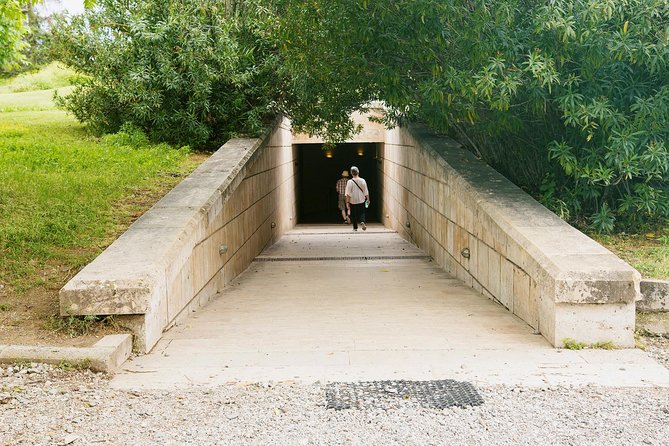
Vergina tickets show the royal tombs of Aigai where they were found, inside an underground shelter shaped like an earth mound. The tomb assigned to Philip II, its painted façade, the Persephone wall painting and the gold and silver grave goods share one space.
The shelter went up in 1993 to enclose the tombs and hold their temperature and humidity steady for the painted walls, and the treasures have been on show inside since November 1997. Its earth cover replaces the original Great Tumulus, lost to the excavation, yet the chambers that Vergina tickets open are ancient originals.
Holders of Vergina tickets stand before Philip II’s burial as the Ephorate presents it: a vaulted two-room tomb below ground, reached by a ramp and fronted by a monumental façade. Its hunting scene carries portraits of Philip and Alexander, who appear again on the main chamber’s deathbed of gold and ivory.
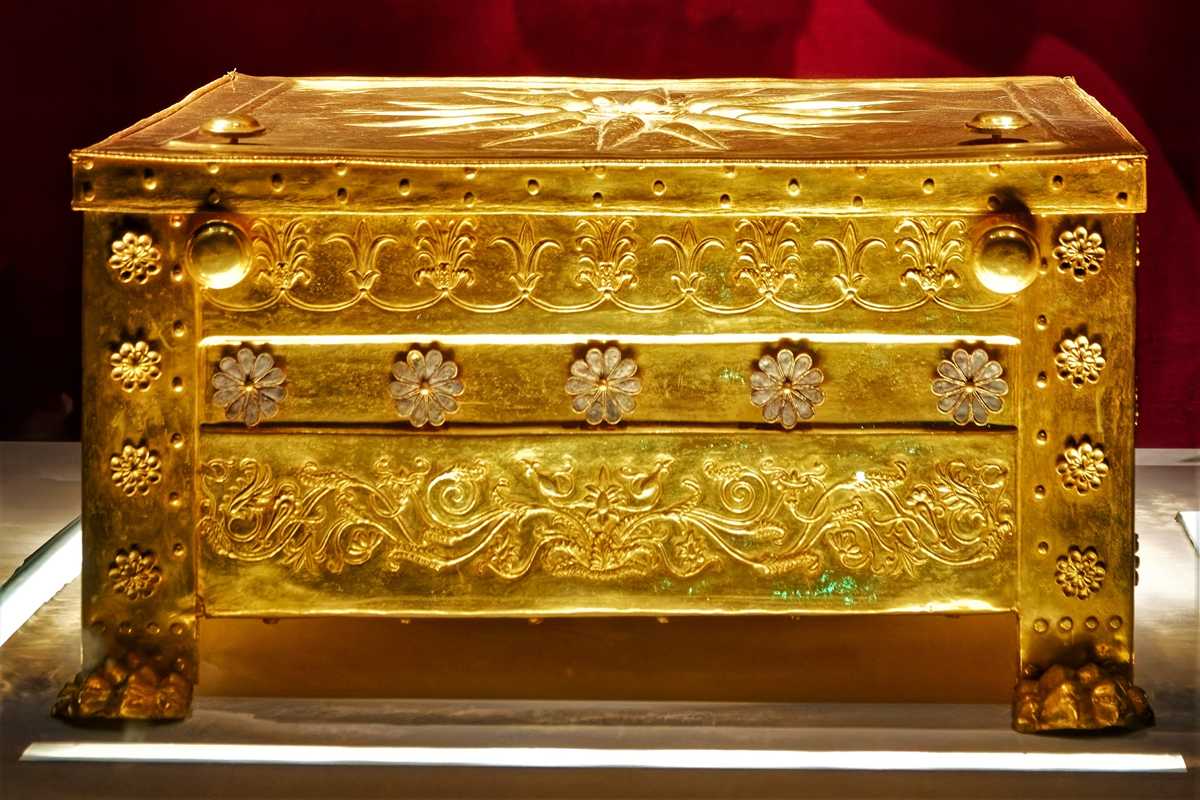
Next to it, a plundered cist grave holds a single wall painting, the god of the underworld carrying off Persephone. The visit with Vergina tickets also takes in the tomb of Alexander IV, son of Alexander and Roxane, the looted heroon and the golden larnax decorated with the Vergina Sun.
What do Vergina tickets show in the Central Museum Building?
Vergina tickets open the Central Museum Building, the gateway to the whole site, with an introductory exhibition on Alexander the Great, an architectural display, a sculpture hall, the main Aigai Memory exhibition, a periodic exhibition and an Art Gallery for contemporary artists.
A reconstructed part of the palace forms the centrepiece of the architectural display, a direct link to the palace site that Vergina tickets also cover. The building is the hub of the polycentric museum and houses the physical base of a digital museum on Alexander the Great, while the periodic exhibition carries the title Oikoumeni Antidoron.
The building has a café and a shop that sells selected official copies of Greek antiquities, archaeology books and souvenirs. The Royal Tombs have the same two facilities, so visitors with Vergina tickets can stop for a drink or a souvenir at either museum building.
What do Vergina tickets add at the Palace of Aigai and the theatre?
Vergina tickets add the Palace of Aigai, which covers about 15,000 square metres and ranks as the biggest building of classical Greece, along with the theatre beside it, where Philip II was assassinated in 336 BC, the event that made his son Alexander king.
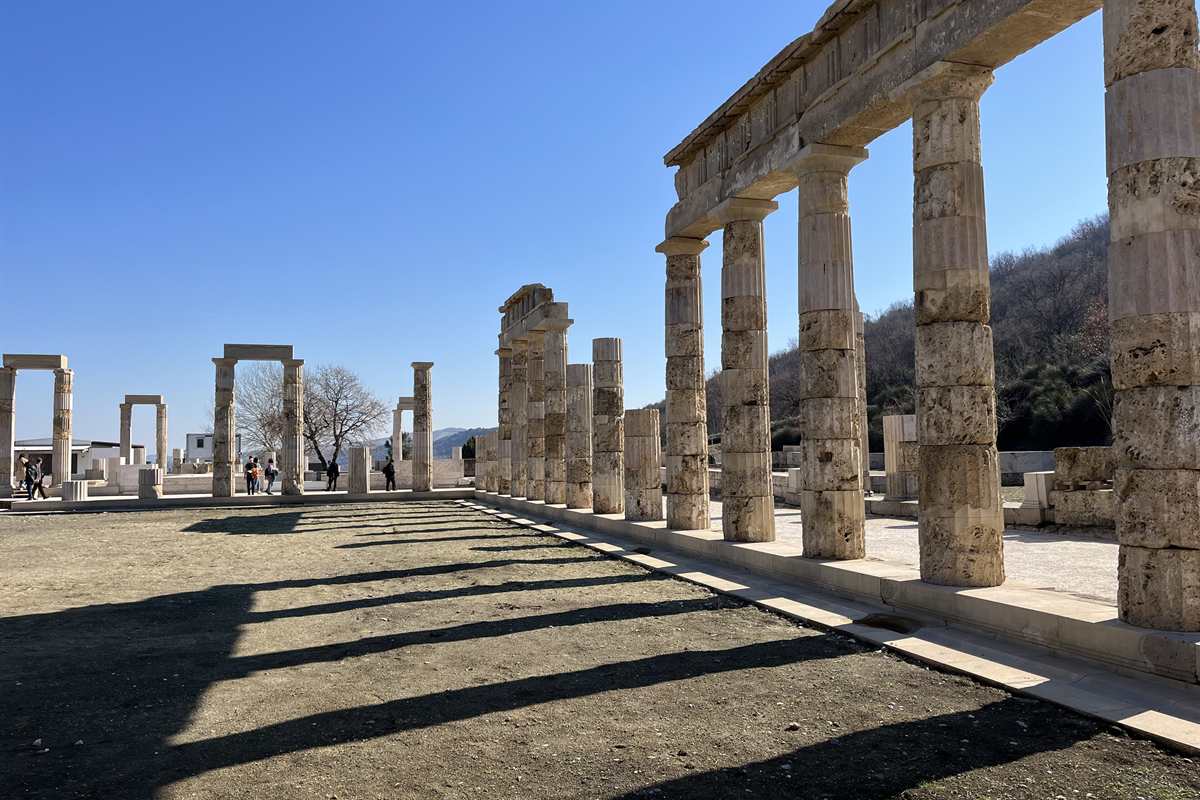
On the palace site, Vergina tickets lead visitors to a vast square peristyle lined by 16 Doric columns per side, close to 30 of them now rebuilt. The court covers 4,000 square metres and held room for at least 8,000 people, as the building served public life rather than a royal household.
The front set a monumental gateway, the propylon, between two-storey porticoes, Doric below and Ionic above, one of 10 columns on the south side and one of 11 on the north, the first complete porticoes of that kind in Greek architecture. In the south wing, a floral mosaic and the abduction of Europa mosaic survive.
The theatre lies next to the palace, on its north side, and belongs to the same building programme of Philip II as the nearby sanctuaries. A corridor on the palace’s north side gave a view over the theatre and the Macedonian plain. Vergina tickets list the Ancient Theatre as a section in its own right.
Do Vergina tickets cover the necropolis and the church of Saint Demetrius?
Yes, Vergina tickets cover both: the Necropolis – Royal Cluster of Temenides, a park inside the royal cemetery of Aigai, and the post-Byzantine church of Saint Demetrius at Palatitsia, with murals from the 16th century. Both sections close for the winter season.
The cemetery of Aigai spreads over more than 200 hectares north of the walled town, and its central zone of about 50 hectares still holds 540 small and medium burial mounds. Vergina tickets give access to the park around the Temenid cluster, one of three royal groups that together hold 34 royal tombs found so far.
Within the park, the Temenid cluster, begun around 575 BC, holds twenty-one tombs spanning the Archaic age to the early Hellenistic years. Built cist graves replaced the first pit graves around 540/530 BC, and two 5th-century BC underground tombs have Ionic columns and stone steps at the entrance.
In Palatitsia, the same Vergina tickets admit visitors to Saint Demetrius, a broad basilica painted in 1569-1570 by Nikolaos from Linotopi, in the Kastoria area. Drums from the palace’s Doric colonnades serve as bases for its columns, and the murals survive nearly whole. The Last Judgement fills the east wall of the narthex, with Alexander the Great beside Nebuchadnezzar, Cyrus and Augustus.
Where can you buy Vergina tickets?
Vergina tickets sell online at tickets.hh.gr, the official Hellenic Heritage store, in person at the site’s ticket offices, and through the GetYourGuide and Viator platforms, which resell an adult entry bundled with two self-guided audio tours that play on your own smartphone.
Hellenic Heritage belongs to ODAP, the state body that develops Greece’s cultural resources under the supervision of the Ministry of Culture; it alone holds the right to issue entry tickets for Greek archaeological sites and museums. The English visit page of aigai.gr sends buyers of Vergina tickets straight to the store’s Aigai venue.
Two Greek-language visit pages on aigai.gr link a purchase service on hhticket.gr instead. Travel agencies that legally operate in Greece or another EU country can open partner accounts on the same system, and the store’s terms treat Vergina tickets as valid only when an official ODAP point of sale issued them, which rules out unofficial sellers.
How do Vergina tickets work as e-tickets?
Vergina tickets bought online reach you by e-mail as a PDF file, carry the entry time slot picked at purchase and a code that staff scan and cancel at the checkpoint, while reduced and free holders show original identification with the ticket.
Full-price Vergina tickets arrive as soon as the card payment completes. Reduced and free tickets follow the same route when an ID card or passport proves the status; where extra papers are needed, the e-mail holds a proof of purchase with a code, exchanged at the ticket office on the visit day with the originals.
A third route needs only a scan: when ODAP can check a free-entry status through an official national digital portal, the buyer receives a QR code by e-mail, and scanning it is enough to enter. Reseller Vergina tickets differ: the audio bundle arrives as a mobile voucher with instant confirmation, redeemed at Vergina.
Who gets reduced or free Vergina tickets?
Free Vergina tickets go to EU visitors up to 25, children up to 18 from outside the EU and other groups the Ministry of Culture lists, reduced ones go to EU visitors over 65 and school escorts, and everyone enters free on set dates.
One admission code from the Ministry of Culture governs every state-run site and museum, and Vergina tickets follow it. An ID card or passport proves age and origin, while other free categories need a certificate or membership card, so bring the document that fits your case. Free entry also covers:
- Visitors with a disability of any nationality, plus one companion for a 67% rating
- Journalists and members of ICOM or ICOMOS, on their valid cards
- Holders of the Ministry’s three-year Free Entry Pass
Reduced Vergina tickets cover a short list: citizens of Greece or any other EU state aged over 65, parents who accompany primary schools from the EU or the European Economic Area, and teachers who lead school or university groups from non-EU countries. The over-65 reduction applies from 1 October and lapses for June, July, August and September.
Vergina tickets are free for everyone on 6 March, in honour of Melina Mercouri; on 18 April, International Monuments Day; on International Museums Day a month later; on the last weekend of September, for the European Heritage Days; on 28 October; and on the first and the third Sunday in each month from 1 November until 31 March. On those dates, only the ticket offices issue tickets.

How long are Vergina tickets valid?
Vergina tickets are valid for one person on the day or period printed on them, inside the booked slot, and admit you once to each unit they list, so leaving a unit ends the ticket there; the reseller bundle shows a one-day validity.
The Hellenic Heritage terms also ask you to keep the stub for the whole visit and show it to staff on request. Groups of more than five can buy an adjusted group ticket in the leader’s name, and those Vergina tickets hold for the day and time slot selected.
The longest validity belongs to the Ministry’s Free Entry Pass: three years, renewable, issued by its regional services on a simple application with two photographs and supporting documents. Teachers in Greece and graduates of archaeology, history, architecture or fine arts schools are among those who qualify, and holders get free Vergina tickets.
Which tours include Vergina tickets?
Of the tours checked, the GetYourGuide and Viator e-ticket bundle is the one that states Vergina tickets come with the booking; the day trips from Thessaloniki describe their stops, guides and transport, and one guided visit lists the museum entrance fee as excluded.
The GetYourGuide day trips checked here all leave from Thessaloniki and run in English, yet their summaries describe the route rather than the admission. Read each inclusion list for Vergina tickets before you pay; the wider choice of day trips from Thessaloniki adds Meteora, Mount Olympus and Halkidiki.
- Private pickup in Thessaloniki for a small-group visit to the Aigai tombs and the museum at Pella
- An archaeologist-led full day joining Pella and Aigai, with the royal tombs museum
- A small-group visit to the royal tombs and Philip II’s burial site, with a private option
- A full-day coach trip to Vergina and Pella with skip-the-line entry
Trekking Hellas shows the opposite case: it runs a three-hour tour with its own guide that meets at the entrance of the Vergina museum, or at Aristotelous Square in Thessaloniki for an optional transfer, and its exclusions name the museum entrance fee, so its guests buy Vergina tickets themselves.
Do Vergina tickets come with an audio guide or a guide?
The aigai.gr visit page and the Ministry’s records attach no audio guide to Vergina tickets, while the GetYourGuide and Viator bundle adds two self-guided phone tours in English; live guides come with guided tours, and tourist guides in Greece enter free.
The bundle’s inclusion list names an activation link, two self-guided audio tours for Android and iOS phones, and offline text, narration and maps that avoid roaming charges. It excludes a live guide, the phone, headphones, food and transport, so bring earphones along with your Vergina tickets.
The Digital Guide app of Hellenic Heritage, run by the same operator as the ticket store, holds self-guided audio in 8 languages for 40 sites. Its page names the Acropolis, Delphi, Festos and Olympia but not Aigai, so check the app for Vergina before choosing plain Vergina tickets over the audio bundle.
Live guiding comes with the archaeologist-led day trip, private guided tours on Viator and the Trekking Hellas visit. Tourist guides in Greece enter free on a professional ID card, and certified guides can open a Hellenic Heritage partner account to issue a free admission card, yet each group member still needs Vergina tickets.



How do you reach Vergina to use your Vergina tickets?
To reach Vergina and use Vergina tickets, drive 1 hour from Thessaloniki or 15 minutes from Veria, ride the KTEL coach to Veria and the local bus on to the village, or book a taxi transfer; the palace and theatre are reached on foot.
Drivers with Vergina tickets take the Egnatia Odos (A2) west from Thessaloniki and leave it for road 5305 through Meliki, a route that skips Veria. From Veria, the Royal Tombs museum lies about 13 km away by the southern bypass and the Veria–Meliki road. The access road for the palace and theatre is closed to vehicles, so drivers park at the municipal car park and walk.
Bus travellers with Vergina tickets change at Veria, which also has trains on the Thessaloniki–Edessa line. KTEL coaches leave the Makedonia station in Thessaloniki for Veria 25 times on weekdays, with a thinner weekend timetable, and the ride lasts 1 hour or 1 hour 20 minutes. From Veria, the KTEL line through Vergina and Palatitsia to Meliki takes 20 minutes and stops beside the Royal Tombs.
A pre-booked taxi transfer from Thessaloniki Airport covers 101 km to Vergina in about 1 hour 8 minutes, and the driver meets the flight and tracks any delay. Travellers who pair Vergina tickets with Veria tours catch the village bus at the Veria bus station, just north of Elia Square, or drive the 15 minutes south-east.
In which order do you use Vergina tickets across the sites?
Use Vergina tickets from west to east: the Central Museum Building first, then the Royal Tombs in the village centre, the Necropolis next door, the theatre and palace further south on foot, and Saint Demetrius at Palatitsia last, a short drive east.
The Central Museum Building stands north-west of the village centre, 1.9 km from the Royal Tombs: about 25 minutes on foot or 3 minutes by car. Opening Vergina tickets there gives an overview of the ancient city before the tombs. The Necropolis lies 0.3 km east of the tombs, a 4-minute walk.
From the Royal Tombs, the Palace of Aigai lies 750 m away, and the theatre stands beside it, so one walk on the pedestrian road covers both. Vergina tickets then end at Saint Demetrius, the Post-Byzantine church in Palatitsia, 4.9 km from the theatre: about 9 minutes by car, or a ride on the KTEL line from Veria, which continues through Palatitsia to Meliki.
Bus riders follow the stops. The village bus halts close to the Royal Tombs museum, so Vergina tickets can start there and finish with a walk west to the Central Museum Building. KTEL also lists a stop at the new archaeological museum on its Sunday Veria–Vergina service, which returns from the village square.
How much time do Vergina tickets need on the day?
Vergina tickets fill at least 3 hours on site: 40 to 60 minutes in the Central Museum Building, 1 hour 30 minutes in the Royal Tombs, the walks between the sites and time on the palace plateau, plus an hour’s drive each way from Thessaloniki.
Inside the Central Museum Building, the main exhibits take 40 to 60 minutes, and each room carries dense English panels. The narrated audio route through the Royal Tombs runs 1 hour 30 minutes, so the two indoor stops alone use up over 2 hours of a day on Vergina tickets.
The open-air half of Vergina tickets adds walking time. The four legs from the Central Museum Building to the Royal Tombs, the Necropolis, the theatre and the palace total about 45 minutes on foot, and summer heat on the plateau, with limited shade, makes long stretches of exploring harder.
Travel time frames the day. The drive from Thessaloniki takes 1 hour each way, while bus riders add the coach to Veria and the 20-minute village bus, plus the wait between them. From 1 September, closing time moves earlier in four steps as daylight shortens, so autumn days on Vergina tickets begin early to fit every site.
Which rules come with Vergina tickets inside the museums?
Vergina tickets come with five site rules: last admission falls 20 minutes before closing, bags can be checked, staff can refuse anyone carrying bottles or sharp objects, visitors leave the finds and ruins untouched, and the palace road is for walkers only.
The Hellenic Heritage terms behind Vergina tickets let site staff refuse entry, even to a ticket holder, to visitors affected by alcohol or drugs and to anyone carrying bottles, sharp or flammable items, or objects usable as weapons. Holding a ticket also means accepting checks of personal belongings and the operating rules of each site.
Each site stops admitting visitors 20 minutes before closing, so the final stop on Vergina tickets needs that margin. The finds and ruins stay untouched, with no climbing on the ancient structures, and the uneven ground and limited shade of the open-air sites call for closed-toe shoes, a hat and sunscreen.
When is the best time to use Vergina tickets?
April and October suit Vergina tickets best, on any day from Monday to Friday except Tuesday: all six sites open from 1 April to 31 October, those months bring milder heat and thinner crowds than summer, and weekday coaches run the fullest timetable.
The summer season, from 1 April to 31 October, opens all six sites on Vergina tickets. In winter, November to March, the Necropolis and Saint Demetrius close, while both museum buildings, the palace and the theatre stay open. The sites shut on 1 January, 25 March, Easter Sunday, Labour Day and 25 and 26 December.
Weather tips the choice of month. From June to August, the open-air sites see days above 30°C, so summer visits with Vergina tickets work best at the start or the end of the day, while April and October bring comfortable temperatures and quieter sites. Around Easter, Good Friday and Holy Saturday bring shorter hours.
Within the week, Tuesday is the weak day: the museums and the palace open later than on other days in summer and close all day in winter, and the museum shops close every Tuesday. Saturday brings two village buses from Veria, against four on each weekday, so a midweek day suits Vergina tickets for travellers without a car.
Can you combine Vergina tickets with Pella or Veria?
No, Vergina tickets cover only the six sites that make up the Polycentric Museum of Aigai, so Pella and the Byzantine and Archaeological Museums of Veria each charge their own admission. Budget a separate ticket for each of those stops on a combined day.
Pella belongs to a different service, the Ephorate of Antiquities of Pella, and Hellenic Heritage sells its archaeological site and its Archaeological Museum through two separate ticket pages. Vergina tickets do not open either, so a day that follows the Macedonian kings from Aigai to Pella, their later capital, needs separate Pella admission. Our Thessaloniki day trip to Pella sets out what each part holds.
Veria follows the same rule. The Imathia Ephorate of Antiquities looks after Aigai and both Veria museums, yet Vergina tickets do not admit you to the Byzantine Museum or the Archaeological Museum, and each sells its own full and reduced tickets. Neither shows an online ticket button on Hellenic Heritage, unlike the Aigai and Pella pages.
The two Veria museums add to a day on Vergina tickets rather than repeat it. The Archaeological Museum shows finds from Veria and the Imathia sites other than Aigai, and the Byzantine Museum traces the city through its Byzantine, post-Byzantine and Ottoman centuries. Five monuments in Veria under the same Ephorate charge no admission at all:
- the Old Metropolitan Church of Veria
- the Christos church (Resurrection of Christ the Saviour)
- the Twin Ottoman Baths
- the Orta Mosque
- the archaeological site of Saint Patapios
Can cruise passengers use Vergina tickets on a Thessaloniki stop?
Yes, cruise passengers use the same Vergina tickets as any other visitor, and shore excursions reach the Royal Tombs as day trips from Thessaloniki. Viator sells a Thessaloniki shore excursion to the Vergina Royal Tombs that runs as a private tour from the city.
Ships call at the Port of Thessaloniki, whose passenger terminal ranks among the largest in the Aegean basin and occupies the former customs house, built between 1909 and 1912. The port lies very close to the city centre. If Vergina tickets carry a time slot and the ship docks late, the slot can move until 120 minutes before entry.
Three GetYourGuide day trips from Thessaloniki show the range. The shortest, a 5-hour visit to the Aigai Royal Tombs and the Pella Museum, offers private pickup anywhere in Thessaloniki. The Vergina and Pella bus trip lasts 8.5 hours and the Macedonian Treasures trip through Veria and Vergina 8 hours, so match the length to your time ashore and confirm whether Vergina tickets are included.
How accessible are the sites on Vergina tickets?
Vergina tickets open two museum buildings that the Ephorate describes as easy to access for visitors with disabilities: the Central Museum Building, plus the Royal Tombs with the space around them. The Royal Tombs also list a ramp, parking and an accessible toilet.
For visitors with limited mobility, the palace and the theatre involve a walk. Their approach road is open to pedestrians only, so cars stay at the Vergina municipal car park, and Hellenic Heritage places the palace 750 metres from the Royal Tombs museum. The Ephorate’s pages for the palace, theatre and necropolis carry no accessibility statement, so ask the Ephorate before a wheelchair visit on Vergina tickets.
Two GetYourGuide day trips from Thessaloniki carry a wheelchair accessible label and offer pickup: the Macedonian Treasures trip to Veria and Vergina, and the Aigai Royal Tombs and Pella Museum trip. On a combined day beyond Vergina tickets, Hellenic Heritage lists a lift at the Archaeological Museum of Pella and at both Veria museums, and accessibility among the amenities of the Pella site.

Can you change or refund Vergina tickets?
Official Vergina tickets cannot be cancelled, refunded or amended once paid, except for a selected entry time slot, which Hellenic Heritage lets you move until 120 minutes before the visit. Booked tours follow their own rules, and the GetYourGuide trips named here offer free cancellation.
Under the terms of the official store, a chosen time slot can be moved twice at no charge, as long as each move happens at least 120 minutes before the booked entry, through the Manage Tickets service of Hellenic Heritage. Every other detail of Vergina tickets stays fixed after payment, and once you pass the entrance of a site, no refund applies for any reason.
Proof of status matters as well. A holder of reduced Vergina tickets who cannot show the required documents at the entrance is turned away and gets neither a change of ticket nor a refund, so pack the papers that prove eligibility before leaving for the site.
Booked tours carry their own terms, separate from those of Vergina tickets. On GetYourGuide, the Vergina and Pella bus trip, the Macedonian Treasures trip and the Aigai Royal Tombs and Pella Museum trip all show free cancellation, with booking cut-offs of 30 minutes, 10 hours and 4 hours before the start.
Frequently Asked Questions
Do you need Vergina tickets for the theatre at Mieza?
No. The Imathia Ephorate of Antiquities, which runs the sites covered by Vergina tickets, lists free admission for the ancient theatre of Mieza and its Nymphaion in the municipality of Naoussa. Both sit outside the Aigai ticket, so a detour there adds no entry cost to a day built around the royal capital.
What happens if you lose Vergina tickets?
Hellenic Heritage does not cover the value of Vergina tickets that are lost, stolen or destroyed, so a missing ticket means buying a new one. Guard the code as well as the file: the terms treat the first person who presents a ticket as its legal holder and refuse anyone who arrives later with another print of it.
Can you resell Vergina tickets?
No. The official terms ban the exchange, resale and any trading of Vergina tickets, and tickets traded that way are invalidated. A sales partner found trading them is struck off the electronic ticket system for two years, and the ban doubles to four years for a repeat case after reinstatement.
What happens to Vergina tickets if the site closes on your visit day?
If force majeure closes the site to visitors on your day of arrival, the terms let Hellenic Heritage either extend the validity of Vergina tickets, after notifying you, or refund the ticket price. A refund returns the ticket value only, with no compensation for transport or any other expense tied to the cancelled visit.