
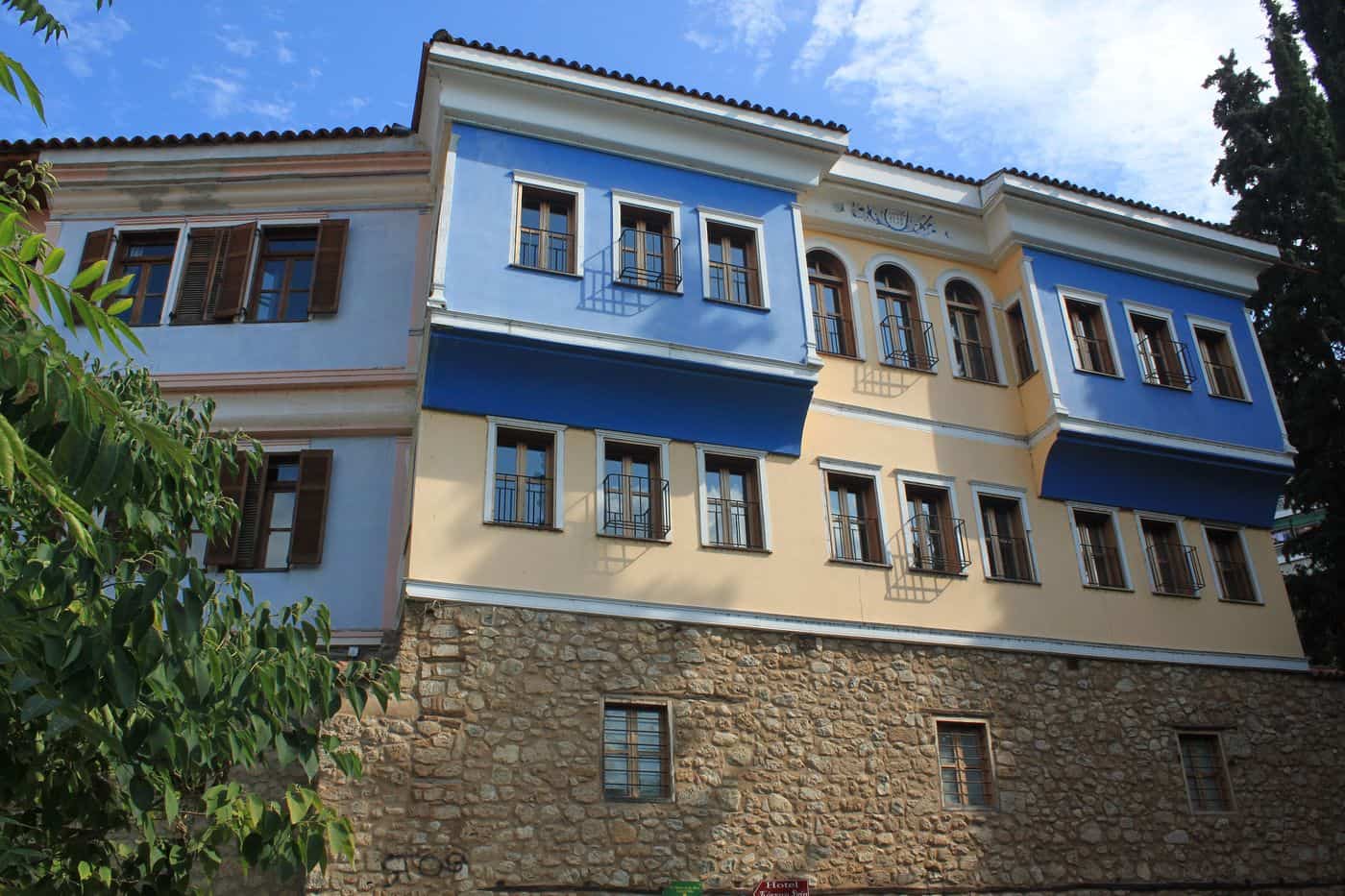
Veria tours start in the capital of the Imathia regional unit in Central Macedonia, a town at the eastern foot of the Vermio Mountains, north of the Haliacmon river. The routes cover the Byzantine churches, the Barbouta Jewish quarter, the Bema of Saint Paul and the museums of the town. Greece Tours lists the day tours that pair Veria with Vergina and the royal tombs of Aigai.
This page covers what Veria tours see in the town, which trips continue to Vergina, Naoussa, Seli and the lakes of the Aliakmonas, how visitors reach Veria, and which season suits each route. The tours below are checked on GetYourGuide and leave from Thessaloniki, Veria and Vergina.
What do Veria tours cover?
Veria tours cover the capital of the Imathia regional unit in Central Macedonia, a town of 48,508 residents at the 2021 census. The town rises at the eastern foot of the Vermio Mountains, with Byzantine churches, the Barbouta quarter and the Bema of Saint Paul.
Veria is the seat of the Municipality of Veria, formed in the 2011 local government reform from five former municipalities: Apostolos Pavlos, Dovras, Makedonida, Vergina and Veria. The municipality counted 62,064 residents at the 2021 census. Imathia holds three municipalities, Veria, Naousa and Alexandreia, and it became a prefecture in 1946 with Veria as its capital.
The town sits on a plateau at the western edge of the Central Macedonia plain, north of the Haliacmon. It straddles the Tripotamos, a tributary of the Haliacmon that crosses the western part of the town. Veria tours walk its small bridges and its bed, under plane trees, alders and willows.
- Elia: the central square, known as the Balcony of Veria, sits on a slope with an extensive view of the Imathia plain.
- Ottoman monuments: eight of the town’s thirteen mosques survive, along with the Twin Hamam.
- Public fountains: taps across the town run cold water 24 hours a day, since the high pressure in the water network needs an outlet.
Visitors based in Thessaloniki join Veria tours on a Veria day trip from Thessaloniki.
What do Veria tours see in the Byzantine churches?
Veria tours see around 48 surviving Byzantine and post-Byzantine churches, out of 72 at the start, a total behind the town’s name of Little Jerusalem. The Church of the Resurrection of Christ leads the list, with frescoes by Georgios Kalliergis from 1314/15.
Veria tours find the Church of the Resurrection of Christ, or Anastasis, in the south part of the town. Its founder’s inscription records that Xenos Psalidas paid for it in 1314/15, after the death of his wife Euphrosyne. The building has a single nave, a timber roof, a hexagonal apse and three entrances, one on each side.
The frescoes belong to the Palaiologan renaissance, with a wide range of colours and precise drawing. On the side walls, full-length saints fill the lower zone, busts of evangelists, saints and prophets the middle zone, and the Great Feasts the top zone. Kalliergis ranks among the rare Byzantine Greek painters known by name, and in an inscription he calls himself the greatest painter in all of Thessaly.
- Old Metropolis: an early 11th-century basilica, one of the largest surviving middle Byzantine buildings in the Balkans, which served as the Hünkar Mosque from 1430.
- Reopening: the Old Metropolis was re-consecrated on 5 June 2016 and opens as a museum and archaeological site.
- Saints Kerykos and Ioulitta: a 14th-century church, repainted in 1589, with its original marble templon.
Veria tours pass a plane tree around 600 years old beside the Old Metropolis. Metropolitan Arsenios was hanged from one of its branches during the Ottoman capture of Veria.
What do Veria tours see in the Barbouta Jewish quarter?
Veria tours see Barbouta, the former Jewish quarter on the north-west side of the town, beside the Tripotamos river. The quarter dates from Roman times, takes its name from a fountain that still survives, and keeps its stone synagogue with a mikveh behind it.
Barbouta formed an enclosed, isolated ghetto with the synagogue and Chavras Street, the only commercial street of that era. A small Jewish community lived there at first. Towards the end of the 15th century, it grew with the arrival of Jews from Spain and Portugal. During the Occupation, the Nazis deported and exterminated almost all of the Jewish community of the city.
The synagogue is a stone building with an elaborate interior, in the heart of the former quarter. Unlike the Christian quarters, which had the church in the middle, Barbouta set its synagogue in line with the houses. Veria tours find it open to visitors as a historic monument, and it opens for worship on certain Jewish holidays and anniversaries.
- Sachnisia: the projecting bays of the houses, a characteristic feature of the quarter.
- Iliakos: a sun room raised above the roof.
- Doors: heavy double-leaf doors with horizontal and diagonal timbers, fixed with flat-headed nails.
- Mansions: the Beka mansion of 1859, the Tsartsani mansion of the 19th century and the Anastasiou mansion of 1882.
Veria tours continue to the Christian quarter of Kyriotissa, which follows the style of Barbouta, with sachnisia, heavy doors and narrow cobbled lanes.
What do Veria tours see at the Bema of Saint Paul?
Veria tours see the Bema of Saint Paul, also called the Step of the Apostle Paul, near Clock Square in the town centre. Paul preached Christianity there to the Jewish community of the city between 50 and 60 AD, and the original 1st-century steps survive.
Acts 17 tells how Paul and Silas left Thessalonica by night and went to the Jewish synagogue of Berea. The text calls the Bereans more noble than the Thessalonians, since they examined the Scriptures every day. When Jews from Thessalonica stirred up the crowds, the believers sent Paul to the coast, while Silas and Timothy stayed.
Veria tours stop at a historic monument of worldwide interest, a source of religious tourism for the town. People from all over the world arrive in every season to see the traces of the Apostle’s journey. The Holy Metropolis of Veria, Naousa and Kampania honours Paul as the founder of the church of Veria.
- Pavleia: the festive events held at the monument each June, which culminate on 28 and 29 June, the feast days of the Apostles Peter and Paul.
- Origins: Metropolitan Panteleimon of Veria, Naousa and Kampania established the Pavleia in honour of the Apostle in 1995.
- Sopater: a man of Berea, son of Pyrrhus, who left Macedonia with Paul, as Acts 20:4 records.
- Bereans: Protestant groups took the name of the city’s people, after their study of Scripture in Acts 17.
What do Veria tours see in the museums of the town?
Veria tours see the Archaeological Museum at Elia, founded in 1965 with finds from the Palaeolithic to the Ottoman period, the Byzantine Museum in the old Markos Mill, opened in 2002, and the Folklore Museum in the old Sarafoglou mansion.
The Archaeological Museum shows its finds in three rooms. Neolithic objects come from Nea Nikomedeia, regarded as the oldest known permanent settlement in Europe. The stele of the Gymnasiarchal Law, dated to 167 BC, describes education at the gymnasium of Veria and is the only law on gymnasia that survives from Greece.
The Byzantine Museum fills a stone flour mill built between 1908 and 1911 beside the Kyriotissa quarter. A fire destroyed it in 1981, and restoration turned it into a museum. Veria tours walk its three floors: Byzantine Veria, city life and religious worship.
- River god Olganos: an inscribed Roman bust of the 2nd century AD, found at Kopanos.
- Medusa head: a carving of the 2nd century BC among the sarcophagi and statues outside the Archaeological Museum.
- Byzantine collection: icons, wall paintings, manuscripts, coins and mosaic floors from the courtyard of Agios Patapios.
- Folklore Museum: the customs of the people of Veria, in rooms that show the interior architecture of the town.
- Vlach Folklore Museum: traditional costumes, photographs and objects of Vlach tradition, in a listed building beside Clock Square.
Veria tours also reach the Museum of Education, which traces Greek schooling from wax tablets to computers.
What history do Veria tours tell?
Veria tours tell the story of ancient Beroea, first mentioned by Thucydides in 432 BC, the seat of the Koinon of the Macedonians, a Roman and Byzantine centre, the Ottoman town of Karaferye and, from 16 October 1912, a Greek city.
Veria tours start with evidence that people lived here as early as 1000 BC. The city reached its peak under the Antigonid kings, minted its own coins and held the Alexandreia games in honour of Alexander the Great.
The Byzantine city became a centre of medieval Greek learning. Basil II took it back from the Bulgarians in 1001, and the Ottoman conquest became final around 1430. The Ottomans called the town Karaferye, “black Veria”, after its morning winter mist. The 17th-century traveller Evliya Çelebi counted 4,000 houses, 16 Muslim and 15 Christian quarters, and two Jewish congregations.
- 168 BC: surrender to Rome after the Battle of Pydna; Diocletian later made Veria one of the two capitals of the province of Macedonia.
- 1822: a rising against Ottoman rule, led by Anastasios Karatasos.
- 1864: a fire on the eve of 15 August that burned over 300 houses, shops and workshops, and eight churches.
- 1912: the entry of the Hellenic Army on 16 October, now an official holiday in Veria.
- 1946: Veria became the capital of the prefecture of Imathia.
Which Veria tours continue to Vergina?
Veria tours continue to Vergina, 12 km south-east of the city centre, where ancient Aigai, the first capital of Macedon, is a UNESCO World Heritage Site. The royal tombs stay in place inside an underground museum built over the Great Tumulus.
Philip II was assassinated in the theatre of Aigai in 336 BC, and his son Alexander the Great was proclaimed king there. In 1977, the archaeologist Manolis Andronikos dug the Great Tumulus for six weeks and found four buried tombs, two of them never disturbed. He identified Tomb II as the tomb of Philip II. The site entered the UNESCO list in 1996.
Vergina belongs to the municipality of Veria. Refugees from Anatolia founded the modern village in 1922 and named it after a legendary queen. Veria tours that reach the tombs also see the palace, on a plateau directly below the acropolis of Aigai.
- Golden larnax: a chest of 24-carat gold, 11 kilograms in weight, embossed with the Vergina Sun.
- Oak wreath: a gold wreath of 313 oak leaves and 68 acorns, 717 grams in weight, found inside the larnax.
- Hunting fresco: a wall painting 5.6 metres long above the Doric entrance of Tomb II.
- Persephone fresco: the abduction of Persephone by the god of the underworld, the only wall painting in Tomb I.
- Palace of Aigai: the largest building of classical Greece, open again after a 16-year restoration, with nearly 30 rebuilt columns.
A separate page covers Vergina tours and the full site of Aigai.

Which Veria tours continue to Naoussa and Seli?
Veria tours continue to Naoussa, 22 km north of the city on the eastern foothills of Vermio, for its Xinomavro red wine and the Agios Nikolaos park, and climb to Seli, the first organised ski centre in Greece, 24 km away.
Xinomavro, “sour black” in Greek, is the main red grape of the Naoussa uplands, and the Naoussa Protected Designation of Origin, set up in 1971, requires 100% Xinomavro. The Wine and Vine Museum shows the history of wine production in a neoclassical building of 1908.
Veria tours stop at Agios Nikolaos, 3 km from the centre of Naoussa, where the Arapitsa river rises among dense plane trees. The protected Landscape of Special Natural Beauty holds sports courts, an Olympic-size indoor pool, hotels and restaurants.
Seli lies in Kato Vermio, at 1,450 metres one of the highest villages in Greece. Its ski centre spans 1,534 to 1,900 metres, with 11 lifts and 17 downhill runs. It began work as an organised centre in 1934, the year of the first Panhellenic ski races, and the first lift in Greece went up there in 1955.
- Mieza: the ruins of the school of Aristotle near Naoussa, where the young Alexander the Great studied.
- 3-5 Pigadia: a second ski centre 17 km from Naoussa, the first in Greece with artificial snow.
- E4 trail: the international hiking path that crosses the Seli ski area.
- Naoussa carnival: the dances of the Boules and the Genitsari.
Winter Veria tours combine the slopes of Seli with Naoussa, and a separate page covers the Naoussa wine day trip from Thessaloniki.
Which Veria tours reach the Aliakmonas river and its lakes?
Veria tours reach the Aliakmonas at the Agia Varvara dam, 8 km south-east of the town, in the Straits, a narrow gorge between Vermio and the Pierian Mountains. South of Veria, the Asomata and Sfikia dams hold two more artificial lakes.
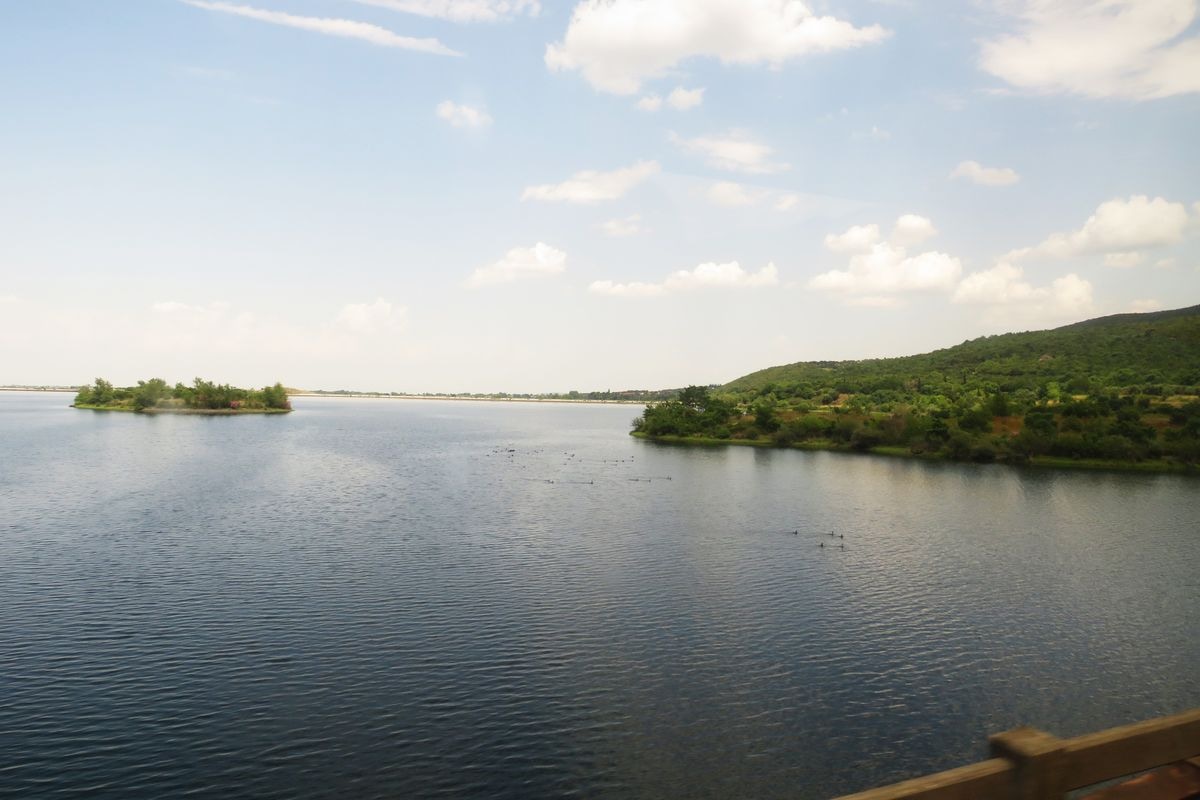
The Aliakmonas is the longest river that flows only on Greek soil, running 297 km from the Gramos mountains to the Thermaic Gulf. Veria stands on a plateau north of the river, which enters the central Macedonian plain south-east of the town.
Before the Agia Varvara dam went up in the mid-1950s, the river had no fixed bed in the lowlands and flooded the plain. Older residents of Veria and Alexandreia still recall the flood of December 1935. The dam now irrigates the farmland and supplies water to Thessaloniki, and its banks serve walks and bike rides, with parking near the Egnatia junction.
Veria tours on the river also stop at Asomata, a village at 210 metres on Vermio with a view over the plain, the dams and the lakes. The village centre is known for its grill houses. In summer, young people from Veria stage shows and concerts on the river banks.
- Lake Asomata: an artificial lake of 2.6 square kilometres behind a dam built in 1985, 8 km south of Veria.
- Lake Sfikia: the lake lies west of Sfikia, a village at 610 metres on the Pierian slopes, about 25 km south of Veria.
- Power station: the Sfikia plant on the Aliakmonas is one of two pumped-storage stations in Greece.
- Monasteries: Kallipetra stands at Rachi in the Aliakmonas valley, and Profitis Ilias sits at the Agia Varvara dam.
How do visitors reach Veria for Veria tours?
Veria tours start in a town 73 km by road from Thessaloniki and 511 km from Athens. The A2 Egnatia Odos passes the town to the south-east, KTEL buses link it with Thessaloniki, and Line T2 trains stop at Veria railway station.
Visitors who stay in Thessaloniki drive west on the A2, which shares its course with the A1 as far as the Kleidi interchange. There the A1 heads for Katerini and Athens, while the A2 continues west to exit 14, signed for Veria, Naoussa and Edessa. The motorway carries tolls, and the EO4 national road runs through the town itself.
Veria railway station opened in June 1894 on the Thessaloniki–Bitola line, 72 km from Thessaloniki, and keeps its original brick building. Line T2 of the Thessaloniki Regional Railway calls there. It runs via Sindos and Platy, where it leaves the Athens line, then on to Naoussa, Edessa and Florina. Rail-based Veria tours combine with Edessa tours, since both towns sit on Line T2.
- Trains: three trains a day run to Thessaloniki, two to Florina via Edessa and one to Edessa.
- Buses: KTEL routes link Veria with Naoussa, Alexandreia, Thessaloniki, Athens and Ioannina.
- Airport: Thessaloniki International Airport “Macedonia” lies 88 km east-north-east of Veria.
- From the west: the Egnatia section from Polymylos in Kozani crosses the Kastania pass through 15 tunnels, the longest 2.2 km, and 6 bridges.
When do Veria tours run best?
Veria tours run best in spring and early autumn, when April highs average 19.4°C and September highs 27.8°C, against 31.3°C in July. Peach blossom turns the plain pink each March, and the Imathiotika festivities fill late summer.
Veria has a Mediterranean climate on the edge of a cold semi-arid one. Hot, dry summers last from April to October, and July brings 14.1 mm of rain and 309.6 hours of sun. Wet, cool winters run from mid-October to March, and December is the wettest month at 69.1 mm. Humid winter mornings bring mist, and snow falls in the town once or twice a season.
Veria tours in spring meet the blossom. Each March, the Tourist Club of Veria leads a bike ride through the pink orchards of the plain. The International Guitar Festival takes the first week after Easter, with contests, master classes and recitals.
- Evichi Poli: a June music festival with street musicians, outdoor events and a record swap market.
- Peach Festival: mid-June events that link the local peach with modern cooking and culture.
- Imathiotika: a programme drawn from local tradition, from 15 August to 15 September.
- Week of Tradition: a festival of traditional dances at the end of August, in the town and its villages.
- Puppet festival: the International Puppet Theatre and Pantomime Festival, held each mid-October.
Winter Veria tours add the snow of Vermio, the range above the town, home to the Seli and Tria Pente Pigadia ski resorts.
Frequently Asked Questions
Can Veria tours include fishing on the Aliakmonas?
Yes. Anglers fish from the banks of the Agia Varvara lake, close to Veria. The river holds 33 kinds of fish, and about 30 of them are native. One of them, the mavrotsironi, lives nowhere else in the world. The river has also been stocked with rainbow trout for amateur fishermen.
Which birds do Veria tours find along the Aliakmonas?
Observers have recorded 215 kinds of birds in the Aliakmonas region, and about a third of them nest there. The list includes the Dalmatian pelican and the curlew, two of the rarest birds in the world, plus the purple heron. The river ends in a delta inside the Axios-Loudias-Haliacmon Delta National Park.
Can Veria tours continue by train beyond Edessa?
Yes, as far as Florina. Line T2 runs two trains a day from Veria to Florina by way of Edessa. The line was built to reach Bitola in North Macedonia, but no trains run there now, because the cross-border link from Mesonisi to Neos Kafkasos is disused.
Which winter events shape Veria tours?
Winter Veria tours meet the wine party on the pedestrian Elli Street, where visitors taste local wine to the sound of brass bands. At Christmas, the Regional Unit of Imathia runs a Chocolate and Confectionery Festival. The municipal theatre company, DIPETHE Veria, stages its plays in the town each winter and tours Greece in summer.