
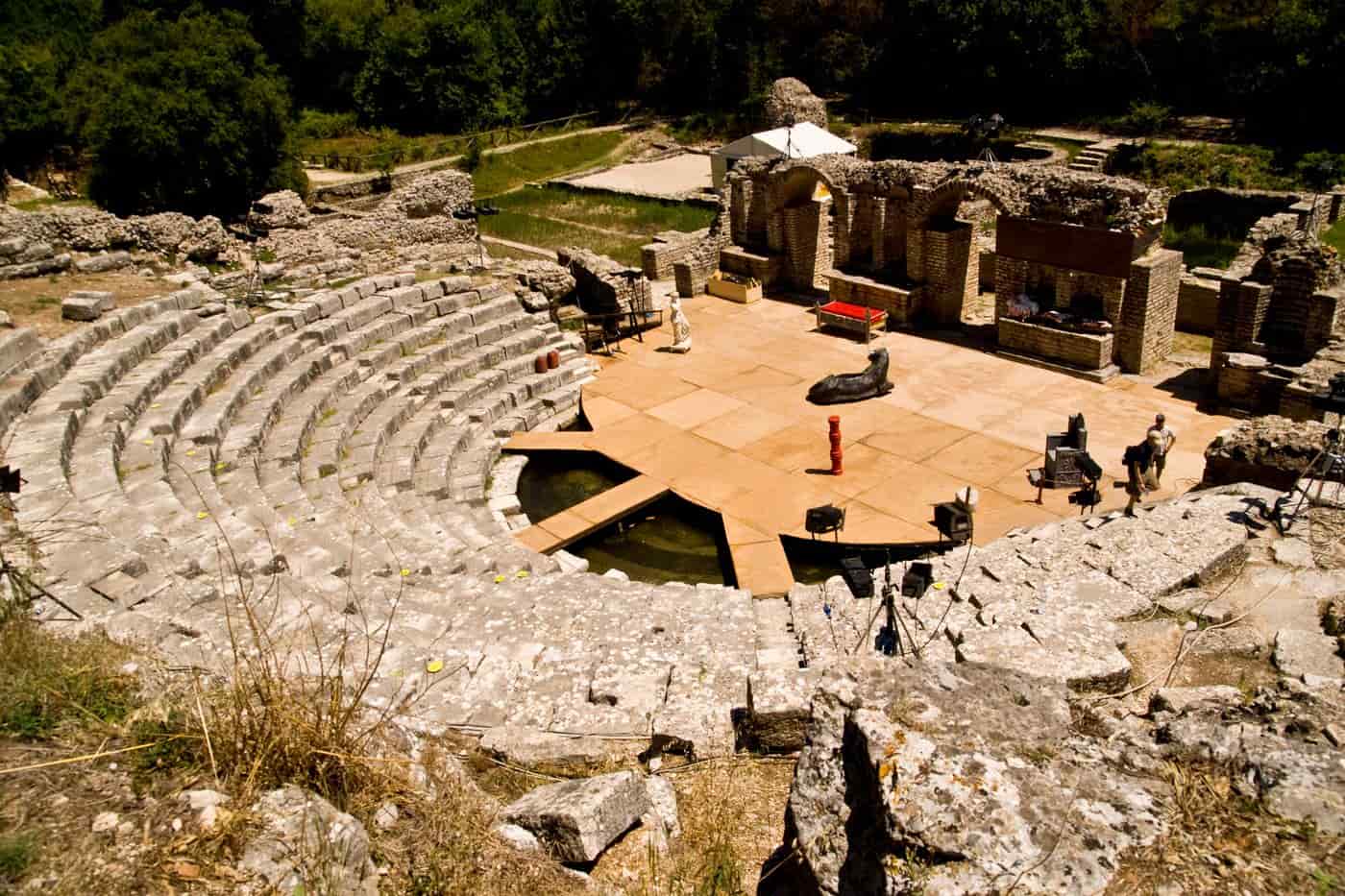
Butrint tours start at the ancient city of Butrint in southern Albania, inside Butrint National Park near Saranda and opposite the island of Corfu, on the UNESCO World Heritage List. The routes cover the theatre, the sanctuary of Asclepius, the baptistery, the great basilica, the Lion Gate, the Vivari Channel and the museum on the acropolis. Greece Tours lists the day trips that reach Butrint from Corfu.
This page covers what Butrint tours see inside the archaeological park, which trips combine Saranda, Ksamil and the Blue Eye, how visitors reach Butrint from Corfu and from mainland Greece, and which season suits each route. The tours below are checked on GetYourGuide and Viator and leave from Corfu, Saranda and Ksamil.
What do Butrint tours cover?
Butrint tours cover the walled ancient city of Buthrotum inside Butrint National Park in Vlorë County, Albania: the Greek theatre, the sanctuary of Asclepius, the 6th-century baptistery, the Great Basilica, the Lion Gate and the Venetian castle on the hilltop.
Butrint tours walk through a natural woodland, because the ancient city stands on a hill above the Vivari Channel. Holly oak and bay laurel form the upper tree level across the archaeological site.
The park lists its principal monuments as a Roman theatre, a Dionysus altar, a nymphaeum, thermae, a gymnasium, a forum, an aqueduct, the temples of Minerva and Asclepius, the Lion Gate and a baptistery. UNESCO calls Butrint a microcosm of Mediterranean history, with occupation from 50,000 BC up to the 19th century AD.
Butrint tours draw day-trippers from the nearby Greek island of Corfu, the route of our Corfu to Albania day trip.
- Greek city: a theatre, a sanctuary of Asclepius and an agora by the 4th century BC.
- Roman colony: an aqueduct, a Roman bath, houses, a forum complex and a nymphaeum built for veteran settlers.
- Late antique town: the Triconch Palace, the house of a local notable, built around 425.
What do Butrint tours see at the theatre and the sanctuary of Asclepius?
Butrint tours see the theatre just below the acropolis, facing out over the Vivari Channel, with Hellenistic inscriptions carved into its stones, and the sanctuary of Asclepius, whose cult made the fortified city a centre of worship around the 4th century BC.
The national park dates the theatre to the 3rd century BC and ranks it among the best-preserved buildings of the town. In the Roman period builders renovated and extended it, added boxes for the upper class above its two entrances and enlarged the auditorium for a growing population. Butrint tours also see the stage, rebuilt in the early 1st century AD.
Butrint tours point to the theatre inscriptions, which deal mainly with manumissions, the freeing of slaves. The names of the freed slaves are almost all Greek, and the Latin names among them bear Greek family names. In the mid-3rd century AD, under Emperor Decius, the local Christian Therinus was condemned to wild beasts in this theatre, and he later became a saint.
After Augustus made Butrint a veterans’ colony in 31 BC, new structures rose around the theatre and the temple of Asclepius. In the early 1st century AD the temple of Asclepius was rebuilt over the ruins of an older temple. Butrint tours at times find the theatre area under water, because climate change floods the zone of the ancient theatre and the Roman forum.
- Finds: the statue called the Goddess of Butrint, a marble head of Zeus and a portrait of Agrippa.
- Temple of Minerva: named in a 1st-century AD inscription on the southern acropolis.
- Events: concerts and performances held in the theatre.
What do Butrint tours see in the baptistery and the great basilica?
Butrint tours see the 6th-century baptistery, a round building 14.5 metres across with a cross-shaped font and a mosaic floor of seven circling bands, and the Great Basilica, a church with three naves, a transept and an outer polygonal apse.
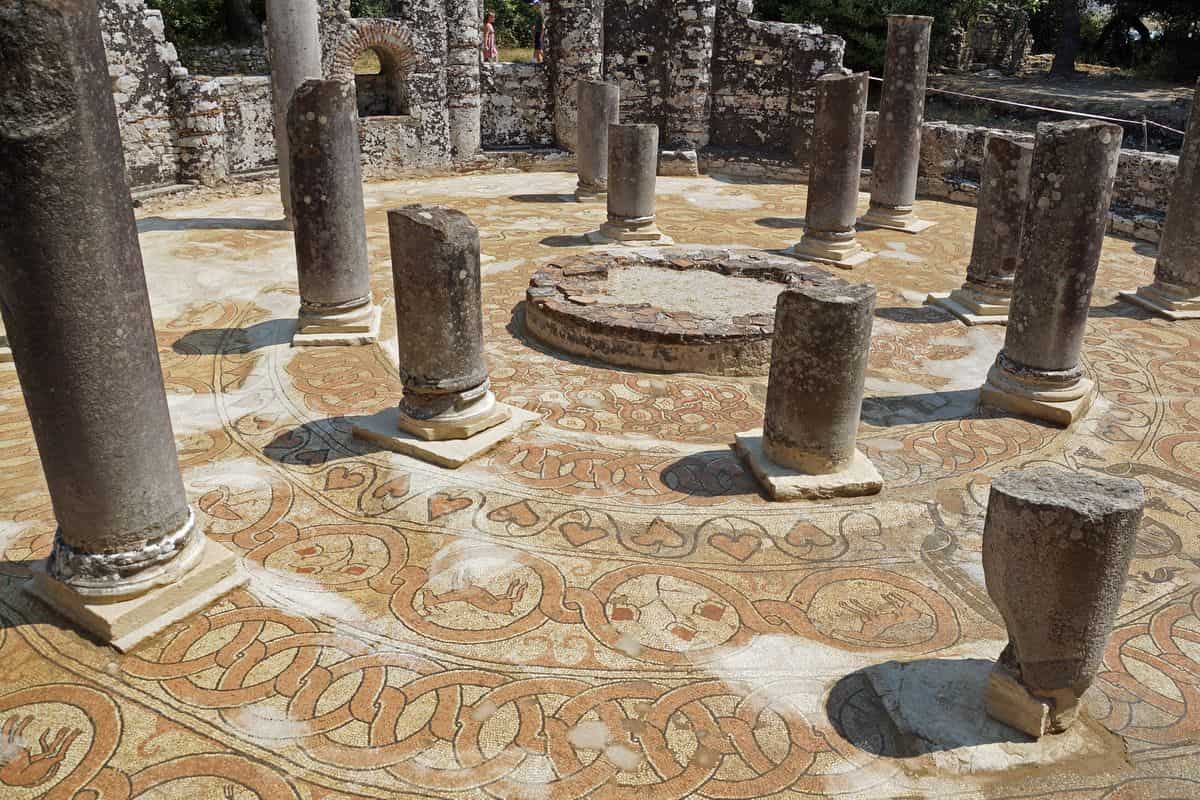
An Italian archaeological mission led by Luigi Maria Ugolini excavated the baptistery in 1928. Butrint tours find it inside a large rectangular space that once belonged to a Roman bathhouse or household bathing complex. Two concentric colonnades of eight Egyptian granite columns each, 16 in all, once held up a wooden roof, and 24 half-columns lined the plastered and painted inner wall.
Hot water from a furnace in the eastern corner room ran underground to the font and mixed there with cold water from a cistern. No surviving late antique baptistery in the Mediterranean has a more complex mosaic floor. Butrint tours look for two scenes: peacocks on either side of a kantharos hung with grapevines, a symbol of eternal life, and two stags at a fountain, a reference to Psalm 42. A small fountain in an arched recess faces the entrance, and archaeologists read it as an image of the Fountain of Life.
The Great Basilica went up in the lower city in the first half of the 6th century, and its walls still stand to their original height. It was rebuilt in the 9th century and again in 1267 by Charles I of Naples. Butrint tours can trace its plan in the ruins, which UNESCO rates as well enough preserved for analysis of the structure.
- Font steps: two interior steps lead down into the cross-shaped basin.
- Animal roundels: birds, sea animals, leopards, a hunting dog and a net.
- Acropolis Basilica: an older church from the end of the 4th century, paved with mosaics.
What do Butrint tours see at the Lion Gate and the walls?
Butrint tours see the Lion Gate, a 4th-century BC entrance that shows a lion about to eat a bull, the Scaean Gate, the three circuit walls of the acropolis and the Venetian castle on the highest point of the peninsula.
The outer circuit wall went up around 380 BC and enclosed an area of 4 hectares, with bastions and five gates. The Scaean Gate and the Lion Gate ranked as the two chief gates. At the Lion Gate, Butrint tours see a lion that stands for the people of the city and a bull that stands for their enemies.
Butrint tours pass through the Lion Gate’s very narrow passage, which limits the number of people who enter at the same time. The Italian excavations of 1928 to 1943 uncovered both gates, and Ugolini named the Scaean Gate after the gate of Troy in Homer’s Iliad. UNESCO notes that the fortifications show the different stages of their construction from the Greek colony to the Middle Ages.
Butrint was fortified again in the 5th century AD, when it became an episcopal centre. The walls burnt down in the 9th century and were repaired, and attacks by the despots of Epirus and later the Ottomans led to further strengthening. The Venetians bought the land around Butrint from the Angevin Kingdom of Naples in 1386 and soon built a castle on the highest point of the peninsula. Butrint tours climb to that castle, abandoned in 1572 during the wars between Venice and the Ottoman Empire.
- Tower Gate: a gymnasium rose beside it around the 2nd century AD.
- Triangular Castle: the Venetian replacement across the Vivari Channel, built to protect the fish traps.
- Restoration: Luigi Maria Ugolini restored the acropolis castle.
What history do Butrint tours tell?
Butrint tours tell a story that runs from a Chaonian Greek town to a Roman colony, a Byzantine bishopric, a Venetian outpost and a fort of Ali Pasha, ending with Italian digs from 1928 and the UNESCO World Heritage listing of 1992.
Butrint tours begin with the Greek city, a major centre of the Chaonians, an Epirote tribe with close contacts to Corcyra, modern Corfu. Its Greek calendar appears on the Antikythera Mechanism, the oldest known analog computer, dated c. 150 to 100 BC.
Butrint tours also follow the founding legend. The Roman writer Virgil named the seer Helenus, a son of King Priam of Troy, as founder. A local tale adds that a cow chosen for sacrifice, struck but not killed, swam across the sea, and Helenus named his city Buthrotos.
In 44 BC Caesar made Buthrotum a colony for soldiers who had fought for him against Pompey, though Cicero lobbied against the plan. In 31 BC, after the battle of Actium, Augustus renewed it, and new residents built an aqueduct, a Roman bath, a forum complex and a nymphaeum, doubling the town.
- 1204: the Despotate of Epirus takes the town after the Fourth Crusade.
- 1267: Charles of Anjou takes control of Butrint and Corfu.
- 1386: Venice buys the area, Corfu included, from the Angevins.
- 1537: Suleiman the Magnificent captures the Venetian outpost.
- 1798: Ali Pasha Tepelena conquers the city; after his death it stays Ottoman until 1912.
Modern Butrint tours owe the visible city to archaeology. In 1928 Mussolini’s Italy sent an expedition under Luigi Maria Ugolini, and the digs continued until 1943. Nikita Khrushchev visited the ruins in 1959 and suggested a submarine base. UNESCO kept Butrint on its Danger list from 1997 to 2005, and the National Park was declared in 2000 under its first director, Auron Tare.
What do Butrint tours see at the Vivari Channel and Lake Butrint?
Butrint tours at the Vivari Channel see two forts near its mouth, the Ali Pasha Castle and the Venetian Triangular Castle, a cable ferry across the water, and Lake Butrint, a 16-square-kilometre lagoon listed as a wetland of international importance.
The Vivari Channel links Lake Butrint with the Straits of Corfu, and its water flows in both directions every six hours. International organizations treat it as the line where the Adriatic Sea ends and the Ionian Sea begins. The Butrint Cable Ferry crosses it, and a pontoon sits near the park gate.
Across the channel, Butrint tours reach the Venetian Triangular Castle, built to defend the fish traps, a key source of food and income. After the acropolis was abandoned in 1572, Domenico Foscarini, the Venetian commander of Corfu, moved the administration of Butrint to this small fortress. The Ottomans seized it in 1655 and 1718, and Ali Pasha later rebuilt it.
Butrint tours also view the Castle of Ali Pasha Tepelena on a small island at the mouth of the channel, one of two forts he built in 1807 against French attacks from Corfu. It is a small rectangular structure with battered walls, two round towers with cannons on the seaward side and two square towers with firing loops.
Lake Butrint is a salt lagoon 7.1 km long, 3.3 km wide and 24.4 m at its deepest point, shaped like a giant footprint pointing north. Its mix of fresh and salt water suits mollusc farming, and the Ramsar Convention recognised the Butrint Wetlands in 2002.
- Birds: 246 species in the park; the common pochard, great cormorant and great crested grebe feed on the wetlands.
- Fish: 105 species, led by the flathead grey mullet, thinlip mullet and European eel.
- Mammals: 39 species, including the otter in the streams and lakes.
What do Butrint tours see in the museum on the acropolis?
Butrint tours climb to the Venetian castle on the acropolis, built after 1386 on the highest point of the peninsula and restored by Luigi Maria Ugolini; since 1936 it has housed the Archaeological Museum of Butrint, with marble statues and portraits.
The archaeological park covers 15 hectares at 30 to 50 metres above sea level, and the castle’s Albanian name is Kalaja Venedikase e Akropolit. Butrint tours on the hill also pass the Acropolis Basilica, built at the end of the 4th century and once paved with mosaics.
Inside the museum, Butrint tours see marble sculpture. The Apollo, a 2nd-century AD statue 1.38 metres tall, was found by Ugolini in the Nymphaeum, and its separately carved head is in the museum. The Artemis, a Hellenistic work of the 2nd century BC, shows the goddess in motion; it stands 1.25 metres tall, lacks its head and both arms, and was found on the hill of Finiq in 1958.
- Thefts: the stolen Artemis and Apollo turned up in Piraeus.
- Portraits: Germanicus, Herculiana and a girl, stolen in 1991, came back from Athens and Ioannina in summer 2003.
- Security: cameras, an alarm system and a generator keep surveillance running non-stop.
Which Butrint tours combine Saranda, Ksamil and the Blue Eye?
Butrint tours that combine Saranda, Ksamil and the Blue Eye link three stops in one day: the port town of Saranda, the beach village of Ksamil inside Butrint National Park, and the Blue Eye spring at Muzinë, the source of the Bistricë river.
Saranda, the unofficial capital of the Albanian Riviera, is the base for Butrint tours in Albania; its name comes from the Byzantine monastery of the Forty Saints. For visitors staying on Corfu, Saranda lies opposite the island, and a ferry service between Sarandë and Corfu was established in 1988.
Butrint tours stop at Ksamil, a village built in 1966 off the road to Butrint. Its main attractions are the Ksamil Islands, reached only by boat, though two of them are joined by a narrow strip of sand. The Guardian placed Ksamil Beach among its 20 best bargain beach holidays.
The Blue Eye, Syri i Kaltër in Albanian, is a spring in the village of Muzinë in Finiq municipality. Divers have descended to 50 metres, yet the true depth of the karst hole is still unclear. The source sits 152 metres above sea level, discharges 18,400 litres per second and feeds the 25 km Bistricë river, which reaches the Ionian Sea south of Sarandë.
- Blue Eye: a natural monument of 180 hectares with oak and sycamore trees.
- Lekures Castle: views over Saranda Bay, the Butrint Lagoon and Corfu.
- Ksamil walls: the Corcyreans built fortifications from Ksamil to Buthrotum during the Peloponnesian War.
Which Butrint tours leave from Corfu?
Butrint tours from Corfu leave from the New Port of Corfu Town and cross the strait to the port of Sarandë in Albania. Flying Dolphin hydrofoils take 30 minutes and slower ferries take 90 minutes, with sailings every day in both directions.
The northeastern edge of Corfu lies off the coast of Sarandë, across a strait that varies from 3 to 23 km in width. A ferry service between Sarandë and Corfu began in 1988, and Butrint tours from Corfu still use that sea route to reach the ruins.
Ionian Seaways sails 2 Flying Dolphins, 1 passenger ship and 2 car ferries between Corfu and Sarandë. Finikas Lines, in service since 1994, runs 3 Flying Dolphins and 3 passenger ships on the same line, with daily departures from the port of Corfu Town.
Butrint tours from Corfu enter Albania, so every passenger meets the Albanian entry rules:
- Passport: every visitor carries a passport valid for at least 3 months.
- ID card: citizens of certain countries enter with an ID card in lieu of a passport.
- Visa-free stay: Schengen Annex II nationalities receive 90 days of visa-free entry, bar 13 countries such as Dominica and Tonga.
- Residence permit: holders of a Schengen, Cypriot, Irish, British or US residence permit enter without a visa for up to 90 days.
- e-Visa: citizens outside the visa-exempt countries obtain an Albanian e-Visa.

How do visitors reach Butrint on Butrint tours?
Butrint tours reach the ruins by road from Sarandë, which lies 18 km to the north. The road, first built in 1959, runs south past Ksamil to the southeastern corner of the Ksamil peninsula, where Butrint stands close to the Greek border.
The road was built for a visit by the Soviet leader Nikita Khrushchev and was upgraded during the summer of 2010. Ksamil lies off this road, so Butrint tours from Sarandë pass the village on the way to the site.
Public transport in Albania runs mainly on furgons, minibuses with yellow plates, and bus transport is also available. Ionian Seaways adds bus transfers to and from the ports of Sarandë and Corfu for passengers on its crossings.
Butrint tours by car from mainland Greece cross the border at Kakavia or Qafë Botë. Kakavia carries the main road from Sarandë and Gjirokastër to Ioannina, and the Greek village of Ktismata sits 3 km from the border and 47 km northwest of Ioannina.
Qafë Botë faces Mavromati near Konispol, a town 1 km from the border. Sagiada, 4 km south of Konispol, lies 15 km northwest of Igoumenitsa, and visitors on Igoumenitsa tours also reach Corfu on the frequent passenger and car ferries from that port.
- Kakavia: Kakavijë in Dropull faces Kakavia in Pogoni, on the SH4 in Albania and the EO22 in Greece.
- Qafë Botë: Qafë Botë in Konispol faces Mavromati in Filiates, on the SH-97 in Albania.
- Rips: Rips in Finiq faces Ampelonas in Filiates, on a local road for pedestrians only.
When do Butrint tours run best?
Butrint tours draw visitors all year round, and the tourist season on the Albanian Ionian Sea Coast peaks in the summer months. Sarandë records over 300 sunny days a year, while winter brings the rain and the wintering birds of the Butrint wetlands.
Butrint tours cross a park with a Mediterranean climate (Csa and Csb), rainy winters and dry, warm to hot summers, and the park receives 1,500 mm of precipitation a year. Across the Albanian lowlands, winters average about 8 °C, summer temperatures average 33 °C, and nearly 95% of the rain falls in winter.
Butrint tours enter a park with over 246 bird species, where part of the birds are residents and the rest travel the Adriatic flyway. The wetlands feed and shelter the common pochard, great cormorant, great crested grebe, Eurasian coot and black-headed gull, and the marshes feed the little egret, grey plover, European golden plover and dunlin. The Butrint wetland complex became Ramsar site number 1290 on 28 March 2003 and covers 13,500 ha.
- Summer: hot, dry days and the peak of the tourist season on the coast.
- Winter: mild, rainy weather, wintering birds and grey wolves inside the park.
- High water: climate change can leave the area of the ancient theatre and Roman forum covered with water.
Frequently Asked Questions
Do cruise passengers join Butrint tours from the Port of Sarandë?
Yes. Sarandë has seen a steady increase in tourists, and cruise ships bring a share of them. The Port of Sarandë, the only port in southern Albania, is too small for cruise lines to dock, so a fast boat shuttles passengers to shore. Since 2012 the port has been expanding to fit a cruise terminal.
Which animals besides birds can Butrint tours spot?
Butrint National Park records at least 39 mammal species, 25 reptile species, 10 amphibian species and 105 fish species. Golden jackals and red foxes hunt rodents in the grasslands. The Ramsar listing names the loggerhead turtle Caretta caretta, the leatherback Dermochelys coriacea and Monachus monachus, and the world’s rarest pinniped visits Butrint.
What happened in the strait that Butrint tours cross from Corfu?
The strait saw the Corfu Channel incident of 1946, an early episode of the Cold War. Albanian artillery fired on seven Royal Navy ships, including HMS Orion and HMS Superb, and later Royal Navy ships struck mines. The United Kingdom took Albania to the International Court of Justice, and diplomatic relations returned only in 1991.
Can Butrint tours start at Corfu airport?
Yes. Travellers fly to Corfu International Airport from European cities, then take a taxi or bus to the port of Corfu Town for the boat to Sarandë. Ionian Seaways also runs transfers between the airport and the port. Olympic Air and Aegean Airlines connect the airport with domestic flights inside Greece.