
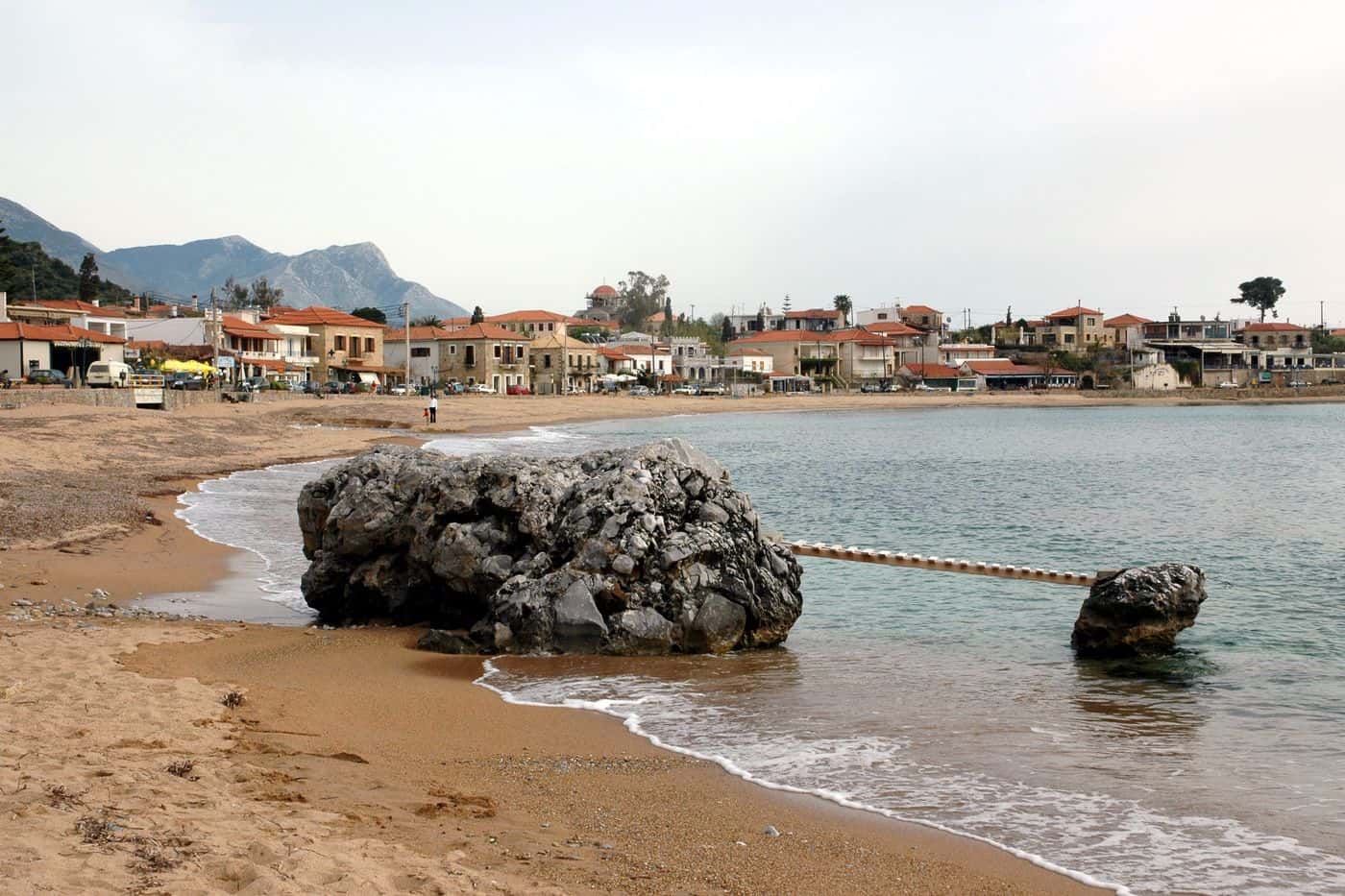
Stoupa tours start in a seaside village of the Messenian Mani in the south-west Peloponnese, on the coast between Kardamyli and Agios Nikolaos below the Taygetos range. The routes cover the beaches of Stoupa and Kalogria, the castle above the village, boat trips and sea kayaking along the Mani coast and the paths of the Taygetos foothills. Greece Tours lists the tours that start in Stoupa and Kalamata.
This page covers what Stoupa tours see on the shore and at sea, which trips continue to Kardamyli, Areopoli and the Diros caves, how visitors reach Stoupa, and which season suits each route. The tours below are checked on GetYourGuide and Viator and leave from Stoupa and Kalamata.
What do Stoupa tours cover?
Stoupa tours cover a coastal village of Outer Mani in Messenia: the spring-fed beaches of Stoupa and Kalogria, the Frankish Leuktron Castle on its seaside hill, and the places where Nikos Kazantzakis lived and mined lignite with Georgios Zorbas, the model for Zorba.
Stoupa tours start from a village on the coast of the southern Peloponnese, in the municipal unit of Lefktro within the municipality of West Mani. The village economy is oriented towards tourism. West Mani was formed in 2011 under the Kallikratis reform, which merged the municipalities of Avia and Lefktro. Our Mani tours cover the whole peninsula, the central one of the three that extend south from the Peloponnese.
Stoupa tours stay in Outer Mani, also called Messenian Mani, the northwestern part of the peninsula on the western side of the Taygetos range. Outer Mani receives more rainfall than Laconian Mani, which lies in a rain shadow, so it is more agriculturally productive, and locals call it aposkiaderi, meaning “shady”. Olive groves on its lower slopes and coastal plain are mainly cultivated without herbicides, and the West Mani economy rests on olive growing, livestock, building work and tourism.
The village name has two explanations. One links it to the processing of flax bundles, called stoupia, in the sea pools of the beach by locals and people from neighbouring villages; the other derives it from an Arabic word, “stoupa”, meaning beach or shore. Stoupa tours begin in a new settlement, built at the foot of Taygetos.
- Municipality: West Mani, 402.8 square kilometres, with its seat at Kardamyli.
- Municipal unit: Lefktro, 222.981 square kilometres.
- Population: 5,875 residents in West Mani at the 2021 census.
What do Stoupa tours see on the beaches of Stoupa and Kalogria?
Stoupa tours see two beaches fed by underground freshwater springs. Stoupa beach has sand crossed by small streams, and Kalogria is a sandy, relatively sheltered beach where water from a Taygetos spring rises through the rocks. Kalogria faces west, towards the summer sunsets.
On Stoupa tours, points of submarine groundwater discharge show clearly on the sea surface around the bay. The largest groundwater source lies about 100 metres offshore, where two strong discharges rise from fissures in the bedrock at roughly 25 metres depth.
The Drakos river, also called Drakolangado, reaches Stoupa beach in winter and runs underground for the rest of the year; it gave the area its older name, Potamos, “river”. Stoupa tours also pass a rock named Stoupa and a group of reefs and islets known as “tou Potamou oi xeres”. In earlier times, people from neighbouring villages came to these shores for drinking water, washing, fishing and processing lupins.
- Agia Paraskevi: a small river that flows all year across the sand of Stoupa beach.
- Lygia: a second small river, visible on the same sand.
- Avloi and Chalikoura: two more shores, listed with Kalogria and Stoupa as suited to tourism.
What do Stoupa tours see at Leuktron Castle (Beaufort)?
Stoupa tours see the ruins of Leuktron Castle, which the Franks named Beaufort, on a coastal hill by Stoupa. Prince William II Villehardouin of Achaea built it around 1249 to subdue the Slavic tribes of Mount Taygetos, on the walls of the ancient acropolis of Leuktron.
The Chronicle of the Morea gives the Greek names Lefftro or Lefktro and the Frankish name Beufort, meaning “beautiful fort”; its Greek version also calls it the Castle of Gisterna, “castle of the Cistern”. The hill has been inhabited at least since the Mycenaean era, and Pausanias placed a temple of Athena with her statue here. Stoupa tours stand on a castle finished early in the 1250s by a Venetian engineer the prince called in from Koroni.
In 1259 the prince was defeated and taken prisoner at the battle of Pelagonia; he was released in 1262 after agreeing to surrender castles to the Byzantines, Leuktron among them. The Despotate of Mystras took the castle at the end of the 14th century, it later passed to Constantine Palaiologos, and locals speak of a “castle of the Marble King”.
Stoupa tours also reach Lefktro, the village above Stoupa, also known as Choriadaki, “little town”, with restored Maniot tower houses and newer houses of local stone in the traditional style. It stands 50 metres above sea level, a ten-minute walk from the sea and Stoupa’s beach, and counted 248 residents in 2021.
- Platform: a rock about 120 metres long, 50 metres wide and 80 metres high.
- Footprint: less than 2,000 square metres, with a perimeter of around 185 metres.
- Walls: a curtain wall of irregular stones mixed with brick fragments.
- Interior: remnants of a square keep and a cistern.
What links Stoupa tours to Nikos Kazantzakis and Zorba?
Stoupa tours follow Nikos Kazantzakis, who rented a house on Kalogria beach in 1917 and 1918 and worked the Prastova lignite mine with the miner Georgios Zorbas. That venture much later became the novel Zorba the Greek, first published in 1946 and filmed in 1964.
The real Zorbas was born in 1865 at Katafygio, on Pieria Mountain, and worked as a miner for a French company in Stratoniki, Chalkidiki. In 1915 he left for Mount Athos to become a monk, met Kazantzakis there, and the two became close friends before going to Mani together. Prastova lies between Stoupa and Neo Proastio. Zorbas died on 16 September 1941 and was buried near Skopje.
Kazantzakis completed the novel, Life and Times of Alexis Zorbas, in 1943. In the book, the narrator sets off for Crete to re-open a disused lignite mine, so fiction moved the Mani mine to Crete. Stoupa tours show the real Prastova mine at Neo Proastio, which is open to visitors.
The 1964 film, directed by Michael Cacoyannis with music by Mikis Theodorakis, starred Anthony Quinn as Zorba alongside Alan Bates and won three Academy Awards; the stage musical Zorba followed in 1968. The success of the book draws Greek and foreign visitors to the area, and Stoupa tours point out four Kazantzakis sites.
- House: the small house on the right side of the beach, preserved to this day.
- Bust: a bust of Kazantzakis on a cliff overlooking Kalogria beach.
- Cave: the cave of Kazantzakis on the southern cape of the bay, reached from the sea by swimming or by boat.
- Mine: the abandoned Prastova mine, left of the main road before the village entrance, closed in the summer of 1918.
Which boat trips do Stoupa tours run along the Mani coast?
Stoupa tours by boat follow the eastern shore of the Messenian Gulf, where the Taygetos foothills meet a rocky, hard-to-reach coast. Trips stop at the Foneas sea caves, the underwater springs off Stoupa and Kalogria, and the harbours of Kardamyli and Agios Nikolaos.
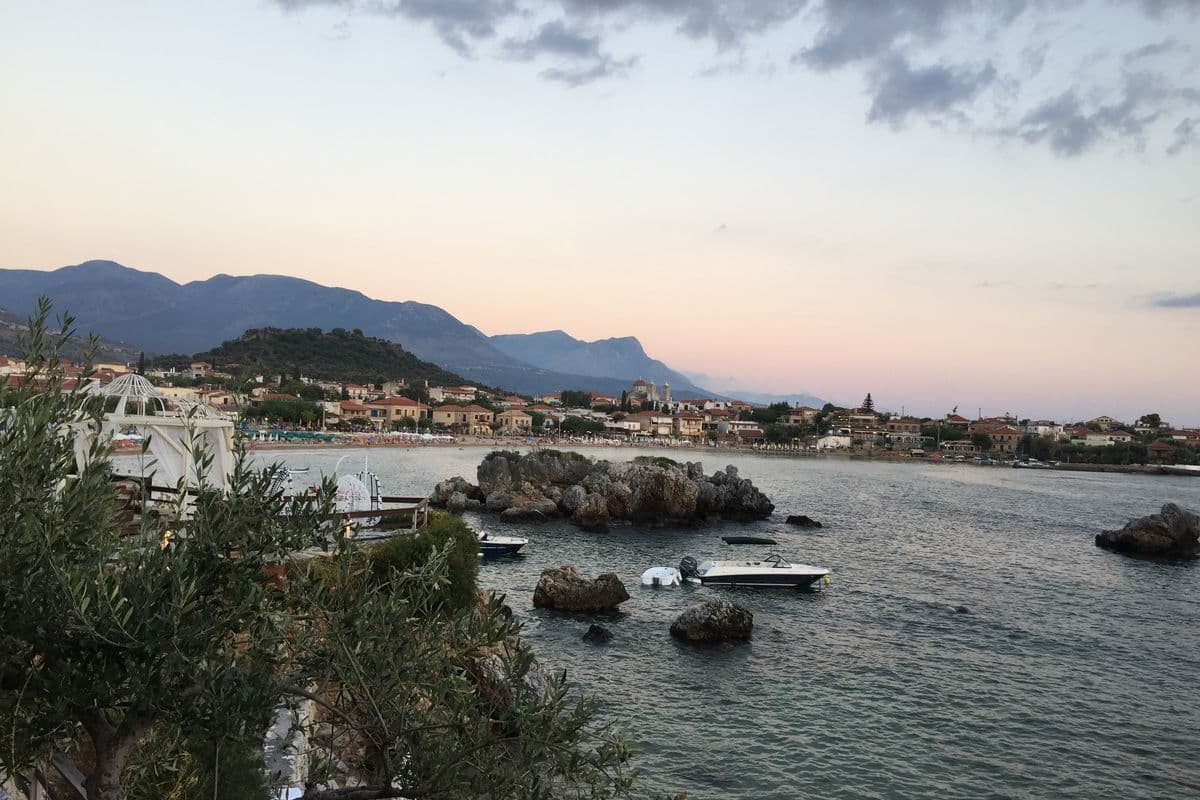
Private Stoupa tours by motor boat embark at Stoupa port with a multilingual skipper and a group of up to 10 guests. The Messinia Yachts route links Kardamyli, Stoupa, Foneas Beach and the Katafygi caves, then runs on to Itylo and Limeni. Swim stops use the snorkelling gear, 2 SeaDoo sea scooters and 1 stand-up paddleboard on board.
Self-drive Stoupa tours begin in the small harbour of Kardamyli, where Mani Boats rents motorboats that need no licence, plus speedboats. Every boat carries GPS, every crew gets a full safety briefing, and skippers cruise at their own pace past the cliffs, with swims in natural pools.
Morning trips meet a calm sea, because the mountains around Kardamyli largely block the Meltemi wind and the water stays lake-like until the sea breeze picks up. Kalamata, the major urban centre of the gulf, lies 30 km north-west of Agios Nikolaos, and the Kalamata catamaran cruise sails the same Messenian Gulf.
- Foneas Beach: pebbles, deep water, a canteen and a rock for diving, beside turquoise sea caves.
- Kazantzakis Cave: the sea cave where the writer Nikos Kazantzakis found inspiration.
- Itylo and Limeni: cruise stops 32 km and 36 km from Stoupa.

Which Stoupa tours go sea kayaking and snorkeling?
Sea kayak Stoupa tours leave from Kalogria Beach in Stoupa and from the old harbour of Kardamyli, paddling past limestone cliffs, sea caves and coves reachable only by water. Snorkel stops cross the freshwater springs off Kalogria, where cold patches speckle the warm sea.
Begetis Travel & Adventure runs Stoupa tours by kayak from Kalogria Beach. The guide has decades of experience on these waters, a licensed rescue vessel stays with the group at all times, and the trip suits all skill levels, beginners included.
The Kardamyli option of these Stoupa tours sets off from the old customs house in St. John’s harbour and lasts 4 hours with breaks. British Canoeing leaders with first aid certificates guide stable single or tandem kayaks to the Blue Cave, where sunlight through a crack turns the seafloor aquamarine. A halfway stop brings snorkelling and a picnic of fresh bread, olive oil and cheese, and children over 5 join.
Snorkelling Stoupa tours float over submarine groundwater discharges that show on the surface around the bay. The largest source sits about 100 metres offshore, where two strong flows rise from bedrock fissures at roughly 25 metres. In 2008 the Hellenic Centre for Marine Research and the Agricultural University began measuring the main vent, 50 metres long and 30 metres wide, which runs fresh in winter and brackish in summer.
- Sponges: different types in bright colour combinations, including rare blue sponges.
- Nudibranchs and fish: residents of the vent, filmed by the Grafas team with the Dive Code centre.
- Foneas caves: a huge chamber, passages and stalactites for divers.
- Sea turtles: lucky paddlers spot one swimming under the kayak.
Which hiking trails do Stoupa tours walk in the Taygetos foothills?
Walking Stoupa tours climb from the shore into the Taygetos foothills on kalderimi, the stone donkey paths that linked the villages until the 1970s. Foothill villages include Lefktro, Neochori, Platsa and Kastania, and a marked trail runs from Saidona past two monasteries to Exochori.
Stoupa tours on foot start with Lefktro, the village directly above Stoupa, a ten-minute walk from the beach. Also known as Choriadaki, little town, it keeps restored Maniot tower houses of local stone, and an official record of 1835 names it Pyrgos Lefktrou. Neochori, 1 km east-south-east, grew in the late 17th century under Venetian rule with settlers from Nomitsi and Milea, and Stoupa belongs to its community.
Longer Stoupa tours take the Agios Nikolaos to Platsa trail, which begins at Pantazi Beach and rises 1,200 feet through Pigi, returning through Katroni: six miles in three hours. Platsa, whose name means plateau, was the upper part of ancient Pefnos and once the centre of Exo Mani, with 1,425 residents and the seat of a bishopric.
Kastania, also called Kastanea, holds 10 of the 44 Byzantine churches of the Peloponnese, and its 12th-century Agios Petros won a Europa Nostra award in 2016 after a 16-month restoration. Theodoros Kolokotronis took refuge in its Dourakis tower. From Saidona, a 3-hour trail passes the monasteries of Saint Samuel and Voidonitsa to Exochori.
- Lefktro: 50 metres above sea level.
- Neochori: 220 metres, on a hill of olive and oak trees.
- Platsa: 362 metres, with a view of the sea.
- Kastania: 700 metres, in the Taygetos foothills.
- Profitis Ilias: 2,405 metres, the tallest summit in the Peloponnese.
Which Stoupa tours continue to Kardamyli and Agios Nikolaos?
Stoupa tours continue to Kardamyli, the seat of West Mani, 8 km away, for the tower houses of Old Kardamyli and the house of Patrick Leigh Fermor, and to Agios Nikolaos, a working fishing village once called Selinitsa, 4 km south along the coast.
Day Stoupa tours to Kardamyli start in Old Kardamyli, where the 18th-century church of Saint Spyridon stands in the fortified compound of the Mourtzinoi-Troupakis clan. The heirs Maria and Eleni Boukouvalea gave the complex to the Greek state in 1967, and its three-storey fortified house became a museum between 1999 and 2004. Homer lists Kardamyli in Book 9 of the Iliad among the seven cities Agamemnon offered Achilles.
Literary Stoupa tours stop at Kalamitsi, just outside Kardamyli, home of Patrick Leigh Fermor (1915–2011) and his wife Joan. Nikos Hatzimichalis designed the house, completed in the mid-1960s; the couple bequeathed it to the Benaki Museum in 1996, and since July 2019 it opens for guided tours on request. For the 20 km Viros Gorge, dry in summer and flooded in winter, compare our Kardamyli tours.
Coastal Stoupa tours reach Agios Nikolaos on the paved Stoupa Bike Path, 50 minutes each way. One account traces the old name Selinitsa to the Slavic word selo, village, so it means small village. The Gerakaris battery, built by Stavros Gerakaris, guards the entrance, and a 5-metre lighthouse stands to the west.
- Gnospi: a swimming platform with bathing ladders just north of the village.
- Pantazi Beach: pebbles and sand, a 10 to 15-minute walk south.
- Pefnos islet: the islet opposite ancient Pefnos where, in myth, the Dioskouri were born.
Which Stoupa tours continue to Areopoli and the Diros caves?
Stoupa tours that continue south follow the coast road past Oitylo to Areopoli, 40 kilometres from Stoupa, then drop to the Diros caves below the town. The route crosses from Messenian, or Outer, Mani into Laconian, or Inner, Mani, the land of stone tower houses.
Areopoli, called Tsimova before 1912, takes its name from Ares, the god of war. On 17 March 1821, 12,000 Maniots gathered there and declared war against the Ottoman Empire, and the first flag of the Greek War of Independence rose in Taxiarchon Square. Stoupa tours walk lanes of tower houses built with field stones, and an open-air market fills the main square each Saturday.
The Diros caves lie on Dirou Bay, between Pyrgos Dirou and Areopoli, which holds three caves: Alepotrypa, Glyfada (also called Vlychada) and Katafygi. On Stoupa tours, parts of the system are reached by small boat and through narrow passageways. Giannis and Anna Petrochilou began to explore Glyfada in 1949, and its known length now passes 15 kilometres. Its brackish water stays near 14°C, and the cave holds the largest concentration of hippopotamus bones in Europe.
Alepotrypa, “the Fox’s Hole”, lies 220 metres east of Glyfada and ranks among the largest Neolithic burial sites in Europe, with bones of at least 170 people. A catastrophic earthquake blocked its entrance around 3200 BC.
Limeni, the port of Areopoli, sits on the safest natural harbour of the west Mani coast, 154 nautical miles from Piraeus. Its Petrobey palace faces the sea and ends in a four-storey tower; it belonged to Petros Mavromichalis, the last bey of Mani. Stoupa tours see the same pattern across the peninsula: tower houses, called pyrghóspita, stood inside a fortified clan compound known as a xemóni.
- Oitylo: 32 kilometres from Stoupa, named in the Iliad as Oetylus.
- Limeni: 36 kilometres from Stoupa, on the Bay of Oitylo.
- Areopoli: 40 kilometres from Stoupa, at 250 metres above sea level.
- Pyrgos Dirou: about 4 kilometres south of Areopoli, with a six-storey Sklavounakos tower 19 metres high.
How do visitors reach Stoupa on Stoupa tours?
Stoupa tours start from Kalamata, 45 kilometres from Stoupa and home to Kalamata International Airport (KLX). From the city, a winding road with coastal stretches runs south through Kampos and Kardamyli to Stoupa. Drivers from Athens reach Kalamata on the A7 Moreas Motorway.
The airport, named after Captain Vassilis Constantakopoulos, lies between Kalamata and Messini on the EO82 road, and Aegean Airlines opened a base there in March 2013. For Stoupa tours, the bus stop sits close to the terminal building, and buses reach Kalamata in 20 to 25 minutes.
From Athens, Stoupa tours cover 243 kilometres to Kalamata in less than 2.5 hours by car. The A7 links Corinth and Kalamata via Tripoli. KTEL buses connect Kalamata with Tripoli, Corinth and Athens, while train services from Kalamata stopped in December 2010. Visitors who spend a night in the city first can add Kalamata tours before the drive south.
Past Stoupa, the road reaches Oitylo, where a cross-peninsular road runs northeast to Gytheio. From Gytheio, National Road 39 runs north to Sparta and connects with the A7, so Stoupa tours of the whole Mani return north without retracing the coast.
- Corinth to Tripoli: 74 kilometres on the A7.
- Corinth to Kalamata: 147 kilometres on the A7.
- Airport runway: about 2.7 kilometres long.
- Airport history: opened in 1959, with charter flights from 1986.
When do Stoupa tours run best?
Stoupa tours run best from June to October, the warmest months at sea, and in March and early April, the best season for the flora of Mani. Summers are hot and dry, while winters are mild to cool and wet, under a Köppen Csa climate.
The Stoupa side of Mani receives more rain than the Laconian side, which lies in a rain shadow, so locals call the first aposkiaderi, “shady”, and the second prosiliaki, “sunny”. At Kardamyli, just north of Stoupa, winter lows run a bit higher than in Kalamata, because the Taygetos blocks northerly winds.
Normals from Kalamata airport for 1971 to 2010 give a January high of 14.7°C and a January low of 5.4°C, and the record of 45.0°C came on 24 June 2007, so summer Stoupa tours suit early starts. The sea off Stoupa averages 25.2°C in summer and 17.3°C in winter.
Kalamata airport mainly receives flights in summer, so off-season Stoupa tours start with the drive from Athens. Mani shows a second burst of flora in late October and through the mild winter, and April is the best month for birdwatching, when migrating birds pass through.
- April: Kalamata highs of 19.9°C, sea at Stoupa 16.8°C.
- June: Kalamata highs of 29.1°C, sea at Stoupa 22.8°C.
- August: Kalamata highs of 31.4°C, sea at Stoupa 27°C.
- October: Kalamata highs of 24.3°C, sea at Stoupa 23.7°C.
Frequently Asked Questions
Do Stoupa tours reach Vatheia and Cape Matapan?
Past Areopoli, the road runs via Gerolimenas and Vatheia to Cape Matapan, the southernmost point of continental Greece. Vatheia, largely abandoned, keeps hillside tower houses and Maniot architecture from the 18th and 19th centuries. The cape keeps the ruins of the Temple of Poseidon, and myth made a sea cave there a portal to Hades.
Which prehistoric finds come from the coast on Stoupa tours?
Apidima Cave, on the west side of the peninsula, yielded a Homo sapiens skull at least 210,000 years old, the earliest evidence of modern humans in Europe. Kalamakia Cave, near the coast northwest of Areopoli, held Neanderthal remains from 100,000 to 40,000 years ago, the first Neanderthal remains identified in Greece.
Why do Stoupa tours pass protected tower villages?
Mani was once called Maina Polypyrgos, after its tower houses. From 1978 the Greek state declared tower settlements “traditional” and set limits on new building, and in 2003 the whole peninsula became a “cultural complex of international importance”. The stronger clans, the megalogenites, held better land, built high towers and dominated the weaker ahamnoteroi.
Which Mani products do Stoupa tours learn about?
The olive dominates Mani crops and gives high-quality olive oil, and the Areopoli area produces select oils and keeps notable livestock. In the 19th and early 20th centuries, Maniots harvested sea salt on the west coast, in natural rock pans near Gerolimenas and Mezapos, and traded it for barley, wheat, maize, cheese and dried figs.