
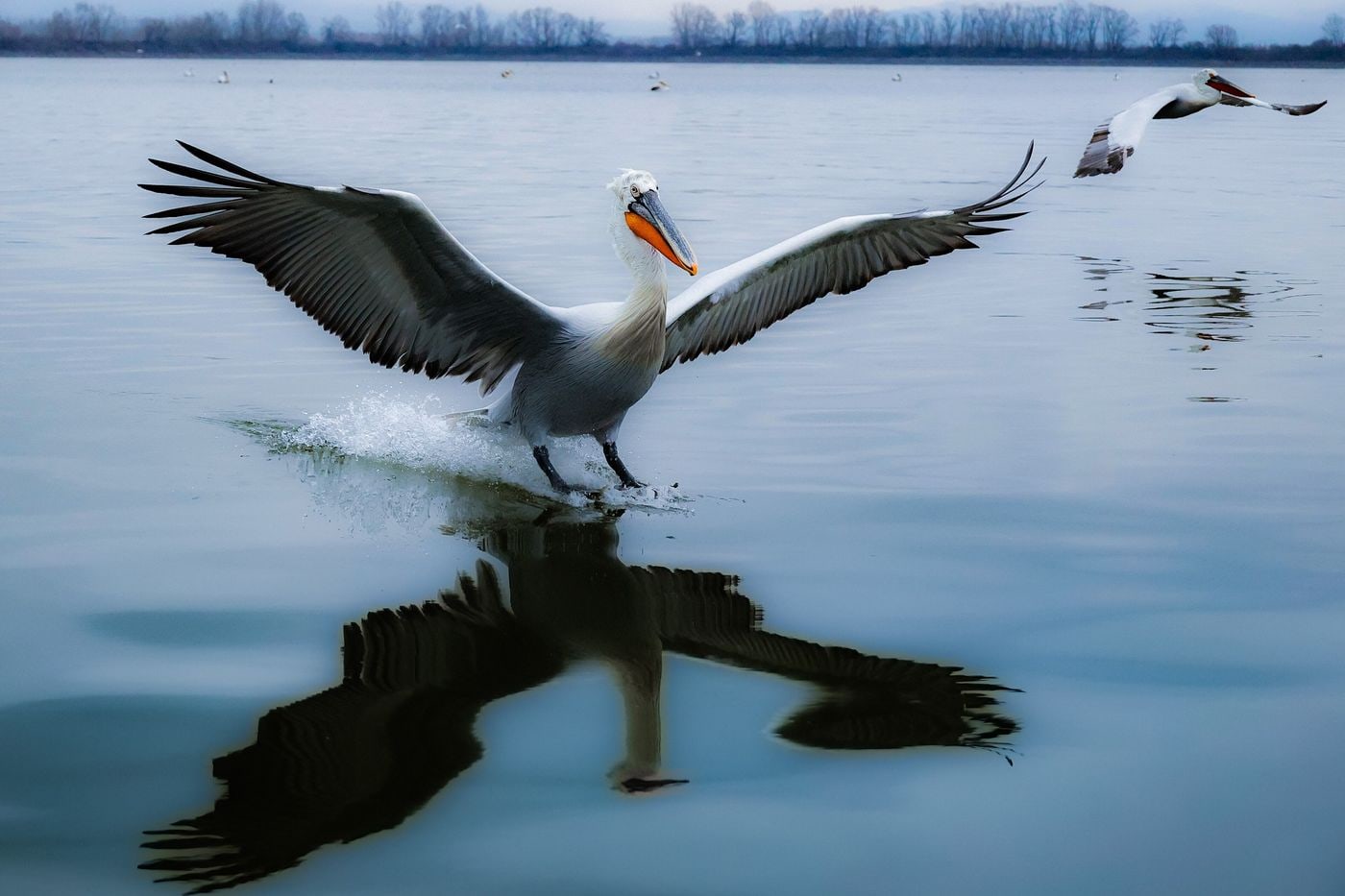
Kerkini tours start at Lake Kerkini, the reservoir on the Strymonas river in the Serres regional unit of Central Macedonia, close to the border with Bulgaria. The routes cover boat trips among the Dalmatian pelicans, birdwatching, the water buffalo herds, the lakeside villages and the Belles mountains. Greece Tours lists the day tours that reach the lake from Thessaloniki and Sofia.
This page covers what Kerkini tours see on the water and around the shore, which activities and villages they add, how visitors reach Lake Kerkini, and which season suits each route. The tours below are checked on GetYourGuide and Viator and leave from Thessaloniki and Sofia.
What do Kerkini tours cover?
Kerkini tours cover Lake Kerkini, a reservoir on the Strymonas river in the Serres regional unit of Central Macedonia, with boat trips to the pelicans, birdwatching on the embankments, water buffalo herds on the shore and the lakeside villages of Kerkini and Lithotopos.
A dam near Lithotopos created the lake in 1932, and a new dam opened in 1982 after silt from the Strymonas cut its capacity. Kerkini tours reach the water 35 km from Serres and 80 km from Thessaloniki, the start point of the Lake Kerkini day trip from Thessaloniki.
The lake is Ramsar site no. 58, listed on 21 August 1975 over 10,996 ha, and a national park since 2003 inside the Natura 2000 network. Kerkini tours start from three small harbours on three sides of the water, and each one sits beside a village.
A road runs close to the lake from Lithotopos to Kerkini village, and cars can drive a 17 km embankment from Lithotopos. Gordon Ramel’s birding notes name the first 3 km of embankment south of Megalochori and the marshes south of Vyroneia as hot spots.
- Mandraki: the north-shore harbour, listed as a birding hot spot for its view.
- Kerkini: the west-shore harbour with a cafe; the Kerkini Wetland Information Centre stands by the village square.
- Lithotopos: the southern tip, where the dam holds the river and the Lake Kerkini Centre for Ecotourism stands.
What do Kerkini tours see on the lake boat trips?
Kerkini tours on the lake boat trips see a seasonally flooded forest, wide beds of floating plants and water lilies, the largest mixed nesting colony of waterbirds in Greece, and flocks of pelicans and cormorants feeding together on open water below Mount Kerkini.
Boats head for the drowned forest, a birding hot spot reached from the villages of Kerkini and Mandraki. Kerkini tours glide between trees standing in water, because the lake level shifts 4.5 to 5.0 metres between low and high water, and the surface grows from 51.5 km² to 74.4 km² across the year.
The water peaks in early to mid summer, then drops in late summer as it is released to irrigate the plain of Serres. Kerkini tours see a plant cover that changes each year: white water lily, water chestnut and the floating Salvinia natans, the last two listed in the Red Book of protected species.
Kerkini tours move through a protected area where distance matters. In Greece, recreational powerboats carrying tourists have been linked to feeding disruptions in Dalmatian pelicans, and visits to the bird colonies harm their breeding.
- Mixed colony: the only site in Greece with a 12-species mixed breeding colony in spring and early summer.
- Feeding flocks: one March flock held 3,000 cormorants and 500 pelicans.
- Fish: 30 species, led by eels and carp, give lakeside residents an income.
- Mountain views: the Kerkini range, 2,031 m at its peak, on the north shore and the Mavrovouni, or Krousia, range to the south-west.

Which birds do Kerkini tours find at Lake Kerkini?
Kerkini tours find Dalmatian pelicans and pygmy cormorants, both globally threatened, along with herons, black-winged stilts, storks, greater flamingos, ducks, swans and eagles, on a lake that sits on the migration flyway to the Aegean Sea, the Black Sea and the Hungarian steppes.
The Dalmatian pelican is the largest member of the pelican family, with a wingspan of 2.7 to 3.2 metres, curly nape feathers, grey legs and silvery-white plumage. Lake Kerkini is a major wintering site for this pelican and the pygmy cormorant, and naturalist Gordon Ramel recorded the lake as the only new Dalmatian pelican breeding site in 50 years.
The lake holds at least 300 of the 407 bird species found in Greece. About 140 species nest here, 170 pass through on migration and 134 spend the winter, so the bird list on Kerkini tours changes with the season.
April brings the richest variety, with migrants that include greater flamingos. In late spring, when the chicks hatch, Kerkini tours see herons, pygmy cormorants, black-winged stilts and stork nests; in October and November ducks, swans and grebes arrive from north-eastern Europe. The area’s rare raptors include golden eagle, eastern imperial eagle and peregrine falcon, and white-tailed eagles and booted eagles breed in the hills beside the Lithotopos to Kerkini road. Gordon Ramel’s lake notes log these sightings:
- January: 20,000 pochard on the water.
- April: 15,000 black-headed gulls.
- August: Eleonora’s falcons and cattle egrets.
- November: 1,000 flamingos in flight.
Where do Kerkini tours meet the water buffalo?
Kerkini tours meet the water buffalo on the north and north-west shores of Lake Kerkini, around Kerkini village and Mandraki, where herds walk into the calm water to swim and cool off in summer; the lake keeps the largest buffalo population in Greece.
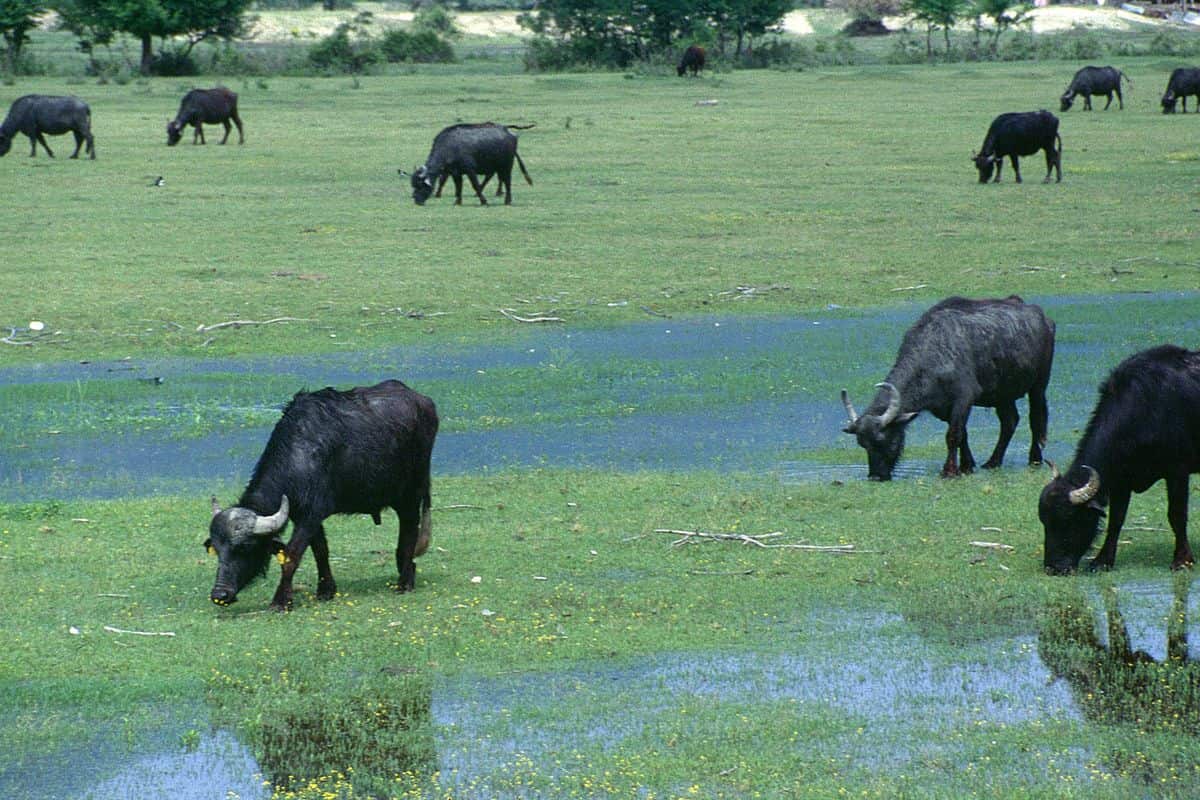
Kerkini tours meet an animal with a long local record. The Greek Gastronomy Guide traces water buffalo in Greece back 2,500 years, to the Persian king Xerxes, who used them to carry his army’s supplies across the Strymon in 480 BC. Farmers valued them for meat, milk and pulling the plough, until tractors and Dutch cows cut their numbers; by the end of the 1990s the remaining animals joined a programme to save them as an endangered species.
- Up to the 1950s: 75,000 buffalo in the region.
- 1992: 600 animals left.
- Today: 1,600 in the Kerkini area, by the Greek Gastronomy Guide count; another estimate puts the lake herd above 4,000.
- Second herd: about 400 buffalo around the Ambracian Gulf in western Greece.
Kerkini village sits on the north-west shore; it carried the name Butkovo until 1923 and had 757 residents at the 2021 census. Kerkini tours pass the buffalo farms around the lake, which supply buffalo meat products, and buffalo in the gastra is a Serres dish. The meat is rich in iron, phosphorus and vitamin A and low in fat and cholesterol, and the village’s traditional dishes are kapamas and rimbnik.
The herds feed birds too: Gordon Ramel logged hundreds of yellowhammers, cirl buntings and corn buntings feeding on the leftovers of a buffalo feast. These are river buffalo, the type kept from the Indian subcontinent west to the Balkans, Egypt and Italy.
What do Kerkini tours see in the villages around the lake?
Kerkini tours stop in six villages around the lake: Kerkini with its visitor centre, Lithotopos on the southern shore, Ano Poroia at the foot of Mount Belles, Megalochori near the Strymonas inflow, Chrysochorafa on the eastern bank and Rodopoli in north-west Serres.
Kerkini village is a farming settlement of the Municipality of Sintiki, with 757 residents in the 2021 census, down from 980 in 2011. Kerkini tours call at its visitor centre, which stands away from the lake itself, for maps, orientation and English-speaking staff. The Kerkini community also takes in the hamlets of Koryfoudi, Monastiraki and Stavrodromi.
Ano Poroia, home to 836 residents in 2021, keeps the Macedonian architecture that Aromanian settlers from Epirus and Western Macedonia brought with them, joined later by refugees from Asia Minor in 1922. Kerkini tours walk the cobbled streets of its mahalades, or neighbourhoods, and visit the painted chapels of Agios Georgios and Agios Dimitrios. Under Ottoman rule, the local beys kept summer houses here, which earned the village the name Little Constantinople. Its multi-instrument philharmonic band dates from 1934.
- Lithotopos: a 45-metre village in the Municipality of Irakleia, with 525 residents in 2021.
- Megalochori: a 35-metre village settled in 1925 by refugees from Efstathochori in Eastern Rumelia and renamed in 1927.
- Chrysochorafa: a 30-metre village 4 kilometres west of Irakleia, with 1,023 residents in 2011 who farm and fish.
- Rodopoli: a 105-metre village recognised as a community on 2 August 1926, with 808 residents in 2021.
Which outdoor activities do Kerkini tours add?
Kerkini tours add hiking, horse riding, mountaineering and 4×4 routes around Ano Poroia, the 380-metre village that overlooks the lake. Hiking trails cross the area, and the Mountaineering Association of Ano Poroia supports climbs on the Belles range above it.
Kerkini tours base these outings in Ano Poroia, where restaurants, cafes and hotels operate. Above the village rises Mount Kerkini, the second Greek name for the Belles range, a Natura 2000 protected habitat with forests and rare wildflowers.
After a day on the trails, Kerkini tours add a soak in the old Byzantine thermal baths at Agistro, which are rented privately and booked in advance. The thermal spa of Sidirokastro offers a second stop.
- Plane trees: the aesthetic forest of Ano Poroia, listed among the village sights.
- Black pine: upland conifer forest of Pinus nigra ssp. pallasiana, mainly plantations on Mount Kerkini.
- Chestnut: forest on the border at the east end of the Kerkini Mountains.
What history do Kerkini tours tell?
Kerkini tours tell how the Strymonas marshland became a reservoir in 1932, how a new dam followed in 1982, and how the wetland gained Ramsar listing, Natura 2000 status and a national park whose core follows the river to the Bulgarian border.
Before 1932, the Strymonas spread into irregular marsh lakes, one of them called Podkova, the Bulgarian and Slavic Macedonian word for horseshoe. Ancient sources describe the river as navigable from its mouth up to the ancient Kerkinitis (Cercinitis) lake, now dried, which gave Kerkini village its name. Kerkini tours explain that the reservoir first served to regulate the Strymonas and prevent floods further downstream.
The first works raised embankments on the eastern and western banks and a dam near Lithotopos, and the reservoir later stored water to irrigate the plain of the Serres prefecture. Silt from the Strymonas reduced its capacity, so the embankments were raised again and the new dam was built; the eel has disappeared from the lake since that dam came into operation. Kerkini tours follow a river that runs 415 kilometres from its source on Vitosha Mountain in Bulgaria and enters Greece near Promachonas.
The national park works in two layers: the core holds the lake and the Strymonas, with high-protection zones inside it, and a wide peripheral zone takes in the Belles, Krousia and Mavrovouni mountains plus land south and east of the lake. The main threats listed for the lake are Strymonas pollution, illegal logging, fishing and hunting, visits to bird colonies and the raising of embankments. Kerkini tours also cite at least 4,700 invertebrate species, at least 46 of them new to science and recorded nowhere else.
- Ramsar site 58: designated on 21 August 1975, covering 10,996 hectares.
- Montreux Record: listed on 4 July 1990 after water management projects and nutrient enrichment changed the site, removed in 1999.
- Special Protection Area: classified under an EC Directive and run as a No Hunting Zone.
Which Kerkini tours combine Serres and Mount Belles?
Kerkini tours that combine Serres and Mount Belles pair the Byzantine acropolis on Koulas hill and the museums of Serres with the Belles range, a 60-kilometre ridge shared by Greece, Bulgaria and North Macedonia whose highest point, Radomir, reaches 2,031 metres.
Serres counted 70,703 residents in its municipality in 2021 and lies on a fertile plain at about 70 metres. Herodotus recorded the city as Siris in the 5th century BC, and the ancient town stood on Koulas, the high and steep hill just north of the centre. Kerkini tours climb to the ruined castle on its crown and follow the paths through its pine-filled slopes. The modern city was almost entirely rebuilt after the retreating Bulgarian army set it on fire during the Second Balkan War in 1913.
Inside the city, Kerkini tours visit the Archaeological Museum of Serres in the Ottoman bezesten, the Ecclesiastical Museum, the Sarakatsani Folklore Museum, the Hadzilia Folklore and Ethnological Museum, the Mehmet Bey Mosque and the Church of Saints Theodore Tyro and Theodore Stratelates. The Serres day trip from Thessaloniki covers the city on its own.
On the mountain side, Kerkini tours reach a range that forms the natural border between Greece to the south and Bulgaria and North Macedonia to the north. Greece holds about 45 percent of it, the ridge is 7 to 9 kilometres wide, and the three borders meet at Tumba Peak. The range is identified with the wooded, uninhabited Kerkini that Thucydides named in his account of the march of Sitalces, king of the Odrysian Thracians, against Macedonia in 429 BC.
- Kleidion monument: the Monument of Basil II outside Promachonas, on the Thessaloniki-Promachonas motorway, for the battle fought on 29 July 1014 between the Kerkini and Western Orvilos ranges.
- Fort Roupel: a fort built in 1914 and expanded in the 1930s into the Metaxas Line, with a museum exhibition and an underground tour.
- Sintiki: the only Serres municipality that borders Bulgaria and North Macedonia, with its seat at Sidirokastro.
How do visitors reach Lake Kerkini on Kerkini tours?
Kerkini tours reach the lake by road in about one hour and twenty minutes from Thessaloniki, 80 km away, while Serres lies 35 km from the water. Regional trains stop at Rodopoli and Vyroneia, on the railway that follows the north shore.
From Serres, drivers head for Lithotopos, the village beside the dam, or follow the road through Sidirokastro, Neo Petritsi and Vyroneia to Kerkini village. From Kilkis, the approach runs through Doirani and Kastanoussa. From Thessaloniki, Kerkini tours take the road towards Strymoniko and Lithotopos. The short drive makes the lake an attraction for day trips from Thessaloniki.
The Thessaloniki–Alexandroupolis railway runs along the north shore of Lake Kerkini and crosses the Strymonas river near Sidirokastro. Line 3 of the Thessaloniki Regional Railway calls at Rodopoli, Vyroneia and Strymonas, but service is limited.
Kerkini tours from Sofia enter Greece at Promachonas, the village opposite Kulata in Bulgaria, where the A25 motorway starts its run to Serres and Thessaloniki. The cross-border train on the 17.5 km Strymon–Kulata line is suspended, and a 14 km replacement bus links Kulata with Strymon, where a train continues to Thessaloniki.
- Sofia to Blagoevgrad: the E79 follows the A3 Struma motorway through Pernik.
- Blagoevgrad to Kulata: the E79 reaches the border, leaving the motorway only for the old two-lane road through the Kresna Gorge.
- Promachonas turnoff: the exit for Sidirokastro comes 12 km after the border crossing.
- Last stretch: the road reaches Neo Petritsi in 20 minutes and the boat harbour at Kerkini village in 40.
When do Kerkini tours run best?
Kerkini tours run best in late spring and June, when breeding birds raise their young and the lake stands at its highest. October and November follow, as ducks, swans and grebes fly in from northeastern Europe ahead of the chillier weather of early winter.
Water levels set the calendar for Kerkini tours. Snowmelt lifts the lake to its peak in late spring and early June, when it covers 72 square kilometres. Through summer, farms below the dam draw the water for irrigation, and by autumn and winter the surface shrinks to 54 square kilometres, exposing wide mudflats that pull in flocks of greater flamingos, wildfowl and waders.
The flooded forest sits in the northeast corner of the lake, a remnant of the boggy, alluvial edge of the old river. Its willows stand under water for nearly half the year and shelter pelicans, herons, egrets, cormorants and terrapins. The trees cannot cope with the large seasonal swings in water level, and no young willows replace them, so Kerkini tours now see a shrinking wood.
The climate around the lake is continental, with a summer that is not very hot and a cold winter, which the lake itself softens a little. Spring and autumn stay cool and bring sunshine as well as a fair share of rain, so Kerkini tours in those seasons pack a waterproof layer.
- February: Dalmatian pelicans wear rich orange beak pouches, the top month for photographers.
- Late spring to June: herons, pygmy cormorants and black-winged stilts tend their chicks, and stork nests dot the area.
- July and August: flamingo numbers drop sharply as the flocks migrate.
- September: flamingos return in large numbers, and autumn and winter counts sometimes pass 10,000.
Which local food do Kerkini tours taste?
Kerkini tours taste water buffalo products above all: white cheese, yoghurt, custard-like kazan dipi, sausages, pastrami and dry-aged steaks. Lake fish, led by carp and eels, complete the table, and Kerkini village lists kapamas and ribnik among its traditional dishes.
Buffalo milk holds twice the fat of cow’s milk, touching 9% depending on the season, and its high level of solids makes it ideal for cheese. For Kerkini tours, the local cheese to try is Kerkinella, made at Thrakiko, right beside the lake, by a family dairy that uses only milk from its own free-grazing herd. The fresh cheese keeps its shape on the grill and already appears in restaurants around Kerkini.
Buffalo meat is lean, with about 2% fat, and 100 g gives 130 calories against 260 to 300 for beef. The Thrakiko farm turns its meat into kavourmas, smoked salami, soutzoukakia, and spicy and village-style sausages. A firm at Livadia makes buffalo pastrami with spices and dried coriander, and a butcher in Rodopoli dry-ages buffalo steaks for 90 days.
The lake holds 30 fish species, and the Kerkini carp counts as a local delicacy. Fishing still provides income for local residents. The old Vyroneia railway station now houses a restaurant, and its former station office works as a small grocery selling local and traditional delicacies, and Kerkini tours arriving by train step off right beside it.
- Kerkinella: a slightly sour white buffalo cheese flavoured with dried basil, mint and oregano.
- Yoghurt: a creamy, slightly sour buffalo yoghurt rich in calcium and protein.
- Kazan dipi: a caramelised Constantinople-style cream, the top dessert for locals and visitors.
- Kaimaki: buffalo-milk ice cream sold in Kerkini village.
Frequently Asked Questions
Which wild mammals do Kerkini tours spot?
The Kerkini area holds jackals, wolves, wildcats, otters, weasels, roe deer, hares and wild boar, and the national park counts over 58 mammal species in all. The surrounding area adds frogs, salamanders and newts, while lizards, snakes and turtles fill out the reptile list. Elusive wolves and golden jackals draw wildlife photographers from across the world.
Which film was shot at the lake that Kerkini tours visit?
Director Theo Angelopoulos used the dry lakebed to build a mud and stone village for his Greek drama The Weeping Meadow. Once the village stood, the crew waited for the rising waters of late winter and filmed the houses drowning. The film traces the difficult political history of Greece in the 20th century.
How do Kerkini tours protect the lake?
Kerkini tours protect the lake by keeping clear of bird colonies, since visits to nesting sites harm breeding. Illegal logging, fishing and hunting rank as further threats, along with pollution in the Strymonas, river silt and raised embankments that reduce fish species. Visitors help by avoiding litter, protecting wildlife and supporting local businesses.
Which plants and small creatures do Kerkini tours find?
The national park lists over 1,300 plant species, including rare and endemic ones, and more than 4,700 invertebrate species. Nearly 1,400 of those invertebrates were first recorded in Greece at Kerkini, and 46 were new to world science. Water lilies, once spread across a large area, have declined as the water level swings.