
Vergina tours start in a small town in Imathia, Central Macedonia, built beside the site of ancient Aigai, the first capital of the Macedonian kingdom and a UNESCO World Heritage site. The routes cover the museum of the royal tombs, the tomb of Philip II, the palace and theatre of Aigai and the history of the Macedonian kings. Greece Tours lists the day tours that reach Vergina from Thessaloniki.
This page covers what Vergina tours see in the royal tombs museum and at the palace, the history of Aigai, the trips on to Pella, Veria, Edessa and Mount Vermio, how visitors reach Vergina and which season suits each route. The tours below are checked on GetYourGuide and leave from Thessaloniki and Vergina.
What do Vergina tours cover?
Vergina tours cover a small town in Imathia, Central Macedonia, and the site of ancient Aigai, the first capital of the Macedonian kingdom. The archaeological site entered the UNESCO World Heritage List in 1996, and today it holds two museums.
Vergina lies at the foot of the Pierian Mountains, at an altitude of 120 m, 13 km southeast of Veria. Vergina tours explore the remains of Aigai, which spread between Vergina and the village of Palatitsia in the Haliacmon valley, above the central Macedonian plain.
Vergina tours set out from a village founded in 1922, when Asia Minor Greek families settled between the old villages of Koutles and Barbes. The Metropolitan of Veria proposed the name, after a legendary queen Vergina. Vergina formed a separate municipality until 2011, when it joined the municipality of Veria, which counted 62,064 residents at the 2021 census. The same census recorded 1,096 residents in the community of Vergina.
- Name: Aigai comes from the Greek word for goat, and Diodorus Siculus writes that the Pythia told Perdiccas I to build his capital where goats led him.
- UNESCO: the listing cites the shift from the classical city-state to the imperial structure of the Hellenistic and Roman periods.
- Museums: Vergina tours enter the Museum of the Royal Tombs of Aigai, built over the tombs, and the Polycentric Museum of Aigai, which holds parts of the palace.
- Cemetery of the tumuli: Vergina tours pass more than 500 grave mounds spread over 3 km, and the oldest go back to the 11th century BC.
Finds from Aigai are on show in the shelter over the royal tombs and in the Archaeological Museum of Thessaloniki, the city where a Vergina day trip from Thessaloniki begins.
What do Vergina tours see in the museum of the royal tombs?
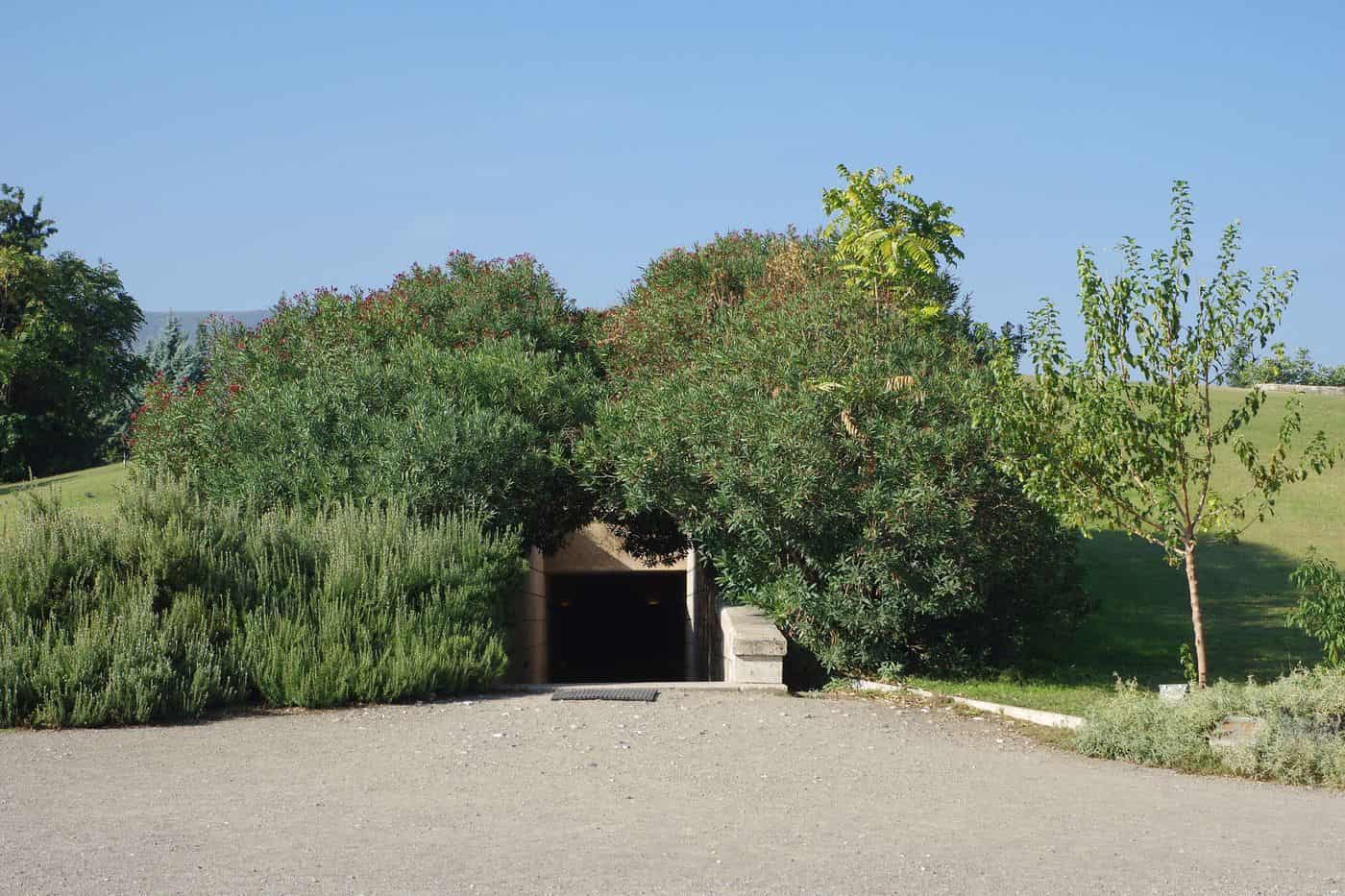
Vergina tours see four tombs and a small shrine, the heroon, inside the Great Tumulus. The museum keeps the tombs in place under a rebuilt earth mound and shows the golden larnax, the gold oak wreath and the wall painting of Persephone.
Vergina tours visit the Great Tumulus, which Antigonus II Gonatas raised at the start of the 3rd century BC to protect the royal tombs, after Gallic mercenaries of Pyrrhus had plundered the cemetery in 276 BC. Work on the underground museum began in 1993, and it opened in 1997.
The main treasures come from Tombs II and III, which were never looted. Manolis Andronikos assigned Tomb II to Philip II, and its main chamber held a marble chest with the golden larnax, made of 24-carat gold, weighing 11 kg and bearing a sixteen-rayed star on the lid. Inside lay the bones of the dead and a gold wreath of 313 oak leaves and 68 acorns. A second gold larnax in the antechamber held the bones of a woman wrapped in gold and purple cloth. The star on the lid became known as the Vergina Sun, and the Greek parliament made it an official national symbol in February 1993.
- Hunting fresco: the hunting scene above the Doric entrance of Tomb II, 5.6 m long, is attributed to Philoxenos of Eretria and thought to show Philip and Alexander.
- Tomb of Persephone: Tomb I, a cist grave found plundered, holds one wall painting, Hades carrying off Persephone, a work credited to Nicomachus of Thebes.
- Prince’s tomb: Vergina tours find Tomb III, assigned to Alexander IV, son of Alexander the Great and Roxana, near Tomb II; a silver hydria held his cremated bones under a gold oak wreath.
What do Vergina tours see at the palace of Aigai?
Vergina tours see the palace of Aigai, the largest building of classical Greece, built in the reign of Philip II, the theatre below it where Philip II was killed, and the Polycentric Museum, which displays the restored upper part of the palace facade.
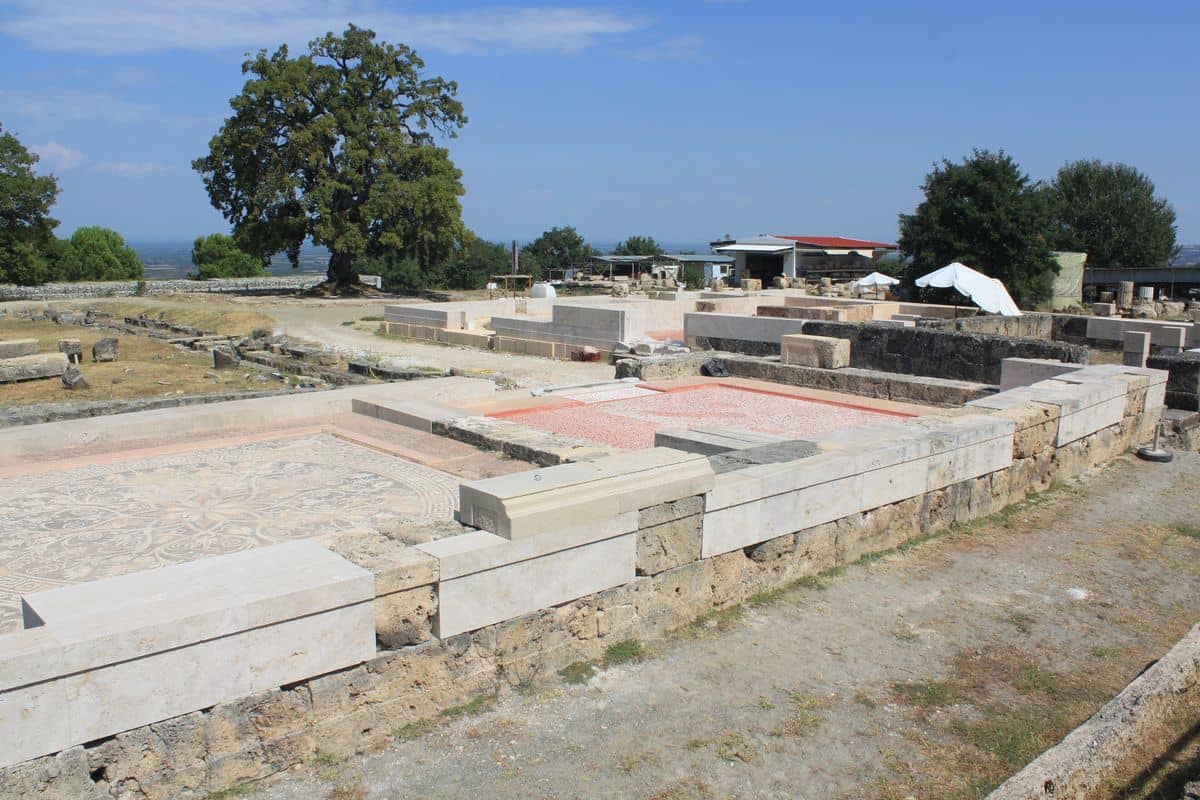
The palace stands on a plateau just below the acropolis. Its core measured 104.5 m from east to west and 88.5 m from north to south, and 60 Doric columns framed a courtyard of 44.5 by 44.5 m. Mosaic floors, painted plaster walls and relief tiles decorated the rooms. Vergina tours view nearly 30 rebuilt columns of the main peristyle and over 5,000 square feet of conserved mosaics, among them the abduction of Europa, after a 16-year restoration.
Vergina tours stop at the theatre, 50 to 60 m north of the palace on lower ground. In October 336 BC, during the wedding of his daughter Cleopatra to King Alexander of Epirus, Philip II entered the theatre in a royal procession with statues of the twelve gods. Pausanias of Orestis, one of his seven bodyguards, stabbed him, and Alexander the Great was proclaimed king at Aigai.
- Polycentric Museum of Aigai: on Vergina tours, this museum displays the restored upper central part of the palace facade and other architectural members of the building.
- Architect: scholars link the design to Pytheos of Priene, who worked on the Mausoleum at Halicarnassus.
- Sanctuary of Eukleia: its terraces lie about 80 m north of the theatre, and three inscribed bases there carry the name of Eurydice, the mother of Philip II.
- Destruction: fire destroyed the city and the palace in 168 BC, and a landslide in the 1st century AD buried the ruins under 3 to 4 m of soil.
What history do Vergina tours tell?
Vergina tours tell the story of the Argead kings, who ruled from Aigai, of Philip II and Alexander the Great, and of the 1977 excavation by Manolis Andronikos, who opened the Great Tumulus and found two royal tombs that robbers had never reached.
The Argeads, also called the Temenids, traced their roots to Argos and claimed descent from Heracles. Herodotus writes that Perdiccas I led the royal house out of Argos about 650 BC. Vergina tours also recall Archelaus I, who brought artists, poets and philosophers to his court; Euripides wrote and staged his last tragedies at Aigai.
Early in the 4th century BC, Archelaus moved the capital to Pella, but Aigai stayed the sacred city of the kingdom, with its cult centres, a royal palace and the royal tombs. Philip II reigned from 359 to 336 BC, and the body of Alexander the Great was meant to rest at Aigai as well, until Ptolemy I Soter took it to Memphis.
Vergina tours retrace a dig that began in 1861, when Léon Heuzey worked near Palatitsia with the backing of Napoleon III. In 1968 Nicholas Hammond linked the site with Aigai, and Manolis Andronikos found Tomb II on 8 November 1977. A 2010 study of the bones backed his view that Tomb II held Philip II, while a 2023 study led by Antonios Bartsiokas places Philip II in Tomb I and Philip III, half-brother of Alexander the Great, in Tomb II.
- Konstantinos Rhomaios: he founded the Aristotle University excavation at Vergina in 1937, where Andronikos worked beside him as a student.
- Manolis Andronikos: born in Bursa in 1919, he taught classical archaeology at the Aristotle University of Thessaloniki and died in 1992.
- Tomb of Eurydice: found in 1987, this tomb of around 340 BC holds a marble throne and is identified as the tomb of the mother of Philip II.
Which Vergina tours continue to Pella?
Vergina tours that continue to Pella reach the capital that replaced Aigai, the birthplace of Philip II in 382 BC and of Alexander the Great in 356 BC. The ruins lie 1 km outside the modern town of Pella, near the Archaeological Museum of Pella.
Vergina tours bound for Pella cross the Central Macedonian Plain, which runs about 34.5 km from Giannitsa in the north to Vergina in the south; ancient Pella lies about 7 km from Giannitsa. Thessaloniki, built 40 km southeast of Pella, is the start of the Pella day trip from Thessaloniki.
Archelaus I (413–399 BC) or Amyntas III founded Pella as the new capital. Its port reached the Thermaic Gulf through a navigable inlet, and silt has since filled the harbour, so the ruins now stand inland. Xenophon names it the largest city in Macedonia at the start of the 4th century BC.
Vergina tours at Pella walk a Hippodamian grid of blocks about 45 m wide around an agora of about 7 hectares. Houses with colonnaded courts kept mosaic floors of a lion hunt and of Dionysus riding a panther. The palace covered 75,000 m² on a hill 70 m high north of the city, and its oldest parts date from the time of Philip II, 350 to 330 BC.
- Archaeological Museum of Pella: designed by Kostas Skroumpellos and completed in 2009, the building has a rectangular atrium that recalls the peristyle courts of ancient Pella houses.
- Curse tablet: a lead scroll of about 375–350 BC, found in 1986, carries a curse in a Doric Greek idiom and ranks as the main inscription of the museum.
- Alexander: a head regarded as a portrait of Alexander the Great stands at the entrance, and the last gallery covers the palace and the life of Alexander.
How do Vergina tours combine Veria?
Vergina tours combine Veria, the capital of Imathia, which lies 12 km north-west of the royal site. The city adds about 48 surviving Byzantine and post-Byzantine churches, the former Jewish quarter of Barbouta, the Vima of Apostle Paul and the Archaeological Museum of Veroia.
Veria stands at the eastern foot of the Vermio Mountains, on a plateau at the western edge of the Central Macedonia plain. Its churches once numbered 72. The Church of the Resurrection of Christ, the leading Byzantine monument of the city, keeps frescoes from 1315 by Georgios Kalliergis, a master of Thessaloniki and one of a small group of Byzantine painters known by name.
The Old Metropolis, a basilica of the early 11th century, served as the Hünkar Mosque from 1430. Outside the major feast days, it now opens as a museum and archaeological site, and a plane tree of about 600 years stands beside it. Vergina tours that stop in Veria also reach the Vima of Apostle Paul, a monument to the visit of the apostle, who taught in the city in the 1st century AD.
Barbouta, the former Jewish quarter, dates from Roman times and takes its name from a fountain that still survives. It lies in the north-west of the city, beside the Tripotamos river. Its stone synagogue of the 19th century stands open to visitors as a historic monument, and the mikveh, the ritual bath, survives behind it.
- Archaeological Museum of Veroia: founded in 1965 at Elia, with three halls of finds from the Palaeolithic to the Ottoman period, including Iron Age finds from the cemetery of Vergina.
- Byzantine Museum of Veroia: opened in 2002 in the four-storey Markos flour mill, in the Kyriotissa district, with icons, mosaics, manuscripts and coins.
- Ottoman monuments: the Twin Ottoman Baths, with separate sections for men and women, and the Orta Mosque, both from the end of the 15th century.
- Barbouta mansions: the Beka mansion of 1859 and the Anastasiou mansion of 1882, examples of Macedonian architecture.
A separate page covers the Veria day trip from Thessaloniki for Vergina tours that spend longer in the city.
Which Vergina tours reach Edessa, Naoussa and Mount Vermio?
Vergina tours reach Edessa, Naoussa and Mount Vermio through Veria, where the roads to all three begin. Naoussa lies 22 km north of Veria and Edessa 49 km north, while the Seli ski centre sits 24 km from Veria, on the slopes of Vermio.
Edessa, the capital of the Pella regional unit, enters Vergina tours for its waterfalls, the main attraction of visitors to the town. Four rivers cross Edessa and form 12 falls, four of them easily visible, inside a park of 100,000 square metres. The largest, Karanos, drops 70 metres, with a cave of stalactites and a vaulted roof at its base.
The falls formed after a strong earthquake in the 14th century, and their water comes from the Agra-Nissi wetland through the Edessaios river. The Open-Air Water Museum keeps restored factory buildings, water channels and watermills, and the first aquarium of native freshwater fish in Greece has worked beside the falls since 2001. The falls sit at the edge of the Varosi district, the old acropolis and historic core of the town, which keeps multi-storey stone mansions in the traditional Macedonian style. The falls also have a page of their own, the Edessa waterfalls day trip from Thessaloniki.
Naoussa lies on the eastern foothills of Vermio, west of the Giannitsa plain, and the Arapitsa river forms a waterfall inside the town. Its red wine comes from Xinomavro, the main red grape of the Naoussa uplands, and the Naoussa Protected Designation of Origin, set up in 1971, requires 100% Xinomavro. Vergina tours that stop in the town find the Wine and Vine Museum in a Boutari family building of 1908.
- Seli: the first organised ski centre in Greece, in operation since 1934, the year of the first Panhellenic ski races, with 11 lifts, 17 runs and 2 cross-country trails.
- 3-5 Pigadia: a ski centre 17 km from Naoussa, at 1,430 to 2,005 metres, and the first in Greece with an artificial snow system.
- Chamitis: the highest peak of Vermio, at 2,065 metres, west of Naoussa.
- Natura 2000: Vermio is a protected habitat under code GR1210001, across 254 square kilometres.
How do Vergina tours travel from Thessaloniki and Veria?
Vergina tours start from Thessaloniki, about 80 km to the north-east, or from Veria, 12 km away. Line T2 trains link Thessaloniki with Veria, KTEL coaches serve Veria, and Thessaloniki Airport Makedonia, 88 km from Veria, is the closest international airport.
By road, Veria lies 73 km from Thessaloniki. The A2 motorway, also called Egnatia Odos and part of European route E90, bypasses the city to the south-east, and the EO4 national road passes through it. Vergina tours from Thessaloniki by car or coach follow this network to Veria before the short run to the site.
Veria railway station stands near the town centre, 72 km from Thessaloniki on the Thessaloniki–Bitola railway. It opened in June 1894 and still uses its original brick building, with a booking office and waiting rooms. Line T2 of the Thessaloniki Regional Railway calls there on its route between Thessaloniki and Florina.
Thessaloniki Airport Makedonia, the former Mikra Airport, lies 13 km south-east of Thessaloniki, in Thermi. Both of its terminals hold car rental offices in the departure sections, a start point for Vergina tours by hire car.
- Rail route: Line T2 passes Sindos, Adendro and Platy before Veria, then runs north to Naoussa and Skydra and west to Edessa on the way to Florina.
- Coaches: KTEL routes from Veria run to Thessaloniki, Naoussa, Alexandreia, Athens and Ioannina, inside a national network of more than 500 destinations.
- Airport bus: OASTH line 01X/01N runs 24 hours a day between the airport and the KTEL coach station of Thessaloniki.
When do Vergina tours run best?
Vergina tours run best in September and October, and in April, when average highs in nearby Veria stay between 19.4 °C and 27.8 °C. July averages highs of 31.3 °C, while December brings the highest rainfall, at 69.1 mm.
Veria has a Mediterranean climate that borders on a cold semi-arid one. Its summers, from April to October, are hot and dry, and its winters, from mid-October to March, are wet and cool. July gives the longest sunshine, 309.6 hours, and the lowest rainfall, 14.1 mm, while August and September average only 3.5 and 3.6 days with rain.
Spring adds colour to Vergina tours. From Elia, the central square known as the Balcony of Veria, the plain below turns pink with peach blossom, and the blossoming peach trees of the Veria plain featured in the National Geographic documentary Europe From Above.
Summer Vergina tours meet the heat. In late July, the Ephorate of Antiquities of Imathia has issued heatwave notices that adjust the operating hours of its archaeological sites and monuments.
- Pavleia: celebrations held every June at the Vima of Apostle Paul in Veria.
- Imathiotika: a cultural programme drawn from local tradition, held in Veria from 15 August to 15 September.
- Naoussa carnival: a carnival staged with the Boules and Genitsari dances.
- Liberation days: 16 October in Veria, and 18 October in Edessa, which adds a 5 km Night Water Run.
- Music at Aigai: the International Music Festival of Aigai, announced by the Ephorate of Antiquities of Imathia, has reached its fifth edition.
Frequently Asked Questions
Can Vergina tours add Mieza and the School of Aristotle?
Vergina tours can add ancient Mieza, in the Naoussa area, where finds at Kopanos, Hariessa and Lefkadia run from the Bronze Age to the Roman period. Excavations there have found Aristotle’s school, an ancient theatre and Hellenistic tombs, and the Ephorate of Antiquities of Imathia lists the archaeological site of Mieza beside Aigai.
Can Vergina tours see the Edessa waterfalls at night?
Vergina tours can see the Edessa waterfalls after dark. Since 2003, the falls have been lit in the colours of the rainbow at night, which makes evening visits possible. Karanos, the big fall, is floodlit in the evening, and steps and paths in the park lead even behind the falling water.
Do Vergina tours suit a winter visit?
Vergina tours in winter meet cool, wet weather in Veria, where January averages a high of 9.1 °C and a low of 0.6 °C. Naoussa sees snow on an average of 10 to 15 days a year, and Kato Vermio, at 1,450 metres, holds the Seli ski centre, set at 1,534 to 1,900 metres.
Is Veria station step-free for Vergina tours by train?
Veria station is not step-free for Vergina tours by train. It has no footbridge over the lines, passengers cross the rails on foot, and the station is not wheelchair accessible. Travellers who need step-free access reach Veria by road instead, on the A2 motorway or the EO4 national road.