
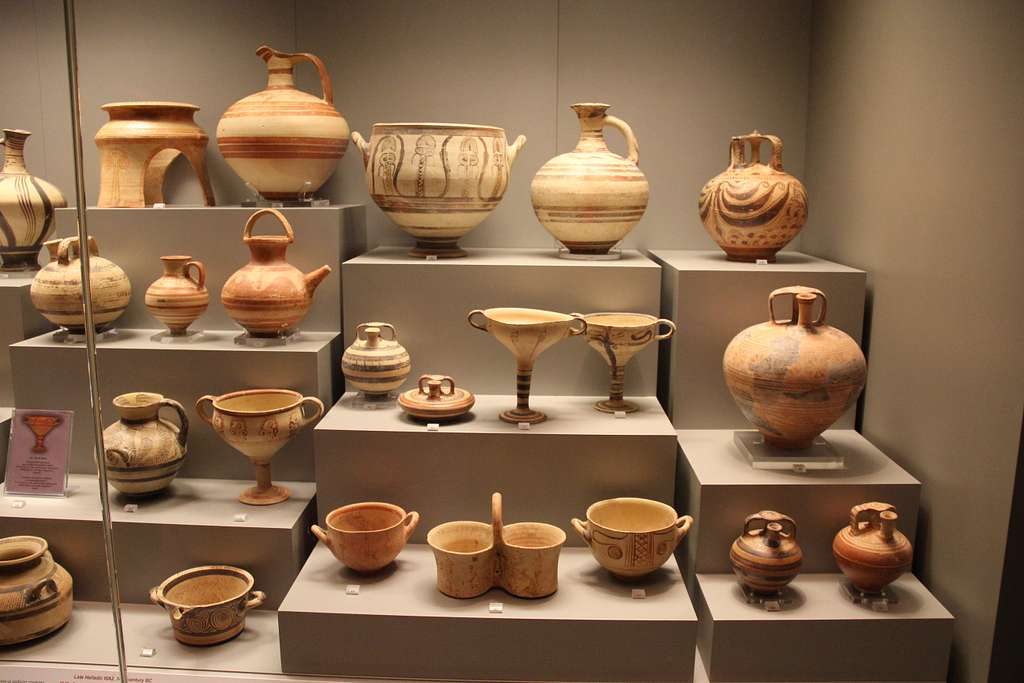
Mycenaean pottery is the decorated ceramic ware of Bronze Age mainland Greece, produced in quantity at centres such as Mycenae itself. Potters threw it on the fast wheel and fired it to a hard, pale surface, then painted it with lustrous dark designs. Early pieces borrowed flowing motifs from Minoan Crete, while later work turned to orderly bands, spirals and stylised sea creatures, flowers and figures. Drinking cups, oil jars, deep bowls and great mixing kraters carried the oil and wine of Mycenae far across the sea. Trace this everyday craft of a lost world with My Greece Tours.
Mycenaean pottery opens a direct window onto the daily life and the long reach of the Mycenaean world. These painted vessels held the wine poured at feasts, the oil shipped abroad and the perfume sealed in narrow-necked jars. Their step-by-step changes in style let archaeologists date sites across the eastern Mediterranean. The sections below cover how the ware was made, its painted designs, its main shapes, its role in far-flung trade, and its value for dating the Bronze Age. Set the pots against the citadel that made them with our Mycenae travel guide.
What was Mycenaean pottery and where was it made at Mycenae?
Mycenaean pottery was the wheel-thrown painted ceramic ware of Bronze Age mainland Greece, made in quantity at centres such as Mycenae. Potters fired it to a hard, pale surface and painted it with lustrous dark designs.
Mycenaean pottery names the decorated ceramic ware produced across the Greek mainland during the Bronze Age, with Mycenae standing among its leading centres of manufacture. Workshops there turned out vessels for the table, the storeroom and the export trade, all shaped on the fast potter’s wheel that let a craftsman raise a thin, even wall in moments. The finished pots were fired to a hard body with a pale buff or cream surface, a clean ground that showed off the dark paint applied over it. This ware belonged to the same world that raised the Cyclopean ramparts and buried its lords in gold.
The pottery of that world is set out among the finds of the Mycenaean civilization across the Aegean lands, a craft as central to the story as the walls and the tombs themselves.
The centres of production clustered around the great citadels, and Mycenae itself gave its name to the whole culture and to its pottery alike. The palace economy needed vessels in bulk, for storing oil and grain, for pouring wine at feasts and for packing goods bound overseas. The workshops answered that demand with a standardised, recognisable ware. The best of these finds now sit in display cases within the Mycenae archaeological museum, where a visitor can trace the shapes and the painted patterns at close range, vessel by vessel.
The pottery ties the daily working life of the city to the grand monuments above it, showing that the same hands which built for kings also threw the humble cups and jars used in every mainland household.
How was Mycenaean pottery made and painted?
Mycenaean potters threw their vessels on the fast wheel and fired them hard to a pale surface. They then painted lustrous dark designs over the clean ground, at first flowing Minoan-style motifs and later orderly bands and stylised figures.
The making of a Mycenaean pot began at the fast wheel, a turning platform that let the potter draw up a thin, symmetrical wall from a lump of prepared clay. This technique gave the ware its crisp, regular profiles, from the tall stem of a drinking cup to the swelling body of a storage jar. The shaped and dried vessel then went into the kiln and was fired to a hard body with a pale, light-coloured surface that served as the ground for decoration. Onto that ground the painter laid a lustrous dark slip, ranging from deep brown to near black, which fused to a glossy finish in the firing.
The painted surface, not modelled relief, carried the artistry of the piece, linking pottery to the wider tradition of Mycenaean art.
The painted designs changed in character over the life of the culture. The earliest Mycenaean vases borrowed their vocabulary from Minoan Crete, with flowing, naturalistic motifs drawn from the sea and the plant world spreading freely across the surface. Over the generations that followed, the decoration grew more orderly and controlled. Painters marked out the pot with horizontal bands, filled the zones between them with running spirals, and reduced the old sea creatures, flowers and human figures to neat, stylised shapes set in ordered rows. This move from loose Minoan flow to tighter mainland pattern gives each phase its own look. The same taste for measured design and processional order appears on the walls of the palaces.
The vase-painting stands close in spirit to the Mycenaean frescoes that decorated the great halls.
What were the main shapes of pottery made at Mycenae?
The main Mycenaean shapes include the stemmed drinking cup or kylix, the stirrup jar for oil and perfume, deep bowls and large mixing kraters. The Warrior Vase from Mycenae is the most famous of these great kraters.
The shapes of Mycenaean pottery each served a clear purpose at the table, in the storeroom or on the trade route. The kylix, a shallow bowl raised on a tall stem, was the standard drinking cup, lifted at feasts where wine flowed freely. The stirrup jar, named for the loop handles set beside a false spout, sealed and shipped precious liquids, above all scented oil and perfume, its narrow mouth guarding the contents on long sea voyages. Deep bowls answered everyday needs, while the great mixing krater stood at the centre of the feast, a wide vessel in which wine was blended with water before serving.
These forms recur across the mainland with such regularity that a single sherd can often name its shape at a glance.
The krater gave Mycenaean painters their broadest canvas, and one such vessel became the best-known pot of the whole culture. The Warrior Vase from Mycenae, a large krater found within the citadel, shows a file of helmeted soldiers marching off with spears and shields, watched by a woman raising her hand in farewell. This scene of armed men on the move is set out in full on the page for the Warrior Vase, where its place in the story of the city is explained. The shapes of the pottery, from the delicate stemmed cup to the massive figured krater, together map the range of Mycenaean life.
They run from the quiet pouring of perfumed oil to the loud gathering of a warband before the walls of the citadel.
How was pottery from Mycenae traded across the ancient world?
Mycenaean pottery was traded widely across the Aegean, Cyprus, the Levant and Egypt. The vessels carried Mycenaean oil, wine and perfume far from home, and their broad spread across those markets marks the long reach of Mycenaean commerce.
The trade in Mycenaean pottery stretched far beyond the Greek mainland, reaching across the Aegean islands and on to Cyprus, the coasts of the Levant and the ports of Egypt. Merchants loaded stirrup jars packed with scented oil, together with wine and other goods, and shipped them to markets hundreds of miles distant. The pots travelled as both containers and traded objects in their own right, prized abroad for their fine finish and their painted decoration. Where the vessels turn up in a foreign harbour, they mark a link in a network of exchange that bound the Mycenaean world to the older powers of the eastern Mediterranean.
This far-flung commerce enriched the palaces, and it ran under the eyes of the lords who ruled from the palace of Mycenae.
The reach of the pottery measures the reach of Mycenaean power. Finds of these vases from Sardinia in the west to the shores of the Near East in the east show how far Mycenaean traders and their goods travelled during the height of the culture. The oil and wine of Greece paid for the metals, ivory and luxuries that flowed back to the citadels. The painted jars are the surviving fingerprints of that two-way traffic. Each pot lifted from a distant site tells of a voyage, a cargo and a market. Together the scattered finds sketch a map of Bronze Age commerce centred on the mainland palaces.
The pottery thus does more than hold oil, it records the trading empire that made the lords of Mycenae rich and the city a name known across the sea.
Why do archaeologists use Mycenaean pottery to date ancient sites?
Mycenaean pottery changed style step by step over the centuries, so each phase has its own recognisable look. Archaeologists match a pot or sherd to a known phase and thereby date the layer and the site around it.
The value of Mycenaean pottery for dating rests on the steady, traceable way its styles changed through time. Painters did not alter their work at random. They shifted from one set of motifs and shapes to the next in an orderly sequence that scholars have pieced together and divided into named phases. A vessel from an early phase looks unlike one from the close of the culture, and the differences fall into a fixed order. An excavator who lifts a sherd from a buried layer can read its style, which points to a particular phase. That phase gives an approximate date to the layer and to everything found alongside it.
This makes the humble potsherd one of the most powerful tools an archaeologist owns for reading the age of a Bronze Age deposit.
The dating power grows stronger still because the ware travelled so far. The same recognisable phases turn up in Cyprus, the Levant and Egypt, sometimes in layers that can be tied to written records and dated rulers of those lands. A Mycenaean pot lying in a datable Egyptian context fixes its phase to a span of years, and that fixed point then dates every mainland site where the same style appears. In this way the pottery links the calendar of the Aegean to the firmer chronologies of the eastern kingdoms. The buried layers of the mainland citadels thereby gain their place in time.
The changing painted styles, so useful for the trader in their own day, became for the modern scholar a clock ticking across the whole of the Bronze Age eastern Mediterranean.
Frequently Asked Questions
How did Mycenaean pottery differ from Minoan pottery?
Mycenaean pottery grew directly out of the Minoan tradition of Crete, so the two share the wheel-thrown body, the pale surface and the lustrous dark paint. The difference lies chiefly in the spirit of the decoration. Minoan painters favoured free, flowing, naturalistic designs, with sea creatures and plants drifting loosely across the whole surface as if caught in motion. Mycenaean painters took over this vocabulary at first but soon reworked it into something more measured and orderly. They marked their pots with horizontal bands, set running spirals in fixed zones, and reduced the old octopuses, flowers and figures to neat, stylised, repeated shapes. The result reads as tighter and more formal than the Cretan work that inspired it.
This mainland taste for pattern and order matches the wider character of Mycenaean art, from fresco to metalwork. In short, Mycenae inherited Minoan technique and imagery, then disciplined the flowing island style into the ordered mainland manner that marks its own ware.
What is the Warrior Vase and why does it matter?
The Warrior Vase is a large mixing krater found within the citadel of Mycenae, and it counts among the most famous pieces of Mycenaean pottery ever recovered. Its painted decoration shows a file of soldiers marching away to the right, each helmeted and carrying a spear and a round shield. A woman stands at the left with her hand raised in a gesture of farewell. The scene matters because it gives a rare, direct picture of Mycenaean fighting men, their gear and their bearing, drawn by an artist of their own age rather than reconstructed by later hands. It shows the helmets, the shields and the marching order of a warband setting out, perhaps to war.
The vase belongs to the late phase of the culture, when armed themes grew common in the art. The Warrior Vase stands as both a fine ceramic and a portrait of Mycenaean warriors, and it links the everyday craft of the potter to the martial world that the citadel and its lords inhabited.
Why is Mycenaean pottery found so far from Greece?
Mycenaean pottery turns up far from the Greek mainland because the culture was a trading power that shipped its goods across the eastern Mediterranean and beyond. The painted vessels served as containers for the oil, wine and scented perfume that Mycenaean merchants sold abroad, so wherever those cargoes went, the pots went with them. Traders carried the stirrup jars and other wares to the Aegean islands, to Cyprus, along the coasts of the Levant and into the ports of Egypt. They exchanged Greek produce for metals, ivory and luxury goods. The pottery itself was also prized abroad for its fine finish and painted decoration, so it travelled as a valued object and not only as packaging.
Finds reaching from Sardinia in the west to the Near East map the full spread of this commerce. Each foreign pot marks a voyage and a market, and together the scattered vessels record the trading network that made the lords of Mycenae wealthy and their city a name known across the sea.