
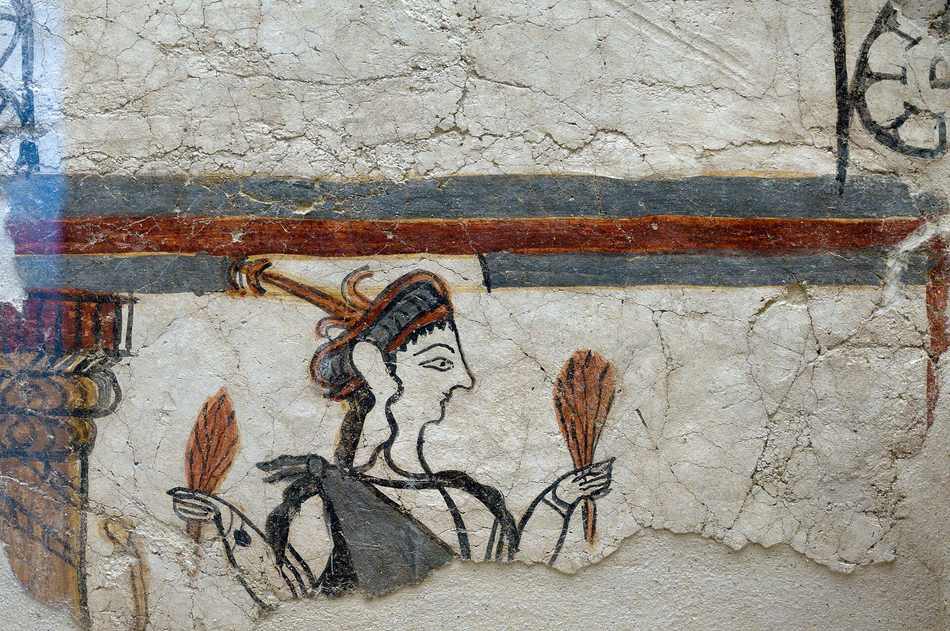
Mycenaean frescoes are the painted wall decorations that once covered the Bronze Age palaces of mainland Greece, the citadel of Mycenae among them. Painters spread mineral colours over wet lime plaster in a technique carried across from the Minoans of Crete, filling halls, corridors and shrines with bright scenes. Their palette ran to red, blue, yellow, black and white, and their subjects reached from stately processions of women to warriors, chariots and imaginary beasts. These paintings turned bare stone walls into windows onto palace life and belief. Step inside the coloured world of the palace elite with My Greece Tours.
Mycenaean frescoes give the ruined citadel back its lost colour, dressing the grey walls in the reds and blues that met the eyes of kings. Painters worked scenes of ritual, hunting and war onto the plaster of the great hall and the cult centre, leaving fragments that survive to this day. The sections below cover the fresco technique borrowed from Crete, the subjects the artists chose, the famous painted pieces from the citadel itself, the shared style of the mainland palaces, and where these paintings are kept now. Set the wall paintings against the walls they adorned with our Mycenae travel guide.
What are Mycenaean frescoes and where were they painted?
Mycenaean frescoes are the painted wall decorations of Bronze Age palaces on the Greek mainland. Artists applied bright mineral colours onto plastered walls of palace halls, corridors and shrines, covering bare stone with scenes of people, animals and ritual.
Mycenaean frescoes belong to the great palace centres of the Late Bronze Age, the fortified seats of the mainland kings who ruled from strongholds such as the citadel of Mycenae. Painters covered the inner walls of these palaces with coloured scenes, turning the stone and plaster surfaces of halls, passages and shrines into settings rich with figures and pattern. The decoration was no minor trimming but a central part of how a palace declared its wealth and its taste to every guest who entered its rooms. Wall painting reached the mainland as part of the wider culture of the Mycenaean civilization, the Bronze Age power whose kings raised the great citadels of the Argolid.
Colour and image marked out the rooms where those kings held court and worship, dressing plain surfaces in the reds and blues of ceremony and rank.
The frescoes were built into the fabric of the buildings, painted directly onto the prepared walls rather than hung or added later. This bound the images to the architecture, so that the shape of a hall or corridor framed the scenes that ran along it. A visitor moving through a palace passed processions, beasts and warriors laid out to be read as the rooms unfolded. The paintings formed one branch of the wider tradition of Mycenaean art, standing alongside carved stone, worked gold and fine metalwork as an expression of palace culture.
Where sculpture and jewellery displayed the skill of the elite in small and precious form, the frescoes worked at the scale of the wall, wrapping whole rooms in the colours and subjects the palace chose to show.
How did Mycenaean artists make their wall paintings?
Mycenaean artists painted on wet lime plaster in a true fresco technique learned from the Minoans of Crete. Mineral pigments in red, blue, yellow, black and white bonded with the drying plaster, fixing the colours firmly into the wall.
The core method was true fresco, the painting of colour onto plaster while it was still wet. Craftsmen spread a smooth coat of lime plaster over the wall, then laid mineral pigments onto the damp surface so that the colour sank in and set as the plaster dried. This chemical bond locked the image into the wall itself rather than leaving it as a film on top, which is one reason fragments have lasted across three thousand years. The mainland artists took this technique from the Minoans of Crete, the island culture whose painters had already mastered wall painting in their own palaces.
The debt to Crete runs through much of mainland palace craft, and the same borrowing shows in the shapes and patterns of Mycenaean pottery, another field shaped by island example.
The palette was drawn from earth and mineral sources, giving the painters a working range of red, blue, yellow, black and white. Red and yellow came from ochres, black from carbon, and blue from a manufactured pigment prized across the Bronze Age world. With these five core colours the artists built their scenes, using flat fields and firm outlines rather than shaded modelling. Convention governed much of the colouring, so that skin tone and dress followed set rules as much as observation. The result was bold and legible, meant to be read across a hall in the changing light of lamp and doorway.
This disciplined use of a small palette gave Mycenaean fresco its clear, poster-like strength, a style that carried figures and pattern with equal confidence over the long walls of the palace.
What subjects appear in the frescoes at Mycenae?
Frescoes at Mycenae show processions of women in fine dress, warriors and chariots, hunting scenes, bulls and imaginary creatures such as griffins and sphinxes. The subjects mix courtly display, warfare and the beasts of myth and ritual.
The painters of Mycenae favoured scenes that set out the concerns of the palace elite. Women in fine dress moved in stately processions, carrying offerings or gifts in ordered files that spoke of ceremony and rank. Warriors and chariots brought the world of war onto the walls, matching the martial spirit of a citadel ringed by massive ramparts. Hunting scenes carried the same charge of action and prestige, the chase standing as a mark of noble life. These subjects framed the palace as a place of both power and display.
They belong to the same visual world as the armed figures on the famous Warrior Vase, the painted pot from the citadel whose file of marching soldiers echoes the processions and battle scenes of the walls.
Animals and creatures of myth held an equal place among the fresco subjects. Bulls appeared in scenes that recall the bull imagery of Minoan Crete, a theme the mainland took up along with the painting technique itself. Beside the real beasts stood imaginary ones, the griffin with its eagle head and lion body and the sphinx with its human face, guardians drawn from the shared symbolic language of the Bronze Age east. These fabulous creatures often flanked doorways or thrones, lending a charged, protective air to the spaces they watched over.
Such images carried meaning tied to Mycenaean religion, the beliefs and rituals of the palace, so that a painted griffin or a procession of women was as much an act of cult as a piece of decoration on the wall.
Which famous painted fragments survive from the citadel of Mycenae?
From the citadel of Mycenae comes the celebrated fragment known as the Mycenae Lady, showing a richly adorned woman. Pieces from the cult centre survive too, showing figures of worship that belonged to the ritual heart of the palace.
The best-known painted survival from the site is the fragment often called the Mycenae Lady. It shows a woman richly adorned, her dress and jewellery rendered with the care the palace lavished on scenes of high rank. The piece stands as a portrait of the courtly world the frescoes were made to reflect, a single figure that captures the wealth and taste of the elite who commanded the citadel from its hill above the plain. Fragments of this quality are rare and precious, since wall painting survives only in broken pieces recovered from the ruins.
The Mycenae Lady is one of the treasures now shown at the Mycenae archaeological museum, where the painted plaster from the citadel is gathered and displayed close to the ground it once decorated.
The cult centre of Mycenae yielded painted figures of a different order, images tied to worship and ritual rather than courtly show. These frescoes came from the part of the citadel given over to religious use, the shrines and rooms where the palace conducted its rites. Their figures of worship put a face on the beliefs practised at the heart of the fortress, linking the painted walls directly to the sacred life of the community. Such pieces belong within the wider walls of the palace of Mycenae, the royal complex crowning the hill, whose halls and shrines the frescoes once lined.
Broken from their walls and pieced together again, these cult-centre fragments carry the clearest evidence of how painting served the religion as well as the pride of the kings.
Do frescoes survive at other Mycenaean palaces beyond Mycenae?
Frescoes survive at the related palaces of Tiryns and Pylos as well as at Mycenae. Together these paintings share a common mainland style, showing that wall decoration ran across the whole network of Bronze Age palace centres.
Mycenae was one centre among a network of mainland palaces, and painted walls survive from its neighbours as well. The citadel of Tiryns, close by in the Argolid plain, has yielded fresco fragments that match those from Mycenae in technique and taste, including scenes of women and of the hunt worked on plaster. Farther off to the southwest, the palace at Pylos in Messenia preserved wall paintings in unusually good condition, giving the fullest picture of how a mainland palace chose to decorate its rooms.
Taken together, the frescoes of these three sites form a single body of evidence for palace painting across the Late Bronze Age mainland, and each site adds fresh pieces that help complete the shared picture of how the kings of the age dressed their palace walls.
The paintings from the different palaces speak a common visual language. Processions, warriors, animals and mythical beasts recur from site to site, worked in the same true-fresco technique and the same five-colour palette. This shared style points to a connected elite culture, a set of tastes and workshops that ran across the whole Mycenaean world rather than staying local to one hill. The link reaches back once more to Crete, since all these mainland centres drew their painting from the same Minoan source.
The frescoes thus tie Mycenae into a broad and coherent artistic tradition, one that stretched from the Argolid to Messenia and shared its subjects, methods and colours across the palaces of kings who ruled a common Bronze Age world of war, wealth and worship.
Frequently Asked Questions
Why did Mycenaean painters learn their fresco technique from Crete?
The Minoans of Crete had built a sophisticated palace culture before the mainland centres rose to their full height, and wall painting was one of their most developed arts. The mainland kings, raising their own palaces, looked to Crete as the leading model for how such buildings should be decorated, taking over the true-fresco technique of painting on wet lime plaster along with much of its visual language. Craftsmen and ideas moved from the island to the mainland, carrying the method and the subjects with them. This is why the frescoes of the mainland share their bulls, their processions and their griffins with Minoan work, and why the technique itself matches so closely.
The mainland artists did not simply copy Crete, though. They bent the borrowed style toward their own concerns, giving more room to warriors, chariots and the hunt in keeping with the martial spirit of their fortified citadels. The debt to Crete was real, but the frescoes remained a distinctly Mycenaean expression.
What made the colours of Mycenaean frescoes last so long?
The lasting power of the colours comes from the true-fresco technique itself. Painters laid their mineral pigments onto lime plaster while it was still wet, so that as the plaster dried a chemical reaction bound the colour into the surface. The image became part of the wall rather than a coating sitting on top of it, which protected it from flaking and fading over time. The pigments were durable earth and mineral colours, red and yellow ochres, carbon black and a manufactured blue, all stable materials that hold their tone across ages. Palaces that fell and burned left plaster fragments buried and sealed beneath the debris, further shielding the colour from light and weather.
Recovered from the ruins three thousand years later, the pieces still carry their reds, blues and yellows with surprising strength. This union of a sound technique, hard-wearing pigments and long burial explains why so much colour survives on the broken plaster of Mycenae and the other palaces.
Where can visitors see the frescoes of Mycenae today?
The painted fragments recovered from the citadel are kept close to the site itself, gathered in the museum that stands beside the ruins. The Mycenae Lady and the fragments from the cult centre are shown among the finds from the excavations, letting visitors see the wall painting near the very halls and shrines it once decorated. Seeing the frescoes beside the citadel gives them their full meaning, since the broken plaster reads best against the walls and rooms it came from. A tour of the site takes in the great gate, the walls and the palace on the hill, and then the museum where the coloured fragments and other treasures are displayed.
The pieces are shown alongside pottery, weapons and worked gold, setting the wall painting within the wider world of palace craft. To walk the citadel and then study the painted plaster is to rebuild, in the mind, the colour that once filled the grey stone rooms of the kings of Mycenae.