
Ancient Corinth Review: Is It Worth Visiting the Ruins, Museum, and Acrocorinth?
Ancient Corinth review: plan a 3–4 hour visit to the Temple of Apollo, Roman Agora, fountains and museum—plus optional Acrocorinth views.
Ancient Corinth is one of those places that can look “quiet” in photos, some columns, a wide valley, a hill in the background, and then you arrive and realize you’re standing inside a real working city of the ancient world. Roads, fountains, civic buildings, a marketplace where business and politics happened daily… and above it all, Acrocorinth looming like a stone ship.
As local Greek guides who spend a lot of time on the road (and on the islands), we don’t recommend sites just because they’re famous, we recommend the ones that deliver a strong, memorable visitor experience. In this Ancient Corinth review, we’re judging the ruins, the on-site museum, and the Acrocorinth climb with clear criteria: what’s genuinely impressive, what’s skippable, how hard it is, what it costs, and who will actually enjoy it.
If you’re deciding between a day trip from Athens, a Peloponnese loop, or “one more ruin,” Ancient Corinth deserves a serious look as a must do Greek Tour.
Key Takeaways
- Ancient Corinth is a standout day trip because the ruins read like a real working city—Temple of Apollo, Roman Agora, fountains, and streets—rather than a single monument.
- Plan 3–4 hours for Ancient Corinth (ruins plus museum) to get the full story, or 5–7 hours if you also tackle Acrocorinth.
- Start early in summer since Ancient Corinth is wide open with limited shade, and heat can quickly turn the visit into a grind without water, sun protection, and good shoes.
- Follow a simple route for the best experience: Temple of Apollo first, then the Agora and Bema, then Peirene Fountain, and finish in the on-site museum to connect objects to the ruins.
- Treat Acrocorinth as a separate chapter: the climb can be moderate to strenuous, but the fortress walls and panoramic views explain Corinth’s strategic importance instantly.
- Ancient Corinth offers strong value for time and money with lighter crowds than Athens’ top sites, especially for travelers interested in Roman urban life, layered history, and the site’s biblical connections.
At A Glance
Best for: history lovers, Roman-era city fans, biblical history travelers, Peloponnese road-trippers
Main draw: a large, legible ancient city plan (Temple of Apollo + Roman Agora + fountains), plus the optional Acrocorinth fortress for huge views
Top highlights we think most visitors shouldn’t miss:
- Temple of Apollo (6th century BC Doric remains)
- Roman Agora and the Bema (traditionally associated with Paul’s appearance in Corinth)
- Peirene Fountain and other spring/fountain structures (the “lifelines” of the city)
- Archaeological Museum of Ancient Corinth (small-to-medium, but high impact)
- Acrocorinth (a separate visit/drive up the hill: payoff is excellent)
Typical time needed (realistic):
- Ruins + museum: 3–4 hours at a comfortable pace
- Add Acrocorinth: +2–3 hours depending on fitness, heat, and how far you explore
Crowd level (most of the year): generally lighter than Athens, often pleasantly uncrowded outside peak summer hours.
Reality check: this is a wide, open site with limited shade. In summer, timing matters more here than at many “compact” sites.
Location, Access, And Time Needed
Ancient Corinth sits in the northern Peloponnese, at the northern foothills of Acrocorinth, roughly 90 km west of Athens. It’s one of the easiest major archaeological sites to reach as a day trip, close enough to feel simple, but far enough that it doesn’t get the constant crush you’ll see on the Acropolis.
Getting there (what works in real life)
By car (our default recommendation):
- Fast, flexible, and ideal if you want to combine the ruins + museum + Acrocorinth without watching a clock.
- It also makes it easy to pair with the Corinth Canal viewpoint, Mycenae, Nafplio, or a broader Peloponnese loop.
By train/bus:
- Possible and budget-friendly, especially from Athens.
- The tradeoff is the “last-mile” convenience and the way heat affects you when you’re forced to walk extra distances.
How much time do you actually need?
We’ve done Ancient Corinth in under two hours (for scouting), and we’ve spent nearly a full day when we slow-walk the story. For most travelers, this breakdown works:
- 2–2.5 hours: quick visit focused on the Temple of Apollo + Agora core + a fast museum pass
- 3–4 hours: the sweet spot for first-timers (ruins + museum with time to read and absorb)
- 5–7 hours: ruins + museum + Acrocorinth climb and exploration (recommended if the weather is kind)
Best time of day:
- Summer: arrive early. Ancient Corinth is exposed, and Acrocorinth can feel like a slow oven after midday.
- Shoulder season: late morning is comfortable, and golden-hour light makes the columns and fortress walls look unreal.
Historical Overview And Timeline Context
To appreciate Ancient Corinth, it helps to stop thinking of it as “a ruin” and start thinking of it as a long-lived urban system, a place that reinvented itself across eras because the geography kept paying dividends.
Corinth’s power came from position: it controlled movement between mainland Greece and the Peloponnese and benefited from trade between two gulfs. That’s why you’ll see layers of Greek, Roman, Byzantine, and Frankish history in one tight area.
A quick, useful timeline (with the moments that matter on-site)
- Neolithic settlement (as early as ~6500 BC): evidence points to deep, early habitation in the area.
- Archaic Greek rise (7th–6th century BC): Corinth becomes a wealthy hub. The Temple of Apollo belongs to this world.
- Classical/Hellenistic phases: political shifts and regional rivalries reshape the city.
- Roman Corinth (from 44 BC onward): this is the Corinth you “read” most clearly today. The Agora, civic buildings, and monumental public spaces largely reflect Roman urban life.
- 1st century AD (Paul in Corinth): tradition places Paul at the Bema around 52 AD, tying the site strongly to early Christian history.
- Late Antiquity to Byzantine/Frankish periods: power and defense concentrate on the hill. Acrocorinth becomes a fortress with long strategic afterlife.
What this means for visitors
Ancient Corinth is especially strong if you like sites where you can recognize a city plan: streets, civic center, water infrastructure, and places where people argued, traded, worshipped, and showed off wealth.
And unlike some “greatest hits” sites that feel like isolated monuments, Corinth feels like an organism, a working city with a practical heartbeat (water, commerce, administration). That’s why it lands so well even for travelers who claim they’re “not museum people.”
Evaluation Criteria (How This Site Is Being Judged)
In this Ancient Corinth review, we’re not judging the site by hype. We’re judging it like we judge any destination we’d recommend to friends (or to guests on a long Greece itinerary): by what you can actually see, understand, and enjoy.
Here’s our evaluation framework.
1) Excavation completeness & legibility
- Can visitors “read” the site without needing a PhD?
- Are the city’s main elements (agora, roads, fountains, civic spaces) visible and coherent?
2) Preservation & visual impact
- How well do major structures hold up as photographic and emotional anchors?
- Are there standout monuments that justify the stop? (Yes, Temple of Apollo and the fortress setting matter.)
3) Historical significance (Greek + Roman + later layers)
- Does the site represent a meaningful cross-section of Greek and Roman life?
- Is there depth beyond a single era?
4) Interpretation quality (signage + learning)
- Are there clear panels, maps, and context?
- Can a first-time visitor connect ruins to function?
5) Visitor logistics (access, comfort, flow)
- Ease of access from major hubs (Athens/Patras)
- Shade, heat exposure, terrain safety
- Facilities and the overall “friction level” of the visit
6) Value for time and money
- Does the experience feel worth it without over-romanticizing it?
- Does the museum meaningfully increase the value of the ticket?
We also keep our bias transparent: we love sites that feel alive through infrastructure, roads, water systems, and civic centers. Corinth delivers that more than many headline attractions.
Disclosure: We’re local Greek travel professionals and guides, but we have no affiliation with the site’s ticketing or management. We’re writing this review to help travelers plan well, not to sell a specific product.
What To See And Do (Evidence-Based Walkthrough)
Ancient Corinth rewards a simple strategy: start with the big visual anchor (Apollo), then “walk the city” through the Agora and fountains, then finish with the museum. If you’re doing Acrocorinth the same day, decide early, because heat and legs decide for you later.
A practical route we use:
- Temple of Apollo (orient yourself, take photos while you’re fresh)
- Move into the Agora core: Bema, shops, stoas, administrative areas
- Visit the Peirene Fountain and related water features
- Optional extensions: Lechaion Road, baths, theater/odeon/Asklepieion area
- End at the Archaeological Museum to “name the faces” and objects behind the stones
Key Highlights: Temple Of Apollo, Fountains, And Main Agora Area
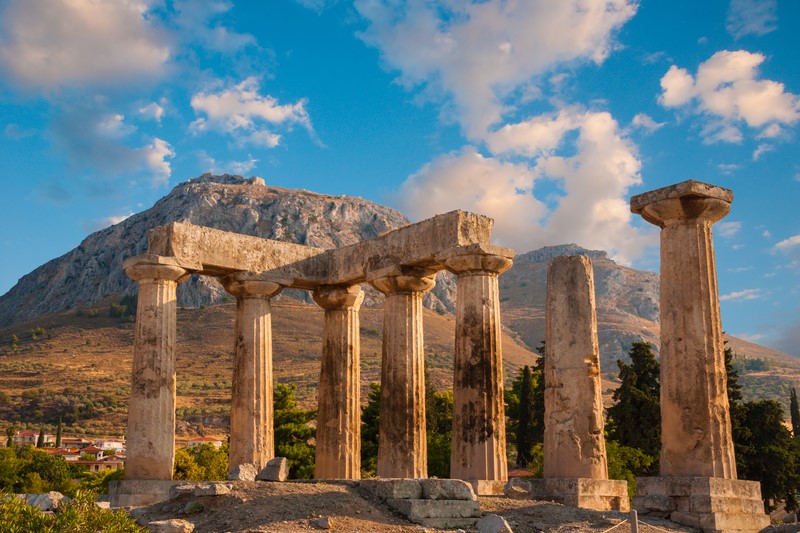
The Temple of Apollo is the scene-setter. It’s Archaic, Doric, and famously photogenic, seven columns remain from a 6th-century BC structure. More importantly, it gives you instant scale: Corinth wasn’t a minor town. It had the confidence (and money) for monumental building early.
From there, the experience shifts from “monument” to “city.” The Roman Agora area is where Ancient Corinth becomes unusually legible:
- You can follow the logic of a commercial and civic center: open space, surrounding buildings, processional routes.
- The Bema matters because it’s one of those rare features that connects archaeology to a specific narrative many visitors already know (especially biblical history). Even if you’re not traveling for religious reasons, it’s a strong example of Roman civic architecture and public life.
- The long lines of stoas and shop foundations help you picture daily movement, people buying, arguing, meeting, and waiting.
Water is the other star here. The Peirene Fountain is not just a “nice ruin.” It’s evidence of what made the city sustainable and prosperous. Springs and fountains in Corinth are infrastructure turned into architecture, practical, but also designed to impress.
If we’re guiding friends, we’ll often pause and ask: If you removed the water system, would this city still work? Corinth’s fountains answer that immediately.
Acrocorinth: Fortress Views, Climb Difficulty, And Payoff
Acrocorinth is the hill you can’t ignore. It’s a steep, monolithic acropolis that became a fortress across Byzantine and Frankish phases (and beyond). The experience is different from the lower ruins: less “urban plan,” more “strategic stronghold.”
Difficulty (honest version):
- The climb ranges from moderate to strenuous depending on temperature, pace, and how far inside the fortress complex you roam.
- Surfaces can be uneven, and in summer the sun is relentless. Bring water, more than you think.
Payoff:
- The views are huge and cinematic: you understand instantly why Corinth mattered.
- Fortification lines, gates, and layered walls give you that rare “medieval meets ancient” feeling.
If you’re choosing between rushing the lower site or adding Acrocorinth, we’d usually prioritize not rushing the lower site, unless you’re the kind of traveler who collects viewpoints and fortresses. But if you have the time (and the weather cooperates), Acrocorinth turns a good day into a memorable one.
Archaeological Museum: Notable Finds And How Much It Adds
The Archaeological Museum of Ancient Corinth is the glue. Without it, the ruins can feel like a beautiful shell. With it, you get names, faces, and everyday texture.
Notable things we look for (depending on displays and rotations):
- Prehistoric pottery that reminds you this place has deep roots
- Roman statuary and portraiture (a fast way to understand status and identity)
- The Twin Kouroi (iconic Archaic style)
- The synagogue lintel and other inscriptions that broaden the cultural picture
- The Captives Façade figures and decorative elements that show Roman Corinth’s taste for display
- Smaller pieces, like an Eros head, that deliver disproportionate emotional impact
Does it add value? Yes, strongly. We’d put Corinth in the category of sites where the museum isn’t “optional” if you care about understanding what you’re seeing. Even a 30–45 minute museum visit will sharpen the ruins outside.
Tip: Do the museum after walking the site. You’ll recognize architectural fragments and details you just passed, and it makes the interpretation stick.
Visitor Experience
Ancient Corinth feels calmer than many marquee Greek sites, and that calm is part of the appeal. You get space to think, to take photos without elbows in the frame, and to actually hear your guide (or your own thoughts).
What the visit feels like (the human side)
- Spacious: The layout lets you wander and create your own pacing.
- Narrative-friendly: Even self-guided travelers can stitch together a story: temple → marketplace → water → museum.
- Less “performance tourism”: You’re not forced into a single choke point the way you are at some famous citadels.
Where expectations can go wrong
If someone expects a “single iconic monument” experience like the Acropolis, they may initially feel underwhelmed, until they realize Corinth is about systems: commerce, water, governance, and a city’s long afterlife.
Guided, private and audio-guided formats, with their start points and add-ons, are compared on the Ancient Corinth tour page.
In our experience, visitors who enjoy it most do two things:
- They give it enough time (at least 3 hours with the museum).
- They treat Acrocorinth as a separate chapter, not a quick add-on.
Practical on-the-ground tips we wish everyone knew
- Wear shoes you’d trust on uneven stone.
- Carry water even outside peak summer.
- If you’re doing Acrocorinth, plan the climb when your energy is highest, usually morning.
On-Site Signage, Interpretation, And Learning Value
For an open-air site, Ancient Corinth does a relatively solid job with interpretation, especially at the major monuments. You won’t get a theme-park style “storyline,” but you do get enough anchors to understand what you’re looking at.
Signage quality (what’s good)
- Key areas typically have informational panels that identify structures and explain function.
- The site’s most important elements, Apollo, Agora features, fountains, are usually contextualized well enough for self-guided visitors.
What could be better (and how we compensate)
Some sections still require imagination. Ruins are foundations and fragmentary walls: a sign can only do so much. We recommend:
- Using a simple site map and orienting yourself at Apollo first
- Reading about Corinth’s Roman period before you go, because that’s the layer you’ll “see” most clearly on the ground
Learning value: why Corinth is unusually teachable
Ancient Corinth is a great “first big ruin” in Greece because it demonstrates fundamentals:
- How an agora works (public space + commerce + administration)
- How water infrastructure shapes urban life (fountains and springs aren’t side attractions here)
- How cities layer over time (Roman rebuilds, later fortifications above)
And yes, the biblical connection is real in terms of visitor interest. Even if you’re not traveling for religious reasons, it brings a level of attention and curiosity that makes people read more carefully on site.
Reference note: The excavations and ongoing scholarly work are closely tied to institutions such as the American School of Classical Studies at Athens, which is part of why the site’s documentation and research tradition are strong.
Crowds, Heat/Shade, Accessibility, And Comfort
This is where Ancient Corinth can be either a dream day or a slightly brutal one, mostly depending on weather and mobility needs.
Crowds
Compared with Athens’ headline sites, Ancient Corinth is typically less crowded. Even in high season, it often feels manageable because the space is spread out.
Heat and shade
- Shade is limited. The open areas around the Agora and the approach routes can feel exposed.
- In July/August, we treat this site like we treat island hikes: start early, pause often, and don’t be proud about water.
Accessibility and terrain
- The ground is uneven in many places, with stones, steps, and irregular surfaces.
- Full wheelchair accessibility is challenging, and visitors with knee/ankle issues should plan a slower pace and stick to the most stable paths.
- Acrocorinth is a separate accessibility category: it’s a fortress on a hill, and it can be demanding.
Comfort (what helps)
- A hat and sunscreen are not “nice to have” here.
- If you’re visiting as a family, plan short breaks and use the museum as a cooler, calmer reset.
If comfort is your top priority, aim for spring or fall. In shoulder season, Ancient Corinth shifts from “hot but worth it” to “this is why we travel.”
Value For Money
Ancient Corinth generally scores well on value because you’re not paying for a single photo-op, you’re paying for a multi-part experience: major ruins, a substantial urban center, and a museum that genuinely improves what you see outside.
Where the value comes from
- High historical density: Greek Archaic landmark + Roman civic core + later layers nearby.
- Low crowd friction: you’re not spending half your time in queues or bottlenecks.
- Museum included/adjacent: it upgrades the site from “stones” to “story.”
The hidden “cost”: time and energy
The only real drawback is that Corinth asks for time on your feet in an exposed landscape. If you’re doing it as a rushed add-on between Athens and Nafplio, it can feel like you didn’t get your money’s worth, not because the site is weak, but because your schedule was.
Our value verdict
For travelers who give it at least 3 hours and include the museum, Ancient Corinth is one of the better value archaeological stops near Athens, especially if you want substance without the Acropolis-level crowding.
Pros And Cons
Pros
- Temple of Apollo is iconic and instantly sets a powerful tone.
- Roman Agora is legible: you can understand how the city functioned.
- Water features (Peirene and others) are genuinely interesting, not just decorative ruins.
- Museum adds real depth with sculptures, inscriptions, and everyday material culture.
- Generally lighter crowds than Athens’ top sites.
- Acrocorinth is a major bonus for views and fortress history.
Cons
- Heat and limited shade can make summer visits uncomfortable.
- Uneven terrain reduces accessibility and can slow some visitors.
- Some areas feel fragmentary/unrestored, requiring imagination.
- Acrocorinth can be tough (it’s not a casual stroll), and the payoff depends on weather/fitness.
Net: the drawbacks are mostly logistical, not about the quality of the archaeology.
Comparisons With Alternatives (Context For Travelers)
Ancient Corinth isn’t competing with every site in Greece, it’s competing with the limited time you have. Here’s how it stacks up against common alternatives and pairings.
Ancient Corinth vs. Athens Acropolis
| Factor | Ancient Corinth | Athens Acropolis |
|---|---|---|
| Crowds | Typically lighter | Often very crowded |
| Experience | City-infrastructure + museum + optional fortress | Monumental “greatest hit” |
| Shade/Heat | Exposed | Exposed + crowded bottlenecks |
| Best for | Understanding urban life | Iconic architecture and symbolism |
If you’ve already done the Acropolis, Corinth is a strong “next step” because it shows how a major city actually worked.
Ancient Corinth vs. Delphi
Delphi is dramatic and spiritual, with landscape doing half the work. Corinth is more urban and practical, streets, commerce, water, governance.
If we’re forced to generalize:
- Choose Delphi for sanctuary atmosphere and mountain setting.
- Choose Ancient Corinth for a readable Roman/Greek city and a fortress viewpoint option.
Ancient Corinth as a pairing stop
Ancient Corinth pairs naturally with:
- Mycenae (Bronze Age citadel power, very different vibe)
- Nafplio (beautiful base town for the Argolid)
- Corinth Canal (quick scenic stop)
If you’re building a Peloponnese itinerary, Corinth often works best as the “gateway” site: easy access, strong return, and it sets historical context for everything that follows.
Who Ancient Corinth Is Best For
Ancient Corinth is a great match if you fit at least one of these profiles.
You’ll love it if you’re…
- A history enthusiast who wants more than a single temple photo
- Interested in Roman Greece and how cities were organized
- Drawn to biblical history and early Christian context (the Bema connection matters for many)
- A traveler who prefers less crowded, more spacious sites
- Doing a day trip from Athens and want something substantial without an all-day marathon
It’s only “okay” if you’re…
- Mostly chasing Instagram icons and don’t care to read or imagine layouts
- Traveling in peak summer midday and hate heat (this can genuinely ruin the mood)
It may not be the best choice if you…
- Need fully smooth, step-free accessibility throughout
- Don’t have at least 2–3 hours to give it (Corinth punishes rushed visits)
Our honest take: Ancient Corinth is one of the best sites in Greece for travelers who want to feel they understood something by the end of the visit, not just that they “saw it.”
Verdict And Recommendation
Ancient Corinth is worth visiting in 2026, clearly. As a complete experience (ruins + museum + optional Acrocorinth), it delivers a rare mix: an iconic Archaic landmark, a highly readable Roman civic center, and a fortress landscape that explains the region’s strategy in one panoramic glance.
Our recommendation:
- If you’re doing one archaeological day trip from Athens beyond the capital’s core sights, Ancient Corinth is a top contender.
- Plan 3–4 hours minimum for the ruins and museum.
- Add Acrocorinth if the weather is moderate and you want the “wow” views, just treat it as its own chapter and bring water.
If you want a site that feels less crowded than Athens, more like a real city than a single monument, and rich enough to satisfy both casual travelers and serious history fans, this Ancient Corinth review lands on a strong verdict: go, and don’t rush it.
What is the connection between Ancient Corinth and Saint Paul?
Saint Paul lived and preached in Ancient Corinth for about eighteen months, founded one of the first Christian communities there, and later wrote his letters to the Corinthians. He stood before the Roman governor Gallio at the Bema in the forum, which survives.
The apostle arrived around AD 50 and worked in the city as a tentmaker while he preached.
The two letters to the Corinthians in the New Testament were written to the community he founded here.
The Bema is a raised stone platform in the middle of the forum. Pilgrims come to stand where the apostle stood.
What are the Corinth Canal and the diolkos near Ancient Corinth?
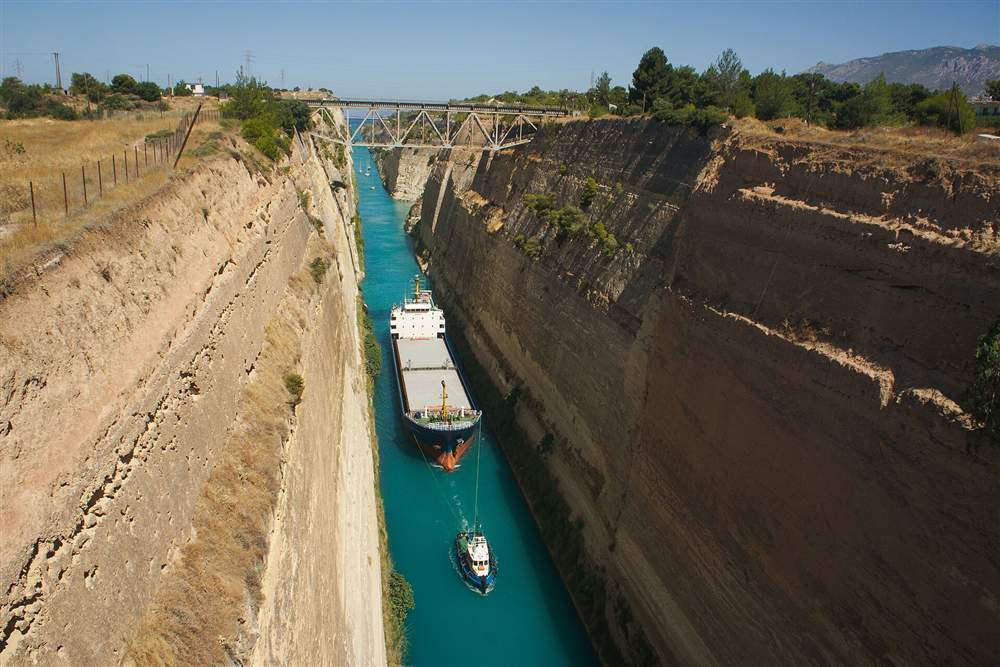
The Corinth Canal is a 6.4-kilometre ship canal cut through the isthmus, opened in 1893, with rock walls up to about 80 metres high. Long before it, ships were hauled across the isthmus on the diolkos, a paved stone trackway from the sixth century BC.
The canal links the Gulf of Corinth with the Saronic Gulf. A stop at the bridge to look down its narrow sides is a highlight of the drive to Ancient Corinth.
The diolkos let goods and even warships cross between the two seas without sailing round the Peloponnese. Parts of its stone track survive at the western end of the canal.
Boat trips pass through the canal from Loutraki and Nafplio.
The passages through the cut, the submersible bridges and the diolkos have their own Corinth Canal tours page.
How do you get to Ancient Corinth from Nafplio?
Ancient Corinth lies about an hour by car from Nafplio, north through the Argolid. A car is the best way to reach both the archaeological site and the fortress of Acrocorinth above it.
Travellers based in Nafplio drive north for the day: the Corinth day trip from Nafplio page covers the tours, the road, the Temple of Apollo, Acrocorinth, the canal and Nemea.
Organised day tours from Nafplio also reach the site, some combined with the canal.
Acrocorinth stands a few kilometres above the site, at the end of a winding road. A car or a taxi reaches its gates, and the fortress is explored on foot.
Acrocorinth is free to enter.
When is Ancient Corinth open?
Ancient Corinth opens daily at 08:00. It closes in the evening from April to October and in the afternoon in winter, so a summer visit allows the longest day. The ticket covers the archaeological site and the museum.
Where to buy entry, how the e-tickets work and who gets reduced or free admission are set out on the Ancient Corinth tickets page.
Tickets are bought at the entrance, with reduced and free categories for those with ID.
Opening hours change with the season, so check them before a winter visit.
Acrocorinth keeps its own hours and charges no entry.
Can you combine Ancient Corinth with Nemea?
Yes. The ancient site and wine country of Nemea lie about half an hour from Ancient Corinth by car, so the two pair into a day of ruins and vineyards in Corinthia.
Winery visits near Corinth, with organic, sparkling and lunch tastings and tours that add Ancient Corinth or the Corinth Canal, are compared on the Corinth wine tasting page.
Nemea holds the temple of Zeus, the stadium of the Nemean Games and a museum.
The wineries of Nemea make red wine from the Agiorgitiko grape, and wineries along the valley open for tastings.
Ancient Corinth also sits on the road between Athens and Nafplio, so travellers stop on the way. Our Nemea page covers the site.
Where do you eat near Ancient Corinth?
Eat in the tavernas of the village beside the archaeological site, which serve Greek home cooking, grilled meats and local wine, some with views of the ruins or Acrocorinth. The coast at Loutraki and the wine country of Nemea add more choice within a short drive.
Guided olive oil tastings in the family groves around Ancient Corinth are covered on the Corinth olive oil tasting page.
The village of Ancient Corinth grew up beside the ruins. Lunch is a short walk from the gate.
The tavernas serve meze, stews and the red wines of nearby Nemea.
Loutraki, on the coast, suits a seafood lunch by the sea after the site.
What myths are linked to Ancient Corinth?
Ancient Corinth is linked to the myths of Sisyphus, the king who founded the city and was condemned to roll a boulder uphill forever; Medea, whose revenge unfolded here; and Bellerophon, who tamed the winged horse Pegasus at the Peirene fountain.
Sisyphus cheated death, and the gods punished him with endless labour. His name became a byword for futile work.
Medea, from the tale of Jason and the Argonauts, lived in Corinth after the voyage of the Argo. The tragedy of her revenge is set here.
Pegasus became the emblem of the city and appears on Corinthian coins.
Which other fountains stand at Ancient Corinth besides Peirene?
Besides Peirene, Ancient Corinth holds the Fountain of Glauke, a huge block of rock hollowed into water chambers near the Temple of Apollo, and the Sacred Spring in the forum, reached by a stairway.
The Fountain of Glauke is named after the bride of Jason. In legend, she threw herself into the spring to escape Medea’s poison.
The Sacred Spring was once fenced off as holy ground inside the forum.
Peirene, Glauke and the Sacred Spring show a city built around its water.
Can you visit Ancient Corinth from a cruise ship?
Yes. Ancient Corinth is a common shore excursion from Piraeus, about an hour from the port. Cruise excursions combine the archaeological site with the Corinth Canal, sometimes adding Acrocorinth or a winery.
A half-day ashore covers the site and the canal.
The fortress needs more time than a shore excursion allows.
Visitors who want Acrocorinth and a full visit come independently and give Corinth a whole day.
What was Ancient Corinth famous for?
Ancient Corinth was famous for its wealth, its bronze-working and painted pottery, the Isthmian Games and its trade across two seas. The Corinthian order, the most ornate style of Greek column, carries the city’s name.
Control of the isthmus and two harbours made Corinth one of the richest cities of Greece. An ancient saying held that not everyone can afford to go to Corinth.
Corinthian bronze was among the most valued metals of antiquity, and the city’s pottery sold across the Mediterranean.
The acanthus-leaf capitals of the Corinthian order appear on buildings across the world today.
What were the Isthmian Games?
The Isthmian Games were one of the four great Panhellenic games of ancient Greece, with Olympia, Delphi and Nemea. They were held every two years at the sanctuary of Poseidon on the isthmus near Corinth.
The games honoured Poseidon, god of the sea, fitting for a city that lived by its harbours.
Athletes and spectators came from across the Greek world.
The site of the sanctuary lies at Isthmia, east of the canal, with a small museum.
What are the Lechaion road and the theatre of Ancient Corinth?
The Lechaion road was the paved avenue from the forum of Ancient Corinth to its harbour of Lechaion on the Corinthian Gulf, lined with shops and colonnades. The theatre and the odeon of the Roman city stood nearby.
The road was the grand entrance to the city from the harbour, busy with trade.
The theatre was rebuilt in Roman times for plays and, later, for gladiatorial games.
The smaller odeon beside it hosted music and recitations.
What was the temple of Aphrodite on Acrocorinth?
The temple of Aphrodite stood on the highest summit of Acrocorinth, dedicated to the goddess of love. Little of it survives, but the summit gives the widest view over the isthmus, both gulfs and the mountains.
The temple made the summit sacred as well as strategic.
Ancient stories linked it to the city’s reputation for pleasure. Historians debate how much of that reputation was real.
The walk to the top passes three lines of walls and gates from Byzantine, Frankish, Venetian and Ottoman times.
What is the difference between Ancient Corinth and modern Corinth?
Ancient Corinth is the archaeological site at the foot of Acrocorinth, in a village of the same name. Modern Corinth is a separate town on the coast about seven kilometres away, rebuilt on a new site after an earthquake in 1858.
The Temple of Apollo and the forum lie inland, in the village beside the ruins.
The modern town is a working town with the port and the railway, not a sightseeing stop.
Visitors head straight for Ancient Corinth and Acrocorinth, and the village is the base for a visit.
How did Ancient Corinth rise, fall and rise again?
Ancient Corinth grew rich on trade across two gulfs and founded Syracuse and Corfu in the 8th century BC. Rome destroyed the city in 146 BC. Julius Caesar refounded it as a colony in 44 BC, and it became the capital of the province of Achaea.
Thucydides wrote that the Corinthians were the first Greeks to build triremes. Corinth founded Corfu, then called Kerkyra, and Syracuse in Sicily around 733 BC. The colonies carried Corinthian pottery and trade across the western Mediterranean.
In 146 BC the Roman general Lucius Mummius sacked the city. Its men were killed, and its women and children were sold as slaves. The site stood almost empty for a century. The forum that Caesar’s colonists laid out is the centre of the Ancient Corinth day trip from Athens.
In the Middle Ages the city moved up to Acrocorinth. The Franks took the rock in 1210 after a siege of five years. The Ottomans took it in 1458. The Venetians held it from 1687 to 1715, and then the Ottomans returned until the Greek revolution.
What remains at the sanctuary of Isthmia near Ancient Corinth?
The sanctuary of Isthmia keeps the foundations of the temple of Poseidon, a stadium with the grooves of a mechanical starting gate, a theatre and Roman baths with a mosaic of sea creatures. Its museum holds glass panels from the harbour of Kenchreai.
The starting gate is called the hysplex. Cords ran from a pit behind the line to a gate at each lane. One pull released all the runners together. The grooves for the cords survive in the stone.
Winners of the Isthmian Games took a crown of pine, and in some periods of wild celery. Athens held seats of honour at the games, because Theseus was said to have founded them.
The Hexamilion wall crossed the Isthmus from gulf to gulf beside the sanctuary. It was built in the early 5th century AD and repaired under Justinian. It ran for about 7 km with 153 towers.
The museum’s glass panels, in the opus sectile technique, came from Kenchreai, the eastern harbour of Corinth. They were found still packed in crates, left when an earthquake sank the harbour. Paul sailed from Kenchreai for Syria, according to the Acts of the Apostles. The harbour moles now lie about a metre under the water off Kechries.
Who tried to cut the Corinth Canal before 1893?
Periander of Corinth planned a canal across the Isthmus around 600 BC but built the diolkos instead. Nero began a cut in AD 67, and the work stopped after his death. French and then Greek companies dug the modern canal between 1882 and 1893.
Demetrios Poliorketes also studied a canal around 300 BC. His engineers warned that the two seas stood at different levels. They feared the higher sea pouring over the lower shore. Julius Caesar and Caligula planned canals, and neither began work.
Josephus records that 6,000 young Jewish prisoners were sent from Judea to dig for Nero. Traces of the Roman trenches came to light during the works of the 1880s.
Today two submersible bridges, at Isthmia and Poseidonia, sink under the water to let ships pass. The canal measures about 24.6 m wide at the surface, too narrow for modern cargo ships. Landslides from its soft rock walls close it for months at a time. The road bridge above the cut is the main stop on the Corinth Canal day trip from Athens.
What does the stadium at Nemea show?
The stadium at Nemea keeps a vaulted entrance tunnel of about 320 BC, with names scratched into its walls by athletes waiting to compete. The stone starting line survives in the track. The revived Nemean Games are run in the same stadium every four years.
The tunnel is one of the earliest vaulted passages in Greece. The athletes walked through it from their changing room into the stadium. One graffito praises an athlete named Akrotatos as beautiful.
In the revived games, entrants run barefoot in white tunics. They start from the ancient stone sill. Anyone can enter. Winners take a crown of wild celery, the prize of the ancient festival.
In myth the games began as funeral games for the infant Opheltes, killed by a snake. Herakles killed the Nemean lion in the hills above the valley. The vineyards around the site climb from the valley floor to the high slopes of Asprokampos, as the Nemea wine guide explains.
What is Sikyon, west of Ancient Corinth?
Sikyon is an ancient city on a plateau about 5 km inland from Kiato, on the coast west of Ancient Corinth. It keeps a theatre for about 10,000 spectators, a gymnasium on two terraces, a stadium and a museum in its Roman baths.
Sikyon was a rival of Corinth. In the 4th century BC it led Greece in painting and in bronze sculpture. Lysippos, the court sculptor of Alexander the Great, came from Sikyon. Demetrios Poliorketes moved the city up to the plateau in 303 BC.
The theatre is one of the largest in the Peloponnese. It keeps two vaulted side passages. The gymnasium below it has a fountain house on each of its two levels. The museum in the restored Roman baths holds mosaics and pottery from the site. Kiato lies on the coastal motorway that Peloponnese tours follow west toward Patras.
Further west on the same coast, the Odontotos rack railway starts at Diakopto and climbs the Vouraikos gorge toward Kalavryta, the route of the Diakopto tours.
The mountain town at the top of the line, with the Agia Lavra monastery and the Cave of the Lakes, has its own Kalavryta tours page.
What are the mountain lakes of Stymphalia and Doxa?
Stymphalia is a shallow lake at about 600 m in the mountains south-west of Corinth, the setting of the sixth labour of Herakles. Lake Doxa is a reservoir at about 900 m above the Feneos plain, ringed by fir forest, with a chapel on a small peninsula.
In the myth, Herakles drove the Stymphalian birds off the lake with a bronze rattle. The basin has no river outlet and drains through sinkholes. In the 2nd century AD an aqueduct built under Hadrian carried its springs more than 80 km to Corinth.
The ruins of ancient Stymphalos stand on the northern shore. Nearby lies Zaraka, a Cistercian abbey built by the Franks in the 13th century. The Environment Museum of Stymphalia explains the wetland and the crafts of the basin. The lake is a protected Natura area for herons and ducks.
Lake Doxa was created in the 1990s to hold the winter water of the Feneos plain. The chapel of Agios Fanourios stands on its peninsula. The old monastery of Agios Georgios is built into the rock above the shore.
What does Loutraki add to a visit to Ancient Corinth?
Loutraki adds thermal springs, a long pebble seafront and the cliff monastery of Osios Patapios to a visit to Ancient Corinth. The spa town lies on the Corinthian Gulf about 8 km from the canal. It serves as a coastal base for the Isthmus.
The spa town has its own Loutraki tours page for the springs, Lake Vouliagmeni, the Heraion and the canal crossings.
The springs rise at the foot of the Gerania mountains. Their water was bottled and drunk across Greece from the 19th century. A municipal hydrotherapy centre on the seafront still runs baths.
The monastery of Osios Patapios stands at about 650 m on the slope above the town. It keeps the relics of a 4th-century hermit from Egypt, found in its cave church in 1904. The terrace looks down over Loutraki to the gulf.
West of the town, the cliffs of Gerania meet the sea in caves and small coves. Sea kayaks reach them from Loutraki. The town lies about 84 km from Athens, the route of the Loutraki day trip from Athens.
What are the Heraion of Perachora and Lake Vouliagmeni?
The Heraion of Perachora is a sanctuary of Hera on the western tip of the Perachora peninsula. Lake Vouliagmeni is a salt lagoon on the road to it, joined to the Corinthian Gulf by a narrow channel. Both lie within half an hour of Loutraki.
The sanctuary served Corinth from the Geometric period. Its temple of Hera Akraia stands above a small harbour. A clay model of a house from the 8th century BC was found here. It is now in the National Archaeological Museum in Athens.
Above the temple lie a stoa, dining rooms for pilgrims and a deep rock-cut cistern. A lighthouse stands on the point above the ruins. The sun sets straight into the gulf beyond it.
Lake Vouliagmeni lies about 4 km before the sanctuary. Its water warms early and stays flat when the open gulf is rough. Fish tavernas stand on decks over the water on its southern bank.
Frequently Asked Questions About Ancient Corinth
Is Ancient Corinth worth visiting in 2026?
Yes—Ancient Corinth is worth visiting in 2026 because it feels like a real working ancient city, not just a single monument. The Temple of Apollo, Roman Agora, fountains, and the on-site museum create a complete, readable experience, usually with lighter crowds than Athens’ top sites.
How long do you need at Ancient Corinth (including the museum)?
Plan 3–4 hours for Ancient Corinth’s ruins plus the Archaeological Museum at a comfortable first-timer pace. A quick visit can be 2–2.5 hours if you focus on the Temple of Apollo and Agora core. Add extra time if you like reading signage or photographing details.
What are the must-see highlights in Ancient Corinth?
Don’t miss the Temple of Apollo (6th century BC Doric columns), the Roman Agora and Bema, and the Peirene Fountain and other water structures that kept the city functioning. Finish in the Archaeological Museum to connect the ruins to sculptures, inscriptions, and everyday objects.
How hard is the Acrocorinth climb, and is it separate from Ancient Corinth?
Acrocorinth is a separate visit above Ancient Corinth, often reached by driving up and then walking inside the fortress complex. The effort ranges from moderate to strenuous due to steep, uneven surfaces and intense sun. The payoff is panoramic views and layered Byzantine/Frankish fortifications.
What’s the best way to get to Ancient Corinth from Athens—car, bus, or train?
A car is usually the easiest way to visit Ancient Corinth because it’s about 90 km west of Athens and lets you combine the ruins, museum, and Acrocorinth without rushing. Bus or train can be budget-friendly, but “last-mile” walking and heat can make the day harder.
When is the best time of day or season to visit Ancient Corinth to avoid heat and crowds?
In summer, visit Ancient Corinth early in the morning because the site is wide open with limited shade, and Acrocorinth can feel punishing after midday. In spring or fall, late morning is comfortable. Outside peak hours, crowds are often pleasantly light compared with Athens.
See more about Greece Tours:
- 7 Days in Greece Itinerary – Athens, Santorini, Mykonos & More
- Top 10 Greece Wedding Destinations For A Dream Island Celebration
- Greek Island Hopping Tours, Trips, And Tips: How To Plan The Perfect Route
- Top 10 Greek Islands To Visit In Summer For An Unforgettable Greece Vacation
- Free Things to Do in Athens: Athens on a Budget
- Milos Tours: Explore Milos Boat Tours, Excursions & Tours in Milos Greece
- Mykonos Tours & Excursions – Discover Mykonos, Greece