
An Ancient Corinth day trip from Athens reaches one of Greece’s wealthiest ancient city-states in around an hour, taking in the Temple of Apollo, the Corinth Canal and the Acrocorinth fortress. Make the journey simple with a guided day trip or skip-the-line tickets from My Greece Tours and see far more in your day.
This excursion is one of the most rewarding escapes in the Athens travel guide. The sections below cover whether it is worth it, how to get there, what to see, costs and the best way to visit.
Is Ancient Corinth worth a day trip from Athens?
Yes, the site rewards the journey richly. Ancient Corinth ranked among the richest and most powerful city-states of Greece, a true rival to Athens at its peak, and the ruins span Greek, Roman and Byzantine eras. The standing Temple of Apollo, the Corinth Canal and the Acrocorinth fortress make it one of the easiest and most varied day trips from the capital.
Few half-day excursions pack in as much variety as this corner of the Peloponnese. Lying about 80 kilometres west of the capital, the archaeological site preserves monuments from the Archaic, Classical, Hellenistic, Roman and Byzantine periods on a single walkable plateau. Corinth grew immensely rich on trade because it controlled the narrow Isthmus linking mainland Greece to the Peloponnese, and at its height it rivalled Athens itself in power and wealth. Rome razed the city in 146 BC, and Julius Caesar refounded it as a Roman colony a century afterwards, which is why so much of what you see is grand Roman architecture.
For Christian visitors the site carries extra meaning, since the Apostle Paul spent eighteen months preaching here and later addressed his New Testament epistles to its congregation. Add the engineering spectacle of the Corinth Canal and the commanding fortress of Acrocorinth, and the day combines ancient history, religion, scenery and engineering. It pairs naturally with a wider look at things to do in Athens. Reaching it is refreshingly quick.
How do you get from Athens to Ancient Corinth?
The drive from Athens to Corinth takes about one hour on a good highway covering roughly 80 kilometres. Trains leave Larissa station every two hours and reach modern Corinth in about 55 minutes, though the ruins sit 8 kilometres further on. The simplest option is an organised half-day or full-day tour by coach, which removes all transfers.
Three practical routes connect the capital with the site, each suiting a different kind of traveller. Driving is the most flexible: the modern motorway toward the Peloponnese is in excellent condition, and the trip to either modern Corinth town or the ruins takes around an hour, with parking available beside the archaeological area. Trains depart from Athens Larissa station roughly every two hours and reach modern Corinth in under an hour, with tickets easy to buy at the station, though from the station you still need a local bus or taxi to cover the final eight kilometres to Ancient Corinth itself.
The most stress-free choice for many visitors is a guided tour, which collects you centrally and handles every transfer; half-day tours focus on the ruins and a canal photo stop, while full-day versions often add the seaside town of Nafplio or the theatre at Epidaurus. Whichever you choose, the short distance means you keep most of the day for exploring. Onward connections are explained in the guide to getting around Athens. The ruins themselves are the heart of the visit.
What is there to see at Ancient Corinth?
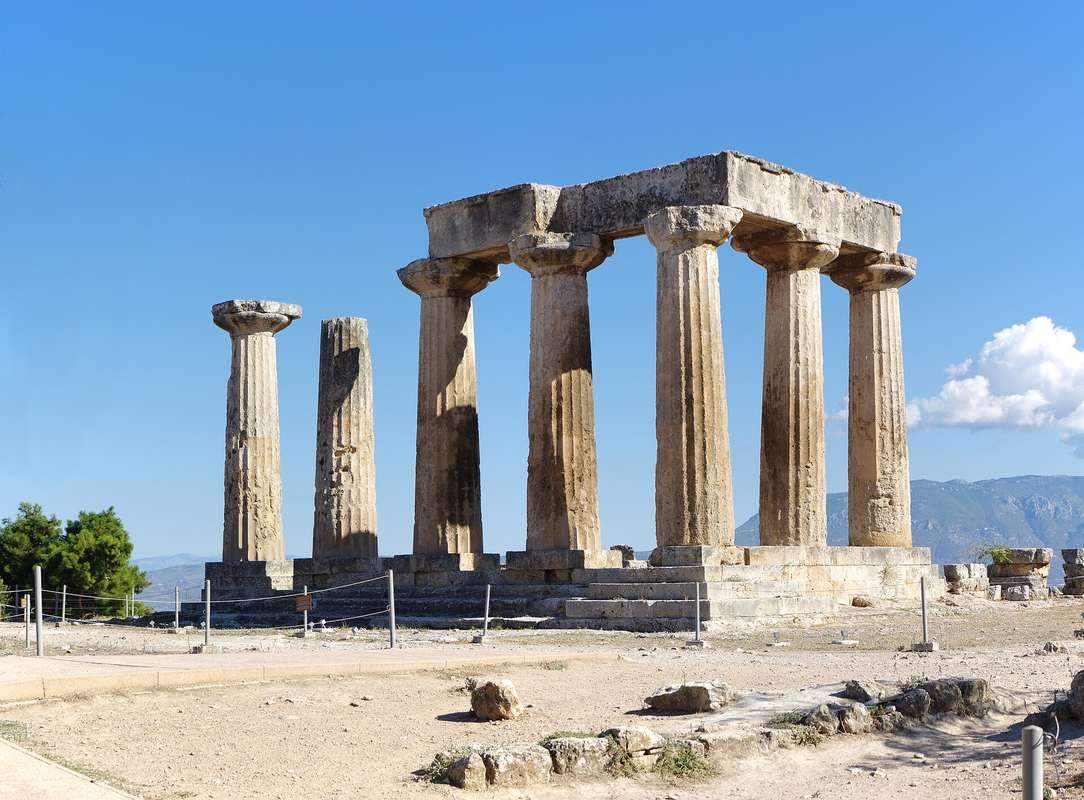
The archaeological site centres on the Temple of Apollo, a 6th-century BC Doric temple whose seven monolithic columns still stand. Other highlights include the Roman Agora, the Fountain of Peirene, the Lechaion Road, the Bema where Paul was tried, and the excellent on-site Archaeological Museum displaying mosaics, sculpture and finds from across the city’s long history.
Compact and unusually well preserved, the ruins reward a slow, attentive wander. The undisputed star is the Temple of Apollo, among the very oldest stone temples in all Greece, raised around 540 BC, whose seven surviving monolithic Doric columns rise dramatically against the backdrop of the Acrocorinth mountain. Spread below the temple is the vast Roman Forum, or Agora, a well-preserved marketplace and civic centre that reveals how a Roman provincial capital was laid out. From here you can walk the Lechaion Road, the marble-paved avenue that once linked the city to its harbour, and visit the Fountain of Peirene, an elegant spring-house that supplied Corinth with water for centuries.
History and faith meet at the Bema, the raised public platform where, according to tradition, the Apostle Paul faced trial before the Roman governor Gallio. The visit is completed by the site’s Archaeological Museum, which gathers vivid mosaics, statues, pottery and everyday objects excavated across the city. Together these monuments tell the story of a metropolis that thrived for over a thousand years. Visitors who enjoy ruins like these also appreciate the Ancient Agora of Athens. Two more sights crown the day.
What are the Corinth Canal and Acrocorinth?
The Corinth Canal is a narrow 6.4-kilometre channel cut through solid rock in the 1890s, slicing the Isthmus to link the Aegean and Ionian seas; its dramatic 80-metre-high walls make a famous photo stop. Acrocorinth is a vast medieval fortress on the rock above the ruins, with Greek, Roman, Byzantine, Frankish, Venetian and Ottoman defences and sweeping sea views.
Two extra landmarks frame the ancient city and add scale to the trip. Heading toward the site, almost every visit pauses at the Corinth Canal, an astonishing feat of nineteenth-century engineering completed in 1893 that finally fulfilled an ambition dating back to antiquity. Cut straight through solid limestone, the canal runs for 6.4 kilometres and is barely 24 metres wide at sea level, its sheer walls rising as much as 80 metres above the still green water; the road bridge across it offers a vertigo-inducing view that has become one of Greece’s signature photographs. High above the ruins stands Acrocorinth, the towering acropolis of ancient and medieval Corinth, set on a rugged 575-metre rock.
This is one of the largest and most continuously used castles in Greece, its layered walls and gateways reflecting Greek, Roman, Byzantine, Frankish, Venetian and Ottoman rule, and from its summit the views stretch across the Isthmus to the sea on both sides. Entry to the fortress is free, and a short drive takes you most of the way up before a walk to the gates. These additions turn a ruin visit into a full day out. The scenery rivals that of a Delphi day trip from Athens. Planning the practical details keeps it smooth.
How much time and money does the trip take?
You need a couple of hours at the ruins and museum, so a half-day covers the site, the canal and lunch, while adding Acrocorinth makes a full day. Entry to the archaeological site is around €8 and includes the museum; Acrocorinth fortress is free. Allow extra for transport, and bring water, sun protection and sturdy shoes.
Sensible planning lets you see everything without rushing. The archaeological site and its museum need roughly two hours to enjoy properly, which means a half-day trip comfortably covers the ruins, a stop at the Corinth Canal and a relaxed taverna lunch, including the travel time from the capital. If you want to add the Acrocorinth fortress and its panoramic walls, set aside a full day, as the climb and the views deserve unhurried time. Admission to the main site costs around €8 and conveniently includes entry to the on-site Archaeological Museum, while the Acrocorinth fortress can be visited free of charge.
Beyond tickets, budget for your transport, whether fuel and tolls by car, train fares, or the price of a guided tour. The site is open and exposed, so carry water, wear a hat and sunscreen, and choose sturdy shoes for the uneven ancient paving and the fortress slopes. The village of Ancient Corinth has a cluster of tavernas right by the ruins serving honest, simple Greek food. With these basics covered, the day runs effortlessly. Families managing a busy schedule will find the guide to Athens with kids useful. Choosing how to visit shapes the experience.
What is the best way to do an Ancient Corinth day trip?
An organised tour is the easiest way, combining hotel pick-up, the canal, the ruins and often Acrocorinth or Nafplio with a guide who explains the history. Independent travel by car suits flexible visitors, while the train is the cheapest option. For depth and convenience, a guided half-day or full-day tour delivers the most for first-time visitors.
Matching the method to your priorities makes for the best day. For most first-time visitors, a guided coach tour is the standout choice, because it removes every logistical worry, includes the photogenic canal stop, and provides an expert guide who turns scattered stones into a living story of trade, conquest and early Christianity. Many tours bundle Corinth with the Peloponnesian highlights of Mycenae, Epidaurus or the harbour town of Nafplio, giving exceptional value for a single day. Drivers who prefer independence gain total flexibility over timing and can linger at Acrocorinth for sunset, though they take on navigation and parking.
Budget travellers and rail enthusiasts can reach modern Corinth cheaply by train, accepting the extra hop to the ruins by local bus or taxi. Whichever route you choose, going early beats both the heat and the larger tour groups, and combining the ancient site with the canal and fortress gives the fullest sense of why Corinth mattered for so long. Book skip-the-line tickets and tours in advance to lock in your day. The questions below cover the points visitors ask most.
What else can you combine with an Ancient Corinth day trip?
Ancient Corinth combines easily with other Peloponnesian highlights on a full day. Popular pairings include the seaside town of Nafplio, the Bronze Age citadel of Mycenae, the great theatre of Epidaurus, and the ancient sanctuary and wine country of Nemea. The Corinth Canal sits directly on the route, and Acrocorinth fortress crowns the day with panoramic views.
Because Corinth lies at the gateway to the Peloponnese, it makes a natural springboard for some of mainland Greece’s finest sights, and many full-day tours bundle two or three together. The most popular companion is Nafplio, the elegant former capital of Greece, with its Venetian fortresses, marble streets and harbourside cafés, only a short drive further on. Close by stand two UNESCO World Heritage sites: Mycenae, the mighty Bronze Age citadel of Agamemnon with its famous Lion Gate and beehive tombs, and the theatre of Epidaurus, renowned for its perfect acoustics and still used for performances today.
Wine lovers can detour to Nemea, the heart of the Peloponnese wine country, where vineyards surround an ancient sanctuary and stadium linked to the labours of Heracles. Any of these can be linked with Corinth in a single long day, especially with an early start, turning a focused ruin visit into a sweeping tour of ancient and medieval Greece. Choosing one or two companions keeps the day relaxed rather than rushed. The classic pairing with Nafplio is detailed in the Nafplio day trip from Athens guide. The questions below cover the points visitors ask most.
Frequently Asked Questions
How far is Ancient Corinth from Athens?
Ancient Corinth lies about 80 kilometres west of Athens, roughly a one-hour drive on the modern Peloponnese motorway. Trains from Athens Larissa station reach modern Corinth in under an hour, leaving a short onward transfer of around 8 kilometres to the archaeological site itself.
How much does it cost to visit Ancient Corinth?
Entry to the Ancient Corinth archaeological site costs around €8 and includes the on-site Archaeological Museum. The Acrocorinth fortress above the ruins is free to enter. Beyond tickets, budget for transport by car, train or guided tour, plus lunch at one of the village tavernas.
Can you visit Ancient Corinth and the Corinth Canal together?
Yes, most day trips combine them easily, as the Corinth Canal sits on the route between Athens and the ruins. Organised tours almost always include a canal photo stop, and independent drivers pass directly beside it, making the two landmarks a natural pair on the same day.