
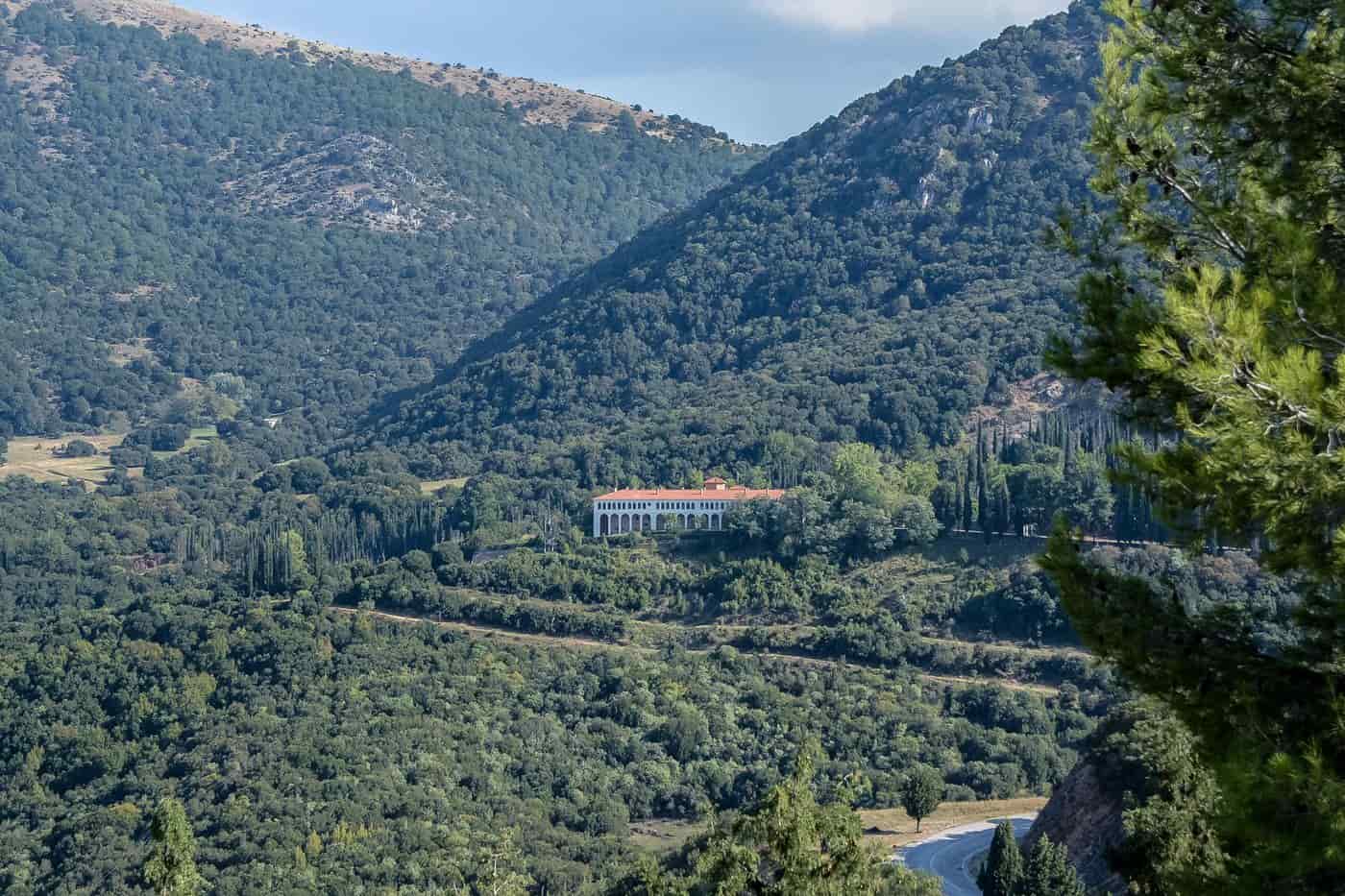
Kalavryta tours start in a mountain town of Achaea, built at about 735 metres at the foot of Mount Helmos. The routes cover the memorial of the Kalavryta massacre, the Agia Lavra monastery, the Cave of the Lakes, the rack railway line to Diakopto, the Mega Spilaio monastery and the ski centre of Helmos. Greece Tours lists the day tours that reach Kalavryta from Athens, Patras and Olympia.
This page covers what Kalavryta tours see in the town and in the mountains around it, the status of the rack railway, how visitors reach Kalavryta, which season suits each route and the local food. The tours below are checked on GetYourGuide and leave from Athens, Patras, Olympia and Diakopto.
What do Kalavryta tours cover?
Kalavryta tours cover a mountain town of Achaea, built at about 735 metres at the foot of Mount Helmos. The town had 1,600 residents at the 2021 census, and the tours reach a war memorial, the Agia Lavra monastery and a cave with 13 lakes.
Kalavryta tours start in a town on the right bank of the Vouraikos river, 24 km south of Aigio and 40 km southeast of Patras. The town grew near the site of ancient Cynaetha, and scholars read its name as “good springs”. In the 13th century, it was the seat of one of the twelve baronies of the Frankish Principality of Achaea.
Kalavryta tours also cross one of the largest municipalities in Greece by area. It took its present form in the 2011 local government reform, when four former municipalities merged, and it counted 9,223 permanent residents at the 2021 census. The town is the southern terminus of the rack railway from Diakopto, and Diakopto tours cover the northern end of the line.
- Region: the mountainous east-central part of Achaea, in the region of Western Greece.
- Altitude: about 735 metres, at the foot of the Aroania range, also called Helmos.
- Mountains: Mount Erymanthos in the west of the municipality and Helmos in the southeast.
- Status: a designated martyr town, for the events of December 1943.
What do Kalavryta tours see at the memorial of the Kalavryta massacre?
Kalavryta tours see the Kappi hill memorial, where German troops shot the men and boys of the town on 13 December 1943, and the museum in the old primary school, where the women and children were locked inside before the building was set on fire.
The massacre was part of Operation Kalavryta, a German sweep against Greek resistance fighters. Partisans had executed German soldiers taken prisoner in October 1943, and General Karl von Le Suire ordered the killing of the male population in reprisal.
The troops gathered the residents in the school yard and led the men and boys over 13 to Kappi hill, a slope on the edge of town with a full view of the burning houses. Machine-gun fire killed 499 people in Kalavryta that day, by the count of the German historian Hermann Frank Meyer, and 13 men survived under the bodies. Kalavryta tours stop at the memorial that marks the site, where the dead are remembered every December.
The women and children escaped from the burning school. Kalavryta tours then enter the building, which first opened in 1906 with funds from the benefactor Andreas Syngros, taught pupils again from 1950 to 1992 and has housed the Museum of the Kalavryta Holocaust since 2005. Its collection holds maps, photographs and personal items of the executed men.
- Cenotaph: bronze plaques placed under the monument in 1980 carry 601 names.
- Museum building: a listed historic monument since 1986.
- State visit: German President Johannes Rau came on 18 April 2000 and expressed shame and sorrow for the tragedy.
What do Kalavryta tours see at the Agia Lavra monastery?
Kalavryta tours see Agia Lavra, an Orthodox monastery founded in 961, 4 km from the town. Greek tradition places the start of the 1821 revolution at its gate, and the monastery keeps the banner of the fighters’ oath, the first flag of the Greek nation.
The monk Eugenios, a fellow ascetic of Saint Athanasios the Athonite, founded it about 300 metres southwest of the present site. Fire destroyed it in 1585, and the monastery moved to its present site in 1689. The troops of Ibrahim burned it in 1826, and an earthquake ruined it in 1844.
Greek tradition holds that on 25 March 1821, the feast of the Annunciation, Bishop Germanos of Old Patras blessed the fighters, took their oath and raised the banner under the plane tree outside the gate. Historians of the 20th century treat the ceremony as a legend, as the memoirs of Germanos do not mention it. Kalavryta tours see the banner beside the arms of the 1821 fighters.
- Banner: the curtain of the Beautiful Gate of the church, used for the oath.
- Saint Alexios: relics of the patron saint of Kalavryta, a gift of Emperor Manuel II Palaeologus in 1398.
- Gospel: a Gospel book given by Empress Catherine II of Russia.
- Library: 3,000 printed books, the oldest dated 1502.
- Monument: a memorial to the heroes of 1821 on the hill opposite the monastery.
German troops burned Agia Lavra on 14 December 1943, the day after the massacre, and executed the monks who had stayed. Kalavryta tours see the buildings as restored in 1950.
What do Kalavryta tours see at the Cave of the Lakes?
Kalavryta tours see the Cave of the Lakes near Kastria, 16.5 km from the town. The cave is the bed of an old underground river on three levels, and in summer its water stands in 13 lakes at different heights, divided by dams of dripstone.
The cave lies 9 km from Kleitoria. In winter, melting snow turns it into a flowing river with waterfalls.
Visitors enter through an artificial tunnel that leads straight to the second of the three levels, and raised bridges carry the path over the lakes. Kalavryta tours walk this route past stalactite formations. Fossil bones of humans and animals, including a hippopotamus, came to light on the lower level, which is set aside for a biospeleology laboratory.
Locals from Kastria first climbed to the second level on wooden ladders in 1964, and a first exploration team entered on 17 January 1965. The Greek National Tourism Organisation began to develop the cave in 1981, and the Municipality of Kalavryta runs it today.
- Length: 1,980 metres in total, with 500 metres open to visitors.
- Old name: Troupisio.
- Prehistory: human use from the Neolithic Age through the Bronze Age.
- Myth: Melampus cured Lysippe and Iphianassa, daughters of King Proetus of Tiryns, here.
Kalavryta tours from the capital run as a Kalavryta day trip from Athens.
Which Kalavryta tours ride the Odontotos rack railway?
Kalavryta tours that ride the Odontotos follow a 22 km rack line from Diakopto, on the Gulf of Corinth, up the Vouraikos Gorge to Kalavryta. Hellenic Train has suspended regular services on the route until the line reopens, and no replacement buses run.
The Odontotos opened on 10 March 1896 as a branch of the Piraeus, Athens and Peloponnese Railways. It climbs from sea level to 720 m and is the steepest railway in Greece.
The track has a 750 mm gauge. Where the gradient passes 10%, gear wheels on the train lock into a toothed rail in the centre of the track. Three Abt rack sections cover 3.8 km in total, with a top gradient of 17.5%.
Kalavryta tours by rail call at these stops, from the coast upward:
- Diakopto: the coastal terminus, home to the rolling stock sheds and maintenance facilities.
- Niamata and Triklia: two halts in the gorge, where the track crosses the Vouraikos on bridges and runs through tunnels.
- Mega Spilaio: the stop at Kato Zachlorou, 12.6 km from Diakopto, for visitors to the monastery.
- Pliatsikoureika and Kerpini: two upper stops, the second 18.2 km up the line below the village of Kerpini.
- Kalavryta: the upper terminus, where a Cail steam locomotive from 1891 stands preserved.
At Diakopto the rack line meets the standard-gauge main line from Athens Airport to Patras, the city covered by the Patras city tour. While the rack line stays closed, Kalavryta tours reach the town by road.
What do Kalavryta tours see at the Mega Spilaio monastery?
Kalavryta tours at Mega Spilaio see an eight-storey monastery set into a 120 m cliff above Kato Zachlorou and the Vouraikos Gorge. Its name means Great Cave, and tradition says the monastery holds an icon of the Virgin painted by Luke the Evangelist.
The formal name is the Monastery of the Dormition of the Theotokos. It stands at about 900 m, where the western slopes of Mount Helmos drop to the Vouraikos river. Tradition dates the founding to 362, when the brothers Symeon and Theodore from Thessaloniki found the icon in the cave with the help of Euphrosyne, a local shepherdess.
German troops destroyed the monastery on 8 December 1943, and the complex was rebuilt from the ground up after the war. Kalavryta tours inside the monastery see these features:
- Icon: the Panagia Megaspilaiotissa, a relief 3 cm thick, made of wax, mastic and other materials and darkened by fire.
- Katholikon: the main church, cut into the rock, with frescoes from 1653 and a carved wooden screen.
- Museum: relics of the Greek War of Independence and a library of more than 3,000 volumes.
- Feast days: 15 August for the Dormition, 14 September, and 18 October for Luke the Evangelist.
When the rack railway runs, Kalavryta tours get off at the Mega Spilaio stop in Kato Zachlorou, a village at 623 m on the left bank of the Vouraikos.
Which Kalavryta tours reach the Helmos ski centre and Mount Helmos?
Kalavryta tours reach the Kalavryta ski centre on the north side of Mount Helmos, about 14 km by road from the town. The same massif holds the 2,355 m summit, the Aristarchos telescope and the Styx waterfall of Greek myth.
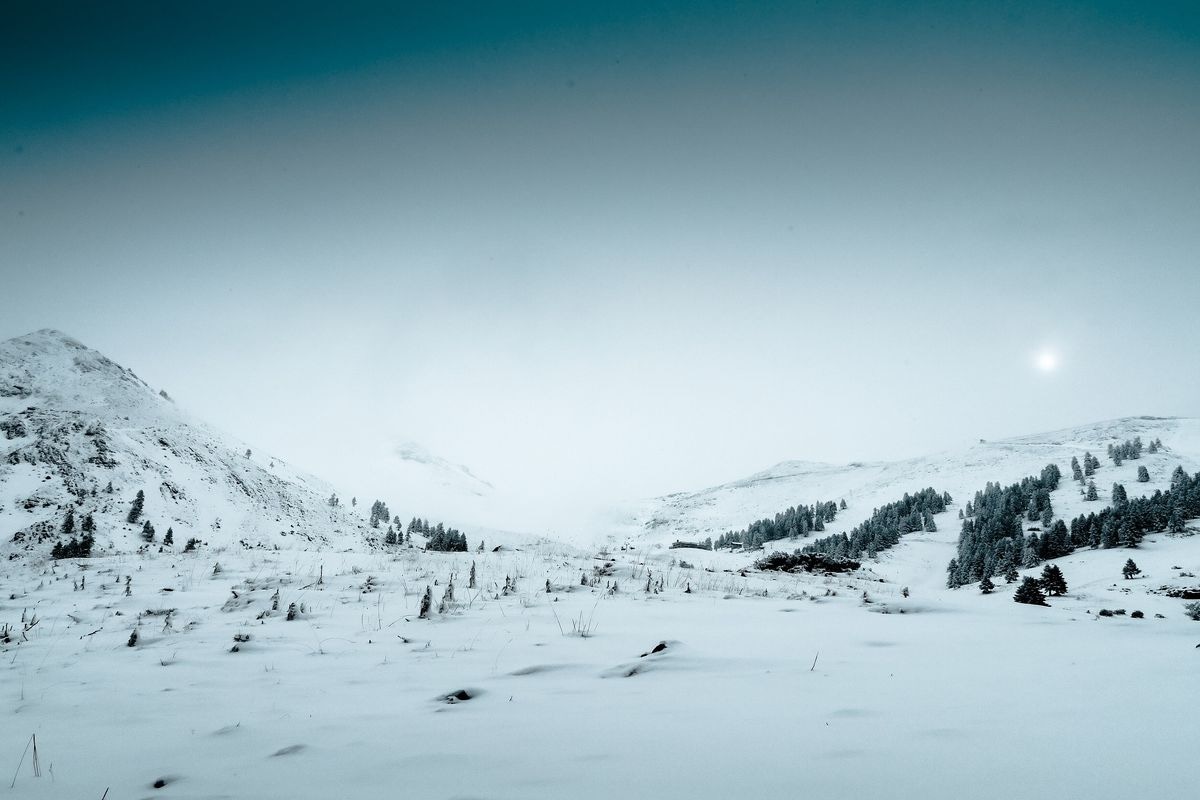
Helmos, called Aroania in antiquity, is the third-highest mountain of the Peloponnese after Taygetus and Kyllini. The massif and the Vouraikos Gorge form a protected national park. The mountain holds 1,500 plant species, 90 of them endemic to Greece.
The ski centre opened to the public in the winter of 1988 and carries the name of Panos Polkas, the mayor whose idea it was. Its runs lie between 1,700 m and 2,330 m, served by 8 lifts. The Nefeli run joins the Danae run to form a 3,200 m descent, the longest ski run in Greece.
Kalavryta tours with a summit hike climb from the north, by the ski centre, or from the east, through the ravine of the Styx. In myth, the gods swore oaths on the water of the Styx. Kalavryta tours on the mountain pass these points:
- Psili Koryfi: the 2,355 m summit and the highest point in Achaea.
- Aristarchos telescope: a 2.3 m Carl Zeiss telescope, the largest in Greece, in the Chelmos Observatory on Neraidorachi at 2,340 m.
- Styx waterfall: the Mavroneri, a stream that drops from a high cliff and feeds the Krathis river.
- Mavrolimni: a seasonal alpine lake at 2,050 m, formed by melting snow near the high peaks.
What do Kalavryta tours see at Planitero and the Aroanios springs?
Kalavryta tours at Planitero see a plane tree forest where the karst springs of the Aroanios river rise. The village sits at 700 m on the southwest side of Helmos, with watermills, rainbow trout farms and restaurants at the springs.
Planitero lies southeast of Kalavryta, in the municipal unit of Kleitoria. Its houses rise in tiers above the plane forest of the springs. A geological study counted 41 small spring outlets, where the water rises straight from karst rock or up through sand and gravel. The springs and the wooded ground form a natural area classed as a geotope.
The Aroanios runs 12 km through the Katsana valley to meet the Ladon river near Pangrataika Kalyvia. Pausanias already used the name Aroanios for it. Kalavryta tours in summer share the forest with day-trippers who arrive by bus and car from as far as Patras.
- Plane forest: a strip of plane trees, 580 m by 30 m, growing over the spring outlets.
- Trout farms: rainbow trout farms beside the springs, with river trout served among the plane trees.
- Watermills: Planitero is known for its watermills, and old nerotrives stand at the springs.
- Kleitoria: the largest town of the Aroanios valley, with wall remains of ancient Cleitor 1,300 m to its west.
How do Kalavryta tours reach the town from Athens and Patras?
Kalavryta tours reach the town by road. Kalavryta lies 190 kilometres from Athens and 72 kilometres from Patras on the road network. KTEL intercity buses link the town with both cities, while Hellenic Train keeps the rack railway from Diakopto suspended.
The drive from Athens follows the Olympia Odos motorway toward Patras. Drivers leave at the Kalavryta exit near Trapeza (Pounta) in Diakopto and cover the last 33 kilometres to the town. From Patras, the national road through Chalandritsa is the short route, and the Olympia Odos alternative runs 88 kilometres.
KTEL Achaias runs the intercity buses of Achaea from its main terminal in Patras, and daily KTEL services also connect Kalavryta with Athens and nearby towns. In the snow season, travel agencies and ski shops run ski buses from Athens and Patras, with stops at key points in both cities.
The Diakopto–Kalavryta rack line covers 22 kilometres through the Vouraikos Gorge, but no passenger trains use it at present. Kalavryta tours therefore travel by car or coach until the line reopens.
- Athens: 190 kilometres by road, through the Olympia Odos and the Diakopto exit.
- Patras: 72 kilometres by road, or 88 kilometres on the Olympia Odos.
- Aigio: 55 kilometres by road, on the Gulf of Corinth.
- Tripoli: 86 kilometres by road, in the central Peloponnese.
The same road network ties Kalavryta tours to wider Peloponnese tours, with Corinth and Pyrgos each 110 kilometres away and Kalamata 174 kilometres away.
When do Kalavryta tours run best?
Kalavryta tours run all year, and visitor numbers peak in winter thanks to the ski centre on Mount Chelmos. Spring brings blossom, summer stays cool under the plane trees, and each December the town commemorates the massacre of 13 December 1943.
The town stands at about 735 metres on the foothills of Mount Chelmos, also called Aroania. Snow is common in winter on the Achaean ranges of Erymanthos, Panachaiko and Aroania. In summer, the coast of Achaea stays sunny, while the mountains can turn cloudy and rainy. On the low ground of Achaea, winters stay mild, with daytime highs around 10 °C.
Winter Kalavryta tours focus on the ski centre, which lies 14 kilometres from the town on the north side of Chelmos, with runs between 1,700 and 2,330 metres. The main town offers about 2,000 beds for this busy season.
On 13 December 1943, German occupation troops executed almost the entire male population of Kalavryta and burned the town. The clock on the bell tower of the central church stays fixed at 02:34, the hour when time stood still.
- Winter: ski season on Chelmos and the busiest months in town.
- Spring: nature in full bloom along the routes around the town.
- Summer: plane trees shade the squares on the hottest days.
- Autumn: red and yellow leaves cover the streets.
- 13 December: the yearly commemoration of the 1943 massacre.
Which local foods do Kalavryta tours taste?
Kalavryta tours taste trout from the farms of Planitero, feta and myzithra from dairies below Mount Chelmos, fir honey, wild mountain tea and village pasta such as chylopites and trahanas, all sold in the town and in the villages around it.
Kalavryta tours that continue to Planitero, 24 kilometres from the town, reach a plane forest at the springs of the Aroanios River, at about 690 metres. Farms there raise trout and salmon, and restaurants in the area serve the fish fresh or cooked. The village is also known for its water mills.
Dairy units at the foot of Chelmos make feta and myzithra from milk collected from local flocks. In Kalavryta itself, the Union of Agricultural Cooperatives runs a milk-processing plant, and dairy shops sell local cheese. Across the Chelmos-Vouraikos UNESCO Global Geopark, farms keep mainly sheep and goats, and the traditional items sold to visitors are mainly honey and aromatic plants.
Local farmers pick wild aromatic plants on the slopes and peaks of Chelmos, chiefly mountain tea and oregano. Chelmos fir honey takes its character from the local fir species and the soil and climate of the mountain. Walnut trees, watered by the Aroanios River, cover its valley, a workshop in the town makes spoon sweets, and an organic winery works vineyards at Plataniotissa.
- Trout: farmed at the Aroanios springs and served fresh or cooked.
- Cheese: feta and myzithra from the milk of local flocks.
- Pasta: chylopites, trahanas, lazania and kritharaki from village workshops.
- Honey: fir honey from the Chelmos mountains.
- Herbs: wild mountain tea and oregano.
Frequently Asked Questions
Do Kalavryta tours ride the rack railway?
No. Hellenic Railways suspended traffic on the Diakopto line indefinitely, citing damage left by a wildfire in the Vouraikos Gorge that loosened the ground and set off landslides and rockfalls. Hellenic Train then halted its trains until the line reopens, no replacement buses run, and Kalavryta tours travel by road.
How long do Kalavryta tours take by bus from Athens?
Daily KTEL buses from Athens reach Kalavryta in about 3 to 3.5 hours, and the ride from Patras takes about 1.5 to 2 hours. The same intercity network links the town with nearby towns, which gives Kalavryta tours a route for travellers without a car.
Where do Kalavryta tours buy local products?
The main cluster of shops for traditional products stands on the central pedestrian street of Kalavryta, where chylopites, honey, herbs and regional cheeses fill the shelves. Small shops also line the roads to and from the town, and the villages of the area sell their own produce.
What do Kalavryta tours see on 13 December?
Each December the town commemorates the victims of 1943, and Kalavryta holds the official status of a martyr town. The Museum of the Kalavryta Holocaust occupies the old primary school, and the Kalavryta Holocaust Memorial marks the site of the executions on the field overlooking the town.