
A Kalavrita day trip from Patras climbs from the port city into the mountains of Achaia for caves, monasteries and the rack railway. Plan more days around the country with Greece Tours.
This page sets out the tours you can book, each stop on the way, the season, the trip length, public transport, booking and common questions.
What is a Kalavrita day trip from Patras?
A Kalavrita day trip from Patras is a single day out from the port city into the mountains of Achaia. Tours mix the Cave of the Lakes, the Mega Spilaio monastery, the rack railway and the town itself.
Each Kalavrita day trip from Patras follows the same basic shape. You start in Patras, travel up to Kalavrita and its sights, then return to the city. The Patras tour card places Kalavrita in the Peloponnese. The whole outing fits inside one day, with no overnight stay.
The cards and titles name four main stops. The Cave of the Lakes features on both booking cards. The Mega Spilaio monastery features on the Patras card. The rack railway features on the second card. Both cards also name the town of Kalavrita in their titles, so the town is part of each plan.
No single card covers all four stops at once. Each tour picks its own mix from the list. The card you choose sets the shape of your day in the hills.
One booking card adds a wine stop to the day. The Patras tour lists a tasting at a winery alongside the cave and the monastery. With that stop, a Kalavrita day trip from Patras pairs a cave and a monastery with a wine tasting.
Which Kalavrita day trips from Patras can you book?
The cards and titles show four options to book. Three name Patras in their titles, and two of those visit the Cave of the Lakes. The fourth card joins the Lakes Cave with the rack railway and is listed under Diakopto.
Each entry below comes from a booking card or a listing title. Compare the stops on each Kalavrita day trip from Patras before you pick one.
- Kalavrita, Cave of the Lakes, monastery and winery tour from Patras: a Kalavrita day trip from Patras for a private group, lasting 7 hours. It visits the Mega Spilaio monastery and a winery for a tasting, with pick-up available.
- Lake caves and rack railway tour in Kalavrita: a private, small-group day that rides the rack railway and visits the Lakes Cave. It also takes in the town of Kalavrita and lists pick-up as available.
- Private Kalavrita tour from Patras: a private trip whose title names Kalavrita, the cave lakes, a monastery and a winery.
- Lake Tsivlou and Zarouchla day tour from Patras: a day tour from Patras to Lake Tsivlou and Zarouchla, as its title states.
The two booking cards share the Cave of the Lakes but differ elsewhere. The Patras card names Patras in its title and adds the monastery and a winery. The rack railway card is listed under Diakopto. It swaps the monastery and the winery for a ride on the rack railway.
The lake day stands apart from both cards. Its title names Patras and Lake Tsivlou, but not Kalavrita or the cave. Next to a Kalavrita day trip from Patras, it offers a second day out from the same city. For trips that centre on the town, see our Kalavryta tours.
How does the guided Kalavrita day trip from Patras run?
The guided Kalavrita day trip from Patras lasts 7 hours. It takes in the Cave of the Lakes, the Mega Spilaio monastery and a winery tasting. Pick-up is available, the group is private, and the tour runs in English or Greek.
The booking card describes the Kalavrita day trip from Patras as a tour to Kalavrita in the Peloponnese. Its title names the town first, then the cave, the monastery and the winery. The summary lists the three stops in this order:
- The Cave of the Lakes comes first, and the card invites you to explore it. The cave lies at Kastria, in the Kleitoria unit of the Kalavrita municipality.
- The Mega Spilaio monastery comes second.
- A winery comes last, with a tasting of its wines.
The whole outing runs for 7 hours, as the card states. The card does not split those hours between the cave, the monastery and the winery.
The Kalavrita day trip from Patras runs as a private group tour. Only your own party takes part in the tour. The card also lists pick-up as available for the day.
Two tour languages appear on the card: English and Greek. No third language is listed for the guiding. The card files the outing as a day trip that leaves the city behind. It also names Patras as the main location of the tour.
Which road does a Kalavrita day trip from Patras follow?
Two ways lead up for a Kalavrita day trip from Patras. One runs inland from Aigio on National Road 31. The other follows the Vouraikos valley from Diakopto, on the coast east of Patras.
Both ways begin on the coast road east of Patras. National Road 8 runs along the southern shore of the Gulf of Corinth and ends in downtown Patras. On its way into Patras from the east, it passes Aigio and then Rio. Since every route starts in the city, a Patras city tour fits on another day of the stay.
The inland way on a Kalavrita day trip from Patras leaves the coast at Aigio. There, National Road 31 meets National Road 8 and heads south via Pteri. The road ends at Kalavrita, which stands 24 kilometres south of Aigio.
The coastal way carries on to Diakopto. The town faces the Gulf of Corinth where the Vouraikos river reaches the sea. It sits on the old National Road 8. The newer National Road 8A passes one kilometre to the south.
From Diakopto, a Kalavrita day trip from Patras turns inland along the Vouraikos. The river flows past both Diakopto and Kalavrita before it meets the Gulf of Corinth.
How does the rack railway fit a Kalavrita day trip from Patras?
The rack railway is the core of a Kalavrita day trip from Patras. Its lower terminus, Diakopto, lies about 40 km east of Patras. From there, the line climbs from sea level to 720 metres in 22.3 km.
The line opened in the late nineteenth century. It was built for the Piraeus, Athens and Peloponnese company as a branch line. At Diakopto, it meets the standard-gauge railway between Athens Airport and Patras. That junction links the mountain line with Patras by rail. Diakopto itself is a coastal town in Achaea, on the Gulf of Corinth.
- Track: a single line with a 750 mm gauge.
- Stations: six in total, three of them now disused.
- Main stops: Diakopto, Zachlorou and Kalavrita.
- Rack: three Abt-system sections, 3.8 km in total.
- Steepest gradient: 17.5%.
- Top speed: 40 km/h on adhesion track and 12 km/h on rack track.
- Trains: four three-car diesel-electric sets, ordered to replace the old stock.
- Steam era: six locomotives built specifically for this line.
Rack track starts wherever the gradient exceeds 10%. On those stretches, gear wheels on the train engage toothed rails in the centre of the track. The line ranks as the steepest railway in Greece. On a Kalavrita day trip from Patras, these rack stretches are where the train runs slowest.
One bookable tour for a Kalavrita day trip from Patras puts the rack railway in its title. The card sells it per group of up to six passengers. Its title places the ride in Kalavrita.
What do you see in the Vouraikos gorge on a Kalavrita day trip from Patras?
On a Kalavrita day trip from Patras, the train runs up the Vouraikos gorge, a canyon about 20 km long. Steep cliffs, waterfalls and caves mark the gorge, and the track passes through a long run of tunnels and bridges.
The Vouraikos river rises in the Aroania mountains, near the village of Priolithos. It runs for 37.5 km and passes Kalavrita on the way. The river meets the Gulf of Corinth close to Diakopto, which stands at the lower end of the gorge. For the coastal end of the line, see our Diakopto tours.
The rack railway runs through this gorge on a Kalavrita day trip from Patras. The line starts at Diakopto and then enters the gorge. Bridges carry the track across the Vouraikos river, and the route also runs through tunnels. The single track has passing loops at Niamata, Triklia, Zachlorou and Kerpini. Dense vegetation grows along the water.
On a Kalavrita day trip from Patras, the train stops halfway, after 12.6 km, at Kato Zachlorou. The village stands at 655 metres on a mountain slope above the Vouraikos. Below it, the river runs through a narrow gorge.
Kato Zachlorou lies about 11 km south of Diakopto and 9 km north-east of Kalavrita. It sits in eastern Achaea, within the municipality of Kalavrita. The narrow-gauge line runs through the village.
What lies inside the Cave of the Lakes on a Kalavrita day trip from Patras?
The Cave of the Lakes holds an old underground river laid out on three levels. In summer the water stops flowing and leaves 13 lakes behind. The cave also holds stalactites and stalagmites, and it forms the underground stop of a Kalavrita day trip from Patras.
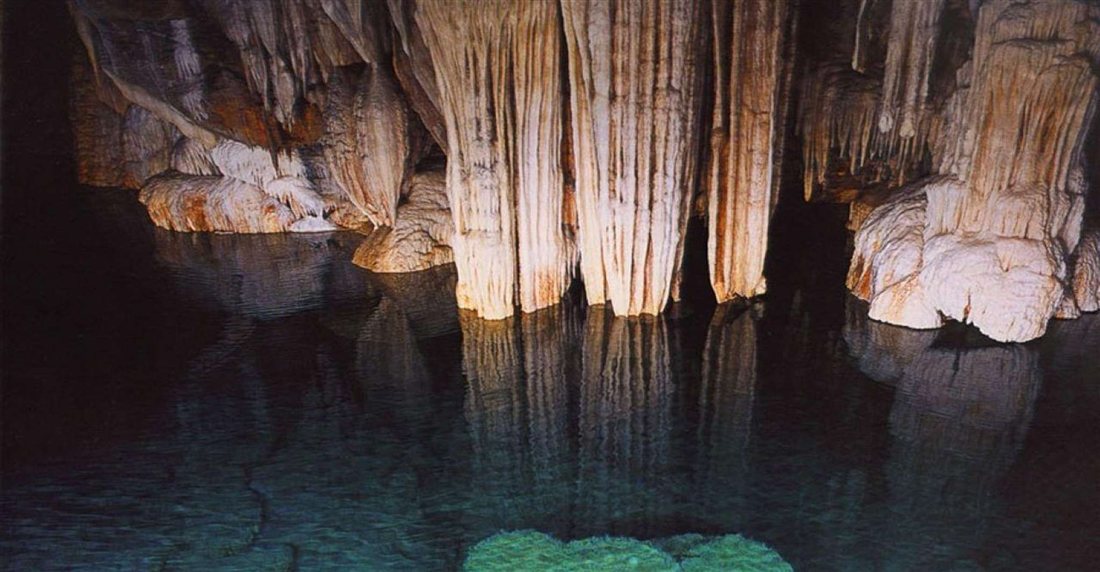
The cave lies near the village of Kastria, in the municipality of Kalavrita in Achaea. Its former name was Troupisio. The site has one entrance, and it is open to the public with lighting inside. The key figures below give a quick picture of the cave before a Kalavrita day trip from Patras.
- Levels: three, cut along an old subterranean river course
- Lakes: 13, left behind when the river dries up in summer
- Entrances: one
- Distance: 17 km from Kalavrita and 9 km from Kleitoria
- Discovery: the twentieth century
The seasons shape the water inside. In winter, snowmelt turns the cave into a running river, complete with waterfalls. In summer, that river dries up, and the lakes stay in its bed. A visit on a Kalavrita day trip from Patras therefore shows the cave in one of these two moods.
The ancient traveller Pausanias mentions the cave in his writings. Greek legend places a cure here. Melampus healed Lysippe and Iphianassa, two daughters of Proetus, king of Tiryns. Their sister Iphinoe died on the way.
Humans used the cave in the Neolithic Age and kept using it through the Bronze Age. On the lower level, fossilised bones of humans and other animals have been identified, including hippopotamus. These finds give the cave palaeontological and archaeological interest for anyone on a Kalavrita day trip from Patras.
Why does the Mega Spilaio monastery belong on a Kalavrita day trip from Patras?
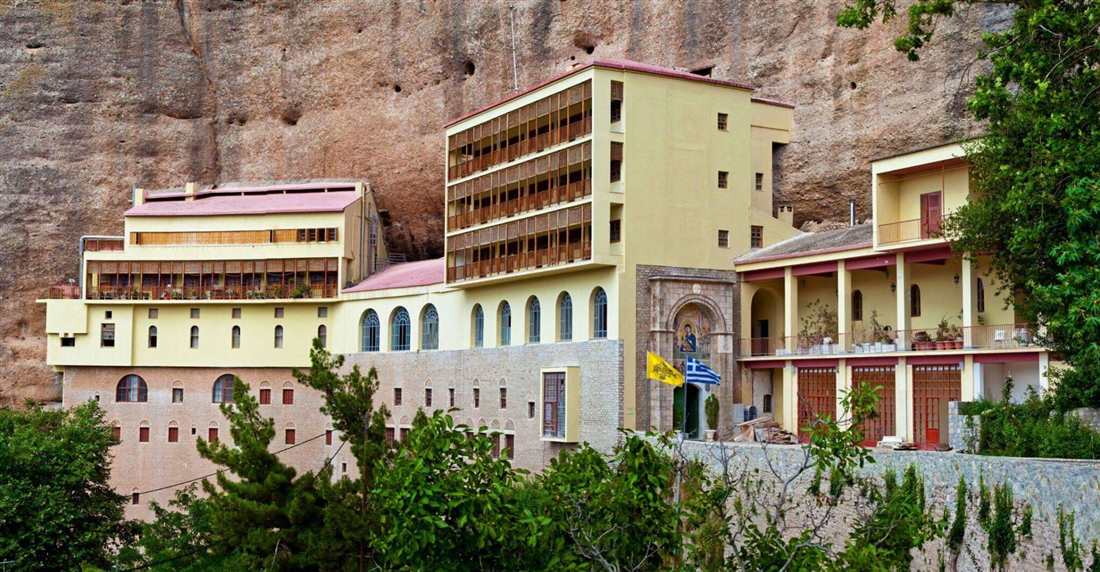
Mega Spilaio, meaning “Great Cave”, is a Greek Orthodox monastery set in a large cave in a sheer cliff. Tradition names it one of the oldest monasteries in Greece. Its old tie to the city earns it a place on a Kalavrita day trip from Patras.
The cliff stands where western mountain slopes drop down to the gorge of the Vouraikos river. The monastery lies about 11 km northwest of Kalavrita. Today it comprises an eight-storey complex set in a cliff face 120 metres high.
Christian hermits lived in the cave during the first Christian centuries. Tradition says Symeon and Theodore, two Thessalonian brothers, founded the monastery in 362. A local shepherdess, Euphrosyne, helped them find an icon of the Theotokos in the cave. Tradition holds that Luke the Evangelist painted that icon. Her role earned Euphrosyne honour as a saint.
From about the middle of the fourteenth century, the monastery served as the residence of the Orthodox Metropolitan of Patras. The Latins still held Patras at that time. A Kalavrita day trip from Patras therefore reaches the former home of the city’s Orthodox Metropolitan.
The complex suffered large-scale destruction three times between 849 and the seventeenth century. After the last of these, it was comprehensively rebuilt. In the twentieth century, a fire destroyed the katholikon, the main church. Three years later, a new church replaced it.
What does Kalavrita remember from the Second World War?
Kalavrita remembers the massacre of 13 December, carried out by German troops during the occupation of Greece. In the town, 438 men, boys and seniors were killed, and the houses were burned. The events are commemorated every December.
The story told on a Kalavrita day trip from Patras starts with a German military operation. Its aim was to encircle guerrilla fighters of the Greek Resistance. Guerrillas had taken 78 German soldiers prisoner in October and later executed them. General Karl von Le Suire then personally ordered the “severest measures”.
Early that morning, the soldiers rounded up every resident of the town. About 1,300 women and children were locked inside a school, which was then set on fire. They found a way to escape the burning building. The men and older boys were moved to a field overlooking the town and machine-gunned there.
There were only 13 male survivors, saved because they lay hidden under the bodies of the dead. After looting Kalavrita, the troops set it ablaze, and about 1,000 houses burned. The next day, they burned down the Agia Lavra monastery.
Twenty-eight communities, including towns, villages and monasteries, were destroyed. During the reprisals of the operation, 693 civilians were killed.
Today the site of the massacre is kept as a memorial, known as the Place of Sacrifice. The names of the victims are listed on memorials in Kalavrita and in other villages. The town museum holds accounts from survivors.
A German president, Johannes Rau, later expressed shame and sorrow for the massacre. A Kalavrita day trip from Patras passes this history, from the memorial above the town to its museum.
Why does Agia Lavra matter on a Kalavrita day trip from Patras?
Agia Lavra matters because the Greek War of Independence is linked with this monastery. Bishop Germanos of Old Patras blessed the flag of the revolution here. On a Kalavrita day trip from Patras, the monastery sits on a hill 4 km south-west of the town.
The monastery was built in 961 AD. The Turks burnt it to the ground in the late sixteenth century. It burnt again in the early eighteenth century. The armies of Ibrahim Pasha of Egypt set it alight once more in the nineteenth century.
The call for the revolution was first heard here on 25 March. There Bishop Germanos led a service of thanks and swore in the fighters of the Peloponnese. He raised the flag of the revolt beneath the plane tree outside the monastery gate.
Germanos served as the Orthodox Metropolitan of Patras. He proclaimed the Greek national uprising against the Ottoman Empire. The date of 25 March was also the Feast of the Annunciation. Greece now marks 25 March as Independence Day. A Kalavrita day trip from Patras shows the setting of that date.
The monastery keeps the vestments of Germanos, along with documents, books and icons. These relics give a Kalavrita day trip from Patras a direct link to the first days of the revolution.
What is the town like on a Kalavrita day trip from Patras?
A Kalavrita day trip from Patras reaches a mountain town 764 metres above sea level. It stands on the right-hand bank of the Vouraikos river. The town lies 40 kilometres southeast of Patras, among the mountains of central and eastern Achaea.
The town itself is small. At the last census, its own community counted 1,702 residents. The wider municipal unit held 4,929 people, and the whole municipality held 9,223. That municipality covers 1,058 square kilometres and joins four units: Aroania, Kalavrita, Kleitoria and Paia.
The setting on a Kalavrita day trip from Patras is mountain country. Mount Erymanthos rises in the west of the municipality. Aroania, also called Chelmos or Helmos, rises in the southeast. Aigio lies 24 kilometres to the north, and Tripoli lies 62 kilometres to the southeast.
The town also marks the southern terminus of the Diakopto-Kalavrita rack railway. Passengers who ride the line from Diakopto reach the end of the track here.
Kalavrita has a long past. The town is built near the ancient city of Cynaetha. In the late Middle Ages, Kalavrita was the centre of a barony within the Frankish Principality of Achaea. Later, the old province of Kalavrita covered the same land as today’s municipality.
Which wine stop does a Kalavrita day trip from Patras include?
The bookable Kalavrita day trip from Patras includes a winery visit with a wine tasting. The tour’s title names the winery as one of its stops. The tour card says guests taste wines there, but it does not list which wines.
On a Kalavrita day trip from Patras, the tasting connects to a wine region with its own appellation. Patras ranks among the main wine-growing appellations of Greece, in its Peloponnese group. Greek appellation law includes protected designations of origin and protected geographical indications. The Patras area still keeps its traditional winemaking industry.
Two grapes tie in with the wines of Patras and Achaea:
- Roditis: a pink-skinned grape that gives light white wines with citrus flavours. In Patras, it is the principal grape behind the perfumed wines named after the city.
- Mavrodafni: a black grape native to the Achaea region in the northern Peloponnese. Its name means “black laurel”.
Roditis grows throughout the Peloponnese. It ripens late and keeps its acidity in hot climates such as the Peloponnese. Mavrodafni grows in the Peloponnese and the Ionian Islands, and Kefalonia is also an important growing area for it.
Mavrodafni also names a sweet fortified wine tied to the Patras area. It is sold as a dessert wine under the Mavrodafni protected designation of origin. Cellars age it with the solera method of serial blending.
The wine is dark and almost opaque. It carries aromas of caramel, chocolate, coffee, raisins and plums. A Kalavrita day trip from Patras starts in the home area of this dessert wine.
Modern producers make dry red wines from Mavrodafni too. They also use the grape as a blending component in modern Greek reds.
Can you add Mount Helmos to a Kalavrita day trip from Patras?
Yes. Mount Helmos stands in the south-east of the Kalavrita municipality, and Kalavrita is the largest town near it. A Kalavrita day trip from Patras can add one Helmos sight: the ski centre, the Styx falls or the observatory.
Helmos, also written Chelmos, is another name for Aroania, a mountain of Achaea in the Peloponnese. The name comes from a South Slavic word meaning summit. Its highest peak, Psili Koryfi, reaches 2,355 metres. Helmos is the highest mountain in Achaea and the third highest in the Peloponnese, after Taygetus and Kyllini.
The Styx, or Mavroneri, is a stream and waterfall in a ravine on the north face of Helmos. The ancient writer Pausanias described water trickling down a high cliff there. The Greeks called it the water of the Styx. Legend held that it was poisonous. Ancient suspicions linked this water to the death of Alexander the Great.
The Aristarchos telescope stands at the Helmos Observatory, on the top of the mountain, at 2,340 metres. Its main mirror measures 2.3 metres across. No telescope in Greece or the Balkans is larger. In mainland Europe, only one is larger. An institute of the National Observatory of Athens operates it. The universities of Patras and Manchester financed it.
To keep a Kalavrita day trip from Patras simple, pick one Helmos sight rather than all three. Kalavrita’s ski centre lies east of the town, on the slopes of Helmos. The Styx ravine is on the north face, and the observatory stands on the summit. The three lie on different parts of the mountain.
How does a Lake Tsivlou day compare with a Kalavrita day trip from Patras?
A Lake Tsivlou day swaps town sights for a lake formed by a landslide and the village of Zarouchla. A Kalavrita day trip from Patras instead links a cave, a monastery and the railway. Both days stay within Achaea.
Lake Tsivlou, also spelled Tsivlos, sits beside the road between Akrata and Zarouchla. It lies 11 km to the south-west of Akrata. A landslide formed the lake early in the twentieth century. The Chelmos-Vouraikos UNESCO Global Geopark lists it among its water sites. Akrata, in Achaea, stands 52 km east of Patras.
Zarouchla is a village and community in the Akrata municipal unit. The forest between Zarouchla, Seliana, Perithori and Sarantapikho is the largest in Achaea. It consists mainly of black pine, fir and chestnut trees.
The Lake Tsivlou and Zarouchla Day Tour from Patras pairs the lake and the village in one bookable day. Like a Kalavrita day trip from Patras, it leaves from the city, so both suit a stay in Patras.
A Kalavrita day trip from Patras centres on the Cave of the Lakes, a monastery and the railway. A Tsivlou day sets these aside for a lake and a village. Choose the lake day for open water, or the Kalavrita day for the cave and the railway.
When is the season for a Kalavrita day trip from Patras?
A Kalavrita day trip from Patras runs in every season of the year. Both booking cards show open dates in all twelve months. Every day of the week is bookable, so the weather, not a tour season, shapes the day.
The calendar on the private Patras tour to Kalavrita has no closed month. Dates in autumn, winter, spring and summer all show as open. The rack railway and cave tour carries the same open calendar. Even Christmas Day and New Year’s Day stay bookable on both cards. Each calendar runs well over a year ahead without a gap.
Kalavrita stands in a mountainous area, in the east-central part of Achaea. The town has its own ski centre, which lies to the east of Kalavrita. So a Kalavrita day trip from Patras leads into mountain country, whatever the month. The trip date can follow the weather forecast rather than a tour season.
Both cards share one stop, the Cave of the Lakes. Its water changes between winter and summer. The same booking can show a different cave in each half of the year.
How long does a Kalavrita day trip from Patras take?
A Kalavrita day trip from Patras lasts seven hours on the private cave, monastery and winery tour. The rack railway and cave tour lists a validity of one day instead of an hour count. Both cards offer pickup at the start.
The rack railway and cave card names three parts for its day. Guests spend time in Kalavrita town, ride the rack railway and tour the Cave of the Lakes. No hour count appears for any of these parts. The card’s one-day validity is the only measure of length it shows.
The seven hours of the private Kalavrita day trip from Patras divide between these parts:
- Pickup in Patras and the ride up into the mountains to Kalavrita.
- The Cave of the Lakes, close to the village of Kastria.
- The Mega Spilaio monastery, above the Vouraikos valley.
- The winery stop, followed by the ride back to Patras.
Only the private tour’s card gives a length in hours: seven, for the whole day. It sets no fixed time for each stop. The monastery and winery stops appear only on the seven-hour card. The railway card swaps them for the train ride and time in town.
Can you reach Kalavrita from Patras by public transport?
Yes, a Kalavrita day trip from Patras works without a car. The rail operator runs buses from Patras railway station to Aigio and Diakopto. At Diakopto, you change onto the rack railway that climbs to Kalavrita.
Patras railway station sits in the city centre, beside the north port. Today the track there carries only suburban trains to nearby villages, such as Rio. Aigio, east of Patras, is as far west as the rebuilt main line reaches. For that reason, a Kalavrita day trip from Patras starts with a bus ride.
The station is the starting point for rail-operator buses to Aigio, Diakopto and Kiato. Riders can take a bus to Diakopto, or a bus to Aigio and then a train. Local trains on the Kiato–Aigio line call at Diakopto. Diakopto station has no local bus stop of its own.
At Diakopto, the main line meets the narrow rack railway up to Kalavrita. It makes a midway stop at Kato Zachlorou. That final ride finishes a Kalavrita day trip from Patras made on public transport.
Who suits a Kalavrita day trip from Patras?
A booked Kalavrita day trip from Patras suits travellers who want a pick-up instead of public transport. Both tour cards list a private group format, with pick-up available. Between them, they accept every age from infants to 99.
The tour that starts in Patras sells adult, child and infant places. Adults are 13 to 99, children 4 to 12, and infants 3 or younger. That range opens a Kalavrita day trip from Patras to families with young children. The card lists English and Greek as tour languages.
The rack railway tour is listed from Diakopto, not Patras. Its card describes a private, small-group outing with pick-up available, for passengers aged 99 and younger. It suits riders who want the rack railway in their day. Neither card lists accessibility details.
A Kalavrita day trip from Patras also works for travellers who arrive at the port by ferry. Car ferries link Patras with the Ionian Islands and with Italian ports, among them Bari, Brindisi, Ancona, Venice and Trieste. Ferries to Italy now use a newer harbour built in the south of Patras.
Both tour cards state that pick-up is available, but neither names the port as a pick-up point. Travellers without a booked pick-up can look at Patras port transfers to cover the ride off the ship. The rail-operator buses leave from the station beside the north port.
How does a Kalavrita day trip from Patras compare with trips from Athens and Olympia?
A Kalavrita day trip from Patras starts closer to the mountain town than the trips from Athens or Olympia. The Patras tour lasts 7 hours. The tours from Olympia last eight or ten hours, and the Athens route takes about three hours each way.
Our page on the Kalavryta day trip from Athens places Kalavrita about 200 km west of the capital. The town lies in the northern Peloponnese, among high mountains. The road from Athens runs via the Corinth Canal and then Diakopto on the coast. Tours from Athens combine the rack railway, the cave and both monasteries in one long day.
The Kalavryta day trip from Olympia heads north past Pyrgos and through Patras. The A8 motorway then follows the Gulf of Corinth coast east to the Diakopto exit. So the Olympia route passes the starting point of a Kalavrita day trip from Patras on its way east.
From Olympia, reaching Diakopto or Kalavrita by car needs about two hours in each direction. The eight-hour and ten-hour tours on that page both ride the rack railway as part of the day.
Both the distance and the tour length come down when the trip starts in Patras. The bookable Kalavrita day trip from Patras lasts 7 hours, with pickup available. That is one hour shorter than the eight-hour tour from Olympia. Each booking also runs as a private group.
What can you pair with a Kalavrita day trip from Patras?
Pair a Kalavrita day trip from Patras with Olympia, the Mycenaean cemetery of Voudeni or the Rio–Antirrio Bridge. All three start in Patras, the capital of the Achaea regional unit in the north-western Peloponnese. The city’s port adds sea links to the Ionian Islands and Italy.
Patras ranks third among Greek cities by size and serves as the capital of Western Greece. It overlooks the Gulf of Patras from the foot of Mount Panachaikon. The port runs daily routes to Corfu, Kefalonia and Igoumenitsa, and to Bari and Venice in Italy. Ferry arrivals can make the city their base for a Kalavrita day trip from Patras.
- The Olympia day trip from Patras heads about 130 km south by road to the ancient sanctuary.
- The Mycenaean cemetery of Voudeni lies 8 km from the centre of Patras. It stayed in use for nearly five hundred years.
- The Rio–Antirrio Bridge joins Rio, the easternmost suburb of Patras, to Antirrio on the Greek mainland. Rio lies 7 km north of the city and also holds a fortress.
Book the Kalavrita day trip from Patras and the Olympia tour on separate days. The Kalavrita tour lasts 7 hours, while the Olympia tour from Patras runs as a full-day trip. Voudeni and Rio both sit within 8 km of Patras. Either one suits a shorter outing on a third day, before or after the two longer trips.


How do you book a Kalavrita day trip from Patras?
You book a Kalavrita day trip from Patras online in six steps. Pick the tour and date, add each guest by age group and check the cut-off and cancellation terms. Then pay, save the confirmation and note the pick-up point.
- Choose the tour that fits your plans, then pick an open date on its booking calendar.
- Enter the number of guests in each age group that the card lists.
- Read the booking cut-off and the cancellation terms before you continue.
- Pay online to secure places on your Kalavrita day trip from Patras, or reserve if the page offers it.
- Save the confirmation and note the pick-up point and the meeting time.
- Message the operator with any needs, such as food allergies or limited mobility.
The two cards set different cut-offs for a Kalavrita day trip from Patras. The monastery and winery tour must be booked at least 10 hours in advance. The lake caves and rack railway tour must be booked at least 30 minutes in advance.
Both cards state free cancellation. Neither card shows the cancellation window in its summary. Open the full terms before you pay, and note the deadline to cancel. Both cards also list pick-up as available and a private group format.
What do travellers ask about a Kalavrita day trip from Patras?
Is lunch included on a Kalavrita day trip from Patras?
Neither booking card lists lunch among its details. The cards name the group type, pick-up, free cancellation and the booking cut-off, but say nothing about meals. Ask the operator on the booking page whether lunch is part of the tour. If it is not, pack snacks and water for the day.
Are the cave and railway tickets included on a Kalavrita day trip from Patras?
The two cards do not state whether entry tickets are included. The lake caves and rack railway tour names both sights in its title, yet its summary lists no ticket details. The Cave of the Lakes has public access for visitors. Confirm with the operator on the booking page which tickets the tour covers.
Can children join a Kalavrita day trip from Patras?
Yes. The monastery and winery card has three age groups. Adults are aged 13 to 99, and children are aged 4 to 12. Infants are 3 and younger. The lake caves and rack railway card uses a single passenger group for ages 0 to 99. Add each child when you book so the head count is right.
Which languages does the Kalavrita day trip from Patras guide speak?
The monastery and winery card lists English and Greek as its tour languages, with English as the default. The lake caves and rack railway card lists English only. Pick your language at checkout where the card offers a choice. For any other language on a Kalavrita day trip from Patras, ask the operator on the booking page first.