
A Loutraki day trip from Athens reaches a relaxed seaside spa resort just an hour away, famous for its healing thermal springs, a long pebble beach, a grand casino and the spectacular Corinth Canal nearby. Pair the relaxation with a guided tour or tickets from My Greece Tours.
This restful coastal escape is a great option in the Athens travel guide. The sections below cover whether it is worth it, the thermal spa, the beach and waterfront, the Corinth Canal, the nearby ancient sites, how to get there, and the best way to visit.
Is Loutraki worth a day trip from Athens?
Yes, Loutraki is a rewarding day trip one hour from Athens toward the Peloponnese. This seaside spa resort has thermal springs, a modern spa, a pebble beach and palm-lined promenade, a casino, and the Corinth Canal close by.
Loutraki is a seaside resort town on the Gulf of Corinth, just over the isthmus from Athens. It has drawn visitors since antiquity for its natural thermal springs. The mineral-rich water is bottled and sold across Greece. Today the town pairs a modern thermal spa with a long pebble beach, a wide seafront promenade lined with palm trees, cafés and restaurants, and an old casino.
Its strongest asset is location. Loutraki sits right beside the Corinth Canal, one of Greece’s most dramatic sights, and within a short drive of major ancient sites in the Peloponnese. A day trip can blend a spa soak or a swim with a visit to the canal and the ruins of Ancient Corinth. The result is a varied, restful day out that suits couples and families. Its springs remain the historic heart of the town.
What is the Loutraki thermal spa like?
Loutraki is built on natural thermal springs prized since ancient times. Its municipal spa is a modern wellness centre with warm mineral pools, saunas, a hammam, mud therapy and hydromassage. Soaking in the pools is the town’s signature experience.
The name Loutraki means baths, and the town owes its identity to the natural thermal springs that rise here. These mineral-rich waters have been valued for their reputed healing and restorative properties since antiquity, when ancient writers noted their benefits. Today the heritage takes modern form in the town’s thermal spa. This wellness centre offers warm thermal mineral pools plus saunas, a steam bath or hammam, mud therapy, hydromassage tubs, and a menu of massages and beauty treatments.
The naturally warm, mineral-laden water is the draw, said to soothe aches and promote relaxation. A session in the thermal pools is the classic Loutraki experience, a restorative way to unwind for two or three hours during a day trip. The town keeps a long tradition of drinking and bathing in its celebrated waters. Bottled Loutraki water reaches supermarket shelves across Greece, and the springs feed both the spa and public fountains along the front. The spa is the heart of Loutraki’s appeal. The beach and promenade offer further ease.
Booking ahead helps on summer weekends, when the spa fills with day visitors from Athens and the Peloponnese. The wellness centre pairs its pools with treatment rooms for massage and facials, so a single visit can run from a quick soak to a half-day of rituals. Robes, towels and lockers are available on site, which keeps the visit simple for travellers arriving by bus without gear. A soak early in the day leaves the afternoon free for the beach and the canal.
What are the beach and waterfront like?
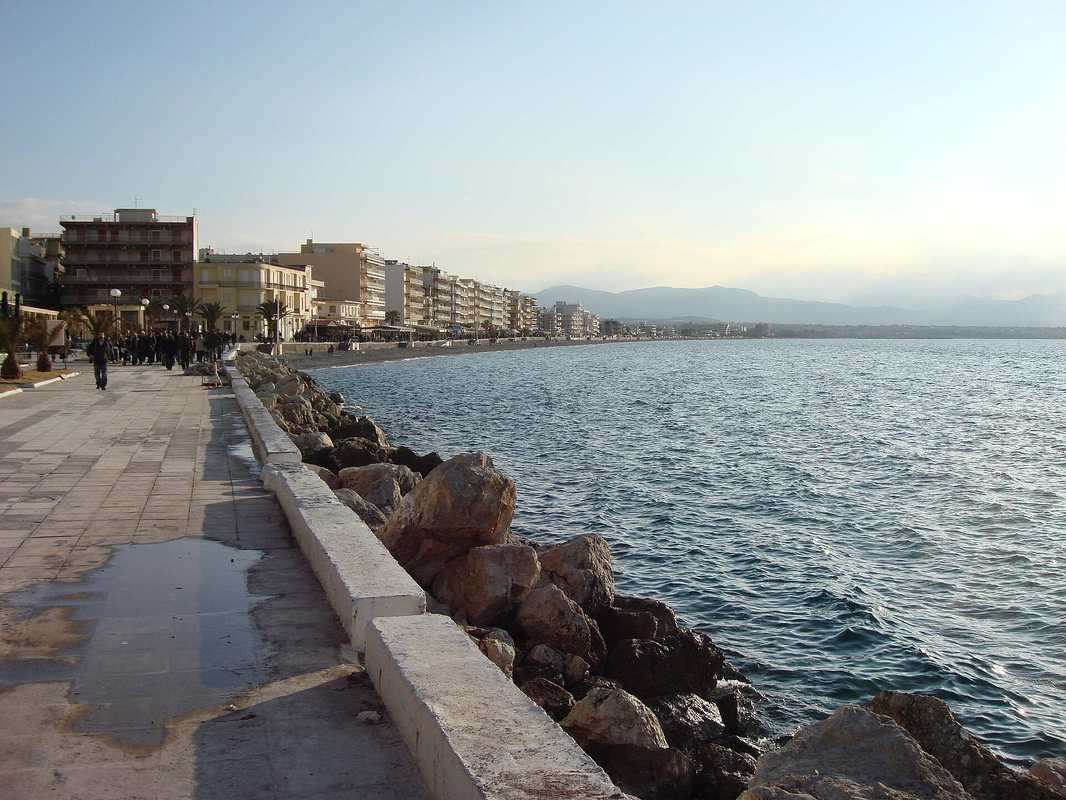
Loutraki has a long pebble beach with clear water good for swimming most of the year. A wide promenade lined with palm trees, cafés, bars and restaurants runs behind it, ideal for a stroll or a meal by the sea.
Beyond its springs, Loutraki is first a seaside resort, and its beach and waterfront are the easy pleasure of a day trip. The beach is a stretch of pebbles running the length of the seafront. The clear water of the Gulf of Corinth stays calm and inviting for swimming through most of the year, and locals bathe even in the cooler months. Behind the beach runs a broad palm-lined esplanade for walking, cycling or sitting. It is dotted with cafés, ice-cream parlours, bars, tavernas and shops that draw both locals and visitors.
Settling at a seafront café for a freddo coffee or a lunch of fresh seafood by the water is an easy pleasure. The mountains across the gulf add to the scenery. The resort has an unhurried, family-friendly atmosphere that invites you to slow down and enjoy the seaside. Sunbeds and umbrellas line the organised stretches of the beach, while quieter sections stay free for those who bring their own towel. The promenade stays lively into the evening, when families walk the front and the tavernas fill for dinner. For a day of gentle relaxation, the beach and promenade work well. A short drive away lies a genuine engineering marvel.
What is the Corinth Canal near Loutraki?
The Corinth Canal, three kilometres from Loutraki, is a man-made waterway cut through solid rock. It runs long and deep, with sheer walls only metres apart. Walk across the bridge to watch ships pass far below in the narrow channel.
A great bonus of a Loutraki day trip is its nearness to the Corinth Canal, a striking feat of engineering three kilometres from the town. Here the narrow isthmus connecting the Greek mainland to the Peloponnese is sliced clean through. The channel was completed in the late nineteenth century after being planned since antiquity. It runs about six and a half kilometres in a perfectly straight line, cut through rock to join the Saronic Gulf of the Aegean with the Gulf of Corinth. Its sheer walls tower over seventy metres above a waterway only around twenty-four metres wide, forming a narrow canyon.
The classic experience is to stand on the road bridge and look down at the drop to the water far below, where ships and boats squeeze through the slim passage. Cruise ships too wide for the channel are towed through by tug, and the sight of a large hull threading the walls draws a crowd to the rail. Thrill-seekers can bungee jump from the bridge into the gorge, and boat trips sail through the canal itself. A café and a small viewing area sit beside the bridge, so the stop pairs a coffee with the view. It is a quick, free and memorable stop. The short detour is well worth it. The area is also rich in ancient history.
What ancient sites are near Loutraki?
Loutraki makes a fine base for ancient sites. A short drive away lies Ancient Corinth, with the Temple of Apollo, and above it the Acrocorinth fortress. The Heraion of Perachora sits on a headland near green Lake Vouliagmeni.
To add culture to the relaxation, Loutraki is well placed for the most important ancient sites in southern Greece, all within a short drive. Closest and greatest is Ancient Corinth, three kilometres away, one of the wealthiest cities of the Greek and Roman worlds. There you can explore extensive ruins, including the Doric Temple of Apollo, the ancient marketplace and a museum, walking in the footsteps of the Apostle Paul who preached here. Above the ancient city rises the crag of Acrocorinth, crowned by a vast medieval fortress whose ramparts reward the climb with wide views.
On a headland reaching into the gulf stands the Heraion of Perachora, the seaside sanctuary of the goddess Hera, where ancient ruins meet the turquoise sea. Beyond it, at the tip of Cape Melagavi, a small stone lighthouse marks the point where the gulf narrows, a short walk from the ruins. The sanctuary and the lighthouse together make a scenic half-day for travellers with a car. The Heraion sits near Lake Vouliagmeni, a green coastal lagoon good for a swim. Combining Loutraki’s beach and spa with one of these sites makes a rounded day. The history here ranks among the finest in Greece. Reaching Loutraki is quick and simple.
What is the Club Hotel Casino Loutraki?
The Club Hotel Casino Loutraki is one of the largest casinos in Europe, set on the seafront. It combines a gaming floor of tables and slot machines with a hotel, restaurants and bars. It adds an evening draw to a day out.
Loutraki carries a long reputation as a resort of leisure, and its casino is a landmark of that identity. The Club Hotel Casino Loutraki stands on the seafront near the promenade and ranks among the biggest gaming venues on the continent. Its floor holds roulette, blackjack and poker tables alongside rows of electronic slot machines. The complex also runs a hotel, restaurants, bars and event halls, so a visit can extend from a meal to a show.
For a day trip, the casino is an optional extra rather than the reason to come. It suits travellers who want to round off the beach and spa with an evening indoors. Entry rules apply to age and identification, and the gaming floor keeps long hours. The venue also stages concerts and shows in its halls, which draw visitors who never touch a card table. Even without playing, the seafront setting and the restaurants make the complex a stop on a stroll along the waterfront.
How do you get to Loutraki, and what is the best way to visit?
Loutraki is about eighty kilometres west of Athens, roughly an hour’s drive on the Athens-Corinth national road past the canal. KTEL buses run from the Kifissos terminal. Driving or an organised tour that adds the canal and Ancient Corinth works best.
Reaching Loutraki from Athens is quick, making it one of the more accessible day trips and simple to pair with the famous sights nearby. By car, the town lies around eighty kilometres west of Athens. The drive takes roughly one hour along the Athens-Corinth national road, which crosses the isthmus close to the Corinth Canal before reaching the town, with a modest toll. Self-driving is ideal for linking Loutraki with the canal, Ancient Corinth and the Heraion at your own pace. Public transport is also straightforward. Frequent KTEL intercity buses run from the Kifissos bus terminal in Athens directly to Loutraki in a little over an hour, so the town is reachable without a car.
For a logistics-free day, an organised tour that bundles Loutraki or its spa with the Corinth Canal and the ruins of Ancient Corinth is a popular choice. The spa, the casino and the seafront town are enjoyable throughout the year. The warmer months from late spring to autumn are best for swimming at the beach. With its closeness and easy access, Loutraki makes a rewarding, low-effort escape. The wider routes appear in the Ancient Corinth day trip guide. The questions below cover the points visitors ask most.
Frequently Asked Questions
How far is Loutraki from Athens?
Loutraki is about 80 kilometres west of Athens, roughly a one-hour drive via the Athens-Corinth national road, which passes close to the Corinth Canal, with a small toll. KTEL buses also run frequently from the Kifissos terminal in Athens, taking a little over an hour, so the seaside spa town is easy to reach by car or bus for a day trip.
What is Loutraki known for?
Loutraki is known as a seaside spa resort on the Gulf of Corinth, famous for its natural thermal springs and mineral water, prized since antiquity. Its highlights include a modern thermal spa with mineral pools, a long pebble beach and palm-lined promenade, a historic casino, and the proximity of the spectacular Corinth Canal and the ancient sites of Corinth.
Can you combine Loutraki with the Corinth Canal?
Yes, Loutraki combines perfectly with the Corinth Canal, which lies just a few kilometres away on the route from Athens. Many visitors stop at the canal to peer down at ships passing through the dramatic rock-cut channel, then continue to Loutraki for the beach, spa and seafront, often adding the nearby ruins of Ancient Corinth to make a full day.
Is Loutraki good for families?
Yes, Loutraki suits families well. The long pebble beach has calm, shallow water near the shore, and the wide promenade gives room for children to walk, cycle or eat ice cream. The thermal spa welcomes visitors of many ages, and the Corinth Canal makes a short, memorable stop. Playgrounds and open squares sit along the front, and the tavernas serve child-friendly menus through the afternoon. The unhurried resort atmosphere and the easy one-hour trip from Athens keep the day relaxed for parents and children alike.