
Ancient Corinth tickets give entry to the archaeological site of Ancient Corinth, at the foot of the rock of Acrocorinth in the north-east Peloponnese, with the Temple of Apollo and the Roman forum, and to the Archaeological Museum of Ancient Corinth on the same ticket. Tours across the rest of the country are listed on Greece Tours.
The sections below cover what the ticket covers, the Temple of Apollo and the forum, the museum, Acrocorinth, where to buy, e-tickets, reduced and free entry, the tours and guides that include entry, getting there, the time a visit needs and combining the Corinth Canal and Mycenae, with links into the Ancient Corinth pages. The tours shown are checked on GetYourGuide and Viator.
What are Ancient Corinth tickets?
Ancient Corinth tickets are the official entry passes for the ruined city-state beneath Acrocorinth, near the Isthmus of Corinth. One combined ticket covers the excavated ancient city and the Archaeological Museum of Ancient Corinth, which stands within the same grounds.
Ancient Corinth tickets are sold as one combined product. Hellenic Heritage lists the ruins and the museum together on its Corinth page, the Ministry of Culture’s records for each venue repeat the same combined package, and the museum’s listing adds that its full ticket includes a visit to the ruins outside.
Ancient Corinth tickets lead into a working excavation. American School of Classical Studies teams have dug the city since 1896, and the Greek Ministry of Culture has added excavations of its own; the catalogued finds stay on the spot, in the museum within the site.
What do Ancient Corinth tickets cover?
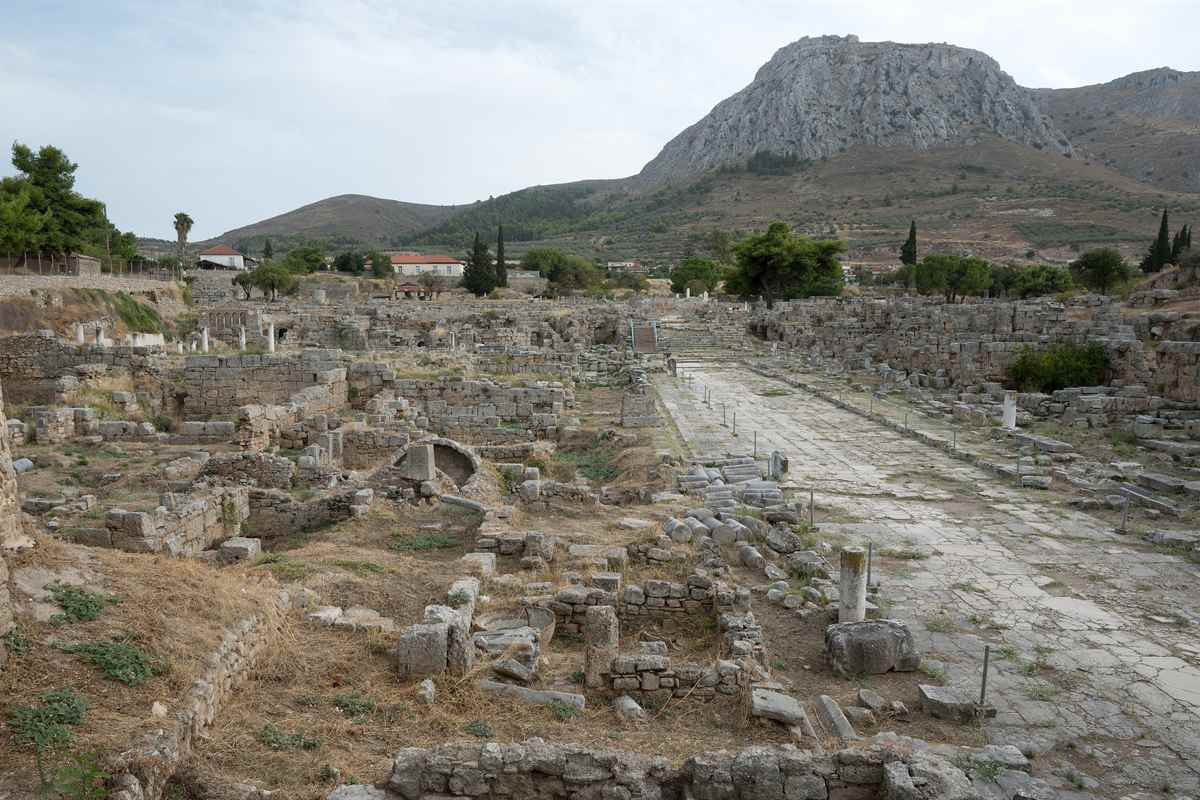
Ancient Corinth tickets cover the organised archaeological site around the Temple of Apollo, with the Roman forum and its bema, the Peirene fountain and the paved Lechaion Road, plus the Archaeological Museum of Ancient Corinth, which was built inside the excavated area.
The organised site spreads around the Archaic temple below the northern slopes of Acrocorinth, where digging has exposed the Roman forum with temples, porticoes, fountains, baths and latrines. Ancient Corinth tickets also reach the Glauke fountain, cut into the western slope of the temple hill.
Other monuments lie beyond the organised area: the Ministry’s description places the Asklepieion, the Theatre, the Roman Odeion and the Potters’ Quarter outside it. The Roman amphitheatre, 1,200 metres north-east of the temple hill, remains unexcavated, though part of its oval shell shows. Ancient Corinth tickets centre on the forum and the museum.
What do Ancient Corinth tickets show at the Temple of Apollo and the forum?
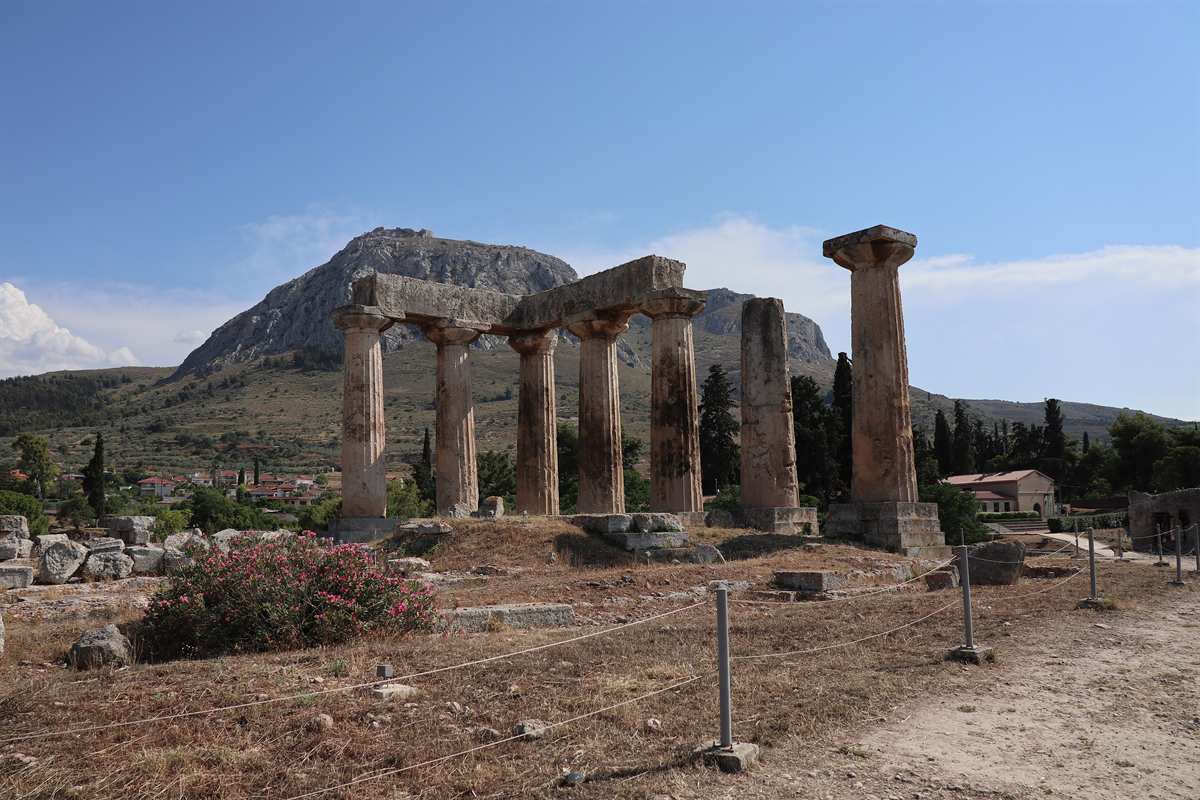
At the Temple of Apollo, Ancient Corinth tickets show seven standing columns of a Doric temple built around 560 BC; around it lie the Roman forum with the bema linked to Saint Paul, and the Lechaion Road leading out past the Peirene fountain.
The Ministry of Culture ranks the temple with the oldest Doric temples of the Peloponnese and mainland Greece. Its 42 monolithic limestone columns, each over 7 metres high, once ringed it; Ancient Corinth tickets now lead to the seven that still stand on the western side, on part of the stepped base.
Julius Caesar refounded the city in 44 BC as Colonia Laus Iulia Corinthiensis, and the Romans turned the Greek agora into their forum, keeping the South Stoa. Ancient Corinth tickets reach the bema at its centre, the raised platform where officials spoke to the public; tradition sets the apostle Paul’s hearing before the proconsul Gallio there.
Pausanias, the ancient traveller, reached Peirene by leaving the market on the road to Lechaion and passing a gateway. Ancient Corinth tickets follow that line: the Lechaion Road, main north-south street of the Roman grid, keeps its paving and drains, and the fountain shows six chambers behind an early Roman front of Doric half-columns and arches.
What do Ancient Corinth tickets show in the Archaeological Museum of Ancient Corinth?
In the museum, Ancient Corinth tickets show the finds of the excavations, from prehistoric vases to Byzantine and Frankish glazed plates, in galleries set around two atriums, with the twin Kouroi of Tenea, Roman mosaics and clay healing offerings from the Asklepieion.
The American School built the museum in 1932, and its rooms surround two atriums. Ancient Corinth tickets open the prehistoric gallery, with vases and cult figurines from Zygouries, the Korakou hill and Ancient Corinth itself, and the “Corinth, a powerful city-state” gallery, which runs to the Roman sack of 146 BC.
That gallery holds the twin Kouroi from the cemetery of ancient Tenea, seized from antiquities traffickers at Klenia. In “Corinth, a Roman colony”, Ancient Corinth tickets show villa mosaics, sculpture and glazed Byzantine and Frankish plates, plus 274 pieces from a museum theft of 1990 that turned up in the USA a decade later and came home.
The Asklepieion gallery displays clay models of human body parts offered at the sanctuary of Asklepios in the 4th and 3rd centuries BC, while the atrium and its side porticoes hold statues, reliefs, Greek and Latin inscriptions and traces of the Jewish community, all covered by Ancient Corinth tickets.
Do Ancient Corinth tickets include Acrocorinth?
No. Ancient Corinth tickets cover only the lower site and its museum. Acrocorinth, the fortified rock rising to 575 metres south-west of the ruins, is an archaeological site in its own right, and Hellenic Heritage lists distinct full and reduced tickets for the fortress.
The official sources differ on the fortress. Hellenic Heritage, the ticket operator, treats Acrocorinth as a separate venue, with its own guardhouse and ticket outside what Ancient Corinth tickets grant, while the Ministry of Culture’s Odysseus record lists entry there as free. As Hellenic Heritage issues the tickets, its listing is the one to plan around.
Ancient Corinth tickets stop where that separate visit begins. Walls about 3,000 metres long, in three defensive circuits with a deep moat on the weaker west side, enclose about 240,000 square metres, including the Sanctuary of Aphrodite on the summit, the Upper Peirene spring and a Byzantine cistern.
Where can you buy Ancient Corinth tickets?
You buy Ancient Corinth tickets at the site’s ticket office, online from Hellenic Heritage, the official tickets.hh.gr store, or inside tours sold by GetYourGuide, Viator and travel agencies. Each official ticket covers both the open-air ruins and the on-site Archaeological Museum.
ODAP, a public body supervised by the Culture Ministry, owns Hellenic Heritage and holds sole rights to issue entry tickets to archaeological sites and museums in Greece. The Ministry’s Odysseus record links to the matching Hellenic Heritage page, where full and reduced Ancient Corinth tickets are listed.
Resellers fold Ancient Corinth tickets into tours rather than selling bare entry: every Viator product that names the site is a tour, and the agency Key Tours lists three tours from Athens on its Ancient Corinth tickets page. Licensed travel agencies buy through ODAP partner accounts, and the terms accept only tickets from official outlets.
How do Ancient Corinth tickets work as e-tickets?
Ancient Corinth tickets bought online are personal e-tickets: a buyer aged 18 or over pays by debit or credit card on tickets.hh.gr, receives each full-price ticket in an e-mailed PDF, and shows it at the checkpoint, where staff scan its code.
Each of the Ancient Corinth tickets admits one person, once, to the places named on it, and walking out of the site ends its validity. If the store asks for an entry slot, the holder enters during that slot and can switch it twice free of charge through Manage Tickets, up to 120 minutes before the visit.
After payment there are no cancellations, refunds or changes to Ancient Corinth tickets beyond that slot, and lost or stolen tickets are not covered. Force majeure is the exception: when it keeps the site closed on the day of the visit, ODAP extends the ticket or refunds it. Whoever shows a ticket first counts as its holder, so keep the PDF private.
Who gets reduced or free Ancient Corinth tickets?
Free Ancient Corinth tickets go to EU nationals aged 25 or under, non-EU children aged 18 or under, disabled visitors and other listed groups, plus everyone on the Ministry of Culture’s free days. EU nationals over 65 pay half, except from June to September.
Free Ancient Corinth tickets need proof: young EU nationals show an ID card or a passport, non-EU children a passport, and disabled visitors from any country a disability card or a certificate, plus a free companion at 67% disability or more. ICOM and ICOMOS members, refugees, journalists, unemployed Greek citizens and tourist guides licensed in Greece go free too.
Hellenic Heritage and the Ministry’s Odysseus portal list the same free days: Melina Mercouri’s memorial day on 6 March, 18 April as International Monuments Day, 28 October, the first and third Sundays from November to March, International Museum Day and the European Heritage Days over the last weekend of September. On those days, Ancient Corinth tickets come from the ticket office alone.
Reduced Ancient Corinth tickets cost half the full rate for EU citizens over 65, Greeks included, except from June to September, and for school-visit escorts: parents from EU or EEA primary schools and non-EU teachers. Booked online, reduced and free tickets arrive as a PDF when ID suffices, or as a proof of purchase to exchange at the office.
Which tours include Ancient Corinth tickets?
One Viator tour from Athens states that it includes Ancient Corinth tickets, a beach stop and pickup, and GetYourGuide marks a private day from Athens on St. Paul’s trail as skip the line; other day trips leave entry out of their summaries.
That private day on St. Paul’s trail runs for 8 hours in English, with pickup and a meal, and closes for booking 20 hours ahead. A 10-hour guided bestseller from Athens pairs the ruins with Nafplion, and a second 10-hour guided day adds the Corinth Canal. All three offer free cancellation, yet neither 10-hour summary mentions Ancient Corinth tickets.
Viator also sells private tours from Athens with the canal and from the city of Corinth, plus a day on St. Paul’s trail with lunch, and their titles leave Ancient Corinth tickets unstated. The day-trip formats, from coach tours to the train, are compared in our Ancient Corinth day trips from Athens guide.
Do Ancient Corinth tickets come with a guide or an audio guide?
Ancient Corinth tickets give admission only, as the official listings offer no guide or audio guide. Spoken commentary comes from guided tours, a GetYourGuide day trip with a virtual reality and audio guide, or a Viator self-guided audio tour sold without entry.
That GetYourGuide trip lasts 6 hours from Athens, offers pickup and free cancellation, and pairs the Corinth Canal with a walk through the ruins led by a virtual reality and audio guide, listed as optional. Its booking form runs from English, German and French to Japanese, Korean and Tagalog, yet its summary never mentions Ancient Corinth tickets.
The Viator option is self-guided: audio commentary and 3D views for your own walk, with a title stating that no ticket is included, so Ancient Corinth tickets are bought separately at the office or online. For live commentary, Viator lists a private visit guided by a licensed expert, and the guided day trips above bring their own.



How do you reach Ancient Corinth to use your Ancient Corinth tickets?
Ancient Corinth tickets open a site 90 kilometres west of Athens: drivers take the Corinth-Patras national highway to the Ancient Corinth interchange, while others ride the suburban train or KTEL bus to modern Corinth and finish by taxi or local bus.
Drivers holding Ancient Corinth tickets need about 10 minutes from modern Corinth. On the national highway towards Patras, the exit for the village lies about 2 kilometres west of the Tripolis interchange. A parking area for cars and coaches sits close to the archaeological zone, and from the village itself the walk to the entrance takes 5 minutes.
Train travellers with Ancient Corinth tickets board the Proastiakos suburban railway at Larissa station in Athens and alight at Corinth station, on the outskirts near Examilia and the A8 motorway, 2.9 kilometres out of the town centre. Taxis wait on its forecourt beside a local bus stop and a big free car park, and the taxi ride to the village takes about 15 minutes.
Coach travellers with Ancient Corinth tickets leave from the Kifissos bus station in Athens, and the KTEL ride to modern Corinth takes about 90 minutes. A local KTEL bus then covers the final stretch in about 20 minutes and leaves every hour; its destination board reads Archaia, and riders pay on board.

How much time do Ancient Corinth tickets need, and in which order?
Ancient Corinth tickets need a half day, with the museum first for the overview and the ruins second: a private half-day tour from Athens built around the site lasts 5 hours, and one ticket covers both halves in a single visit.
Use Ancient Corinth tickets in one unbroken loop: once a holder walks out, the ticket cannot let them back in, so lunch in the village belongs before or after the visit. Keep the stub to hand, because security staff can ask to see it, and arrive well ahead of closing time, since admission stops 20 minutes before the gates shut.
The museum stands inside the archaeological site, and its galleries trace the city from prehistoric to Byzantine times. Seeing them first gives the Roman forum and the Temple of Apollo outside a clear frame, which is why a visit on Ancient Corinth tickets starts in the museum and ends among the open-air ruins.
Can you combine Ancient Corinth tickets with the Corinth Canal or Mycenae?
Yes: Ancient Corinth tickets pair with the Corinth Canal, which the road from Athens crosses on the Isthmus, and with Mycenae, 48 kilometres south of Corinth, which sells its own ticket for its archaeological site, the Tholos Tomb of Atreus and its museum.
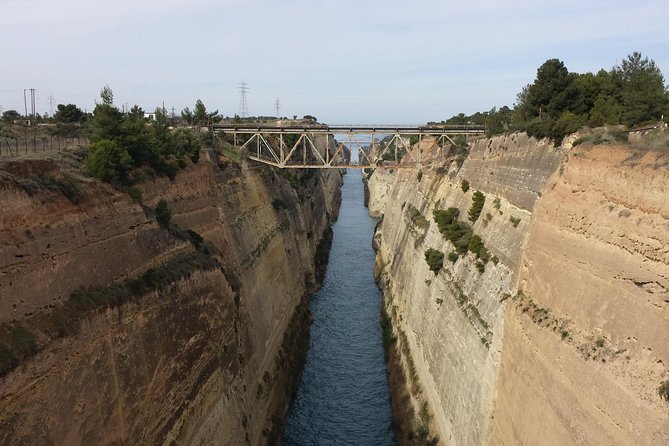
The canal lies outside Ancient Corinth tickets, which cover only the ruins and the museum. The cut links the Saronic Gulf with the Gulf of Corinth over 6.4 kilometres, and at its south-east end the Isthmia submersible bridge has terraces for watching the roadway slide under the water. Both stops fit one outing, which our Corinth Canal day trip page lays out from Athens.
Mycenae needs separate admission, since Ancient Corinth tickets give no entry beyond Corinth; where to buy it and who enters free are set out on the Mycenae tickets page. By car, Mycenae lies 20 minutes from Argos and 30 minutes from Nafplio, and its own museum stands inside the archaeological site.
Drivers with Ancient Corinth tickets can take the three in road order from Athens: the canal on the Isthmus first, then the ancient city, 5 kilometres south-west of modern Corinth, and Mycenae last, 1 hour and 30 minutes by car from Athens for the drive back. One full-day tour from Athens links all three and adds Epidaurus and Nafplio.
Frequently Asked Questions
Do Ancient Corinth tickets work for wheelchair users?
Yes. The Ministry of Culture confirms access for disabled visitors at the ruins and in the museum that Ancient Corinth tickets cover. The museum’s facility list names a ramp and an accessible toilet, and the official Hellenic Heritage page for the site includes an elevator among its amenities.
Can you use Ancient Corinth tickets all year round?
Yes. The site and the museum receive visitors all year and share one timetable with two seasons: summer, 1 April to 31 October, and winter, 1 November to 31 March. Opening times differ between them, so check the official listing before a visit on Ancient Corinth tickets.
Can cruise passengers docking at Piraeus use Ancient Corinth tickets?
Yes. Suburban Line A4 begins at Piraeus and ends at Kiato, stopping at Corinth with up to one train an hour, so passengers whose ship docks at Piraeus ride straight to Corinth without changing trains. At the station, a taxi from the rank covers the last leg to the ancient city.
Which facilities can holders of Ancient Corinth tickets use?
Hellenic Heritage lists toilets, Wi-Fi and a shop for the site, and the museum adds a café and educational programmes. The shop is an ODAP sales desk at the museum entrance, so holders of Ancient Corinth tickets pass it on the way into the galleries.