
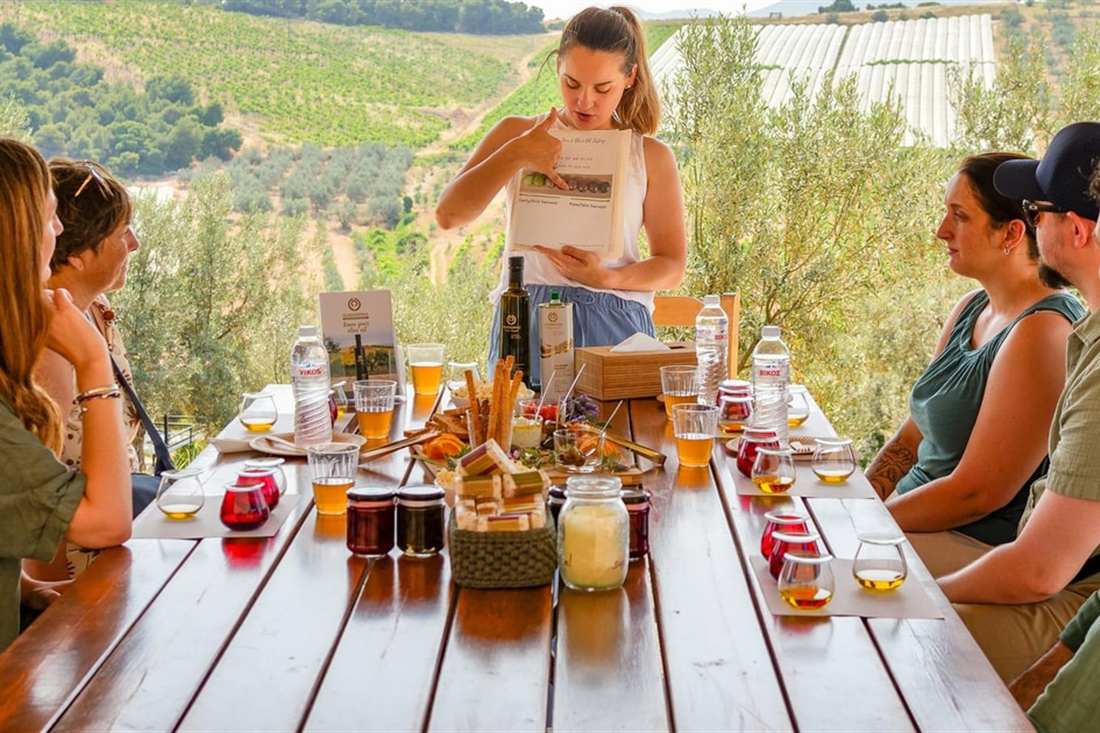
A Corinth olive oil tasting is a guided visit to a family olive farm in Corinthia, with a walk in the grove, a lesson in tasting extra virgin oil from coloured cups and, on the family farm visit, a food pairing at the table. Tours across the rest of the country are listed on Greece Tours.
The sections below cover the tastings you can book, the farms, the tasting steps, the grades and faults, the local varieties, the food, the trip from Athens, who it suits, the months and booking, with links into the Ancient Corinth pages. The tours shown are checked on GetYourGuide and Viator.
What is a Corinth olive oil tasting?
A Corinth olive oil tasting is a guided session on a family olive farm in Corinthia. A producer or olive oil sommelier, meaning a trained taster, pours different oils into small cups. Guests smell and sip each one, then try them with local food.
The session joins a short farm visit with a lesson in taste. Hosts show the trees, explain how oil is made and teach guests to judge quality.
Qoppa sells its Corinth olive oil tasting as a chance to be a sommelier for a day. Oleosophia builds its session around Manaki, a rare olive the hosts say grows nowhere else in the world.
Which Corinth olive oil tastings can you book?
Three bookable Corinth olive oil tasting listings run from family farms near the city. They last about 1.5, 2 and 6 hours. A private day tour also joins Ancient Corinth, Acrocorinth and the canal. It adds a cooking class with olive tasting.
- Olive Oil Tasting & Food Pairing in a Family Farm: about 2 hours in a small group, led by an award-winning producer and sommelier.
- Corinthian olive oil tour & tasting experience: about 1.5 hours as a private group, in a real farm house.
- Olive Oil Tasting Experience & Tour in Corinth: about 6 hours as a private group, with transfers to an olive garden.
- Ancient Corinth, Akrokorinthos, Canal and Cooking Class with Olive Tasting: about 6.5 hours as a private tour, with sights and cooking.
Producers also take direct bookings for a Corinth olive oil tasting at their own farms. Markellos Olive runs a 1-hour grove tour and tasting near Corinth. Oleosophia and Qoppa each host sessions of about 2 hours.
Oleosophia also hosts a farm-to-table cooking class under the olive trees. It opens with a short lesson on the basics of olive oil tasting.
Where do Corinth olive oil tastings take place?
Each Corinth olive oil tasting takes place on a working farm in Corinthia. The groves sit in villages around Ancient Corinth and near the coast. The Qoppa family groves lie only about 60 minutes from Athens.
- Kalentzi: Oleosophia’s grove, about 15 minutes from Ancient Corinth, at the foot of Mount Fokas.
- Assos: the Qoppa farm house and family groves, on the old Corinth to Patras road.
- Solygeia: Markellos Olive’s old groves, with views over the Saronic Gulf.
- Kechries: a coastal village with a local olive oil cooperative and mills.
Legend says the Lion of Nemea was born on Mount Fokas, above the Kalentzi grove. The host family has farmed this land for three generations. A mild microclimate and fertile soil help the trees.
Tours to the Kechries cooperative finish back in Loutraki, a spa town on the gulf. Guests based there can add other Loutraki tours to the same stay.
Corinthia sits at the gateway to the Peloponnese, just across the canal from Athens. A Corinth olive oil tasting fits easily into longer Peloponnese tours heading south.
What happens step by step at a Corinth olive oil tasting?
A Corinth olive oil tasting follows a set path. Guests meet the host, walk the grove and hear how the oil is made. Then they sit down, taste different oils and finish with local food pairing.
- Meet at the small chapel of St Efrem at the Kalentzi grove.
- Walk among the trees and hear the olive’s role in myth and art.
- Learn the farming methods and the faults careless making causes.
- Reach a kiosk at the highest point of the grove.
- Sit at the tasting table and work through the samples.
At Qoppa, the grove tour comes first. Back at the farm house, hosts give a short talk on the brand and local products. A tasting of organic oils from across Greece follows.
At Markellos Olive, a Corinth olive oil tasting moves from the old groves into the mill. A guided tour of the facilities and a short video show the oil’s path from tree to bottle.
How do you taste olive oil at a Corinth olive oil tasting?
At a Corinth olive oil tasting, you warm a small cup in your hands, swirl it and smell. Then you sip and draw in a sharp breath of air. This spreads the oil and its flavour across your mouth.
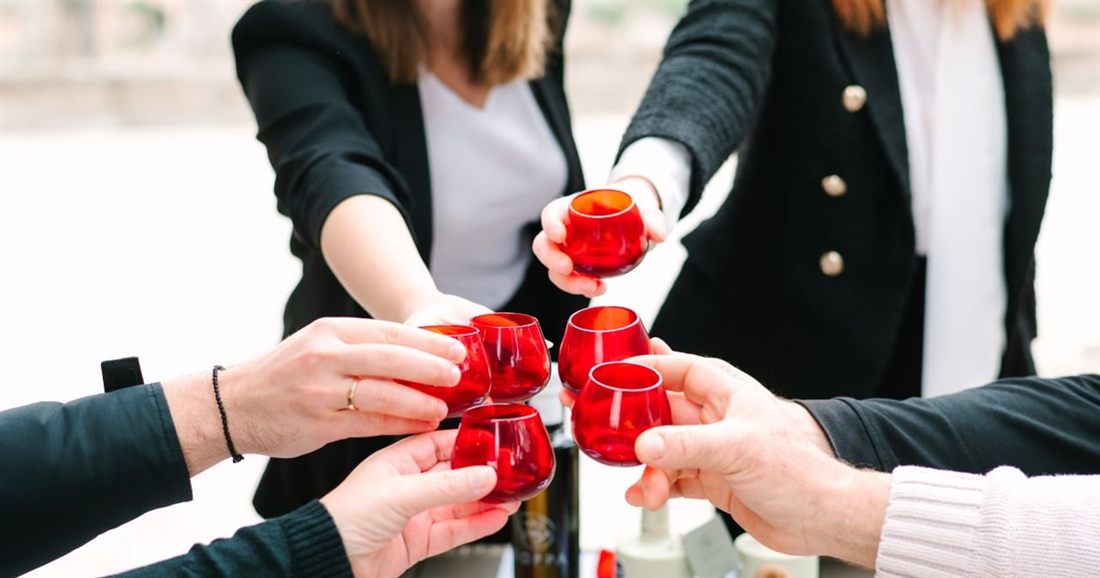
Panels warm the oil to around 28°C, close to skin temperature. Heat helps the scent rise out of the oil. Your palms do the same job at a Corinth olive oil tasting.
Keep the cup covered with your other hand while you swirl. This holds the aromas inside until you lift the cover and breathe in deeply.
The noisy slurp of air carries the oil to the back of the throat. Hosts then ask you to rate the bitterness and the peppery bite. Panels judge each oil in three stages: smell, taste and aftertaste.
Why are the tasting cups coloured at a Corinth olive oil tasting?
The cups at a Corinth olive oil tasting are dark so you cannot see the oil’s colour. Colour tells you nothing about quality. A bright green oil tricks tasters into expecting more fruit and bitterness than it has.
The official glass of the International Olive Council, the world body for olive oil, is deep cobalt blue. It is small, thick and shaped like a stemless tulip.
Its narrow mouth keeps the scents inside. A small glass lid sits on top until the moment you smell. The cup fits in one palm, which helps warm the oil.
Oil colour depends on the variety, the ripeness at harvest and the amount of leaf in the mill. Green does not mean fresh, and gold does not mean old. Qoppa serves its Corinth olive oil tasting in these special glasses, as professional tasters do.
What do fruity, bitter and pungent mean at a Corinth olive oil tasting?
At a Corinth olive oil tasting, fruity, bitter and pungent are the three good signs in an oil. Fruity is the smell of fresh olives. Bitter is a sharp taste on the tongue. Pungent is a peppery tickle in the throat.
Official tasters call these three the positive attributes, or good qualities. Fruity smells range from green to ripe, and green apple is one example. An oil needs at least a hint of fruitiness to be graded extra virgin.
Bitterness is felt on the sides of the tongue. Pungency feels like black pepper at the back of the throat. Both come from polyphenols, natural plant compounds linked to health benefits.
Bitterness grows stronger in oils from early harvests, when olives are still green. Official panels rate each quality on a scale from 0 to 10. A score of 0 means the quality is absent.
Which faults does a Corinth olive oil tasting teach you to spot?
A Corinth olive oil tasting teaches you to spot four common faults: rancid, fusty, musty and winey. At Qoppa, guests taste a faulty oil on purpose. This helps them recognise a good oil back home in the shops.
Tasters call these faults defects. Any single defect stops an oil from being sold as extra virgin. This rule holds even when its lab results pass.
- Rancid: the oil smells of old nuts, wax or crayons, because air, light or heat spoiled it.
- Fusty: the oil smells of wet hay or brine, because olives sat in piles too long.
- Musty: the oil smells damp and mouldy, because olives were stored in humid conditions.
- Winey: the oil tastes sour like vinegar, because the fruit fermented.
Fusty, musty and winey faults come from poor handling of the fruit. Rancid oil goes wrong later, during storage. Oleosophia covers these defects in its Corinth olive oil tasting, too.
What makes an oil extra virgin at a Corinth olive oil tasting?
At a Corinth olive oil tasting, you learn that extra virgin is the top grade. The oil must have free acidity of 0.8% or less. A trained panel must also find zero faults and a trace of fruitiness.
The oil must come from olives by mechanical means alone, without heat that alters it. Free acidity is a lab test of fatty acids in the oil. Low figures point to fresh fruit and quick milling.
The taste panel has 8 to 12 trained tasters who taste blind. Each one scores the oil, and the middle score counts. This middle score is called the median.
The next grade down is virgin olive oil. It allows small faults, scored below 2.5, and acidity under 2%. Oils that fail both grades fall into a third group, called lampante. Oleosophia lets guests compare these quality grades during its Corinth olive oil tasting.
Which olive varieties appear at a Corinth olive oil tasting?
A Corinth olive oil tasting features Corinthian varieties such as Manaki, Koroneiki and Megaritiki. Manaki is the local star. Producers in Ancient Corinth, Kalentzi, Lechaio and Solygeia press it alone or blend it with other olives.
Manaki, also called Kothreiki, grows well on high slopes where other olives struggle. Its oil tastes sweet and soft. Oleosophia grows Manaki at the foot of Mount Fokas, near the village of Kalentzi.
Koroneiki has small fruit and makes up about 60% of Greek oil. The Assos family that runs Qoppa calls it the queen of olives. Its name comes from Koroni in Messinia, the region of a Kalamata olive oil tasting.
Megaritiki copes well with cold and grows across Corinthia, Attica and Argolida. Oleosophia blends it with Manaki in a November harvest oil. Corinto, in Lechaio, blends Koroneiki with a variety called Nemoutiana.
Which foods are paired at a Corinth olive oil tasting?
The Corinth olive oil tasting in Assos ends with a food pairing from family recipes. Guests taste homemade bread, Greek salad, Greek yoghurt, feta, dark chocolate and fruit. A small olive cake comes as a surprise at the end.
The ingredients are local, organic and seasonal. The recipes come from the family grandmother. Food pairing is the last step of the visit. It follows the grove walk and the oil tasting.
- Oleosophia in Kalentzi serves food pairing shots of extra virgin oil with unexpected Greek flavours.
- Markellos Olive serves freshly toasted bread with oregano, sea salt and olive oil.
- The family farm listing (tour 969137) promises food pairings led by an award-winning producer and sommelier.
- Private tours from Athens add food pairing with local products after the farm visit.
The aim is to show how good oil turns a simple dish into a treat. Oleosophia also gives tips on buying, storing and using oil at home after its Corinth olive oil tasting.
How is the oil made before a Corinth olive oil tasting?
The oil at a Corinth olive oil tasting starts as fruit picked by hand in the grove. Within hours, the olives reach a mill. There they are crushed, mixed, spun to separate the oil, then stored in steel tanks.
- Harvest: olives are picked, and early harvest fruit is still small and green.
- Cleaning: the mill strips away leaves and twigs, then washes the olives.
- Crushing: machines grind whole olives, stones included, into a thick paste.
- Mixing: the paste is stirred slowly for 20 to 40 minutes, a step called malaxation.
- Separating: a centrifuge, a fast-spinning drum, splits the oil from water and solids.
- Storing: the fresh oil rests in stainless steel tanks before bottling.
Cold extraction means the paste stays below 27°C during crushing and mixing. Cooler paste keeps more aroma and more polyphenols in the finished oil. Warmer paste gives more oil but less flavour.
Speed matters, because olives start to spoil once they leave the tree. Markellos Olive runs a family mill, and its Corinth olive oil tasting includes a mill tour. Qoppa explains every stage, from the tree to the bottle.
What do you see in the olive grove on a Corinth olive oil tasting?
A Corinth olive oil tasting starts among the trees on a family farm. Hosts show you the olive varieties and explain how they farm them. You see the grove first, then you taste the oil it makes.
At Oleosophia in Kalentzi, the Corinth olive oil tasting walk passes Manaki trees, a delicate local variety not grown anywhere else.
At the Qoppa groves in Assos village, guests see Koroneiki trees, which the hosts call the queen of olives. The talk covers organic farming and irrigation, which means watering the trees. It follows every stage up to bottling.
Each farm shows a different side of the land:
- Manaki olive trees on the Kalentzi slopes
- Manaki and Megaritiki trees grown together for a family field blend
- Old groves on the ancient Solygeia soils, with views of the Saronic Gulf
- A guided grove walk and a 360-degree virtual reality experience at Markellos in Galataki
- Traditional, intensive and super-intensive plantings on one farm tour
How does a Corinth olive oil tasting work from Athens?
A Corinth olive oil tasting works well as a day trip from Athens. The Corinth Canal, at the edge of the region, lies about 80 kilometres west of the city. Tours with transfers last about six hours.
The GetYourGuide Olive Oil Tasting Experience & Tour in Corinth lasts about six hours with transfers. Its listing invites guests into an olive garden surrounded by nature, tradition and culture. The drive to the canal on the A8 motorway takes about one hour.
Private tours pair the tasting with sights. One six-hour itinerary lists a 15-minute canal stop, 60 minutes at Ancient Corinth and 100 minutes at Acrocorinth. A 120-minute Corinth olive oil tasting with food pairing closes the day.
A harvest day trip from Athens also lasts six hours. A private driver collects you at your hotel and stops ten minutes at the canal. At the farm, you pick olives with local farmers before a Corinth olive oil tasting.
How does a Corinth olive oil tasting fit with Ancient Corinth and the Corinth Canal?
A Corinth olive oil tasting sits close to both sights, so one day covers all three. Oleosophia in Kalentzi lies 15 minutes from Ancient Corinth. The canal cuts the isthmus about 4 kilometres east of modern Corinth.
Start or end the grove visit with a day trip to Ancient Corinth from Athens. Guided visits of the ruins sit on the Ancient Corinth tour page. Entry details sit on the Ancient Corinth tickets page.
The canal is 6.4 kilometres long and joins the Gulf of Corinth to the Saronic Gulf. Boat trips and viewing stops appear on the Corinth Canal tours page.
One Viator tour joins all three in about 6 hours 30 minutes. Its name is Ancient Corinth, Akrokorinthos, Canal and Cooking Class with Olive Tasting. It adds a cooking class to the Corinth olive oil tasting.

Can you add wine from Nemea to a Corinth olive oil tasting?
Yes, Nemea wine fits easily after a Corinth olive oil tasting. The village of Nemea lies about 35 kilometres southwest of Corinth. Its vineyards grow Agiorgitiko, a red grape whose name means St George’s grape in Greek.
A full-day private tour from Athens lasts about eight hours. It visits the canal and Ancient Corinth, then offers wine or olive oil at Ancient Nemea. Winery formats sit on the Corinth wine tasting page.
The Nemea wine page covers the region and its grape. The two places share a legend too. Oleosophia grows its early harvest Manaki on Mount Fokas, where myth says the Nemean lion was born.
Who suits a Corinth olive oil tasting?
A Corinth olive oil tasting suits food lovers, families and older travellers. The grove walks are short and rated easy. Sessions run in English and Greek, and no earlier knowledge of olive oil is needed at all.
- Food lovers: tastings cover quality grades, faults and food pairing.
- Children: the Oleosophia walk welcomes guests aged 7 and over.
- Babies: one Athens transfer tour offers infant seats and room for prams.
- Older travellers: Markellos runs short visits of 40 or 70 minutes.
- Drivers: Markellos has free parking on site.
Mobility needs vary by farm. One full-day Corinth and Nemea tour from Athens states it is not wheelchair accessible. The Isthmia tasting tour from Athens says it suits all fitness levels.
The Qoppa tasting runs as a private group at the farm house of hosts Froso and Filio. A family keeps its Corinth olive oil tasting to itself.
Which months suit a Corinth olive oil tasting?
A Corinth olive oil tasting runs from April to mid-November at Oleosophia, and all year at Markellos. Autumn brings the harvest and new oil. Summer days are hot, so a morning slot keeps the grove walk cooler.
The olive harvest in Corinthia starts in October. A harvest day trip lets guests pick olives beside local farmers, then taste the oils with food pairing.
Oleosophia hand-picks its November Harvest blend from late October to mid-November. The olives have just begun turning yellow and purple. That gives sweeter aromas of tomato, oregano and herbs.
- April: Oleosophia sessions open for the season.
- Late spring and summer: hot days, so morning walks feel cooler.
- October: the harvest begins and picking days start.
- Late October to mid-November: the November Harvest blend is picked by hand.
- Mid-November: Oleosophia sessions close for the year.
- All year: Markellos in Galataki runs its Corinth olive oil tasting.
How long does a Corinth olive oil tasting last, and what is included?
A Corinth olive oil tasting at a farm lasts between 1.5 and 2 hours. The visit covers a grove walk, a guided tasting and local food. Tours with transfers from Athens take about 6 hours in total.
The Qoppa tour in Assos lasts 1.5 hours. A 15-minute walk in the grove comes first. Then come 75 minutes of tasting and regional food at the farm house.
The family farm tasting with food pairing runs for 2 hours in a small group. At Markellos Olive in Galataki, a Corinth olive oil tasting includes these parts:
- A guided tour of the family olive mill
- A short walk through the olive grove
- A virtual reality film, watched through a headset, on how the oil is made
- A guided tasting of 4 award-winning extra virgin olive oils
- Fresh bread, bruschetta with olive paste and a mini salad
Private tours from Athens last 6 to 7 hours. They include hotel pick-up, an air-conditioned car or van and bottled water. A shorter 4-hour version pairs a 2-hour tasting with a 15-minute canal stop. It works much like a Corinth Canal day trip from Athens.
Can you buy oil after a Corinth olive oil tasting, and how do you carry it home?
Yes, the hosts sell their own oil after a Corinth olive oil tasting. Qoppa bottles its oil under the QOPPA name, and Oleosophia runs an online shop. Pack large bottles in checked luggage, as hand luggage takes only small bottles.
Airport security allows liquids in hand luggage only in containers of 100 ml or less. All of them must fit in one clear, resealable 1-litre bag.
A standard 750 ml bottle or tin goes in the hold. The 100 ml limit does not apply there. Wrap each bottle in heavy clothes or bubble wrap. Then seal it inside a watertight bag against leaks.
Light, heat and air are the three enemies of fresh olive oil. At home, oil from a Corinth olive oil tasting keeps its taste longer with simple care:
- Keep it in dark glass or a metal tin, never clear glass.
- Store it in a cool, dark cupboard, away from the stove.
- Close the cap tightly after each pour.
- Hold it between 13 and 25°C, the range the International Olive Council advises.
- Buy a size you finish within one to three months of opening.
How does a Corinth olive oil tasting compare with olive oil tastings elsewhere in Greece?
A Corinth olive oil tasting takes place in a working grove, about an hour from Athens. Tastings near Nafplio, in central Athens and on Crete differ in setting, length and extras. Each one teaches the same skills of smelling and sipping.
The Corinth farms also sit close to the Corinth Canal and the hills of Acrocorinth. Elsewhere, the formats change in length and in the food served:
- An estate 25 minutes away runs a 2-hour Nafplio olive oil tasting with an open-air museum.
- A 60-minute tasting in Nafplio old town pairs 3 oils with cheese and cold cuts.
- An Athens olive oil tasting in the city pairs Greek olives and oils, with no long drive.
- A tour near Heraklion on Crete joins an olive oil mill with a winery and a certified sommelier.
Harvest work also sets regions apart. The Nafplio estate lets guests take part in the harvest in October and November. A Corinth olive oil tasting centres on the grove walk and the tasting table.
How do you book and cancel a Corinth olive oil tasting?
You book a Corinth olive oil tasting online through the tour listings or directly with the farm. The farm listings offer free cancellation. Cancel at least 24 hours before the start for a full refund.
The 24-hour cut-off follows local Greek time. A cancellation inside that window brings no refund. A no-show counts the same way. Confirmation arrives at once, with a mobile ticket to show on the day.
A Corinth olive oil tasting at Qoppa starts at the farm house in Assos. A flag marks the entrance.
Frequently Asked Questions
Is a Corinth olive oil tasting given in English?
Yes. Qoppa leads its tour in English. Oleosophia offers live guiding in English and Greek. Its host is both a trained olive oil taster and the producer of the oils. Greek speakers can join the Oleosophia session in their own language.
How large are the groups?
Groups at a Corinth olive oil tasting stay small. Oleosophia takes up to 8 guests per session. Markellos Olive runs its visit as a private tour, so only your party takes part. It also needs a minimum number of guests to run. If that number is not met, guests get a new date or a full refund.
What happens to a Corinth olive oil tasting in bad weather?
Part of each visit takes place outdoors among the trees. Markellos Olive lists good weather as a condition for its tour. If bad weather cancels the visit, guests choose between a new date and a full refund.
Can you reach a Corinth olive oil tasting without a car?
Partly. The suburban railway links Corinth with central Athens and Athens airport. Buses also connect the town with destinations across the Peloponnese. The farms sit in villages outside the town, such as Assos, Kalentzi and Galataki. The last stretch therefore needs a taxi or a transfer.
Are the oils at a Corinth olive oil tasting organic?
At Qoppa, yes. The family farms its groves in Assos by organic methods and explains its irrigation on the walk. The tasting there features organic extra virgin oils from across Greece. The food pairing there also uses local organic and seasonal ingredients.
Does a Corinth olive oil tasting cover health?
Yes. Markellos Olive explains polyphenols, the natural plant compounds that give fresh oil its bitter and peppery bite. It also covers antioxidants and the place of extra virgin oil in the Mediterranean diet. Qoppa and Oleosophia include health benefits in their talks too.