
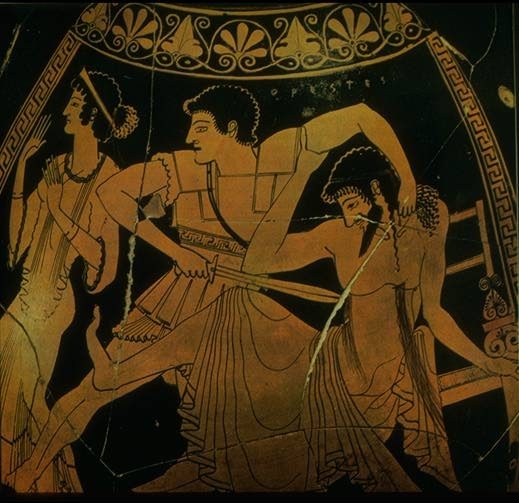
Aegisthus stands among the darkest figures in the legend of Mycenae, the usurper king whose crime and downfall belong to the bloodiest chapter of the royal saga. Greek tradition made him the son of Thyestes, born of the old feud between his father and Thyestes’ brother Atreus over the throne of the citadel. As King Agamemnon fought ten years at Troy, Aegisthus won the queen and plotted the king’s murder. He seized the throne, ruled seven years, and died at the hand of a returning avenger. Step into this tale of feud, murder and revenge with My Greece Tours.
Aegisthus binds the crime of one generation to the vengeance of the next in the great tragedy of the royal house of Mycenae. His story runs through betrayal, murder and a throne seized by force, all of it rooted in an inherited curse that ran through the royal line before he was born. The sections below cover his birth from Thyestes, his part in the murder of Agamemnon, the seven years of his usurped reign, his violent end at the hand of Orestes, and the family curse he carried. Set the whole grim legend against the ruins with our Mycenae travel guide.
Who was Aegisthus, the usurper king of Mycenae?
Aegisthus was the usurper king of Mycenae in Greek myth, son of Thyestes and a central figure in the curse of the royal house. He seized the throne after murdering King Agamemnon and ruled seven years.
Aegisthus belongs to the tragic royal saga of Mycenae, the long chain of crime and revenge that ran through its greatest legendary kings. Greek tradition made him the son of Thyestes, and through that father he was drawn straight into the bitter feud that split the ruling family. He was not a hero in the tale but a usurper, a man who reached the throne of Mycenae through murder rather than birthright or open war. His name became a byword for treachery in the halls of the citadel, the lover who plotted against an absent king and struck him down on the day of his homecoming.
His story sits at the heart of the darkest legend the Greeks told about the royal house that ruled the great fortress above the plain of Argos.
The tradition cast Aegisthus as the outsider who seized what belonged to another, the usurper whose brief rule interrupted the true royal line. He took the throne of Mycenae by killing the rightful king and holding power at the queen’s side for some seven years. His reign carried no glory, only the memory of the crime that won it and the vengeance that ended it. The whole grim episode forms one turn in the wider legend of the House of Atreus, the cursed dynasty whose feuds and murders gave Mycenae so much of its darker fame.
Aegisthus stands within that family drama as the usurper, the man who profited from an old feud and paid for his crime when the son of his victim returned in secret to claim revenge.
How was Aegisthus born from Thyestes and the family feud?
Aegisthus was the son of Thyestes, born of the old feud between Thyestes and his brother Atreus over the throne of Mycenae. That inherited quarrel shaped his birth and set him against the line of Atreus.
The origins of Aegisthus reach back into the feud that tore the royal family of Mycenae apart before he drew breath. Two brothers, Atreus and Thyestes, fought over the throne of the citadel in a quarrel marked by treachery and horror on both sides. Aegisthus came from the losing side of that struggle, born to Thyestes and raised within the bitterness of a family already steeped in crime. His very birth belonged to the feud, tying him from the first to the wrong done to his father and to the house that had wronged him.
Greek legend made this inheritance the root of everything that followed, casting Aegisthus as a child of the quarrel who would grow to carry its violence into the next generation of the royal line at Mycenae.
The feud between the brothers gave Aegisthus both his blood and his grievance against the ruling house. His father Thyestes had lost the throne of Mycenae to Atreus, and the memory of that defeat and the cruelty around it passed to the son as a debt still owed. This placed Aegisthus in direct opposition to the descendants of Atreus, the line that held the citadel and produced its most famous king. The full story of that royal quarrel runs through the history of Mycenae, from the rivalry of the two brothers down to the crimes of the generation that followed.
Aegisthus emerged from this poisoned inheritance ready to strike at the house of Atreus, turning an old feud between fathers into fresh murder among their sons and heirs in the halls of the great fortress.
What part did Aegisthus play in the murder of Agamemnon?
Aegisthus became the lover of Queen Clytemnestra while Agamemnon fought his ten-year war at Troy. On the king’s triumphant homecoming the plotting pair murdered him together, and Aegisthus then seized the throne of Mycenae for himself.
The absence of the king opened the way for the crime of Aegisthus. As Agamemnon led the Greeks through the ten long years of the war at Troy, Aegisthus remained behind in Mycenae and drew close to the queen he had left. He became the lover of Clytemnestra, the wife of the very king he counted as his enemy, and the two of them turned their bond into a plot against the returning warlord. Their scheme grew across the years of the king’s absence, waiting for the day his ships would bring him home.
The betrayal joined the grievance of Aegisthus against the house of Atreus to the queen’s own bitterness, forging a partnership set on ending the reign and the life of the master of the citadel the moment he set foot again within his own walls.
The homecoming of the king became the hour of his death. When Agamemnon returned in triumph from Troy, the plot laid by Aegisthus and the queen closed around him, and the pair struck him down within the halls of his own palace at Mycenae. The murder of Agamemnon stands among the most famous crimes of Greek legend, the killing of a great king on the day of his victory by the wife who should have welcomed him and the rival who coveted his throne. Alongside Aegisthus stood Clytemnestra, the queen whose own reasons for hatred matched his ambition.
Together they turned the king’s return into slaughter, and with his death the throne of Mycenae passed, for a time, into the hands of the usurper who had planned it.
How long did Aegisthus rule Mycenae and how did his reign end?
Aegisthus ruled Mycenae for some seven years at Clytemnestra’s side after murdering Agamemnon. His reign ended when Orestes, the son of Agamemnon, returned in secret and killed both Aegisthus and the queen.
The usurped reign of Aegisthus lasted some seven years, a rule founded on murder and shared with the queen who had helped him seize it. He held the throne of Mycenae as the killer of its rightful king, ruling at the side of Clytemnestra over the same citadel where the crime had been done. His grip on power rested on the death of Agamemnon and on the removal of every threat that might avenge it. Yet the reign carried the shadow of the deed that won it from the first day.
Greek legend never let the usurper rest easy on his stolen throne, for the blood of the murdered king demanded an answer, and the years of his rule were only a pause before the reckoning that the old law of vengeance would bring down upon his head in the end.
The reckoning came from the murdered king’s own son. Orestes, the child of Agamemnon, returned in secret to Mycenae after years away and struck down both Aegisthus and Clytemnestra to avenge his father. The vengeance of Orestes closed the chapter that the usurper had opened, answering one killing with another and ending the seven-year rule in a single stroke of blood. The death of Aegisthus at the hand of the true heir restored the line of Agamemnon to the throne he had stolen.
His fall completed the pattern of crime and revenge that ran through the royal house, the usurper cut down by the son of the king he had murdered, the stolen citadel returned to the rightful line, and the old debt of the feud paid at last in the halls of Mycenae.
What curse did Aegisthus carry through the royal line?
Through his father Thyestes, Aegisthus carried forward the inherited curse that ran through the royal line of Mycenae. This ancestral curse of crime and revenge shaped his own murder of the king and his violent downfall.
The curse of the royal house lay behind every deed of Aegisthus, a dark inheritance passed down through his father Thyestes. Greek legend held that the ruling family of Mycenae labored under an ancestral curse, a chain of crime that bound one generation to the next in an unbroken sequence of wrong and revenge. Aegisthus received this curse as part of his blood, the son of Thyestes drawn into a story of murder that had begun long before his birth. His own crime, the killing of the king, was one more link in that chain, and his death at the hand of Orestes was the answer the curse demanded.
The tradition made him both a doer of evil and a victim of the fate that hung over the whole line, a man playing out a role written by the crimes of his fathers.
This inherited curse gave the story of Aegisthus its weight in Greek legend, tying his single crime to a saga stretching across generations of the royal line. He murdered a king and was murdered in turn, each act feeding the pattern that the curse had set in motion long before. That grim family history unfolded against a real and mighty fortress, and the surviving Cyclopean walls still stand as the stone backdrop to the whole legend. The feud that bred Aegisthus reached back to the years around the great war at Troy, the conflict remembered in the tradition of the Trojan War, whose ending brought Agamemnon home to his death.
Aegisthus stands within that inherited curse as the usurper whose crime and fall belong to the darkest turning of the royal saga of Mycenae.
Frequently Asked Questions
Why is Aegisthus called a usurper rather than a rightful king of Mycenae?
Greek tradition cast Aegisthus as a usurper because he took the throne of Mycenae through murder rather than by lawful succession. He was not the appointed heir of the reigning king but the son of Thyestes, from the losing side of the old family feud. He reached power by killing Agamemnon, the rightful master of the citadel, and by holding the throne at the side of the murdered king’s own wife. His rule rested on crime rather than right, and the true heir to the line was Orestes, the son of the man he had slain.
The word usurper captures this seizure of a throne that belonged to another, a rule founded on treachery and maintained by force for some seven years. When Orestes returned to avenge his father and killed Aegisthus, the tradition treated it as the restoration of the rightful line, which only confirms that the usurper had held the citadel by wrong and not by any legitimate claim of his own.
How is Aegisthus connected to Clytemnestra and the murder of Agamemnon?
Aegisthus was the lover of Clytemnestra, the queen of Mycenae and the wife of King Agamemnon. While the king spent ten years away at the war against Troy, Aegisthus remained behind and drew close to the queen, and the two became partners in both love and treachery. Together they plotted against the returning king across the long years of his absence, waiting for the day his ships would bring him home. On the homecoming of Agamemnon the pair carried out their scheme and murdered him within the halls of his own palace. The crime joined the ambition of Aegisthus to the queen’s own hatred of her husband, so the two acted as one in the killing.
With the king dead, Aegisthus seized the throne and ruled at Clytemnestra’s side. The murder they committed together became one of the most famous crimes of Greek legend, and it bound the fate of Aegisthus to the queen for the rest of their shared and doomed reign.
What happened to Aegisthus in the end, and who killed him?
Aegisthus met his death at the hand of Orestes, the son of the king he had murdered. After ruling Mycenae for some seven years at the side of Clytemnestra, his usurped reign ended when Orestes returned in secret to the citadel to avenge his father Agamemnon. The young heir struck down both Aegisthus and Clytemnestra in a single act of revenge, answering the killing of the king with the death of the pair who had committed it. The fall of Aegisthus restored the line of Agamemnon to the throne he had stolen and closed the chapter of usurpation he had opened with his crime.
His end fit the pattern of the family curse that ran through the royal house, one murder answered by another down the generations. The tradition remembered him as the usurper cut down by the true heir, the man whose treachery won him a throne for a handful of years before the son of his victim returned to claim both vengeance and the citadel of Mycenae.