
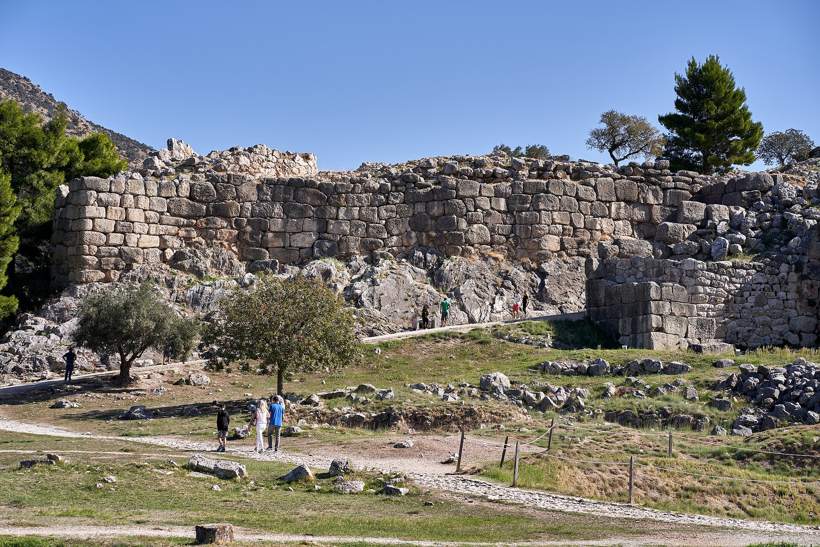
The Cyclopean walls of Mycenae are the vast fortification circuit that rings the Bronze Age citadel in the Argolid, in the Peloponnese. Builders raised them from huge, roughly worked limestone boulders set without mortar, the largest weighing tonnes apiece. The scale of the stones stunned later Greeks, who decided that only the giant Cyclopes could have lifted them, and from that belief the term Cyclopean masonry was born. The walls stand up to metres thick and enclose the palace, the houses, the grave circle and the gates on the hilltop. Trace the origins of these ramparts and plan your route to the citadel with My Greece Tours.
The fortifications rose and grew through the Late Bronze Age in more than one building phase, each adding to the strength of the ruling dynasty on the hill. A hidden vaulted passage drops through the wall to a hidden water source, and similar ramparts still survive at nearby Tiryns. The sections below cover how the walls were built, the masonry that named them, the gates and grave circle they guard, the secret cistern within, and how the circuit compares with Tiryns, all set against our wider Mycenae travel guide for the whole archaeological site.
What are the Cyclopean walls of Mycenae?
The Cyclopean walls are the massive fortification walls that ring the Bronze Age citadel of Mycenae in the Argolid. Builders set huge, roughly worked limestone boulders without mortar into ramparts up to metres thick around the hilltop.
The Cyclopean walls define the citadel of Mycenae as clearly today as they did in the Late Bronze Age. They form an unbroken circuit around the crown of the hill, following the natural contour of the rock and turning the whole summit into a stronghold. The stones are limestone boulders, roughly worked rather than finely cut, and laid one on another without any mortar to bind them. The gaps between the larger blocks were packed with smaller stones and clay, a technique that held the wall firm through the centuries. The ramparts reach metres in thickness, wide enough to carry defenders along the top and to resist any force brought against the gates.
This raw, heavy construction gives Mycenae its brooding character, a fortress that reads as power turned into stone.
The circuit did not appear in a single effort. Builders raised and extended the walls through the Late Bronze Age in more than one phase, enlarging the enclosed area as the ruling house grew in wealth and ambition. Early stretches guarded the palace and the older tombs, while later work brought fresh ground inside the line, including the famous grave circle that now sits within the walls. The result is a fortification that records the history of the citadel in its own masonry, phase upon phase of boulder-work climbing the hill.
A short drive links this stronghold to sister sites across the plain, and a Mycenae day trip from Athens puts the full sweep of the walls within reach of the capital in a single day.
Why is it called Cyclopean masonry?
The name comes from ancient Greek belief that only the giant Cyclopes could have lifted such enormous stones. Later Greeks, seeing boulders weighing tonnes set into the walls, credited the one-eyed giants of myth with the building work.
The term Cyclopean masonry carries a myth inside it. Later Greeks stood before the walls of Mycenae and could not imagine mortal hands raising boulders of that weight into a rampart climbing the hill. They reached instead for legend, deciding that the Cyclopes, the one-eyed giants of their stories, must have lifted the stones into place. The name stuck, and archaeologists still use Cyclopean masonry today for exactly this style of building: huge, roughly shaped blocks laid without mortar, their surfaces left rugged and their joints packed with smaller stones and clay.
The word preserves the awe that the walls once inspired in people who had lost the memory of how the Bronze Age masons of the Argolid actually worked, and it fixes that wonder firmly to the fabric of Mycenae itself.
The reality behind the myth is a feat of organisation rather than magic. Raising boulders weighing tonnes demanded ramps, levers, timber sledges and large teams of workers labouring together under skilled direction over a long season. The very existence of the walls therefore testifies to the wealth and command of the Mycenaean rulers, who could gather and feed such a workforce and hold it to a demanding building programme across the years. The masonry speaks of a society able to plan on a grand scale and to bend heavy stone to a single design.
Travellers drawn to this deep past often pair the walls with the wider story of the Aegean civilisations, tracing the ties and the contrasts between the Minoan and Mycenaean worlds that together shaped the earliest chapters of Greek history.
What do the Cyclopean walls of Mycenae enclose?
The walls enclose the palace, the houses, the grave circle and the gates on the hilltop. The circuit turns the summit of Mycenae into a single defended precinct, guarding the seat of power and the graves of the ruling dynasty.
Within the ring of Cyclopean walls lies the heart of Mycenaean power on the hill. The palace crowns the highest ground, its megaron and its courts looking out over the wide plain of the Argolid toward the distant line of the sea. Around and below it stand the houses of the elite and the working quarters of the citadel, all held safe inside the same heavy line of stone. The grave circle, a ring of shaft graves belonging to early rulers, sits just inside the wall near the main entrance, deliberately kept within the protected zone as the fortifications expanded.
This gathering of palace, dwellings and royal tombs inside one circuit shows the intent of the rulers of Mycenae. They bound their living power and their honoured dead into a single guarded whole, sheltered together behind the same boulder walls.
The gates that pierce the circuit are as famous as the walls themselves. The great western entrance is crowned by a carved relief of two facing lionesses, giving the Lion Gate its name and its fame as the grandest surviving gateway of the Bronze Age Aegean. A smaller North Gate opens the circuit on the far side, offering a second, more discreet way in and out of the stronghold. Both gates were framed by massive stone jambs and heavy lintels in the same Cyclopean spirit as the walls around them. The threshold worn into the stone still marks where the traffic of the citadel once passed.
Passing beneath the lionesses today, a visitor walks the exact threshold that Mycenaean kings, envoys and soldiers once crossed on their way into the stronghold on the hill.
What is the secret cistern inside the walls?
The secret cistern is a hidden, vaulted passage that descends through and below the wall to an underground water source. It secured the citadel during a siege, letting defenders reach fresh water without leaving the safety of the fortifications.
The secret cistern is one of the boldest features hidden inside the Cyclopean circuit. A vaulted passage, built in the same corbelled technique as the great tombs, begins within the walls and drops in stages down through the rock. It passes beneath the line of the fortifications and continues underground until it reaches a spring channelled in from outside the citadel. The whole descent was roofed and screened so that a defender could fetch water in complete safety, unseen and unreached by any hostile force gathered against the walls above. This clever piece of engineering answered the stronghold’s greatest weakness, the constant need for water.
It turned that weakness into a guarded secret held deep inside the hill, hidden from every enemy who ever stood before the gates and screened from view along its whole dark length.
The value of such a passage becomes clear under the pressure of a siege. A citadel could hold behind its walls only for as long as its water lasted, and a besieging force would always try to cut the springs. By carrying the water source inside the defended perimeter through a hidden route, the builders of Mycenae freed the garrison from that fear and let the fortress endure a long blockade. The cistern therefore completes the story that the walls begin: a stronghold planned not only to look formidable but to survive.
Visitors who reach the citadel on a broader tour of the Argolid often fold the walls together with the theatre and sanctuary of nearby Epidaurus into one rich day of Bronze and Classical Greek history.
How do the Mycenae walls compare with Tiryns?
Similar Cyclopean walls survive at nearby Tiryns, another Mycenaean stronghold in the Argolid. Both citadels share the same mortarless boulder masonry, though Tiryns is famed for its thick walls threaded by vaulted galleries within the ramparts themselves.
Mycenae does not stand alone in the Argolid. A short distance across the plain rises Tiryns, a second Mycenaean stronghold ringed by walls built in the very same Cyclopean manner on its own low ridge. The two citadels belong to one world and one shared building tradition. Their ramparts were raised from huge limestone boulders set without any mortar, and their gates were framed by heavy stone lintels in the same bold manner seen across the hills of the Argolid. Seeing them together makes the achievement clearer, for the style repeats from hill to hill across the region, marking out the seats of the Mycenaean lords.
Tiryns is celebrated for the sheer thickness of its walls, so broad that vaulted galleries and storerooms run inside the stonework itself, corridors hidden within the depth of the ramparts.
Comparing the two brings out the range held within a single tradition. Mycenae commands its hill with a sweeping circuit crowned by the Lion Gate and holding the grave circle and the palace, a proud citadel that reads first of all as a royal seat rather than a mere fort. Tiryns, lower and more compact, concentrates on defensive mass, its galleried walls turning the fortification into a warren of stone. Together they define the character of the Argolid in the Late Bronze Age, a landscape of powerful strongholds facing one another across the plain.
The stone chamber tombs of the region complete the picture, and the great domed Treasury of Atreus near Mycenae shows the same mastery of massive masonry applied to the tomb of a king rather than to a wall.
Frequently Asked Questions
How were the Cyclopean walls of Mycenae actually built?
The walls were built from huge, roughly worked limestone boulders set one upon another without any mortar. Masons shaped each block only enough to help it seat, then packed the gaps between the larger stones with smaller stones and clay to lock the courses together. Raising boulders of this weight, running to tonnes each, called for ramps, levers, timber sledges and large teams of workers under skilled direction. The result was a rampart metres thick that followed the contour of the hill and turned the summit into a fortress. Builders raised and extended the circuit through the Late Bronze Age in more than one phase, enclosing more ground as the ruling house grew.
The rough, heavy finish was not a limit of skill but a deliberate character, and it so impressed later Greeks that they credited the giant Cyclopes with the work. That awe is why we still call the technique Cyclopean masonry.
Can visitors walk through the Lion Gate and the walls today?
Visitors enter the citadel of Mycenae through the Lion Gate, the great western entrance crowned by a carved relief of two facing lionesses set above a massive stone lintel. From there the path climbs inside the Cyclopean circuit past the grave circle and up toward the palace on the crown of the hill. The walls stand around the route for much of the way, so a visitor moves within the fortified precinct that once held the seat of Mycenaean power. A smaller North Gate opens the circuit on the far side of the hill.
The famous secret cistern also survives, its vaulted passage dropping through and below the wall toward the hidden water source, though the descent is steep and dark. Walking beneath the lionesses and along the boulder walls, a traveller crosses the exact thresholds that Bronze Age kings and soldiers once used, which makes the citadel one of the most vivid ancient sites in the whole of the Argolid.
Where is Mycenae and how does it fit a wider Greek trip?
Mycenae stands on a low hill in the Argolid, in the northeast of the Peloponnese, overlooking the plain that runs down toward the sea. Its Cyclopean walls, Lion Gate, grave circle and secret cistern make it one of the defining Bronze Age sites in Greece, and nearby Tiryns adds a second Mycenaean stronghold within easy reach across the same plain. The citadel sits comfortably within a broader tour of the region, paired with the theatre and healing sanctuary at Epidaurus or the domed Treasury of Atreus close to the walls. The Peloponnese lies within a manageable drive of the capital, so travellers routinely reach the site from the city and return the same evening.
Those weighing a base for their travels often start their planning in Athens before striking out across the isthmus into the Argolid. Mycenae rewards the journey with fortifications that have loomed over this landscape since the age of heroes.