
An Epidaurus day trip from Athens reaches the world’s most perfect ancient theatre, famed for its flawless acoustics, and the great healing sanctuary of Asclepius, all in under two hours. Make it effortless with a guided day trip or skip-the-line tickets from My Greece Tours and see more of the Peloponnese in your day. Plan the whole trip with Greece Tours.
This remarkable excursion is one of the most rewarding in the Athens travel guide. The sections below cover whether it is worth it, how to get there, the theatre, the sanctuary, the festival, costs and the best way to visit.
Is Epidaurus worth a day trip from Athens?
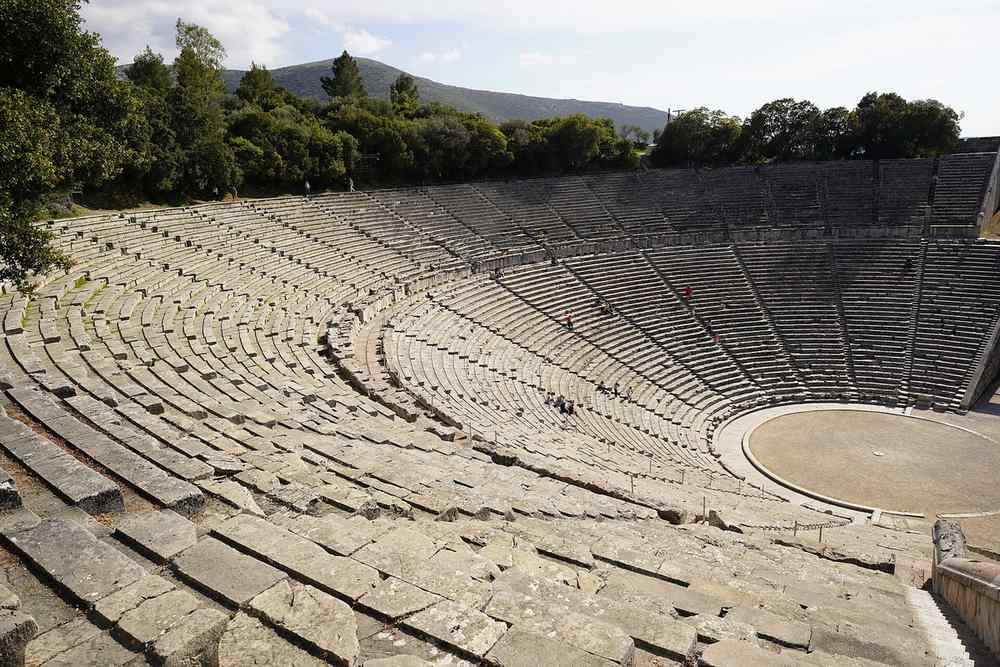
Yes, Epidaurus richly rewards the journey. Its 4th-century BC theatre is considered the most perfect in Greece, architecturally and acoustically, where a coin dropped at the centre can be heard from the top row. The surrounding Sanctuary of Asclepius was antiquity’s most important healing centre, and the whole site is a UNESCO World Heritage Site in the scenic Peloponnese.
For lovers of ancient Greece, Epidaurus is one of the most extraordinary excursions from the capital. Set in the green hills of the north-eastern Peloponnese, less than two hours’ drive away, the archaeological site is famous above all for its breathtaking ancient theatre, widely regarded as the finest and best-preserved in the entire Greek world. Designed in the fourth century BC and built into a natural hillside, the theatre is celebrated for its astonishing acoustics, so precise that the faintest sound from the central stage, even a coin dropped or a whisper, carries clearly to the very highest of its fifty-five rows of seats.
Beyond the theatre, the site was the great Sanctuary of Asclepius, the god of medicine and healing, and for almost a thousand years the sick travelled here from across the ancient world in search of cures at what was effectively antiquity’s most renowned spa and hospital. Recognised as a UNESCO World Heritage Site, with an excellent museum and a peaceful, scenic setting, Epidaurus offers a profound encounter with ancient art, science and faith. It pairs naturally with other Peloponnesian sites in the Nafplio day trip guide. Reaching it is straightforward.
How do you get from Athens to Epidaurus?
Epidaurus is about 2 hours’ drive from Athens, reached by car via the A8 motorway toward Corinth, then south past the Corinth Canal following signs to Epidaurus, with free parking at the site. There is no direct train or easy public bus. The simplest option is an organised full-day tour, which usually combines Epidaurus with Mycenae and Nafplio.
Getting to Epidaurus takes a little planning, but the routes are well established. By car, the drive covers roughly 130 kilometres and takes around two hours each way: you follow the A8 motorway out of Athens toward Corinth, cross the famous Corinth Canal, then continue south on good, well-signposted roads toward Epidaurus, with free parking available at the archaeological site. This is the most flexible option and lets you set your own pace. Public transport is awkward, as there is no train to the site and intercity buses involve slow connections via Nafplio, so independent travellers without a car usually find it impractical for a single day.
For most visitors, the easiest and most rewarding choice is an organised full-day coach tour from Athens, which handles all the driving and provides an expert guide; these tours typically depart the centre around 8am, return by early evening, and very often bundle Epidaurus together with the Bronze Age citadel of Mycenae and the elegant town of Nafplio into one full Peloponnesian day. Whichever you choose, an early start makes the most of the day and the cooler hours. The wider routes are explained in the getting around Athens guide. The theatre is the unforgettable highlight.
What is the ancient theatre of Epidaurus?
The ancient theatre of Epidaurus is a 4th-century BC open-air theatre built into a hillside, considered the most perfect in Greece for its design and acoustics. Attributed to the architect Polykleitos the Younger, it seats around 14,000 across 55 rows and is famed for acoustics so fine that a whisper or a coin dropped on the stage is heard from the top.
The crowning glory of the site, and one of the wonders of ancient engineering, is the great theatre itself. Built in the fourth century BC and traditionally attributed to the architect Polykleitos the Younger, it was carved into the natural slope of a hill so that its tiers of stone seats rise in a graceful, perfectly proportioned semicircle facing the circular orchestra and the ruined stage building below. With fifty-five rows of seating, it could hold an audience of around 14,000 spectators, and it has survived in remarkable condition over more than two thousand years. What makes it legendary is its acoustics: the precise geometry and the limestone seats filter and amplify sound so effectively that an actor speaking, or even a coin dropped or a match struck at the centre of the orchestra, can be heard with startling clarity from the highest and most distant seats, without any artificial aid.
Visitors delight in testing this for themselves, taking turns to stand on the stage and listen from the top row. The harmony of its proportions made it a model of theatre design for antiquity and beyond. Standing within it is a moving experience. The same era is explored in the guide to Acropolis history. The wider sanctuary surrounds it.
What is the Sanctuary of Asclepius?
The Sanctuary of Asclepius was the most important healing centre of the ancient world, dedicated to Asclepius, the god of medicine. For almost a thousand years, the sick travelled here to be cured through rest, ritual, baths, exercise and dream-healing in the temple. The site preserves temples, the Tholos, baths, a stadium and treatment buildings, with finds in the museum.
Although the theatre draws the crowds, it was originally only part of a much larger religious and medical complex, the Sanctuary of Asclepius, which gives Epidaurus its deeper significance. Asclepius was the ancient Greek god of medicine and healing, and his sanctuary here became the most famous and important healing centre in the entire ancient world, a kind of holistic hospital, spa and place of pilgrimage rolled into one. For nearly a thousand years, from around the sixth century BC, sick people journeyed from across Greece and beyond in the hope of a cure, undergoing a regime of rest, purification, ritual baths, diet, exercise and prayer. The most distinctive practice was incubation, in which patients slept in a sacred dormitory, the abaton, hoping the god would visit them in a dream to heal them or prescribe a remedy interpreted by the priests.
The sprawling site preserves the foundations of the Temple of Asclepius, the mysterious circular Tholos, bathhouses, guest houses, a gymnasium and even a stadium for athletic contests held in the god’s honour. The on-site museum displays statues, inscriptions and surgical instruments that bring this ancient medicine to life. It is a fascinating window onto ancient health and faith. The healing theme connects to the wider sites in the Greek heritage guide. The theatre still hosts performances today.
Can you see a performance at Epidaurus?
Yes, the ancient theatre still hosts live performances each summer as part of the Athens Epidaurus Festival, usually on weekends in July and August. Ancient Greek dramas, along with occasional concerts, are staged in the original theatre under the stars, attracting world-famous performers. Attending a play in this 2,300-year-old theatre is an unforgettable experience, with tickets sold in advance.
One of the most magical things about Epidaurus is that its ancient theatre is not merely a ruin to admire but a living stage still in use after more than two millennia. Every summer the theatre comes alive as a principal venue of the Athens Epidaurus Festival, the country’s foremost cultural festival, with performances typically held on Friday and Saturday evenings through July and August. The programme centres on ancient Greek tragedies and comedies by Aeschylus, Sophocles, Euripides and Aristophanes, performed in the very space for which such drama was created, alongside occasional concerts and other productions. Over the decades the theatre has hosted legendary artists, from the soprano Maria Callas to internationally renowned actors and directors, and seeing a production here, with the drama unfolding beneath the open night sky and the famous acoustics carrying every word to your seat, is a profoundly memorable experience.
Tickets are sold in advance and are highly sought after, so booking early is essential if your visit coincides with the festival. Even outside the festival season, simply standing in the theatre conveys its power. For culture lovers, timing a trip around a performance is well worth it. The festival also stages works in Athens itself. Planning the practical details keeps the day smooth.
How much time and money does the trip take?
You need around 90 minutes to 2 hours at the theatre, sanctuary and museum, so a full day covers the journey and often a second site. Admission is modest, with reductions and a combined ticket including the museum. Group tours run roughly €50 to €90 including entry and a guide. Wear sturdy shoes and bring water and sun protection for the exposed site.
A little practical planning ensures a comfortable and rewarding visit to Epidaurus. To explore the great theatre, wander the spread-out ruins of the Sanctuary of Asclepius and see the on-site museum at a relaxed pace, allow around ninety minutes to two hours at the site itself, which means a full day from Athens once travel time is added, often with room for a second stop such as Nafplio or Mycenae. Admission to the archaeological site is modest, with the usual reduced rates for students, seniors and the young, and a combined ticket covering both the site and its museum; there are also free-entry days at certain times of year. If you join an organised group tour, prices typically run from around €50 to €90 per person, generally including the entrance fees and a guide, with transport.
Beyond tickets, budget for your transport if travelling independently. The site is open, green but partly shadeless, with uneven ancient paths and stone steps in the theatre, so wear sturdy, comfortable shoes and carry water, a hat and sunscreen, especially in the hot months. Visiting early in the morning or in the late afternoon avoids both the heat and the largest crowds. With these basics covered, the day runs smoothly. Families managing a schedule will find the Athens with kids guide useful. Choosing how to visit shapes the experience.
What is the best way to do an Epidaurus day trip?
An organised tour is the easiest way, combining hotel pick-up, a guide and usually Mycenae and Nafplio in one full day. Driving suits independent visitors wanting flexibility and to linger, while public transport is impractical. For depth, comfort and the most sights in a day, a guided full-day tour is the best choice for most first-time visitors to the Peloponnese.
The ideal way to visit Epidaurus depends on your priorities and how much else you wish to see. For most first-time visitors, an organised full-day coach tour is the standout option, because it removes all the logistics of the long drive, provides an expert guide who brings the theatre and the healing sanctuary vividly to life, and very often combines Epidaurus with the mighty Bronze Age citadel of Mycenae and the beautiful seaside town of Nafplio, delivering three major Peloponnesian highlights in a single, well-paced day. Drivers who prefer independence gain complete flexibility over timing and route, can pause at the Corinth Canal on the way and linger as long as they like in the theatre, though they take on the navigation and driving.
Public transport, by contrast, is genuinely impractical for a day trip here, as there is no train and the bus connections via Nafplio are slow and awkward, so a car or a tour is strongly recommended. Whichever route you choose, starting early beats both the heat and the larger crowds, and pairing Epidaurus with Mycenae or Nafplio makes for a far richer day than the theatre alone. Book skip-the-line tickets and tours in advance to secure your day. The questions below cover the points visitors ask most.
Frequently Asked Questions
How far is Epidaurus from Athens?
Epidaurus is about 130 kilometres south-west of Athens in the Peloponnese, roughly a two-hour drive via the A8 motorway toward Corinth and then south past the Corinth Canal. There is no direct train, so independent visitors usually drive, while many join an organised day tour that also includes Mycenae and Nafplio.
Why is the theatre of Epidaurus famous?
The theatre of Epidaurus is famous as the most perfect ancient theatre in Greece, both architecturally and acoustically. Built in the 4th century BC for around 14,000 spectators, its acoustics are so fine that a coin dropped or a whisper on the central stage can be heard clearly from the highest of its 55 rows.
Can you watch a play at Epidaurus today?
Yes, the ancient theatre of Epidaurus still hosts performances each summer as part of the Athens Epidaurus Festival, usually on weekends in July and August. Ancient Greek dramas and occasional concerts are staged under the stars, drawing famous performers. Tickets sell in advance and are highly sought after, so book early.