
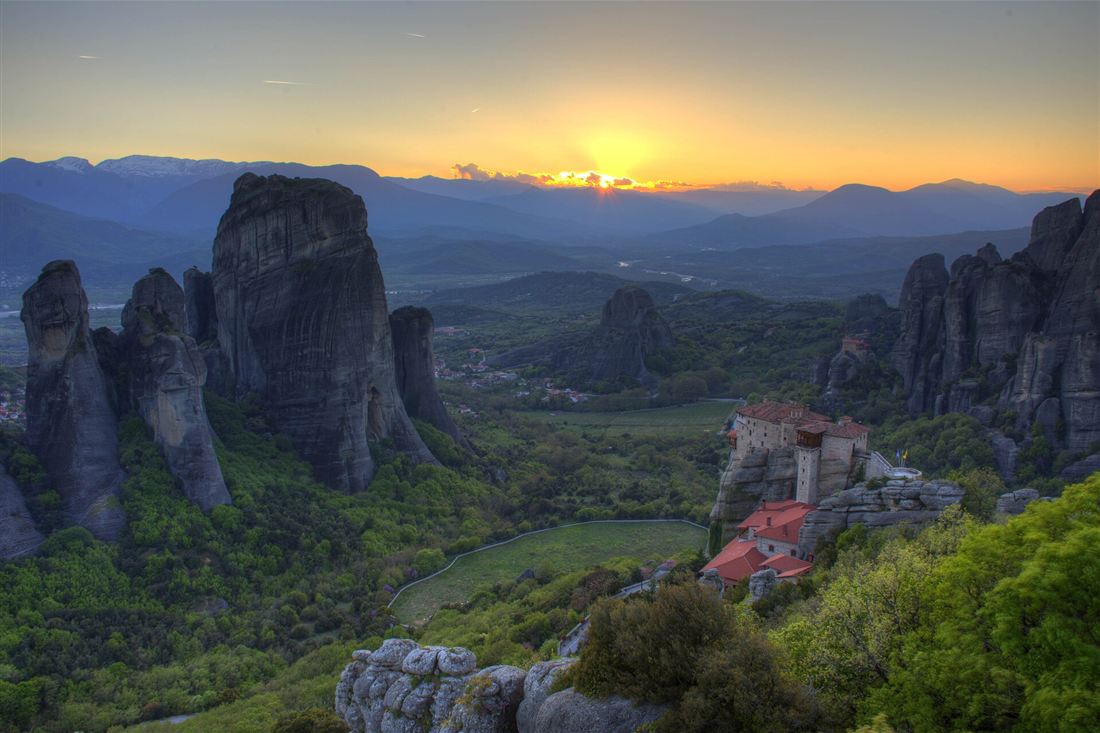
The 6-day private Peloponnese tour from Athens joins Mycenae, Epidaurus, Nafplio, Mystras, Monemvasia and the Mani with Olympia, Delphi and a sunset at Meteora. Tours across the rest of the country are listed on Greece Tours.
The sections below cover what the 6-day private Peloponnese tour includes, each stop, the Diros Caves boat ride and booking, with links into the Peloponnese tours pages. The tours shown are checked on GetYourGuide and Viator.
What is the 6-day private Peloponnese tour?
The 6-day private Peloponnese tour is a multi-day trip from Athens, sold on GetYourGuide. It visits Mycenae, Epidaurus, Mystras, Monemvasia, Olympia, Delphi and Meteora. It also stops in Nafplio and the Mani, with a boat ride in the Diros Caves.
The booking site lists the 6-day private Peloponnese tour under tour number 409912. It files the offer under multi-day trips, not day tours. The trip lasts 6 days in total. Athens is the start point, so the trip suits travellers already based in the Greek capital.
The listing title names a Meteora sunset. It is the only time of day named in the title. The other Peloponnese tours on this site focus on the region alone. This route reaches further north as well.
The listing gives no day-by-day order for the stops. It names the places and the boat ride, but not the sequence. This page follows the same rule and lists places, not days. The ten places appear one by one further down.
What does the 6-day private Peloponnese tour include?
The 6-day private Peloponnese tour carries six feature labels on its listing. They cover the group format, pickup, cancellation terms, the booking deadline and the review status of the trip. Each of the six labels appears in the list below.
- Private group
- Small group
- Pickup available
- Free cancellation
- Must book at least 10 hours in advance
- New activity
The private group label means the 6-day private Peloponnese tour is not shared with other bookings. The listing also carries a separate small group tag. Both labels point the same way: your party travels without strangers. Pickup is available as part of the offer. Confirm the pickup point and time with the operator after booking.
Free cancellation appears as a named feature on the listing. Bookings must be made at least 10 hours in advance. The tour is marked as a new activity. It has no reviews yet, so no guest rating shows. Judge it on the route and on the six labels listed above.
Which places does the 6-day private Peloponnese tour visit?
The 6-day private Peloponnese tour visits ten places. They are Mycenae, Epidaurus, Nafplio, Mystras, Monemvasia, the Mani, the Diros Caves, Olympia, Delphi and Meteora. The list below gives one fact for each of the ten places on the route.
- Mycenae: a Bronze Age citadel in the Argolid and a UNESCO site.
- Epidaurus: the sanctuary of Asclepius and its theatre, a UNESCO site.
- Nafplio: the first capital of the modern Greek state.
- Mystras: a Byzantine city above modern Sparta and a UNESCO site.
- Monemvasia: a town on a tied island off the east coast of the Peloponnese.
- The Mani: the central one of the three southern peninsulas of the Peloponnese.
- Diros Caves: sea-level caves on Dirou Bay in the Mani, toured by small boat.
- Olympia: the sanctuary of Zeus and home of the ancient Olympic Games.
- Delphi: the seat of the ancient oracle, on Mount Parnassus.
- Meteora: monasteries on rock pillars in Thessaly and a UNESCO site.
Eight of the ten places on this route lie in the Peloponnese itself. The Mani and Monemvasia lie in its far south. Delphi lies in central Greece, north of the peninsula, and Meteora lies further north again. The route therefore runs well beyond the peninsula that gives the tour its name.
How does this tour differ from other multi-day Greece tours?
Four multi-day tours on this site are compared here. Only the 6-day private Peloponnese tour adds Mystras, Monemvasia, the Mani and the Diros Caves. The other three run for 2, 4 or 8 days and skip all four of those places.
Our Explore Ancient Greece 4-day tour covers Epidaurus, Mycenae, Olympia and Delphi over 4 days. All four of those sites sit on the 6-day route too. The 6-day trip runs two days longer and reaches Meteora. It also adds the southern stops named in the answer above.
The Delphi and Meteora 2-day tour covers those two places in 2 days. It does not enter the Peloponnese. The 8-day highlights tour covers Athens, Delphi, Meteora and Santorini over 8 days. It adds an island and the capital, with no Peloponnese stops. Both trips share Delphi and Meteora with the 6-day route.
The 6-day private Peloponnese tour sits between the 4-day and 8-day options in length. Pick the 2-day trip for a short run north. Pick the 8-day trip for an island stop. Pick this one for the Peloponnese plus Delphi and Meteora, all in one private booking. Each linked page above carries the full details of its trip.
What do you see at Mycenae and Epidaurus?
The 6-day private Peloponnese tour visits the Lion Gate, the Treasury of Atreus and the walls of Mycenae. At Epidaurus, it reaches the Sanctuary of Asclepius and its theatre. These two stops pair an ancient citadel with a healing sanctuary.
Mycenae stands on a hill 274 m above sea level. It lies 19 km inland from the Gulf of Argolis. In the second millennium BC, it was a major centre of Greek civilisation. As a stronghold, it dominated much of southern Greece, Crete, the Cyclades and parts of south-west Anatolia.
The Mycenaean period, from the 16th to the 12th century BC, takes its name from this city. At its peak, the citadel and lower town held 30,000 people over 32 hectares. UNESCO lists Mycenae together with nearby Tiryns as a World Heritage Site.
In myth, Epidaurus is the birthplace of Asclepius, the healer son of Apollo. The Sanctuary of Asclepius lies about 8 km from the town. The site held a guest house with 160 rooms. The sanctuary and its theatre form a UNESCO World Heritage Site.
Polykleitos the Younger designed the theatre in the 4th century BC. It held 13,000 to 14,000 spectators and is known for its acoustics. The Epidaurus Festival stages performances there in the summer months. The theatre and the sanctuary form the Epidaurus stop of the 6-day private Peloponnese tour.
Why does the 6-day private Peloponnese tour stop in Nafplio?
The 6-day private Peloponnese tour stops in Nafplio for its place in modern Greek history and its fortresses. The town is the capital of the Argolis regional unit. Its old town sits on a peninsula in the Gulf of Argolis.
In the early 19th century, Nafplio became the first official capital of the modern Greek state. That role makes the town a key stop on the 6-day private Peloponnese tour. Its Acronauplia citadel still has walls that date from before the Classical period.
Palamidi fortress crowns a 216 m hill above the town. Venetians built it in the early 18th century. Its bastions were later renamed after ancient Greek leaders such as Leonidas, Achilles and Themistocles. Theodoros Kolokotronis, a hero of the Greek Revolution, was held prisoner in its Miltiades bastion.
The Bourtzi fortress stands in the port. Its name comes from a Turkish word for tower. Nafplio thus has defences at three levels. Palamidi holds the hill, the Acronauplia rises over the old town, and the Bourtzi guards the water.
What are Mystras and Monemvasia?
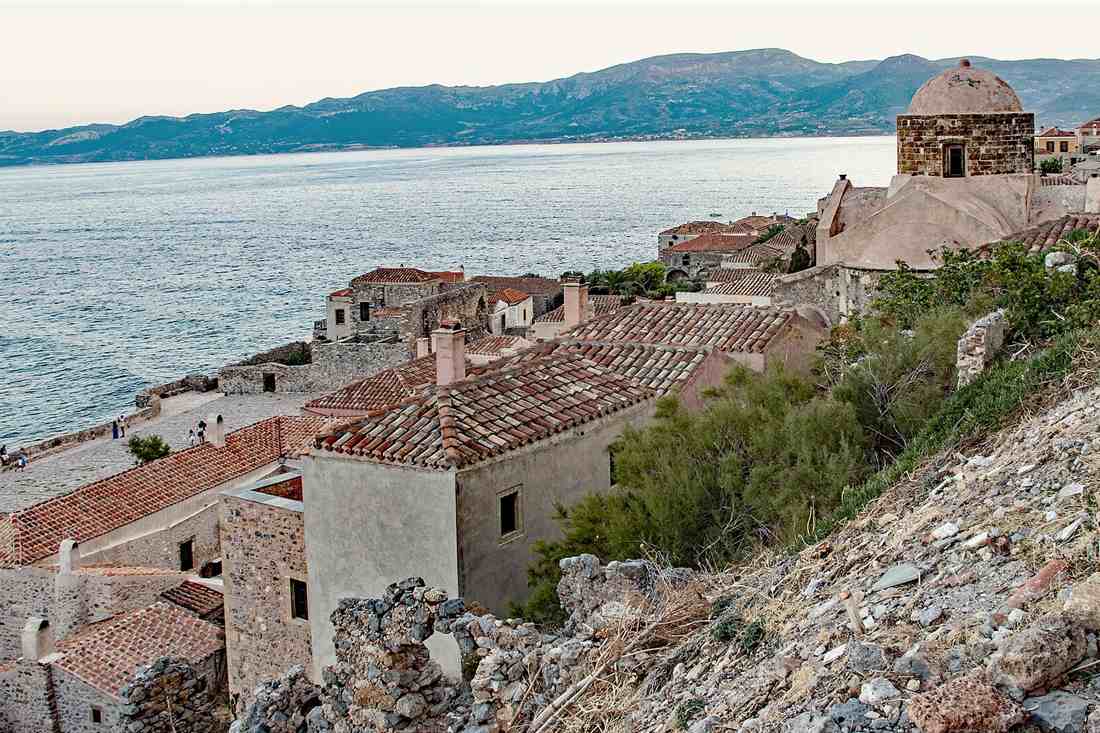
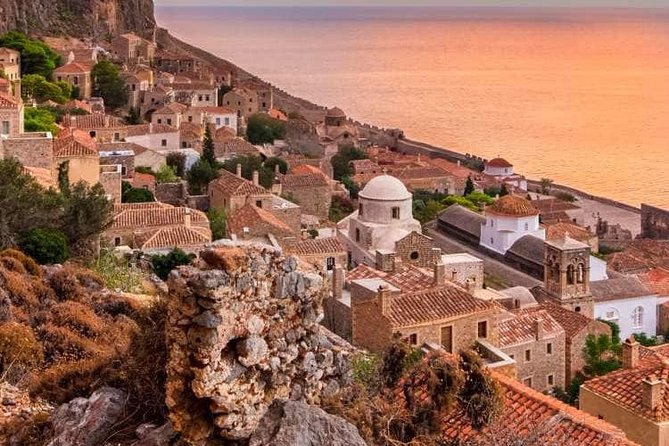
Mystras and Monemvasia are two medieval sites on the 6-day private Peloponnese tour. Mystras is a Byzantine city on a hill above modern Sparta. Monemvasia is a town on a tied island off the east coast of the Peloponnese.
The last Byzantine emperor, Constantine XI Palaiologos, was despot of Mystras before he took the throne of Constantinople. The Palace of the Despots, the seat of its rulers, grew over the 14th and 15th centuries. The city’s churches were covered in frescoes. UNESCO lists Mystras as a well-preserved Byzantine city.
Mystras was abandoned in the 19th century, when new Sparta was built about 8 km to the east. The 6-day private Peloponnese tour takes you up to this empty hilltop city. Our Mystras tours page lists other ways to see its churches and palace.
Monemvasia lies in the Myrtoan Sea. Its name joins the Greek words moni (single) and emvasis (entrance): the city of the single entrance. Its Italian form, Malvasia, gave its name to a wine. Town walls and Byzantine churches still stand. Our Monemvasia tours page shows more ways to reach it.


What is the boat ride in the Diros Caves of the Mani?
The boat ride on the 6-day private Peloponnese tour enters the Diros Caves in the Mani. The caves sit on Dirou Bay near Pyrgos Dirou. Inside, stalagmites and stalactites fill the passages from floor to ceiling.
There are three Diros Caves: Alepotrypa, Glyfada, also called Vlychada, and Katafygi. In Palaeolithic and Neolithic times, they served as places of worship. People then believed the caves were an entrance to the underworld. On the 6-day private Peloponnese tour, the boat carries you into this underground world.
The Mani is the central of the three peninsulas that run south from the Peloponnese. Its people, the Maniots, played a key role in the Greek War of Independence. The 6-day private Peloponnese tour pairs the cave ride with a stop in this region.
- The peninsula is about 45 km long.
- The Mani forms the southern end of the Taygetus range.
- The peninsula ends at Cape Matapan; no point of mainland Greece lies further south.
- Areopoli and Gytheio are also towns of the Mani.
- About 5,000 m of cave passages are open, reached by small boats and narrow passageways.

What does Olympia add to the 6-day private Peloponnese tour?
Olympia adds the major Panhellenic sanctuary where the ancient Olympic Games were held at four-year intervals. The summary of the 6-day private Peloponnese tour names Olympia among its stops. The visit sits inside a six-day private route that starts from Athens.
The Games at Olympia ran from the 8th century BC to the 4th century AD. They took place during the festival of Zeus. The sacred precinct, called the Altis, was dedicated mainly to Zeus. So Zeus tied the Games to the sacred ground.
Olympia lies in the valley of the Alfeios River, in the western Peloponnese. The site sits about 18 km from the Gulf of Kyparissia. The Kladeos River forms the western edge of the site. The stop takes the 6-day private Peloponnese tour to the west of the peninsula.
The ancient stadium of the Games still survives at the site. The ancient author Pausanias counted over 70 temples at Olympia. He also recorded treasuries, altars and statues across the sanctuary. His count shows how densely the sacred ground was built up.
What do Delphi and a Meteora sunset add to the tour?
Delphi and Meteora carry the 6-day private Peloponnese tour beyond the peninsula, into central Greece and Thessaly. The tour summary names both as stops. One holds the seat of an ancient oracle. The other holds monasteries on rock pillars.
Delphi sits on the south-western slope of Mount Parnassus. It was the seat of the Pythia, the oracle consulted on important decisions across the ancient world. The Greeks placed the centre of the world at Delphi. A stone called the Omphalos, meaning navel, marked the spot.
In the late 19th century, the French Archaeological School cleared landslide soil from the site. The work revealed the sanctuary of Apollo and the temple of Athena Pronoia. UNESCO lists the site. These ruins stand at the Delphi stop of the 6-day private Peloponnese tour.
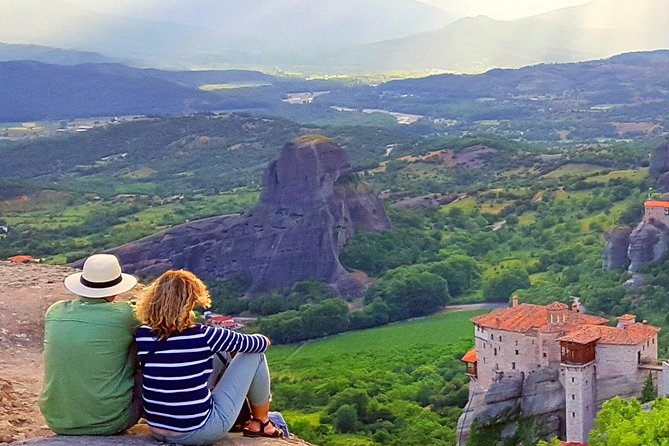
Meteora is a rock formation in the Trikala regional unit, beside the Pindos Mountains. The rocks rise straight up from the plain. The pillars are sandstone and conglomerate. Streams laid down this material in a lake delta. Earth movements lifted it about 60 million years ago.
Twenty-four monasteries were set on the rock pillars, mainly from the second half of the 14th century. The six surviving monasteries form a UNESCO World Heritage Site. The tour title names a Meteora sunset, so travellers see these pillars as the day ends.

How do you book and cancel the 6-day private Peloponnese tour?
Book the 6-day private Peloponnese tour on its GetYourGuide listing at least 10 hours before the start. The listing shows free cancellation, which runs up to 24 hours before the start. Pickup is also available on this tour.
The listing marks this tour as a private group and also as a small group. The date choice, the terms and the payment all take place on that GetYourGuide listing page. Follow the five steps below in this exact order.
- Open the GetYourGuide listing and choose the date and the number of travellers.
- Read the terms on the listing before you pay.
- Pay online to complete the booking.
- Look for the confirmation, which arrives by email.
- Check the pickup details on the listing before the start.
The 6-day private Peloponnese tour has no reviews yet. For that reason, the listing page is the main source of detail. Its text sets out the stops, the pickup and the group type. Travellers match these details against their own dates.
Frequently Asked Questions
How long is the 6-day private Peloponnese tour?
It lasts six days and starts from Athens. The six days cover sites in the Peloponnese and stops further north. This page sets out no day-by-day order. The GetYourGuide listing holds the full plan for each day.
Is the 6-day private Peloponnese tour a private tour?
Yes. The GetYourGuide listing marks it as a private group. The listing also tags it as a small group. Your party sets the date and the number of travellers at booking. Payment happens online through GetYourGuide.
Which is the southernmost point of mainland Greece?
Cape Matapan is the southernmost point of mainland Greece. The Mani, a peninsula of the Peloponnese, ends at this cape. No other point on the mainland reaches further south. Check the listing to see if the route goes that far.
What number of monasteries form the Meteora UNESCO site?
Six monasteries form the Meteora UNESCO World Heritage Site. They are the survivors of the twenty-four monasteries once set on the rock pillars. The other eighteen did not survive. UNESCO lists the six together as one site.
Does the tour have reviews yet?
No. It is a new activity on GetYourGuide, so no traveller reviews exist yet. Until reviews appear, the listing page holds the facts. Read its terms, pickup details and cancellation rules before you pay for the tour.