
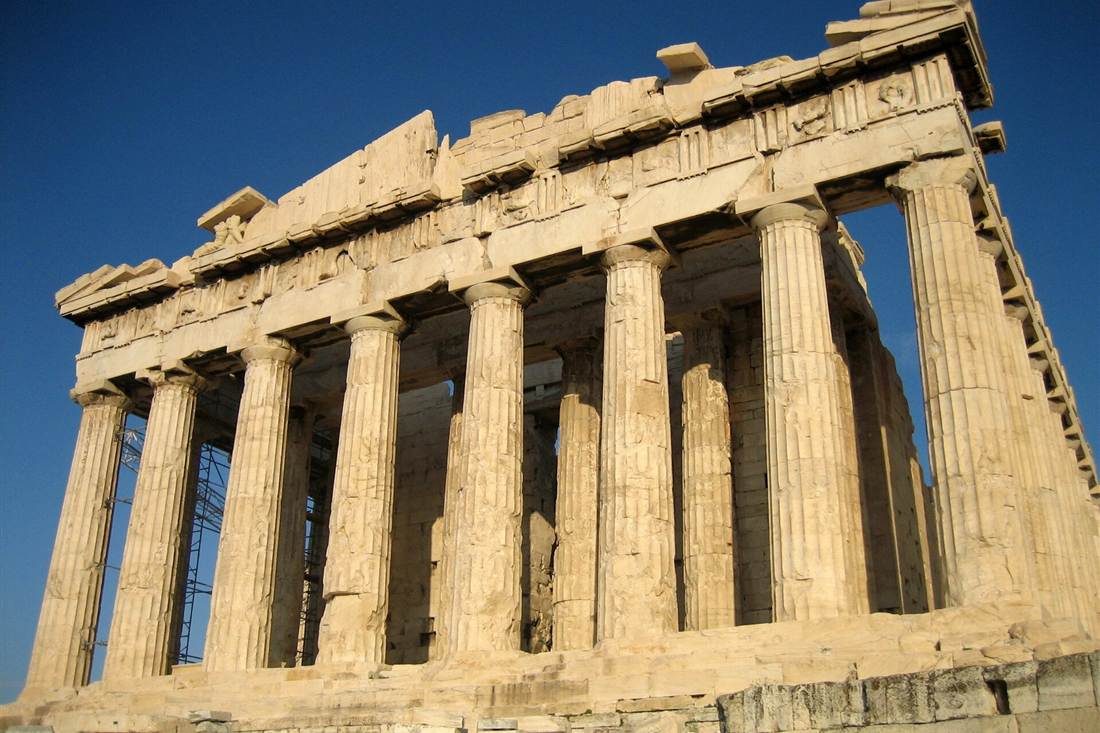
The Athens excursion package joins the Acropolis, Cape Sounion and a cruise to Hydra, Poros and Aegina with day trips to Delphi, Mycenae and Epidaurus over four days. Tours across the rest of the country are listed on Greece Tours.
The sections below cover what the Athens excursion package includes, each site and island, the sea links, season, packing and booking, with links into the Athens pages. The tours shown are checked on GetYourGuide and Viator.
What is the Athens excursion package?
The Athens excursion package is a 4-day trip on GetYourGuide, tour number 1137595. It joins sightseeing in Athens with a cruise to three islands. It adds day trips to ancient sites on the mainland of Greece.
The full listing title reads “Athens: Excursion Package with Island Cruise and Day Trips.” That title names the two parts of the plan: a cruise and day trips. The platform files the tour as a multi-day trip. It also lists the tour under Delphi, so Delphi searches bring it up.
The summary of this Athens excursion package names each stop in one passage. It invites travellers to explore Athens and beyond. It lists visits to the Acropolis and the Sounio temple. It adds a cruise to Hydra, Poros and Aegina, plus time to discover Delphi, Mycenae and Epidaurus.
The listing gives no day-by-day order. It names the places and the trip length, but not the sequence of visits. Travellers learn which stops the trip covers, not which one comes first or last. This page follows the same approach and lists the stops without a fixed schedule.
What does the Athens excursion package include?
The Athens excursion package includes the visits and the three-island cruise in one booking. Its listing shows seven feature labels in total. They cover entry, group type, pickup, cancellation and booking time, plus a note that the tour is new.
- Skip the line
- Private group
- Small group
- Pickup available
- Free cancellation
- Must book at least 10 hours in advance
- New activity, with no reviews yet
Four labels describe the tour itself. Skip the line means entry without the ticket queue. Private group means the tour runs for your party alone. Small group points to a limited headcount on each outing. Pickup available means the tour offers collection at the start. Together, they cover entry, company and transport.
Three labels cover the booking itself. Free cancellation means travellers can cancel without a fee within the listing’s terms. Reservations must come in at least 10 hours ahead of the start. The new-activity label means this Athens excursion package has no reviews on the listing yet. Travellers judge it on the listing details, not on past ratings.
Which places does the Athens excursion package cover?
The Athens excursion package covers eight places. They are the Acropolis, Cape Sounion, Hydra, Poros, Aegina, Delphi, Mycenae and Epidaurus. Two lie in Attica, three are Saronic islands, and three are ancient sites on the mainland beyond Attica.
- The Acropolis: the rock above central Athens, crowned by the Parthenon.
- Cape Sounion: the Temple of Poseidon on a headland at the tip of Attica.
- Hydra: a Saronic island where cars and motorbikes are banned.
- Poros: two islands joined by a bridge.
- Aegina: a Saronic island 27 km from Athens.
- Delphi: the seat of the ancient oracle on Mount Parnassus.
- Mycenae: a Bronze Age citadel in the Argolid.
- Epidaurus: the sanctuary of Asclepius and its ancient theatre.
The three islands sit in the Saronic Gulf, south-west of Athens. Delphi stands alone in central Greece, away from the other stops. Mycenae and Epidaurus sit in the north-east Peloponnese. The Acropolis and Cape Sounion stay in Attica, the region of Athens. This Athens excursion package therefore spans four separate areas of Greece.
The plan mixes two kinds of stop: ancient sites and islands. Five ancient sites stand on the mainland. The cruise in the title links the three islands by sea. The Acropolis is the only stop inside the city itself. The other seven stops lie beyond the city limits.
How does the package differ from single day trips from Athens?
The Athens excursion package joins four trip themes and a three-island cruise in one booking. Single day trips from Athens cover one or two sites each. The package also comes with pickup and a private group.
Among the single trips, the Delphi day trip from Athens covers one site in one day. The Mycenae and Epidaurus day trip from Athens pairs two Argolid sites in one day. Two single trips therefore cover three sites across two days. The package places Delphi, Mycenae and Epidaurus inside one booking instead.
The Cape Sounion half-day trip covers the Temple of Poseidon at sunset. The Athens 4-day itinerary plans four days inside the city. Neither plan leaves Attica or crosses to an island. Each one serves a single theme, from sunset views to city sights. Both themes appear in the package, next to the cruise and the sites beyond Attica.
Single trips need a separate booking for each day out. The package replaces those bookings with one listing and one cancellation policy. It also adds Hydra, Poros and Aegina, which none of the single trips above visit. The trade-off is a fixed list of places instead of a plan built day by day.
What do you see on the Acropolis?
The Athens excursion package takes you onto the Acropolis, a flat-topped rock 150 m above sea level. Its surface covers about 3 hectares. Across that space, you visit the four main buildings that Pericles coordinated in the 5th century BC.
- The Parthenon
- The Propylaea
- The Erechtheion
- The Temple of Athena Nike
The name Acropolis joins two Greek words: akron, meaning highest point, and polis, meaning city. People lived on the hill as early as the 4th millennium BC. On the Athens excursion package, you walk the same summit those first settlers knew. Their settlement came long before the first temple rose.
The Parthenon was badly damaged in the late 17th century. A Venetian siege struck the hill, and stored gunpowder exploded inside. The Athens excursion package lets you approach the temple that stood through that blast. From the paths across the summit, you see its standing columns and the gaps the explosion left.
In the late Bronze Age, a Mycenaean palace stood on the rock. A wall 760 m long and up to 10 m high ringed the palace on its hilltop. Our Acropolis history page traces each era of the hill. It follows the story from that palace to the classical temples and the later sieges.


Why visit the Temple of Poseidon at Sounion?
The Athens excursion package brings you to Poseidon’s temple, built in the 440s BC on a headland. The Aegean Sea surrounds the cape on three sides. The temple ranks among the major surviving monuments of the Golden Age of Athens.
Herodotus records a festival held once in four years. Athenian leaders sailed to the cape for it in a sacred boat. The voyage tied the city to the god of the sea. Our Temple of Poseidon at Sounion page covers the ruins and the headland in full detail. It also sets out the site’s later history.
After the naval victory at Salamis, the Athenians set a whole captured enemy warship at Sounion. They dedicated the ship as a trophy to Poseidon. A ship on dry land served as thanks for a win at sea. On the Athens excursion package, you stand on the cape where that trophy once sat on display.
Later, Sounion was fortified in the Peloponnesian War. The new defences protected grain ships sailing past the cape to Athens. The Sounion Kouros statue was found in a pit east of the temple. Walk the whole site, and you cover faith, war and art on a single headland.

What is Hydra like on the island cruise?
On the Athens excursion package, Hydra stands out as an island where all wheeled vehicles are banned. The ban covers cars, motorbikes, scooters and even bicycles. Rubbish trucks are the only motor vehicles that run anywhere on the island.
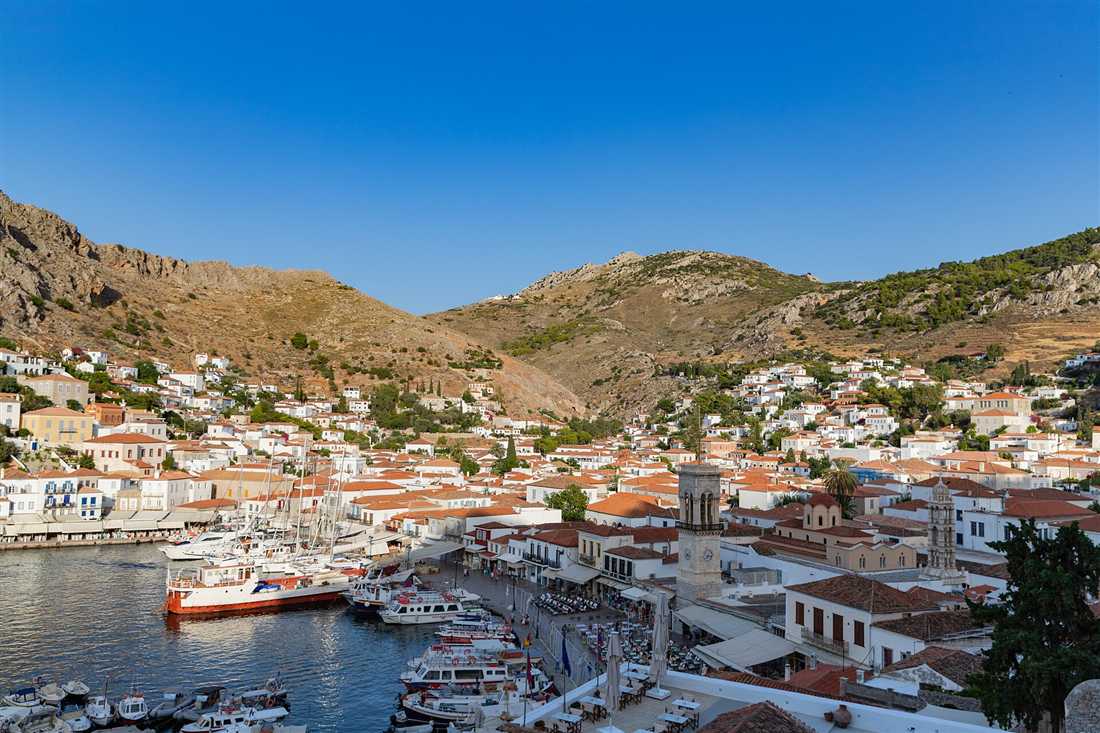
Horses, mules, donkeys and water taxis provide transport on Hydra. With no traffic, the port stays quiet, and you explore the town on foot. You hear hooves and boat engines, not car horns. The Athens excursion package stops on an island where walkers, not drivers, set the pace.
The island covers 49.6 square km of land. Its main town, Hydra port, has about 1,900 people. Hydra lies 69 km from Piraeus by sea. With the town set on the water, your cruise stop starts and ends at the harbour front.
The Tsamadou mansion stands by the harbour. Today the old building serves as a Maritime Academy. The Athens excursion package puts it within sight on a walk along the waterfront. Our Hydra page explains the island, its port and its transport in more depth.
What do Poros and Aegina add to the cruise?
The Athens excursion package adds Poros, two islands joined by a bridge over a narrow strait. It also adds Aegina, one of the Saronic Islands, 27 km from Athens. Aegina is known for the temple of Aphaia and for its pistachio farming.
Sphairia, the southern part of Poros, is volcanic and holds the town. The town’s landmark is a clock tower from the early 20th century. Kalavria is the northern and larger part, and its name means gentle breeze. Our Poros page describes both halves, the bridge, the strait and the town in full.
Kalavria held a sanctuary of Poseidon. Swedish archaeologists excavated the site, and its hilltop ruins can still be visited today. The Athenian orator Demosthenes came to the island. Poros gives the Athens excursion package a second link to Poseidon, after the temple at Sounion.
Aegina is roughly triangular, about 15 km east to west and 10 km north to south. Its area is 87 square km. Aegina was the first city-state in Europe to issue coins, called the Aeginetic stater. The town of Aegina sits at the north-west end of the island. Our Aegina page goes deeper into the island.


Why is Delphi part of the Athens excursion package?
Delphi earns its place in the Athens excursion package as the seat of the Pythia. People across the ancient world consulted this oracle on important decisions. The site lies on the south-western slope of Mount Parnassus, in mainland Greece.
The Greeks placed the centre of the world at Delphi. The Omphalos stone marked that centre. In Greek, omphalos means navel, so the stone stood for the navel of the world. One account says Delphi took its name from Delphyne, a she-serpent killed by Apollo. Other accounts name the serpent Python.
Ancient Greek city-states built monuments in the sacred precinct. Over time, landslide soil buried the ruins. In the late 19th century, the French Archaeological School cleared that soil away. The dig revealed the sanctuary of Apollo and the temple of Athena Pronoia. The work also brought thousands of objects to light.
UNESCO lists Delphi as a World Heritage Site. The Athens excursion package on GetYourGuide lasts four days. Its summary names three ancient sites: Delphi, Mycenae and Epidaurus. It pairs them with a cruise to Hydra, Poros and Aegina. Delphi adds the oracle and its sanctuary to that mix of land and sea.
What is Mycenae?
Mycenae is the ancient citadel named in the Athens excursion package. In the second millennium BC, it was a major centre of Greek civilisation. From its hill, it dominated much of southern Greece, as well as Crete and the Cyclades.
Mycenae stands on a hill 274 m above sea level. The hill lies 19 km inland from the Gulf of Argolis. The city gives its name to a whole era of Greek history. That era, the Mycenaean period, covers about five centuries of the second millennium BC. Travellers on the Athens excursion package stand at the place that named it.
At its peak, Mycenae was home to 30,000 people. That count covers both the citadel and the lower town. Together, the two areas spread over 32 hectares. Those figures show the scale of the city at the height of its power. They help a visitor picture the ruins as a town full of people.
The key structures are the Lion Gate, the Treasury of Atreus and the walls. On the Athens excursion package, these three sights form the core of the stop at Mycenae. UNESCO lists Mycenae as a World Heritage Site, together with nearby Tiryns. The two places share a single entry on that list.
What makes the theatre of Epidaurus stand out?
The theatre of Epidaurus stands out for its acoustics and its proportions. It dates from the late 4th century BC and held 13,000 to 14,000 spectators. The Athens excursion package brings travellers to this theatre at Epidaurus.
According to Pausanias, Polykleitos the Younger designed the theatre at Epidaurus. His plan set the shape of the whole building, from the lowest seat to the top row. A horizontal corridor, 1.82 m wide, divides the lower seating from the upper seating. That corridor turns one bowl of seats into two tiers.
The front rows held seats of honour for important people. Other spectators sat in the rows behind them. The theatre was more than a place for shows. It hosted music, singing and drama as part of the worship of Asclepius, the healer god. In this way, art and religion shared one stage.
Performances began again at the theatre in the mid-20th century, after a long silence. The Epidaurus Festival now runs there in the summer months. Visitors with the Athens excursion package see a stage that serves its first purpose again. The seats built for ancient audiences now hold festival crowds.
How does the island cruise reach Hydra, Poros and Aegina?
The island cruise in the Athens excursion package sails the Saronic Gulf. Hydra, Poros and Aegina all lie in this gulf. Because the three islands share one body of water, a single cruise links them on one route.
Each island holds its own place in the gulf. Poros sits beside the Peloponnese coast, next to Galatas. Hydra lies 69 km by sea from Piraeus. For more days on the water than the Athens excursion package offers, see our Saronic Islands tours.
Beyond the cruise, each island keeps its own public sea links. These routes serve travellers who plan a longer stay on one island after the tour ends. All but one of the crossings below start from Piraeus. The list sets out times and stops for each route.
- High-speed hydrofoils and catamarans from Piraeus stop at Poros first, then serve Hydra and go on to Spetses.
- Hydrofoils from Piraeus reach Aegina in about forty minutes.
- The regular ferry from Piraeus to Aegina takes about an hour, about twenty minutes longer than the hydrofoil.
- A 20-minute passenger ferry also reaches Hydra from Metochi on the mainland.
Which season suits the Athens excursion package?
Spring and autumn suit the Athens excursion package for walking, with milder days on open sites. Summer brings the hottest days and the meltemi, the strong wind of the Aegean. Plan the dates around the heat on land and the wind at sea.
The meltemi is a dry north wind. It blows from about late spring to the middle of September. It is strongest in the afternoon and tends to drop at night. In clear weather it can reach force 7 to 8. At that strength, inter-island ferries can stay in port.
The Epidaurus Festival stages plays at the ancient theatre in the summer months. That gives summer one draw that spring and autumn lack. A summer date places the tour inside the festival season. Read the festival programme for its dates before you book.
Check our Athens weather page for conditions in each season before you pick a start date. Pick spring or autumn if you prefer milder air at the ruins. Pick summer if the heat does not trouble you and the festival plays matter to you.
What do you pack for the Athens excursion package?
Pack light for the Athens excursion package, with gear for sun, stone paths and sea wind. Six items cover the whole tour, from the ancient sites to the cruise boat. Check each item off the list below before the first pickup.
- A hat, sun cream and water for open sites such as the Acropolis rock and Delphi.
- Shoes with grip for marble steps and rock paths.
- A windproof layer for the boat deck.
- Swimwear for the island day.
- An ID card or passport.
- A small day bag to carry the rest through the day.
Wear the shoes with grip and the hat on each site visit. Carry the sun cream, water and ID card or passport in the day bag. On the island day, add the swimwear and the windproof layer. One small bag keeps the load light on each day of the Athens excursion package.
How do you book and cancel the Athens excursion package?
Book the Athens excursion package on its GetYourGuide listing at least 10 hours before the tour starts. Cancel for free up to 24 hours before the start. Read the full terms on the listing before you pay.
The listing page is the main source of detail for this tour, because it has no reviews yet. It lists each feature of the package in one place. Skip-the-line entry appears there, which saves time at ticket queues. For more on entry at the ancient citadel, see our Acropolis tickets page.
The 24-hour rule is GetYourGuide free cancellation, and it applies on listings that show it. This listing shows it among its features. Count back 24 hours from the start time to find your cutoff. If you book inside the final 24 hours, the free window has already closed.
- Open the GetYourGuide listing for the package.
- Choose the date and the number of travellers in your party.
- Pay online on the listing page.
- Watch your inbox for the confirmation, which arrives by email.
- Check the pickup details on the listing.
Frequently Asked Questions
How long is the Athens excursion package?
The package runs for 4 days in total. It combines the Acropolis and the Sounio temple with a cruise to three islands. It also adds day trips from Athens to Delphi, Mycenae and Epidaurus on the mainland.
Does the Athens excursion package include pickup?
Yes. The GetYourGuide listing shows pickup as available for this tour. The exact pickup details sit on that listing, so read them once you book. Note them down before the first day, so you are ready on time.
Is the Athens excursion package a private tour?
Yes, the GetYourGuide listing names a private group among its features. It names a small group option as well. A private group means only your own party takes part. Read the listing to see which format your booking covers.
Which islands does the cruise visit?
The cruise visits three islands: Hydra, Poros and Aegina. The rest of the tour stays on land, at sites in and around Athens and on the mainland. Pack swimwear for the island day.
Are cars allowed on Hydra?
No. Wheeled vehicles are banned on Hydra, including cars, motorbikes and bicycles. Donkeys, mules and water taxis provide transport on the island. Plan to walk on Hydra, and wear the shoes with grip from the packing list above.
Does the package have reviews yet?
No. The package is a new activity on GetYourGuide and has no reviews yet. The listing page is the main source of detail for now. Read its feature list and its terms in full before you pay.