
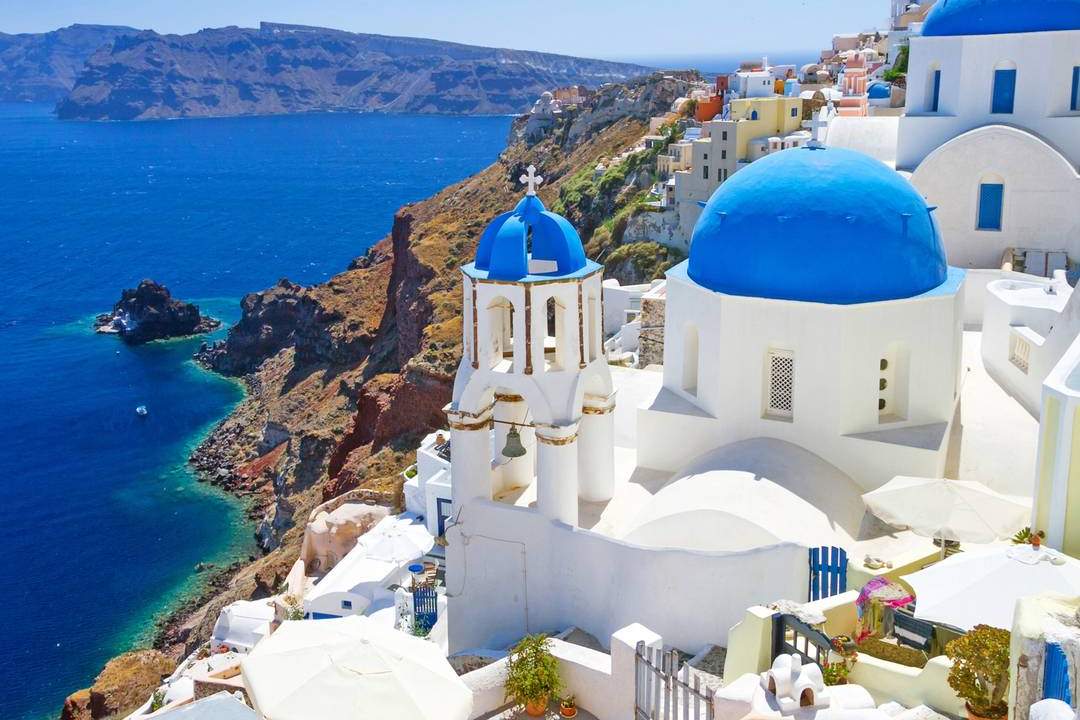
The 8-day highlights tour links Athens, the oracle site of Delphi, the rock monasteries of Meteora and the volcanic island of Santorini in one booking. Tours across the rest of the country are listed on Greece Tours.
The sections below cover what the 8-day highlights tour includes, Athens and the Acropolis, Delphi, Meteora, Santorini, the sunset cruise, booking and shorter options, with links into the Athens pages. The tour shown is checked on GetYourGuide.
What is the 8-day highlights tour?
The 8-day highlights tour is a multi-day trip sold on GetYourGuide. It lasts 8 days in total, and its listing location is Athens. The trip pairs three stops on the Greek mainland with time on one Greek island.
The listing describes two sides of the trip. One side is a chance to experience the Greek mainland. It names stops in Athens, Delphi and the monasteries of Meteora.
The other side is the island of Santorini. The listing gives time to explore the island. It also includes a dinner on a sunset cruise.
Both sides fit inside the 8-day highlights tour, so one booking covers the mainland and the island. One product page on GetYourGuide holds the whole trip. The sections below set out the places and the listed features.
Which places does the 8-day highlights tour visit?
The 8-day highlights tour visits four places in Greece: Athens, Delphi, Meteora and Santorini. Each stop lies in a different region of the country. Together they span a modern capital, two religious sites and an island formed by a volcano.
- Athens: the capital of Greece and the home of the Acropolis.
- Delphi: the ancient sanctuary of Apollo, a sacred site on Mount Parnassus.
- Meteora: rock pillars with Orthodox monasteries, in the Thessaly region of the mainland.
- Santorini: a volcanic island in the Cyclades island group, with a caldera.
Read more about the sanctuary and its history on our Delphi page. The monasteries and their rock setting are covered on our Meteora page.
Delphi and Meteora come from different eras of faith. Delphi belongs to the ancient Greek world and its gods. Meteora belongs to the Orthodox Christian world. The two sites show how belief in Greece changed over time.
What does the 8-day highlights tour include?
The 8-day highlights tour comes with skip-the-line entry, according to its GetYourGuide listing. Pickup is also available for guests. The listing adds four more tags. They cover the group type, the cancellation terms and how early to book the trip.
Skip-the-line entry means you go straight past the ticket queue. This cuts waiting time at the entrance. With pickup, you can be collected instead of making your own way to the start.
The four extra tags on the listing are these:
- Private group: the trip can run for your own party.
- Small group: the group size stays limited.
- Free cancellation: plans can change after you book.
- Advance booking: book at least 10 hours before the start.
GetYourGuide marks the 8-day highlights tour as a new activity on its site. The tag shows that the trip joined the GetYourGuide catalogue recently.
What is Athens like at the start of the 8-day highlights tour?
Athens is the largest city in Greece. It is the first place named in the 8-day highlights tour title. It is the capital of the Attica region, which surrounds the city. Its urban area, with the suburbs, holds over 3.6 million people.
No capital on the European mainland lies further south than Athens. Its recorded history spans over 3,400 years. That long record makes it one of the oldest cities in the world.
In ancient times, Athens was a centre of Greek democracy. Democracy means rule by the people. The word comes from the Greek for people and power. The city was also a centre of the arts, education and philosophy.
The modern city spreads out below the Acropolis, the rocky hill covered in the next section.
What do you see at the Acropolis of Athens?
The Acropolis of Athens is an ancient citadel on a rocky outcrop above the city. Its main monuments are the Parthenon, the Propylaea, the Erechtheion and the Temple of Athena Nike. The hill stands in Athens, a stop on the 8-day highlights tour.
A citadel is a fortified stronghold on high ground. People lived on this hill as early as the 4th millennium BC, more than 5,000 years ago. A Mycenaean palace is thought to have stood there in the late Bronze Age, long before the temples.
In the 6th century BC, a temple to Athena Polias was built on the hill. Athena Polias was the protecting goddess of Athens. Her title comes from polis, the Greek word for city. That temple is older than the main monuments.
In the 5th century BC, the Athenian leader Pericles coordinated a building programme. It produced the four main monuments named above. The Temple of Athena Nike honours the same goddess as the older temple, under a different title.
The Parthenon was over two thousand years old at the time of a 17th-century Venetian siege. During the siege, gunpowder stored inside the temple exploded. The blast left the Parthenon badly damaged. Our page on Acropolis tickets covers entry to the site and its monuments.
What do you see at Delphi on the 8-day highlights tour?
The 8-day highlights tour stops in Delphi, on the south-western slope of Mount Parnassus in Greece. The sacred precinct there holds the sanctuary of Apollo and the temple of Athena Pronoia. Finds from both areas are on show in the Delphi Archaeological Museum.
A sacred precinct is ground set apart for the gods. Before excavation, landslide soil buried this one. In the late 19th century, the French Archaeological School cleared that soil away. The dig revealed both sacred buildings. It also brought thousands of objects, inscriptions and sculptures back into view.
Among the museum finds is a tiny leopard made of mother-of-pearl. Mother-of-pearl is the shiny inner layer of a shell.
The important Greek city-states built monuments in the precinct the 8-day highlights tour visits. These monuments show the shared Hellenic unity of those cities. Hellenic means Greek.
Our page on Delphi tickets lists the entry options for the archaeological site and the museum. Check this page before the 8-day highlights tour arrives in Delphi.
Why was the Oracle of Delphi so important?
Delphi was the seat of the Pythia, the major oracle of the ancient classical world. People from across that world came to consult her about important decisions. The 8-day highlights tour visits the sacred precinct where she once gave her answers.
An oracle gave answers that people believed came from a god. The Oracle of Delphi spoke from what the ancient Greeks considered the centre of the world. A stone called the Omphalos, meaning “navel”, marked that central spot. UNESCO lists the precinct as a World Heritage Site because of its great influence in the ancient world.
A myth explains how the site got its name. Delphi took its name from Delphyne, a she-serpent killed by the god Apollo. Other accounts give the serpent a different name: Python. The name Pytho, in turn, links to the title of the Pythia.
Which monasteries stand at Meteora?
Meteora hosts a major complex of Eastern Orthodox monasteries. Locally, it is seen as second only to Mount Athos. The 8-day highlights tour visits this rock formation, where six monasteries still stand. Four of them remain active and open to visitors.
Twenty-four monasteries were founded on top of the rock pillars in total. These foundations date mainly from the second half of the 14th century. Today, the six-monastery complex is a UNESCO World Heritage Site. UNESCO cites its architecture, its beauty and its religious and cultural value.
Here are the six monasteries still standing at this stop of the 8-day highlights tour:
- Great Meteoron: an active monastery
- Varlaam: an active monastery
- Holy Trinity: an active monastery
- Saint Stephen: an active convent run by nuns
- Saint Nicholas Anapausas: no longer an active monastery
- Rousanou: no longer an active monastery
Our page on Meteora monasteries tickets explains entry to the four active monasteries.
How did the rocks of Meteora form?
The pillars of Meteora are made of sandstone and conglomerate, not volcanic rock. Over time, water, wind and extreme temperatures wore this rock into tall, separate pillars. The 8-day highlights tour stops in Meteora, among these rock columns.
Meteora lies in the Trikala regional unit of Thessaly, in north-western Greece. The rock formation stands between the town of Kalabaka and the village of Kastraki. The Pineios river and the Pindus Mountains lie close by.
Sandstone is rock made from grains of sand pressed together. The conglomerate formed from stone, sand and mud. Streams carried this material down into a delta at the edge of a lake. A delta is the fan of land that forms where a stream meets still water. The material built up there over millions of years.
About 60 million years ago, earth movements pushed the seabed up into a high plateau. Vertical fault lines cut through this plateau. A fault is a crack where the rock has split and shifted. The pillars seen on the 8-day highlights tour took shape along those fault lines.
What do you see on Santorini on the 8-day highlights tour?
The 8-day highlights tour visits Santorini, the Cyclades island that lies farthest south. Santorini is the largest island of a small circular archipelago formed by a caldera. The tour listing says travellers explore the island and dine on a sunset cruise.
Santorini lies in the southern Aegean Sea. Fira, the island capital, stands on the edge of the caldera cliff. That cliff is 400 m high.
Oia is a village on the north-west edge of the island, about 150 m up. It is known as the “Eagle’s Nest”. Its buildings include:
- white-washed churches with blue domes
- cave houses
- captains’ mansions
Read our page on Oia for a closer look at the village.
What is the sunset cruise on Santorini?
The sunset cruise is the dinner stop on the Santorini leg of the 8-day highlights tour. The GetYourGuide listing says travellers explore Santorini, then dine on a sunset cruise. The meal takes place on board as the sun goes down.
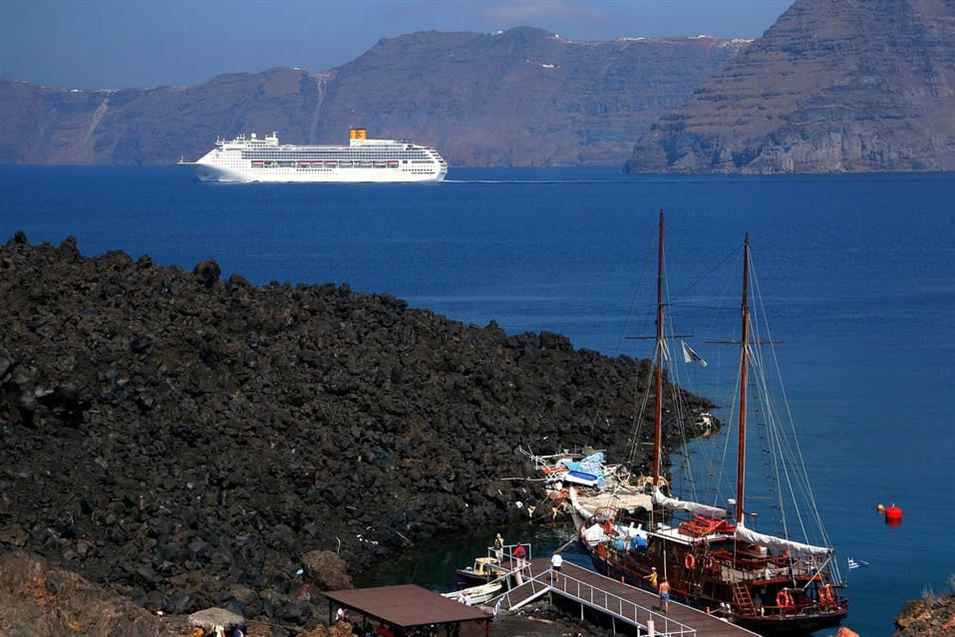
The Santorini caldera is a large water-filled basin. The Minoan eruption left it about 3,600 years ago. That eruption ranks among the largest volcanic eruptions in recorded history.
Volcanic ash deposits hundreds of metres deep ring the basin. The caldera runs 18 km from Cape Akrotiri in the south to Cape Agios Nikolaos in the north. No volcanic centre in the South Aegean Volcanic Arc is more active than Santorini.
For sunset sailings booked on the island alone, outside this 8-day booking, see our Santorini sunset cruise page.
Who is the 8-day highlights tour for?
The 8-day highlights tour is for travellers who want the mainland sites and one Cycladic island. It joins all of them in a single booking. It also matches travellers who prefer a private or small group, and travellers based in Athens.
The mainland sites on this trip are Athens, Delphi and Meteora. Santorini is the Cycladic island. One reservation covers all four places, so you skip separate bookings for each stop.
Travellers who dislike waiting in line match the listing as well, since it includes skip-the-line entry.
Travellers who want a trip without Santorini match the shorter tours compared below.
How do you book and cancel the 8-day highlights tour?
You book the 8-day highlights tour through its GetYourGuide listing. Pick a date and the number of travellers, then pay online. The listing shows free cancellation, which on GetYourGuide runs up to 24 hours before the tour start.
The booking calendar shows departures on each day of the coming weeks. That lets the start date fit your own plans.
Bookings need at least 10 hours of notice. Once you pay, the confirmation arrives by email.
Read the cancellation terms on the listing before you pay. They set the exact rules for your date and group.
The 8-day highlights tour is a new activity on GetYourGuide. It has no reviews yet, so the listing page is the main source of detail. Read the full page, not only the title, before you book.
How does the 8-day highlights tour compare with shorter tours from Athens?
The 8-day highlights tour runs longer than the 2-day, 3-day and 4-day tours from Athens on GetYourGuide. It is also the only one of them that includes Santorini. Choose by trip length and by whether you want Santorini on the route.
GetYourGuide lists four shorter tours from Athens. Their lengths run from 2 to 4 days, as the list below shows.
- From Athens: Delphi and Meteora 2-Day Tour with Hotel (2 days)
- From Athens: 3 Days in Meteora & Delphi with Tours & Hotel (3 days)
- 4-Day Tour of Mycenae, Epidaurus, Olympia, Delphi & Meteora (4 days)
- From Athens: Explore Ancient Greece 4-Day Tour (4 days)
The Delphi and Meteora 2-day tour is the shortest of the four. The Explore Ancient Greece 4-day tour and the Mycenae tour both run 4 days.
The 2-day and 3-day titles both name a hotel. The 3-day title also names tours in Meteora and Delphi. The Mycenae tour takes in Epidaurus, Olympia, Delphi and Meteora as well.
The 8-day highlights tour runs twice as long as either 4-day option. With a shorter tour, Santorini needs a booking of its own. That means two reservations instead of one.


Frequently Asked Questions
How long does the 8-day highlights tour last?
The 8-day highlights tour lasts 8 days. GetYourGuide lists it as a multi-day trip rather than a day trip. That is four times the length of the Delphi and Meteora 2-day option. Plan your arrival and departure around the full eight days.
Where does the tour start?
The tour starts in Athens, the location named on the GetYourGuide listing. Pickup is available, so travellers staying in Athens join from their base. Check the pickup details on the listing when you book. Plan to reach the city before your start date if you fly in.
Is the tour private or shared?
It can be either. The listing offers a private group option and a small group option. A private group holds only your own party. A small group shares the tour with other travellers. Check both options and their dates on the listing before you book.
Which islands sit in the Santorini caldera?
Seven islands sit in the Santorini caldera. Santorini and Therasia are inhabited. Nea Kameni, Palea Kameni, Aspronisi, Anydros and Christiana are uninhabited. Nea Kameni, whose name means “new burnt”, is the volcano island in the middle of the caldera. Tourist boats visit it daily in summer.