
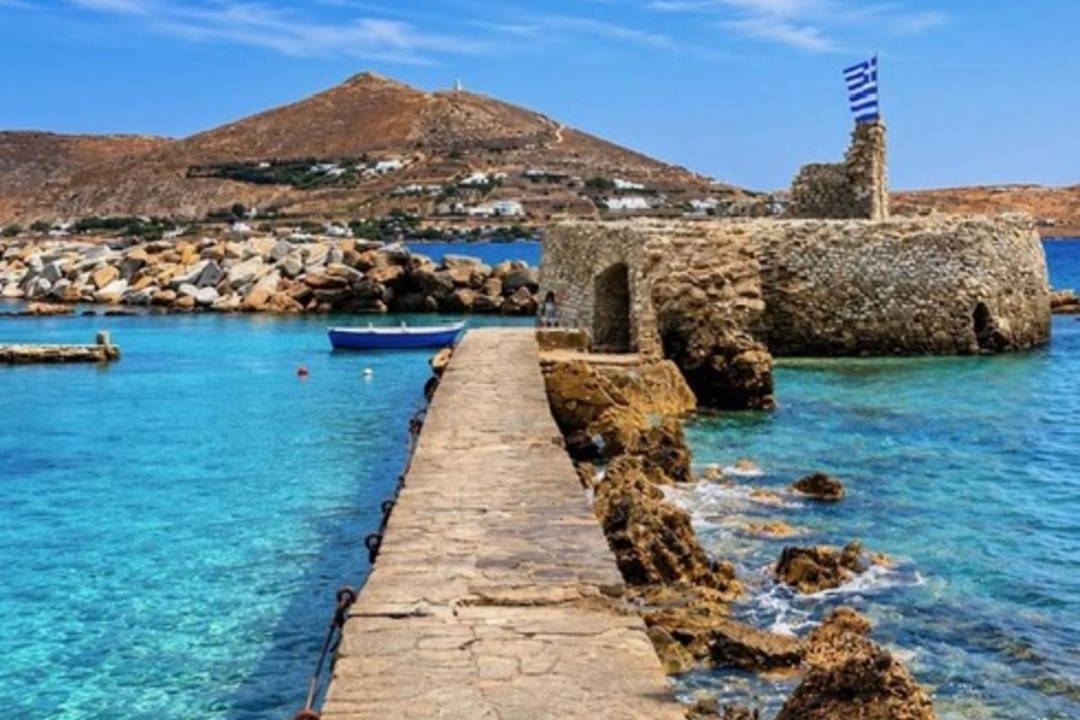
The 8-day island hopping tour from Naoussa on Paros joins guided excursions to Mykonos, Naxos and Sifnos with hotel stays, breakfast and beach time. Tours across the rest of the country are listed on Greece Tours.
The sections below cover what the 8-day island hopping tour includes, the four islands, Naoussa, Antiparos, Parian history, Sifnos and its monastery, the Naxos kouros, Mykonos, season, packing and booking, with links into the Paros pages. The tours shown are checked on GetYourGuide and Viator.
What is the Paros 8-day island hopping tour?
The Paros 8-day island hopping tour is a GetYourGuide package with its listing location in Naoussa on Paros. Guests discover Paros, Mykonos, Naxos and Sifnos over eight days. Hotel stays and breakfast are included, along with guided excursions to nearby islands.
The full listing title reads “Paros: 8-Day Island Hopping Tour with Hotel & Breakfast”. GetYourGuide files it under tour number 1476794. On the site, the 8-day island hopping tour sits under Naoussa. That places the home area of the trip in the village.
Naoussa is a fishing village in the north-east corner of Paros. Paros lies in the central Cyclades, about 150 km south-east of Piraeus. The island is 21 km long and 16 km wide. Parikia, the capital and main port, lies on the west coast.
The summary names four islands in one line: Paros, Mykonos, Naxos and Sifnos. Paros holds the listing location. The other three are the nearby islands reached on guided excursions. No day-by-day order appears on the listing for the 8-day island hopping tour.
Free time sits beside the excursions. The summary invites guests to explore Naoussa and to relax on beaches. Island visits, village walks and beach hours give the 8-day island hopping tour its three parts.
Each island on the 8-day island hopping tour brings its own sight. Naxos holds an unfinished marble kouros in an ancient quarry. Sifnos has a monastery on a cape joined to the island by a bridge. Mykonos adds Cycladic lanes and a short sea link to Delos.
The package suits travellers who want four Cycladic islands in one booking. The 8-day island hopping tour puts hotel stays, breakfast and guided excursions into one package. Guests compare that bundle with booking each ferry and room alone.
The activity is new on GetYourGuide and has no reviews yet. The listing text is the main source for tour details. This page sets those details beside verified facts about each island on the route.
What does the 8-day island hopping tour listing include?
The 8-day island hopping tour listing includes hotel stays, breakfast and guided excursions to nearby islands. It also lists pickup, a small group, wheelchair access and free cancellation. Time to explore Naoussa and relax on beaches is part of the plan.
Eight features appear on the listing page:
- Hotel stays
- Breakfast
- Guided excursions to nearby islands
- Pickup available
- Small group
- Wheelchair accessible
- Free cancellation
- Booking at least 10 hours in advance
Hotel and breakfast are the two parts named in the title. The listing does not name lunch or dinner. Guests plan those meals on their own. The Paros food tour offers a guided tasting on the island.
Guided excursions carry the 8-day island hopping tour from Paros to the nearby islands. The summary does not name the guides’ languages. Guests who need a set language check that point with the operator before paying.
Pickup is listed as available. A pickup saves the search for a meeting point on the first morning. Guests read the pickup notes on the listing before they pay.
Small group means fewer guests share each excursion. The listing does not publish a group cap. Guests who need the exact number ask the operator through GetYourGuide.
Wheelchair access is a listed feature of the 8-day island hopping tour. Boats, ports and old village lanes differ in access. Guests with mobility needs confirm the details with the operator before booking.
Free cancellation and the 10-hour booking window complete the list. Both terms shape when guests book. The booking section near the end of this page explains them in full.
The summary names no flights or ferries to Paros. Guests check whether the arrival leg is part of their booking. The air and sea section below covers the routes to the island.
Which islands does the 8-day island hopping tour reach?
The 8-day island hopping tour reaches four Cycladic islands: Paros, Mykonos, Naxos and Sifnos. Paros is the base, with Naoussa as the listing location. The other three islands are reached on guided excursions, each in a different direction from Paros.
Paros is the home island of the 8-day island hopping tour. The summary asks guests to explore Naoussa and relax on beaches there. The rest of the route branches out from Paros to its neighbours.
All four islands belong to the Cyclades, an island group in the southern Aegean. The name comes from the Greek word for circle. The islands form a rough ring around the sacred islet of Delos.
Paros has a round, pear-like shape. A single mountain, 724 m high, slopes evenly down on all sides to a coastal plain. That plain is broadest on the north-east and south-west sides. The island rock is marble, with gneiss and mica-schist in places.
Naxos lies 8 km east of Paros, across a narrow channel. It is the largest island of the Cyclades. Its main town, Chora, holds the harbour, with the Portara islet at its northern end. Chora has 8,897 of the island’s 20,578 residents.
Mykonos lies between Tinos, Syros, Paros and Naxos. The islet of Delos sits 2 km from its coast. That central spot puts Mykonos within reach of Paros on the 8-day island hopping tour.
Sifnos sits west of Paros, between Serifos and Milos. Its former monastery of Panagia Chrysopigi stands on a cape joined to the island by a bridge. A later section covers the island in full.
- Paros: home island, with Naoussa as the listing location
- Naxos: 8 km east of Paros, the largest of the Cyclades
- Mykonos: between Tinos, Syros, Paros and Naxos
- Sifnos: west of Paros, between Serifos and Milos
The three excursion islands spread around Paros. Naxos lies to the east, Mykonos to the north-east and Sifnos to the west. That layout fits the base-and-excursion shape of the 8-day island hopping tour.
Antiparos lies 1.5 km south-west of Paros but does not appear in the summary. Guests who want it add it on a free day. A later section explains the short crossing.
How does this tour differ from other 8-day Greece tours?
This 8-day island hopping tour stands apart in three ways. Its listing location is Naoussa on Paros. Breakfast is named in its title. It is also the only tour compared here that reaches Sifnos. The other tours use Athens, Naxos or mainland bases.
This site covers four other 8-day tours of Greece. Each one uses a different base or route:
- Naxos: 8-Day Cyclades Tour with Hotel and Transfers: based on Naxos, covering Naxos, Paros and Koufonisi
- Athens: 8-Day Greece Tour with Santorini & Mykonos: starts in Athens and adds two islands
- 8-Day Highlights Tour: Athens, Delphi, Meteora & Santorini: mixes the capital, two mainland sites and Santorini
- Greece: 8-Day Archaeology Holiday with Cycling & Hiking: mainland sites such as Tegea and the Lousios Gorge
The Naxos option is the closest match. The Naxos 8-day Cyclades tour uses Naxos as its base and covers Naxos, Paros and Koufonisi. It shares Paros with the 8-day island hopping tour but does not reach Sifnos or Mykonos.
The 8-day Greece tour with Santorini and Mykonos begins in Athens. It pairs the capital with two islands. It shares Mykonos with this trip, adds Santorini and does not list Sifnos.
The 8-day highlights tour of Athens, Delphi, Meteora and Santorini mixes the capital with the mainland. Two of its four places, Delphi and Meteora, lie inland. Santorini is its only island.
The 8-day archaeology activity holiday leaves the islands aside. It pairs ancient sites such as Tegea with cycling and hiking in the Lousios Gorge. Its route stays on the mainland.
Breakfast in the title is a practical difference. Guests on the 8-day island hopping tour know the morning meal is covered before they book. Of the other four titles, only the Naxos one names a hotel, and none names breakfast.
Sifnos is the clearest difference. It lies furthest west of the four islands, away from the Paros and Naxos channel. Among the five tours compared, only the 8-day island hopping tour lists it.
Why is Naoussa the base of the 8-day island hopping tour?
Naoussa is the listing location of the 8-day island hopping tour, so the trip is anchored there. The fishing village sits in the north-east corner of Paros, near Kolymbithres beach. The summary invites guests to explore the village between island excursions.
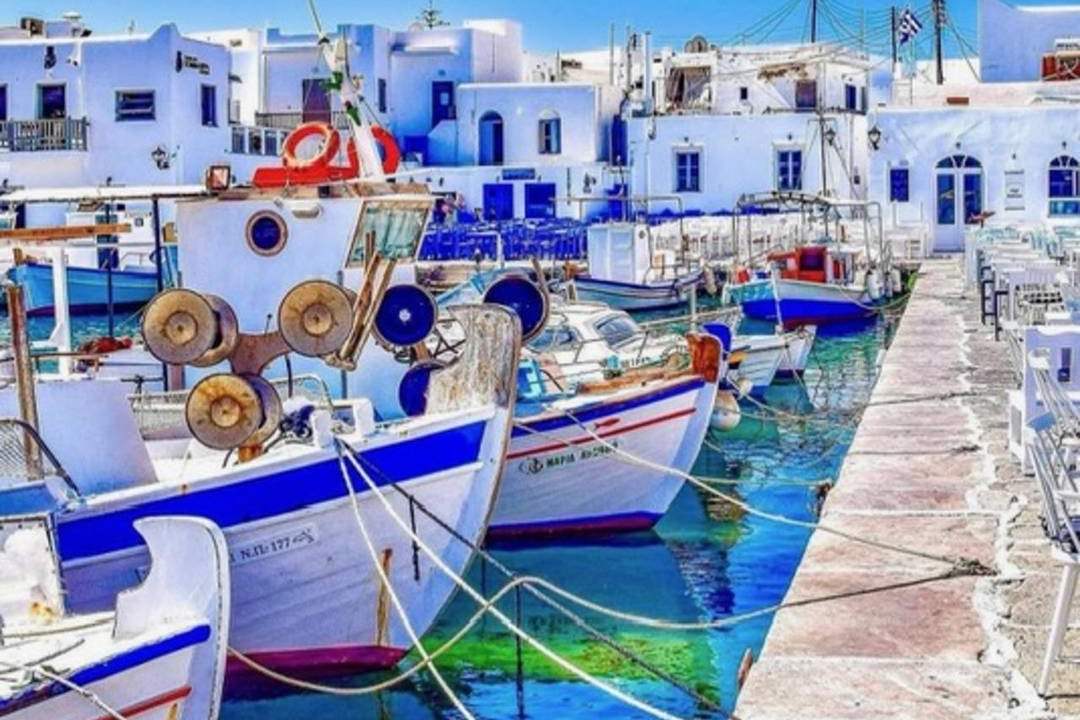
Naoussa is a fishing village with 3,134 residents. It lies in the north-east corner of Paros. Parikia, the capital and main port, lies on the west coast. It has about 4,500 permanent residents.
Parikia holds Panagia Ekatontapiliani, a Byzantine church complex by the sea. Tradition credits Saint Helen, mother of Constantine the Great, with its founding. It ranks second among the Marian pilgrimage churches of the Aegean, after the church on Tinos.
The two towns grew around separate ports on different coasts. Parikia handles the main ferry traffic of Paros. Naoussa gives the 8-day island hopping tour a north-coast village setting instead.
Naoussa has a long history as a harbour. Venetians from the Republic of Venice founded the village around the late 14th century. They built a fortress to guard the port. Part of that fortress still stands at the harbour.
The bay drew a second foreign power four centuries later. In a Russo-Turkish war of the late 18th century, Naoussa Bay became the base of a Russian fleet. Count Alexey Orlov commanded that fleet.
Both powers valued the same thing: the port itself. Guests on the 8-day island hopping tour see that same harbour today. It now serves the fishing boats of the village.
Kolymbithres beach lies near the village. The summary of the 8-day island hopping tour names beach time as part of the plan. A stay in Naoussa keeps that beach close on days spent on Paros.
The summary also asks guests to explore Naoussa itself. The fortress remains, the harbour and the fishing quay form the old core of the village. Each one tells part of the story above.
- Location: north-east corner of Paros
- Residents: 3,134
- Founded: by Venetians, around the late 14th century
- Fortress: Venetian, part still standing at the harbour
- Late 18th century: base of Count Orlov’s Russian fleet
- Nearby beach: Kolymbithres
What do the Parian Chronicle and Archilochus tell about Paros?
The Parian Chronicle is a marble stele from Paros carved with dates from myth to 299 BC. Archilochus was an Archaic Parian poet who wrote about his own feelings. Both belong to the home island of the 8-day island hopping tour.
The chronicle is also called the Parian Marble. It was carved around 264 BC and set up on Paros. Its entries treat myths as history, such as the Flood of Deucalion and the Trojan War. It gives more detail to the Heroic Age than to recent events.
Two upper sections turned up on Paros and were sold in Smyrna in the early 17th century. The buyer was an agent of Thomas Howard, Earl of Arundel. The scholar John Selden read the text and published it in London.
The upper fragments later passed to Oxford University. One survives in the Ashmolean Museum at Oxford, and the other has since been lost. A third fragment, the base of the stele, was found on Paros in the late 19th century.
That base fragment stays on the island in the Archaeological Museum of Paros. It holds the last entries of the chronicle, up to 299 BC. Guests on the 8-day island hopping tour see it in Parikia. Felix Jacoby wrote the major study of the chronicle in the early 20th century.
Archilochus was an iambic poet of the Archaic period, active in the 7th century BC. He is the earliest known Greek author to write almost entirely about his own emotions and experiences. He was also known for new uses of poetic metre.
Tradition says he was born to a notable family on Paros. His father, Telesicles, founded a Parian colony on Thasos. An ancestor, Tellis, helped bring the cult of Demeter to Thasos. The painter Polygnotus showed that mission in a painting at Delphi.
Paros honoured the poet in the 3rd century BC with a sanctuary, the Archilocheion. Admirers offered sacrifices there to him and to Apollo, Dionysus and the Muses. Its inscriptions tie him to the arrival of the cult of Dionysus on Paros.
Other records fill in the island’s standing. Under the Delian League of the 5th century BC, Paros paid the highest tribute of the island members. One ancient estimate puts it at 30 talents a year. In Parikia, a medieval castle above the seafront reuses the marble of an ancient temple of Apollo.
The chronicle and the poet show two sides of ancient Paros. One is a public record cut in marble. The other is a private voice in verse. Both give the 8-day island hopping tour a written past behind its harbours.
What does Antiparos add to the 8-day island hopping tour?
Antiparos adds a small neighbour island 1.5 km south-west of Paros. The summary of the 8-day island hopping tour does not name it. A short ferry links the two islands, and Antiparos holds a cave and ancient sites.
Antiparos was known in ancient times as Oliaros. The Strait of Antiparos, called Amfigeio, separates it from Paros. The strait is less than one nautical mile wide. That narrow gap puts Antiparos within reach of the 8-day island hopping tour’s home island.
The main settlement sits at the north-east tip of Antiparos, opposite Pounda on Paros. A car ferry shuttles across from Pounda, 5 km south of Parikia. A passenger ferry also runs from Parikia, 8 km away. The Antiparos day trip from Paros page covers the crossing.
The municipality covers 45 square km, including the islet of Despotiko. It had 1,265 permanent residents at the last census. Tourism drives the island economy.
A cave sits in the centre of the island. People used it as a natural shelter from the Neolithic period onwards. Income from cave visits forms a large part of the municipal budget. The Antiparos cave page covers the visit.
The cave adds an underground stop to the free days of the 8-day island hopping tour. It sits inland, away from the ferry quay, so guests plan the road leg as well.
Despotiko lies west of Antiparos and has no permanent residents. Christos Tsountas excavated there in the late 19th century and found Cycladic cemeteries. The Classical remains of the area are concentrated on Despotiko. Recent digs there carry great archaeological weight.
Saliagos is a small islet in the strait between Paros and Antiparos. It holds the oldest known settlement in the Cyclades. It dates from the Neolithic age, long before the Cycladic Bronze Age.
- Ancient name: Oliaros
- Distance from Paros: 1.5 km
- Area with Despotiko: 45 square km
- Permanent residents: 1,265
- Main sight: the cave in the centre
- Ferry points on Paros: Pounda and Parikia
A half day on Antiparos fits around the 8-day island hopping tour. The crossing is short, and the cave and the main village sit on one small island.


How do travellers reach Paros by air and sea?
Travellers reach Paros by air through Paros National Airport, about 10 km from Parikia. Ferries arrive at the port of Parikia, the main harbour. From either point, a road leads to Naoussa, the listing location of the 8-day island hopping tour.
The airport lies in the south-west of Paros. The old airport had a runway of 710 m. A new airport opened in the 2010s with a wider 1,400 m runway for larger aircraft. It took over all flights from the old field. An earlier wartime airfield near Marpissa was built by forced labour under the German occupation.
Plans for the airport go further. Announced works include a new terminal, a runway extended to 1,800 m and a new control tower. The aim is to serve international routes.
A bus links the airport with Parikia from a nearby bus station. The Paros airport page covers the terminal and its links.
Parikia is the capital and main port of Paros. Ferries link it with Piraeus and other Cycladic ports. The port sits beside the town, so arriving travellers step off into Parikia itself.
From Parikia, the road to Naoussa crosses the island. Guests who want a booked ride use Paros port transfers. The pickup details of the 8-day island hopping tour sit on the GetYourGuide listing.
Flying saves time on the leg from Athens. Ferries suit travellers who want to see the islands from the sea. Both routes reach the west side of Paros, while Naoussa lies in the north-east.
- Airport: Paros National Airport, south-west of the island
- Distance to Parikia: about 10 km
- Runway: 1,400 m, opened in the 2010s
- Airport link: bus to Parikia
- Main port: Parikia
- Antiparos ferries: Pounda and Parikia
Arrival planning closes the gap between home and the first morning of the 8-day island hopping tour. Guests who land late book a night near the port or airport first.


What is Sifnos like on the 8-day island hopping tour?
Sifnos is a Cycladic island municipality between Serifos and Milos, about 130 km from Piraeus. On the 8-day island hopping tour, it adds towns, cliffs and a long shoreline. Its main town is Apollonia, near the centre.
The island covers 74 square km and stretches 15 km long and 7.5 km wide. Its shoreline runs 70 km around coves and headlands. Plan walks along the coast and short stops between the towns.
Only 2,625 people live on Sifnos all year. That small population keeps the island villages small. Guests on the 8-day island hopping tour meet narrow lanes and low houses.
Apollonia sits near the centre and counts 918 residents. It holds the island’s folklore museum and library. Its name is thought to come from an ancient temple of Apollo. That temple stood where the church of Panagia Yeraniofora stands.
Artemonas, the second town, is thought to take its name from an ancient temple of Artemis. That temple stood at the site of the church of Panagia Kokhi. Walk between the two towns to see how the names link to old worship.
Kastro was the capital from ancient times until the 19th century. It stands on a high cliff on the east shore. Its medieval remains and archaeological museum suit a slow hour on the 8-day island hopping tour.
Kamares is the port on the west coast. Ferries on the Piraeus, Kythnos, Serifos, Sifnos, Milos and Kimolos line serve the island. Other sailings run via Naxos. Those links let the 8-day island hopping tour add Sifnos to a Paros base.
The uninhabited islet of Kitriani lies about 350 m off the south coast. It has no permanent residents.
Sifnos has a long name as a pottery island of the Aegean. Rich clay veins, sun and warm weather suited the craft. Locally, the word Sifnios once meant potter.
The oldest potteries stood inland, in Artemonas and Ano Petali, away from pirate raids. Island workshops made cooking pots, food vessels and clay chimney pots called foufoudes. These pieces remain part of everyday life on Sifnos.
The island counts 237 churches. Panagia Chrysopigi leads them in standing, and the next section covers it. Sifnos also gave Greece the educator Nikolaos Chrysogelos, who served as Minister of Education.
The Sifnos page on this site covers the island’s villages and beaches in more depth. It helps guests plan their Sifnos day on the 8-day island hopping tour.
- Apollonia, the main town near the centre
- Artemonas, the second town inland
- Kastro, the old capital on a cliff
- Kamares, the port on the west coast
- Faros, a fishing settlement on the south-east coast
What is the Panagia Chrysopigi monastery on Sifnos?
Panagia Chrysopigi is a former monastery on a small promontory on the south-east coast of Sifnos, near Faros. A narrow gap cuts the cape off from the island, and a bridge joins the two. Its oldest records date from the 17th century.
The cape is 400 m long and 100 m wide. The gap separates it from the main island, and a small bridge spans it. Guests with a free hour on the 8-day island hopping tour walk across to the church.
Faros, the nearby fishing settlement, is thought to have been the island’s main port in the past. Guests pair a swim at Faros with the walk out to the monastery.
The oldest record of the site is a 17th-century manuscript by the monk Parthenios Hairetis. It describes the miracles of the Panagia, including the splitting of the rock. The same text says older chapels stood on the spot first.
The old refectory and the cells beside it are the oldest surviving buildings. Hieronymus Zambelis built them in the 17th century, together with the first main church.
A wall inscription dates the current single-aisled church to the 18th century. In the same century, the Vrysis monastery bought the site. More cells followed at the end of the 19th century.
The cape also shows well from the sea. The Sifnos boat trips page lists sea tours around the island’s coast.
Why did Sifnos build a treasury at Delphi?
Ancient Siphnos grew rich from silver and gold mines, says Herodotus. The islanders spent a tenth of that income on a marble treasury at Delphi. It held their offerings and raised the prestige of Sifnos, an island on the 8-day island hopping tour.
Herodotus records the wealth of Siphnos in the Archaic period. Mines of silver and gold filled the island’s treasury. The islanders set aside a tenth of that income for a building at the sanctuary.
Delphi sat at the centre of Greek religious life. Cities across the Greek world sent offerings there. A treasury along the Sacred Way held those gifts and showed the donor’s standing among other city-states.
Herodotus is the only classical source on the building. He writes that the Siphnians had just built at Delphi when a group of Samians reached Siphnos. The Samians asked for support against the tyrant Polycrates.
The Siphnian Treasury was the first religious building made entirely of marble. Its date is still debated, and 525 BC is the leading estimate. It is one of the earliest surviving treasuries.
For centuries, the building was confused with the neighbouring Cnidian Treasury. Earlier reconstructions even used parts of both buildings. Recent study separated the two sets of remains.
The sculpture shows a shift in Greek art. Archaic stiffness gives way to the more fluid figures of Classical art. Looking at it, a visitor can watch artists move from rigid poses toward motion and natural form.
Original sculpture from the building stands in the Delphi Archaeological Museum. A reconstruction stands beside it. Guests who pair Delphi with the 8-day island hopping tour see the Sifnos story in marble.
The treasury held lavish votive offerings, handed to the priests for Apollo. It stood longer than other monuments nearby. Later generations respected its carved decoration.
The Siphnian Treasury remains a key stop on the Sacred Way. Walking the path at Delphi shows where each city placed its offering house. The route rises toward the Temple of Apollo.
The 8-day island hopping tour links Sifnos to this story of wealth and faith. Learning the background before departure adds meaning to the island’s ancient past.
- Built by the people of Siphnos from a tenth of their mining income
- The first religious building made entirely of marble
- One of the earliest surviving treasuries, dated to the late 6th century BC
- Stood along the Sacred Way in the Sanctuary of Apollo
- Long confused with the neighbouring Cnidian Treasury
- Its sculpture and a reconstruction stand in the Delphi Archaeological Museum
Who was Nikolaos Tselementes, the cook from Sifnos?
Nikolaos Tselementes was a Greek chef and cookbook writer of the early 20th century. He was born in Exambela on Sifnos, an island of the 8-day island hopping tour. His surname became the Greek word for cookbook.
He grew up in Athens and first worked as a notary clerk. He then cooked in his father’s and uncle’s restaurant. A year of study in Vienna followed, then work for embassies in Greece.
His career crossed borders. He published a cooking magazine and later managed the Hermes hotel. He then left for America, where he cooked in restaurants and studied cooking, pastry and diet.
Back in Greece, he founded a small school of cooking and pastry. He passed his method to home cooks and to students. In the mid-20th century he wrote one book in English, Greek Cookery.
His book of recipes was the first complete cookbook written in Greek. It was reprinted more than fifteen times. That reach shows how strongly the book entered Greek households over the following decades.
He brought French ideas into Greek home cooking. Greek home cooks learned béchamel sauce, pirozhki and bouillabaisse through his work. Béchamel then became part of familiar dishes served at family tables.
Sifnos kept its own clay-pot cooking beside his modern recipes. Revithada is a chickpea soup cooked overnight in a wood-fired oven. It cooks in clay pots called skepastaria and is served after Sunday church.
Mastelo is goat or lamb marinated in red wine and dill. It cooks in a clay pot of the same name, also in a wood-fired oven. Both dishes tie the island’s pottery to its kitchen.
Today the name Tselementes is used as a Greek word for cookbook. People also say it in jest of someone who cooks very well. The word marks how deeply his work entered everyday speech.
Exambela, his birthplace on Sifnos, links the island to this culinary legacy. Learning the name before the 8-day island hopping tour adds context to Sifnos kitchens and their food tradition.
The 8-day island hopping tour places Sifnos alongside other Cycladic islands. Reading about Tselementes before departure frames the island’s place in Greek cooking history.
His story also shows how Sifnos shaped Greek culture beyond antiquity. The island gave Greece a marble treasury in the Archaic age. It gave Greek kitchens a defining cookbook in the modern era. Guests on the 8-day island hopping tour meet both stories on Sifnos.
What Naxos sight stands out on the 8-day island hopping tour?
The Kouros of Apollonas is an unfinished statue 10.7 m tall, carved in light grey Naxian marble. It lies in an ancient quarry near Apollonas, in northern Naxos. It is the standout Naxos sight for guests on the 8-day island hopping tour.
The statue weighs about 80 tonnes and rests on a 50 cm plinth on a rough stone slope. Its body, bearded head, ears and the start of the hair can be made out. The arms are rough rectangles, never carved into shape.
It dates from the Archaic period, around the turn of the 7th and 6th centuries BC. Workers stopped carving it long before it was finished. That unfinished state is what makes the quarry visit so easy to read.
The Kouros of Apollonas lies in an ancient quarry near Apollonas. Apollonas is a small town in the north of Naxos. Naxos lies 8 km east of Paros, so the island sits close to the tour base. Plan time to walk around the whole figure.
It was long called a statue of Apollo because of the nearby sanctuary of Apollo. Cristoforo Buondelmonti used that name in the 15th century, and Ludwig Ross in the 19th. Wilhelm von Massow identified it as Dionysus in the 20th century.
Kouros statues show naked young men with arms at their sides. Seeing one still attached to its rock shows how the carving began. The 8-day island hopping tour gives a clear view of that early stage.
Cracks run through the figure. They already show in a 19th-century sketch by Schaubert. Nobody can say whether they date from the carving itself.
Two other large kouroi lie at Melanes, further inland on Naxos. Those figures are also unfinished and left in the ground. Comparing them with the Apollonas piece shows how work stopped at different points.
The Portara stands at the other end of Naxos, at the harbour of Chora. It is the marble doorway of a temple of Apollo begun around 530 BC by the tyrant Lygdamis. Work stopped when Lygdamis fell from power, and the temple stayed unfinished.
The doorway stands on the islet of Palatia and faces Delos. Its marble pieces weigh up to 20 tonnes each. Workers brought them from the quarry at Flerio, about 10 km away. Myth places Theseus leaving Ariadne on this islet.
Mount Zas, at 1,001 m, is the highest peak in the Cyclades. Myth says the young Zeus grew up in a cave on its slopes. Naxos is known across Greece for Arseniko cheese, potatoes, Kitron citrus spirit and thyme honey.
- Height: 10.7 m, carved from light grey Naxian marble.
- Weight: about 80 tonnes, still resting in the quarry.
- Base: a 50 cm plinth on a rough stone slope.
- Date: Archaic period, around the turn of the 7th and 6th centuries BC.
- Names: the Colossus of Dionysus, and once a statue of Apollo.
- Carving: body, bearded head, ears and the start of the hair are visible.
What does Mykonos add to the 8-day island hopping tour?
Mykonos adds beaches, nightlife and traditional Cycladic architecture to the 8-day island hopping tour. It lies between Tinos, Syros, Paros and Naxos, in the Cyclades. That central spot makes it a natural stop between the other islands on the route.
Mykonos is known for its beaches, nightlife and traditional Cycladic architecture. Those three things give the trip a change of pace. Days can move from sand to whitewashed lanes to evening energy.
The island sits between Tinos, Syros, Paros and Naxos, in the Cyclades. That position means short hops in every direction. It fits well inside an 8-day island hopping tour that links nearby islands.
In ancient times, Mykonos became an important place for supplies and transit. That role grew when Delos, 2 km away, was the meeting ground of the Delian League. Ships and goods passed through Mykonos on their way to that meeting point.
That history adds context to the modern island. Looking toward Delos from Mykonos explains why the island grew as a transit point. The 8-day island hopping tour reaches Mykonos with that past in view.
Delos holds the ruins of that ancient meeting ground. The Delos tour from Mykonos page covers the boat crossing to the site.
Traditional Cycladic architecture fills the towns, with whitewashed walls and narrow lanes. Walking those lanes shows how building styles suit the island climate. It is a calm counterpoint to the beaches and the nightlife.
Mykonos covers 85.5 square km and rises to 341 m. Granite forms the bulk of its rock, worn by strong winds. Nearly 12,500 people live on the island, and the bulk of them live in Chora.
The Kato Mili windmills stand in a row on a hill above the sea in Chora. Venetians built them in the 16th century to mill flour. They worked until the early 20th century.
Little Venice lines the waterfront nearby, with balconies hanging over the sea. Rich merchants and captains first owned these houses. Their small basement doors opened straight onto the water.
Delos covers only 3.43 square km. Myth makes it the birthplace of Apollo and Artemis, and UNESCO lists it as World Heritage. On the Terrace of the Lions, seven of the original marble lions remain. The people of Naxos dedicated the lions to Apollo.
The nightlife draws visitors out after dark, when the streets fill with music and crowds. Beaches give the daylight hours their own rhythm. Together they make Mykonos a full stop on the 8-day island hopping tour.
Which season suits an 8-day island hopping tour from Paros?
Summer brings the hottest days and the meltemi wind. Spring and autumn bring milder days for walks and site visits. An 8-day island hopping tour works in each season. Wind and heat change how each day feels.
The meltemi is the strong, dry north wind of the Aegean. It blows from about late spring to the middle of September. Plan around it, since it shapes boat days and beach time across the islands.
It is strongest in the afternoon and tends to drop at night. In clear weather it can reach force 7 to 8. Early plans and evening walks feel calmer than midday hours on open water.
At force 7 to 8, inter-island ferries can stay in port. The wind rises in clear weather without warning. Guests on the 8-day island hopping tour allow for a changed sailing on windy days.
Around Paros, in the central Aegean, the meltemi blows from the north. Its ancient name, etesian, comes from the Greek word for year. The name marks its yearly return.
Summer days on the 8-day island hopping tour run hot, so shade and water matter on land. The wind can cool the air, yet the sun stays strong. Book beach time for the morning, and keep afternoons for slower plans.
Spring and autumn bring milder days for walks and site visits. These seasons suit an 8-day island hopping tour with less heat and a gentler pace. Evenings turn cooler, so a light layer helps after sunset.
The strait between Paros and Naxos has a strong, steady wind. That makes it a windsurfing spot for riders who want power and speed. The Paros windsurfing page lists sessions on the island.
Wind patterns shift across the year, and month by month detail helps. Check Paros weather by month to match your dates with heat, wind, and sea conditions. Good timing makes an 8-day island hopping tour easier to enjoy.
Whatever the season, the trip covers Paros, Mykonos, Naxos and Sifnos. Hotel stays and breakfast are part of the plan, so mornings start simply. Choose the season that matches your comfort with heat, wind, and walking.
What do you pack for an 8-day island hopping tour?
Pack a windproof layer, sun protection, swimwear, grippy shoes, and your passport or ID card. These items cover boat decks, beaches, cobbled lanes and travel documents. They keep an 8-day island hopping tour simple from morning to night.
Start with a windproof layer for boat decks. The meltemi can reach force 7 to 8 in clear weather, and it feels cold on moving water. A light shell blocks wind without adding bulk to your bag.
Bring a hat, sunscreen, and water for every outing. Summer days run hot, and the sun stays strong even when wind cools the air. Refill your bottle each morning, and keep shade in mind for midday.
Pack swimwear and a quick-dry towel for beach stops and boat days. Quick-dry fabric saves space and weight in a small bag. This keeps your kit light as the 8-day island hopping tour moves between islands.
Choose shoes with grip for cobbled lanes and steps. Old island paths get slick near the sea, and loose soles slip on stone. Good grip also helps on boat ramps and wet decks.
Add a light sweater for spring and autumn evenings. Milder days make walking pleasant, yet nights turn cooler after sunset. One warm layer covers dinner outside and late returns to the hotel.
Carry a passport or ID card for ferries and flights. Keep it in a secure pocket, and check it before each travel day. Documents matter as much as clothing on a multi-island route.
- Windproof layer for boat decks
- Hat, sunscreen, and water
- Swimwear and quick-dry towel
- Shoes with grip for cobbled lanes and steps
- Light sweater for spring and autumn evenings
- Passport or ID card for ferries and flights
- Small day bag for island excursions
A small day bag holds water, sunscreen, swimwear, and a layer for guided excursions. Keep it light, since you carry it on and off boats and up steps. Hotel and breakfast are covered, so daily packing stays focused.
How do you book and cancel the 8-day island hopping tour?
Booking happens online through the GetYourGuide listing for the 8-day island hopping tour. Choose your date and traveller count, pay online, and receive confirmation by email. Book at least 10 hours before the start, and read the free cancellation terms before paying.
The listing covers Paros, Mykonos, Naxos and Sifnos, with hotel stays and breakfast included. It is a small group activity, and pickup is available. The listing location is Naoussa on Paros, which helps with arrival planning.
Read the pickup details on the listing before paying. Pickup points and times are set there, and they matter for the first morning. Confirm the address matches where the group is staying.
Arranging Paros airport transfers in advance keeps the arrival day simple. Landing and heading straight to the hotel works well. The tour then starts from Naoussa without a rush.
Free cancellation runs up to 24 hours before the start on listings that show it. Check the terms on the listing, since not every booking shows the same policy. Keep the email confirmation, because it holds the booking details.
Pay online when the date and traveller count are set. The confirmation email arrives right after payment. Save it on the phone and also in a second place. The email is the record of what was booked.
The listing sets a minimum of 10 hours between booking and the tour start. Guests who book the 8-day island hopping tour early have time to arrange flights or ferries.
The booking page is the main source of detail for this 8-day island hopping tour. Read the terms and the pickup notes there before paying. Those notes explain what the booking covers and where to meet.
- Open the GetYourGuide listing for the tour.
- Choose the date and number of travellers.
- Read the terms and pickup details before paying.
- Pay online and wait for the email confirmation.
- Check the free cancellation window on the listing.
- Book at least 10 hours before the start.
Frequently Asked Questions
Does the 8-day island hopping tour include breakfast?
Yes. The GetYourGuide listing states that the 8-day island hopping tour includes hotel stays and breakfast. That covers the morning meal across the trip, which helps with daily planning. Lunch and dinner are not listed as included, so plan those separately. Check the listing for the exact hotel and meal details before paying.
Where is the base of the 8-day island hopping tour?
The listing location is Naoussa on Paros. That is the base point shown on GetYourGuide, and it sets the starting area for the trip. The tour covers Paros, Mykonos, Naxos and Sifnos. Confirm the pickup point in Naoussa on the listing before paying, since pickup details are listed there.
Is the 8-day island hopping tour wheelchair accessible?
Yes. The listing marks the activity as wheelchair accessible. That is a stated feature on GetYourGuide, along with small group size and pickup availability. Guests contact the operator through the listing to confirm their exact needs. Access on boats and at hotels can differ, so state the requirements before booking.
How far is Antiparos from Paros?
Antiparos lies about 1.5 km south-west of Paros. That short distance makes the crossing quick, and it is a simple add-on for a free day. The main tour covers Paros, Mykonos, Naxos and Sifnos. Check local boat times on the day, since schedules change with the season and weather.
Which island built a marble treasury at Delphi?
Sifnos built the Siphnian Treasury at Delphi. It was the first religious building made entirely of marble. Sifnos is one of the four islands on the 8-day island hopping tour. It adds context to the stop, and it gives a talking point for the trip.
How far is Naxos from Paros?
Naxos lies 8 km east of Paros across a narrow channel. It is the closest of the three excursion islands on the 8-day island hopping tour. Naxos is also the largest island of the Cyclades. Mount Zas there is the highest Cycladic peak.
What is Sifnos known for?
Sifnos is known for pottery and clay-pot cooking. Rich clay veins made it a pottery island of the Aegean. Revithada is a chickpea soup, and mastelo is a lamb or goat dish. Both cook in clay pots in wood-fired ovens.
Where can guests see the Parian Chronicle?
The base fragment of the Parian Chronicle is in the Archaeological Museum of Paros, in Parikia. One upper fragment is in the Ashmolean Museum at Oxford. The other upper fragment has been lost since it reached England.
Does the tour have reviews yet?
No. This is a new activity with no reviews yet. That means there is no traveller feedback to read on the listing. The listing page is the main source of detail for now. Read the terms, the pickup notes and the inclusions there before paying, and keep the email confirmation.