
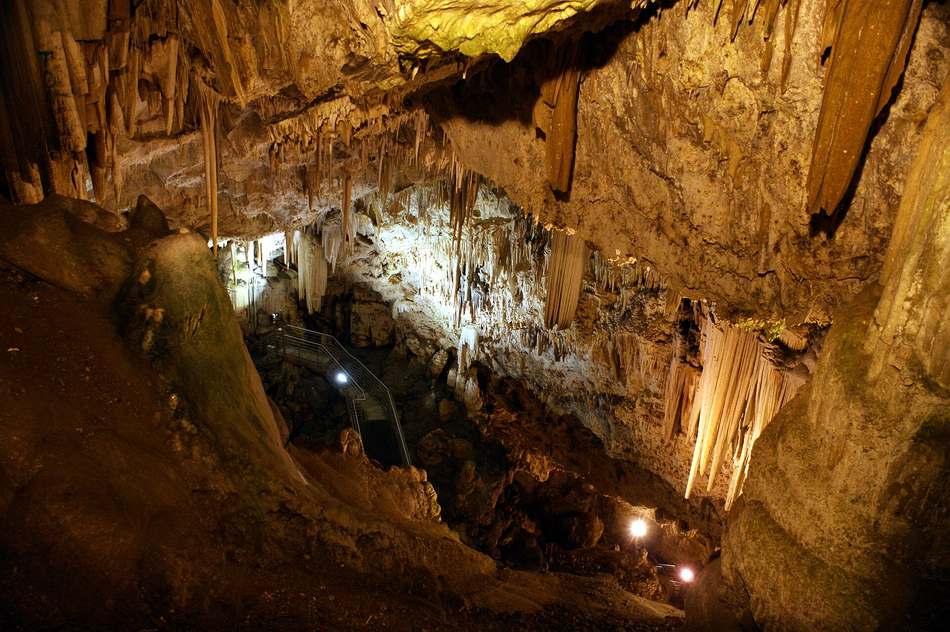
The Cave of Antiparos is the island’s greatest natural wonder and one of the oldest and most famous caves in Greece. It lies deep in the hill of Agios Ioannis, in the south of the island, reached by road and then a long stairway descending steeply into the earth. Inside opens a vast chamber hung with giant stalactites and rising stalagmites, formed over the ages. A small chapel stands at the entrance. Descend into the ancient depths of the Cycladic island with My Greece Tours.
The cave has drawn wonder and visitors since antiquity, its scale and beauty unmatched among the sights of the island. A chapel at its mouth, a steep stairway, a huge decorated chamber and a long history of famous callers all make it unforgettable. The sections below cover what the cave is, its history and famous visitors, the descent and formations, the chapel, and how to visit. Set the cave in context with our Antiparos travel guide.
What is the Cave of Antiparos?
The Cave of Antiparos is a large stalactite cave on the hill of Agios Ioannis in the south. One of the oldest and most famous in Greece, it holds a vast chamber of giant stalactites and stalagmites, reached by a long stairway.
The cave is a great natural cavern hidden within the hill of Agios Ioannis, near the southern tip of the island. It is one of the oldest known and most celebrated caves in Greece, famous for the scale and beauty of its formations. From the entrance high on the hillside, a long, steep stairway of hundreds of steps descends into the earth, leading down into a single vast chamber. There the walls, roof and floor are hung and studded with enormous stalactites and stalagmites, of great size and age, formed drop by drop over an immense span of time. Artificial lighting picks out their strange, dramatic shapes in the darkness, making the descent a memorable, otherworldly experience.
The cave sits in a commanding position, and the climb up to its entrance, and the view over the island and sea from there, are part of the visit. Inside, the air is cool and still, a welcome change from the summer heat above. The great chamber has drawn visitors for centuries, from ancient times to the present, and it remains the island’s single most famous sight. Its combination of natural grandeur, deep age and long human history sets it apart from the caves of other islands. For visitors to the island, descending into this underground wonder is an essential experience, and it pairs well with a day exploring the beaches and the Antiparos town.
The setting of the cave adds to its power. It lies high on the hill of Agios Ioannis, in the quiet south, so reaching the entrance means a climb rewarded by a wide view over the island and the surrounding sea. The little whitewashed chapel at the mouth marks the threshold between the bright world above and the darkness below. Stepping from the heat and light into the cool, still air of the descent is a striking change. This sense of passing into another world, deep beneath a sunlit Cycladic hill, is part of what has made the cave a place of wonder for so long, and it stays with visitors long after the climb back up.
What is the history of the Cave of Antiparos?
The Cave of Antiparos has been known since antiquity and visited across the centuries by travellers, nobles, scholars and even kings, many of whom carved their names on its walls. Ancient inscriptions and later graffiti record its long fame as a natural marvel.
The cave’s fame reaches back to ancient times, and its walls carry the marks of that long history. Ancient Greek inscriptions survive within it, showing that it was known and visited in antiquity, when people sought refuge or left their names in its depths. Over the following centuries the fame of the cave spread, drawing a remarkable succession of visitors: travellers and explorers, nobles and ambassadors, scholars and artists, and even royalty. They carved their names and dates into the rock. These layers of graffiti, from the ancient to the more recent, form a record of the cave’s enduring pull on the curious and the powerful across the ages.
One celebrated episode in the cave’s history was the holding of a Christmas service deep inside the great chamber by a European nobleman and his party, an event long remembered in accounts of the cave. Such stories, together with the carved names of famous callers, gave the cave a romantic reputation among the travellers of past centuries, who counted it among the wonders of the Aegean. This rich human history, layered over the immense natural age of the formations, gives the cave a depth of interest beyond its striking appearance. Learning something of its past adds to the experience of the descent, one of the most rewarding of the things to do in Antiparos.
The great chamber rewards a slow, careful look. The formations take countless forms, from slender hanging spears to massive columns where stalactite and stalagmite have met and joined over an immense span of time. The lighting picks them out against the dark, throwing draperies, curtains and pillars of pale stone into relief. Moving down through the space, the scale becomes clear, far larger than the entrance suggests. Reading the shapes, spotting the oldest and largest formations, and taking in the sheer size of the chamber all repay unhurried attention. This is a place to pause and wonder rather than rush, and the cool air makes lingering a pleasure.
What do you see inside the Cave of Antiparos?
Inside the Cave of Antiparos you see a single vast chamber filled with giant stalactites hanging from the roof and stalagmites rising from the floor, huge and ancient, lit to reveal their dramatic shapes. Old carved inscriptions mark the walls.
Descending the long stairway, you emerge into one enormous underground chamber, the heart of the cave. All around, great stalactites hang from the roof and massive stalagmites rise from the floor, meeting to form columns, built up over an immense span of time by the slow drip of mineral-laden water. A few of the formations are of remarkable size and age, standing among the oldest and largest in such caves. Artificial lighting throws their shapes into relief against the darkness, revealing draperies, curtains and pillars of pale stone in strange and beautiful forms. The sheer scale of the chamber, opening deep beneath the hill, is striking after the long climb down.
Among the natural wonders, the walls also carry the human record of the cave, the carved names, dates and inscriptions left by visitors from ancient times onward. Spotting these among the formations adds interest to the descent, linking the natural marvel to its long history. The cool, still air and the dramatic lighting give the great chamber a solemn, cathedral-like atmosphere. The descent and the return climb are steep and take effort, but the reward is the sight of one of the finest cave chambers in Greece.
It is a complete change of scene from the bright beaches and the sea, and it fits easily into a day that also takes in a swim at the nearby southern Antiparos beaches.
The human record on the walls turns the cave into a kind of visitors’ book of the ages. Ancient Greek inscriptions show it was known in antiquity, and later hands added their names down the centuries, from nobles and ambassadors to scholars and the merely curious. Finding these carved names among the natural formations links the marvel of the rock to the long story of those drawn to see it. The famous Christmas service held deep in the chamber by a European nobleman and his party is only the best-known of the tales attached to the cave. This layering of history over natural grandeur gives the descent a depth beyond the spectacle.
What is the chapel at the cave entrance?
A small whitewashed chapel dedicated to Agios Ioannis, or Saint John, stands at the entrance to the Cave of Antiparos, giving the hill its name. Visitors pass it at the mouth of the cave before descending the stairway into the great chamber below.
At the mouth of the cave, high on the hillside, stands a small whitewashed chapel dedicated to Agios Ioannis, Saint John, from whom the hill takes its name. This simple Cycladic church marks the entrance, a modest human presence at the threshold of the great natural void below. Visitors pass it as they reach the top of the stairway, before beginning the long descent into the earth. The chapel recalls the blend of faith and nature seen at Greek sites, and the long tradition of the cave as a place of pilgrimage and wonder as well as natural marvel. Its white walls against the rock and sky make a striking image at the cave’s entrance.
The setting of the chapel and the cave entrance, high on the southern hill, also offers a fine view over the island and the surrounding sea before you descend into the darkness. The climb up to the entrance from the parking and bus stop below is part of the visit, rewarded by this outlook and by the cool depths beyond. The chapel and the cave together have made the hill of Agios Ioannis a place of note on the island for centuries.
The chapel and its viewpoint make a fitting end to the visit after the descent and climb, before returning down the island toward the town and a boat trip to nearby Despotiko or a swim at a southern beach.
The chapel and the hilltop setting frame the whole experience. Dedicated to Saint John, the little church gives the hill its name and marks the entrance with a quiet human touch. From the open ground around it the view runs far over the island and the sea, a reward for the climb up before the descent into the dark. Pausing here, at the meeting of faith, nature and wide horizons, is a fitting start and end to the visit. The contrast between the sunlit chapel and viewpoint above and the vast shadowed chamber below is one of the things that makes the cave so memorable a place on the island.
How do you visit the Cave of Antiparos?
You reach the Cave of Antiparos on the hill of Agios Ioannis in the south, by car, scooter or the local bus, then climb to the entrance and descend the long stairway. An admission charge applies, and firm shoes help.
Visiting the cave is straightforward, though it takes effort. It lies on the hill of Agios Ioannis, toward the south of the island, reached by the island’s road. You can drive, ride a scooter or take the local bus that runs down the island from the town, which stops near the site in the season. From the parking and bus stop, a path and steps climb up to the cave entrance and its chapel. From there, the long stairway descends steeply into the chamber, so a reasonable level of fitness and firm, non-slip shoes are wise for the steps down and back up. There is a small admission charge to enter the cave.
A visit to the cave takes a couple of hours in all, allowing for the trip out, the climb, the descent and the return. It is best combined with other sights in the south of the island, such as a swim at a nearby beach or a boat trip to the islet offshore, making a full and varied day. The cool interior makes the cave a welcome outing on a hot day. Taking water, sun protection for the climb, and firm shoes will make the visit more comfortable. The island’s greatest natural sight, the cave is worth the effort for any visitor, and reaching the island itself is simple once you have sorted out getting to Antiparos.
A little planning makes the visit smooth and comfortable. The site lies in the south, reached by road, scooter or the local bus, followed by the climb to the entrance, so firm, non-slip shoes are important for the many worn, sometimes damp steps. Carrying water and sun protection helps for the exposed climb, while the interior stays cool whatever the weather. Allowing a couple of hours covers the trip out, the descent and the return without rushing, and pairing the cave with a nearby southern beach or a boat trip fills a varied day. The cool depths make the cave a fine choice for the hottest part of the afternoon.
Frequently Asked Questions
How many steps are there in the Cave of Antiparos?
The Cave of Antiparos is reached by a long and steep stairway that descends hundreds of steps from the entrance high on the hill of Agios Ioannis down into the great underground chamber. The exact number is often given as around four hundred steps, though visitors tend to remember it simply as a long, steep descent. The stairway leads down into the single vast chamber that forms the heart of the cave, past the towering stalactites and stalagmites. Because the descent is steep and the same steps must be climbed on the way back up, a reasonable level of fitness is needed, and the visit is more demanding than a simple stroll.
Firm, non-slip shoes are strongly recommended, as the steps can be worn and a little damp in the cool, humid air of the cave. The effort is well rewarded, however, by the sight of one of the oldest and most impressive cave chambers in Greece. Visitors unsure of their fitness, or with difficulty on stairs, should bear the long descent and climb in mind. For most people the stairway is manageable at a steady pace, with pauses to admire the formations.
Is the Cave of Antiparos worth visiting?
The Cave of Antiparos is very much worth visiting, and it is widely regarded as the island’s single most impressive and important sight. One of the oldest and most famous caves in Greece, it lets you descend into a vast underground chamber of giant stalactites and stalagmites. A few are of remarkable size and great age, dramatically lit to reveal their strange, beautiful forms. Beyond the natural spectacle, the cave has a rich human history. Known since antiquity, it was visited across the centuries by travellers, nobles, scholars and even royalty, who left carved names and inscriptions on its walls.
The small whitewashed chapel of Agios Ioannis at the entrance, and the fine view over the island and sea from the hillside, add to the experience. While the long, steep stairway down and back up requires effort and a reasonable level of fitness, the descent is memorable and the cool interior makes a refreshing change from the summer heat and the beaches. For anyone spending time on the island, and even for day trippers from neighbouring Paros, the cave is an essential and rewarding outing, a genuine natural wonder that sets the island apart.
When is the Cave of Antiparos open?
The Cave of Antiparos is generally open to visitors through the main tourist season, from spring into autumn, when the island is busiest and the local bus runs down to the south. During these months it welcomes visitors through the day, and there is a small admission charge to enter. The exact opening times and season can vary from year to year. The cave may keep shorter hours or close outside the main season, so it is wise to check locally or in advance if you visit at the quieter edges of the year.
Within the open season, it is best to visit earlier in the day to avoid the strongest heat during the climb up to the entrance, though the interior of the cave itself stays cool whatever the weather outside. Allow a couple of hours for the whole visit: the trip out to the hill of Agios Ioannis, the climb to the entrance, the long descent, and the return. This lets you enjoy the cave without rushing. Firm shoes, water and sun protection for the climb all help. Combining the cave with a nearby beach or a boat trip makes for a full and varied day in the south.
Is the Cave of Antiparos suitable for children and older visitors?
The Cave of Antiparos can be enjoyed by children and older visitors, but the long, steep stairway means it requires a reasonable level of fitness and some care, so it is worth considering before setting out. The descent into the great chamber runs down hundreds of steps, often given as around four hundred, and the same steps must be climbed on the way back up, which is demanding, particularly in the humid air of the cave. The steps can also be worn and a little damp, so firm, non-slip shoes are strongly recommended for everyone.
Active older children and teenagers usually manage the descent well and are often thrilled by the dramatic underground chamber and its giant formations, making it a memorable adventure. Younger children can be carried or helped in places, but parents should judge whether the long climb suits them, and keep them close on the stairs. Older visitors who are steady on their feet and comfortable with stairs can take the descent slowly, pausing to rest and admire the formations along the way, and many do so and find it well worth the effort. Those with serious mobility problems, heart or breathing conditions, or difficulty with stairs should think carefully, as there is no easier route into the chamber.
For most reasonably fit people of any age, though, taking the stairway at a steady pace makes the wonder of the cave accessible and rewarding.