
The 8-day Cyclades tour based on Naxos joins guided tours and excursions on Naxos, Paros and Koufonisi with hotel stays, transfers and beach time. Tours across the rest of the country are listed on Greece Tours.
The sections below cover what the 8-day Cyclades tour includes, Naxos Chora, the interior, beaches and food, Parikia, Naoussa and Parian marble, Koufonisi and the Small Cyclades, ferries, season and booking, with links into the Naxos pages. The tours shown are checked on GetYourGuide and Viator.
What is the Naxos 8-day Cyclades tour?
The Naxos 8-day Cyclades tour is a multi-day island holiday sold on GetYourGuide. It lasts 8 days and uses Naxos as its base. The outings of the trip also reach two nearby islands in the same Cyclades group.
The listing title puts Naxos first, which marks it as the home island of the trip. Paros and Koufonisi enter the plan as excursions from that base. The result is one island group seen from one starting point.
The listing opens with one aim: to discover the Cyclades. It packs the stay, the transfers and the island outings into one product. Travellers do not piece the week together from separate bookings. That makes the 8-day Cyclades tour a package holiday rather than a list of tickets.
The tour is a new activity on GetYourGuide. It has no reviews yet, so there is no star rating to read. The first travellers who book it will set that rating. Until then, the listing content is the main source: the islands, the inclusions and the practical features.
Readers who want shorter trips can compare day options on our Cyclades tours page. That page collects island tours from across the group. This Naxos package differs from a single outing because it spans the whole holiday.
The word Cyclades in the title names the region, not a full sweep of it. Travellers after more islands in one trip can compare the other 8-day tours further down. Those tours start elsewhere or follow other routes.
What does the 8-day Cyclades tour listing include?
The 8-day Cyclades tour listing includes a hotel stay and transfers as its core services. It adds guided tours and excursions on Naxos, Paros and Koufonisi. The listing also sets aside leisure time to relax on the beach.
The hotel stay and the transfers form the frame of the trip. The stay gives travellers a room for the holiday, booked through the same listing. The transfers cover the rides the operator arranges. Together they remove two planning jobs from the traveller’s list before the island days begin.
On the 8-day Cyclades tour, the guided tours and excursions fill the active days. They reach all three islands named in the listing. The beach time sits on the other side of the plan. It gives travellers hours with no fixed programme alongside the organised visits.
The listing also shows three practical features. Each one answers a common question before travellers reserve a place:
- Small group
- Pickup available
- Free cancellation
A small group means a smaller party on each outing than a large coach tour. Pickup is available, so travellers can be collected instead of finding a meeting point. Free cancellation lets travellers cancel inside the window shown on the listing. For an eight-day package, that last point lowers the risk of reserving early.
The listing summary does not name the hotel or set out meals. It also gives no day-by-day order for the islands. Read the full GetYourGuide page for those points before you commit. This section sticks to what the summary and the feature list state.
Which islands does the 8-day Cyclades tour cover?
The 8-day Cyclades tour covers three islands: Naxos, Paros and Koufonisi. Naxos is the base, and the other two are its neighbours. Together they form one island group inside the Cyclades, so the plan stays local.
With 20,578 residents, Naxos is the largest of the three islands by population. Of those, 8,897 live in its capital, Chora, also called Naxos town. That is 43 percent of the island’s people. The other 11,681 residents live outside the capital. This makes Naxos the anchor of the 8-day Cyclades tour in population as well as in role.
Paros sits 8 km west of Naxos, across a narrow channel. On a map, the two islands face each other. That short gap explains why Paros fits a plan based on Naxos. The listing names it second, after the base island.
Koufonisi, also called Ano Koufonisi, lies south-south-east of Naxos. It belongs to the Small Cyclades. Among those islands, it has the largest population. The listing names it as the third island of the plan, after Naxos and Paros.
Each island gets its own section further down this page. Those sections cover the sights and details of each island. This section sets out only where the three islands sit. It also shows how Paros and Koufonisi relate to the Naxos base.
How does the 8-day Cyclades tour compare with other 8-day Greece tours?
The 8-day Cyclades tour stays in one island group with a Naxos base. Other 8-day tours on GetYourGuide start in Athens or Paros, or they stay on the mainland. The difference comes down to which islands each one covers.
Four other 8-day tours on GetYourGuide show the contrast. All five share the same length, so the islands and the start point set them apart:
- Paros: 8-Day Island Hopping Tour with Hotel & Breakfast
- Athens: 8-Day Greece Tour with Santorini & Mykonos
- Greece: 8-Day Archaeology Holiday with Cycling & Hiking
- 8-Day Highlights Tour: Athens, Delphi, Meteora & Santorini
The Paros island hopping tour is the closest match. It shares Naxos and Paros with the Naxos package. It also adds Mykonos and Sifnos, and it starts from Paros. The 8-day Cyclades tour swaps those two islands for Koufonisi. Both titles name a hotel, but only the Paros title names breakfast.
The Athens tour takes a wider route. It joins Athens with Santorini and Mykonos. Its Athens start adds a leg away from the islands. Travellers who want that mix can read our 8-day Greece tour with Santorini and Mykonos page. The Naxos package lists none of those three places.
The archaeology holiday stays on the mainland. It mixes cycling and hiking with Tegea, the Lousios Gorge and ancient sites. Our 8-day archaeology activity holiday page covers that trip. Its route lists no islands, unlike the Naxos package. The Naxos plan pairs its outings with beach time instead.
The highlights tour starts in Athens and adds Delphi, Meteora and Santorini. Its route puts three mainland stops beside one island, Santorini. It shares no stop with the Naxos listing. Of the five tours here, only the Naxos package uses Naxos as its base and reaches Koufonisi.
What do you see in Naxos Chora on the 8-day Cyclades tour?
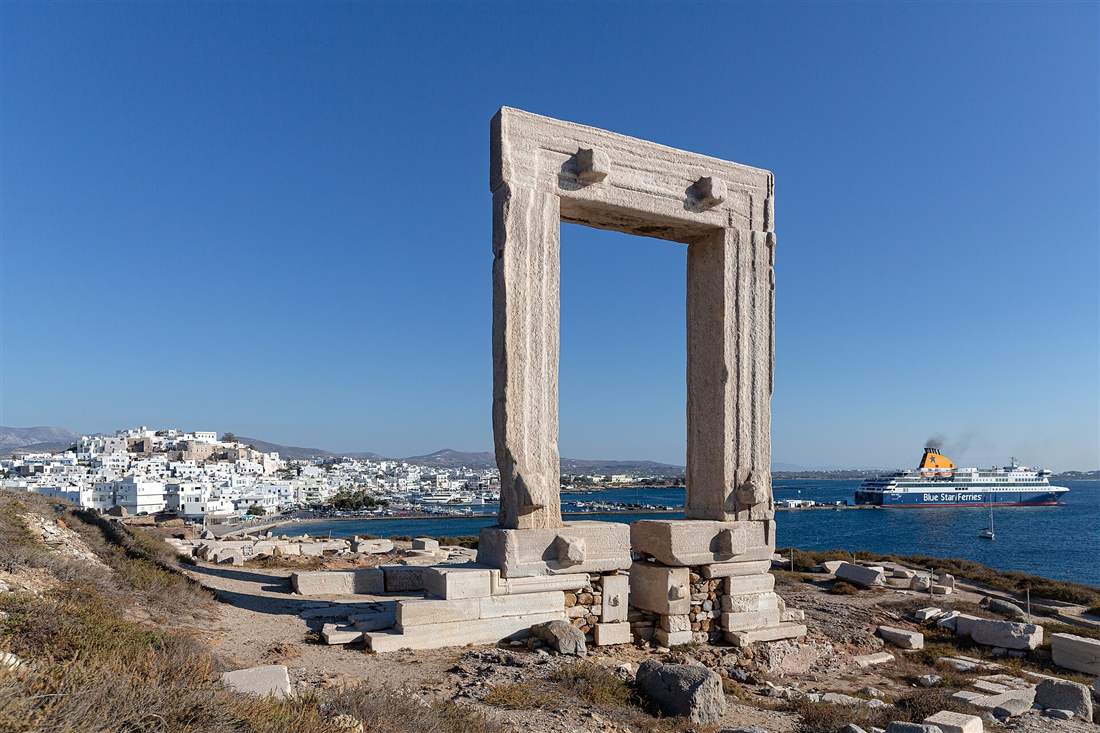
On the 8-day Cyclades tour, Chora shows you the Portara. This marble door frame belongs to an unfinished Temple of Apollo. It stands on Palatia islet, at the northern end of the harbour. Chora is the island capital, home to 8,897 of 20,578 islanders.
The name of the Portara of Naxos means “large door”. A sanctuary of Apollo stood on this islet from at least the 8th century BC. Later, the tyrant Lygdamis began a temple to the god in the 6th century BC. So Apollo was worshipped on the islet before Lygdamis started building.
Work on the temple stopped when the Sparta-led Peloponnesian League removed Lygdamis from power. The building therefore stayed unfinished. The planned temple was more than twice as long as it was wide. These details describe the temple and its marble door frame:
- An Ionic temple, 38 m long and 16 m wide
- A front that faced the sacred island of Delos
- A door frame of five marble pieces, originally four
- Pieces that weigh up to 20 tonnes each
A causeway built in the early 20th century links the islet to the town. Anyone on the 8-day Cyclades tour can walk across it from the harbour front.
More than two thousand years separate the temple work from this causeway. Chora’s harbour thus holds three layers of time: an early sanctuary, an unfinished temple and a 20th-century causeway.
Chora also goes by the name Naxos town. After the Fourth Crusade, the Venetian Marco Sanudo conquered Naxos in the early 13th century. He took other Cyclades islands as well. Before he arrived, Genoese pirates held the castle on Naxos. The island is also a source of emery, a hard rock used as an abrasive.
What lies in the mountain villages of Naxos?
Anyone on the 8-day Cyclades tour who heads inland can reach Filoti and Apeiranthos. Filoti sits at the foot of Mount Zas, which is the highest peak in the Cyclades. Apeiranthos lies higher still, on Mount Fanari, and holds four museums of its own.
For anyone on the 8-day Cyclades tour, Filoti lies about 18 km from Chora. It is a semi-mountain village of 1,617 people at 400 m. The village has three settlements: Rachidi, Klefaros and Lioiri. Its church of Panagia Filotitissa is an 18th-century basilica, built on the site of a Byzantine church.
Apeiranthos, also called Aperathos, lies 28 km north-east of Chora. That puts it 10 km farther out than Filoti. The village stands at 650-700 m, and its museums cover archaeology, folk art, geology and natural history. Its 722 people number less than half the population of Filoti.
The dialect and customs of Apeiranthos resemble those of Cretan mountain villages. For that reason, historians think Cretans built the village in the 10th century. On that view, the village is more than a thousand years old. More highland settlements appear on our Naxos villages page.
Mount Zas rises 1,001 m and takes its name from Zeus. It is also the highest point on Naxos. Myth says young Zeus grew up in a cave on the mountain. Hikers on the 8-day Cyclades tour can pick from these two routes to the summit:
- The easier route starts at the Agia Marina chapel.
- The harder route starts at the Aria Spring and passes the Zeus cave.
The Zeus cave lies about 628 m up the western slope. It held Neolithic stone objects from Melos, a copper dagger and gold sheet. These finds show that people visited the cave in prehistoric times. So the cave links myth and archaeology in one place.
How is Naxos tied to the myth of Ariadne and Dionysus?
Naxos, home of the 8-day Cyclades tour, is the island where myth says Theseus left Ariadne. Dionysus, protector of the island, met her there and fell in love with her. The Palatia islet of the Portara is thought to be the exact spot.
Ariadne earned her place in the myth before she reached Naxos. She had helped Theseus kill the Minotaur. Even so, the hero went on without her. Her story on the island does not end with that loss, because a god steps in.
For travellers on the 8-day Cyclades tour, the myth gives the Portara a second meaning. The marble door marks a temple site and a scene from the story of Ariadne. On one islet, the Temple of Apollo and the tale of Dionysus sit side by side.
The island was once called “Dia”. So the myth of Ariadne belongs to a place with two names, Dia and Naxos.
The story inspired Richard Strauss’s opera “Ariadne auf Naxos”. Its title means “Ariadne on Naxos”. Through it, the name of the island reached the opera stage.
Our Naxos mythology page covers more island myths for readers planning the 8-day Cyclades tour.
What food and drink come from Naxos?
Travellers on the 8-day Cyclades tour can taste two Naxos products: kitron and graviera. Kitron is a citron liqueur, drunk as a digestif at the end of a meal. Graviera is a hard cheese, and only feta is eaten more in Greece.
Kitron is made on Naxos from the fruit and leaves of the citron tree. The first distillery opened in the 19th century in the village of Halki. So the drink has been distilled on the island for more than a century.
The liqueur comes in three colours, each with its own strength. Green kitron is the sweetest, at 30% alcohol. Clear kitron sits in the middle, at 33%. Yellow kitron is the strongest, at 36%.
The gap between green and yellow kitron is 6 points of alcohol. For a guest on the 8-day Cyclades tour, the colour signals the strength before the first sip. Pick green for a sweeter glass or yellow for a stronger one.
Naxos makes one of the main graviera varieties. The other main ones come from Crete, Lesbos and Amfilochia. Visitors on the 8-day Cyclades tour can try the island’s own version.
Makers shape graviera in wheels. The criss-cross pattern on the rind comes from the cloth used to drain the cheese. So the rind shows how the cheese was made. Our Naxos food and wine page covers more of what the island eats and drinks.
What do you see in Parikia on the 8-day Cyclades tour?
Parikia, on the 8-day Cyclades tour, is the capital and main port of Paros. Its streets hold narrow cobbled paths, old churches, small shops and blue-and-white houses. The town is also home to the Byzantine church complex of Panagia Ekatontapiliani.
On the 8-day Cyclades tour map, Paros lies 8 km west of Naxos across a narrow channel. It sits about 150 km south-east of Piraeus. Parikia stands on the west side of the island, with 4,500 permanent residents. In ancient times, this port made Paros a naval power.
Panagia Ekatontapiliani is a complex, not a single building. A main church leads the group, joined by two more chapels. A baptistery, the room used for baptisms, completes the set. Its font is shaped like a cross.
The name Ekatontapiliani means “church with 100 doors.” Legend counts 99 known doors and one hidden door. So the full 100 rests on a story, not on a count of visible doors. Another theory traces the name to “Katapoliani,” the church of the lower town. The church stands by the sea, which fits that reading.
Tradition says Saint Helen founded the church. She was the mother of Emperor Constantine the Great. Justinian is credited with building on the site. An earthquake damaged the complex in the 18th century. It was later restored. So the site holds layers of history, from its founding story to its repair.
Panagia is a Greek title for the Virgin Mary, so Ekatontapiliani is a Marian church. It ranks as the second Marian pilgrimage church of the Aegean. Only the church on Tinos stands above it. That rank makes Parikia a pilgrimage town as well as a port.
What is Naoussa on Paros like?
Naoussa is a fishing village in the north-east corner of Paros, with 3,134 people. Its harbour carries Venetian roots and a naval past. Those two threads frame the village for readers who plan the 8-day Cyclades tour.
The 8-day Cyclades tour includes Paros, an island 21 km long and 16 km wide. Naoussa and Parikia lie on different coasts of that compact island. Each town grew around its own port. Naoussa is the smaller of the two by population.
Venetians, from the Republic of Venice, founded Naoussa around the late 14th century. They built a fortress to guard the port. Part of it still stands. The surviving walls link the modern fishing village to its Venetian founders. Their choice shows that the port was worth defending from the start.
In the late 18th century, a Russo-Turkish war spread into the Aegean. The Russian Empire fought the Ottoman Empire in that conflict. Naoussa Bay became the base of a Russian fleet. Count Alexey Orlov commanded that fleet.
The fleet arrived about four centuries after the Venetians founded the village. So one bay holds two chapters of outside history, Venetian and Russian. Both powers valued the same thing: the port itself.
Kolymbithres beach lies near the village. Naoussa therefore gives the north-east of Paros three draws: a fishing port, a fortress and a beach.
Which Paros beaches and coasts stand out on the 8-day Cyclades tour?
For the 8-day Cyclades tour, Paros coasts fall into three types. There are named beaches, a windy strait shared with Naxos, and a narrow channel to Antiparos. Each type serves a different purpose, from swimming to windsurfing to crossing.
The list below names seven Paros beaches to know for the 8-day Cyclades tour. Two of them, Parikia and Naoussa Bay, belong to the towns covered above. Golden Beach lies near Drios on the east coast, the side of Paros that looks toward Naxos. Its Greek name is Chrissi Akti, meaning “golden shore.”
- Golden Beach
- Pounda
- Logaras
- Piso Livadi
- Naoussa Bay
- Parikia
- Agia Irini
A strong, steady wind blows through the strait between Paros and Naxos, both on the 8-day Cyclades tour. That wind turns the strait into a windsurfing spot. Constant wind matters to windsurfers, since it keeps the sail full and the board moving.
Antiparos lies west of Paros. At its narrowest, the channel between the two islands is less than 2 km wide. That gap is under a quarter of the distance from Paros to Naxos. So the two islands sit close together, split by a thin strip of sea.
A car-carrying shuttle ferry runs all day from Pounda, 5 km south of Parikia. Pounda also appears in the beach list above. Because the boat carries cars, travellers can bring a vehicle across. An Antiparos day trip from Paros starts with that short shuttle ride.
What made Parian marble so prized?
Parian marble is fine-grained, semi-translucent and pure white. Those three traits suited carved statues as well as marble buildings. The 8-day Cyclades tour links to this story, since the island of Paros gave the stone its name.
Paros itself is made of marble, with gneiss and mica-schist in places. So the 8-day Cyclades tour reaches an island built of the stone it once exported. Ancient workers cut it from open pits at Chorodaki, Marathi and Agios Minas. They also used shaft quarries that follow the marble underground.
The three traits explain the demand. Fine-grained means the crystals are small, so a chisel leaves smooth detail. Semi-translucent means light enters the surface a short way before it scatters. Pure white means no tint competes with the sculpted shape. Together, they let a carved face or fold of cloth read clearly.
One type of Parian marble carried its own name, lychnites. Ancient sculptors prized that type. The list below shows works carved from Parian stone, plus one building made of it.
- The Venus de Milo
- The Winged Victory of Samothrace
- The Medici Venus
- The Athenian Treasury at Delphi, built entirely of Parian marble
Parian marble’s ancient rival was Pentelic marble from Attica. Pentelic marble is white with a faint golden tint. That tint sets the two stones apart at a glance. The Parian stone, by contrast, shows no tint at all.
The word “Parian” came to mean marble or porcelain of similar quality. “Parian ware” is an unglazed porcelain first made in England in the 19th century. The porcelain took the name because its quality matched the marble’s. Through it, a place name from the 8-day Cyclades tour entered the English language.
What does Koufonisi add to the 8-day Cyclades tour?
Koufonisi adds a stop in the Small Cyclades to the 8-day Cyclades tour. The tour listing names it among the islands explored on tours and excursions. The same listing sets aside leisure time on the beach there.
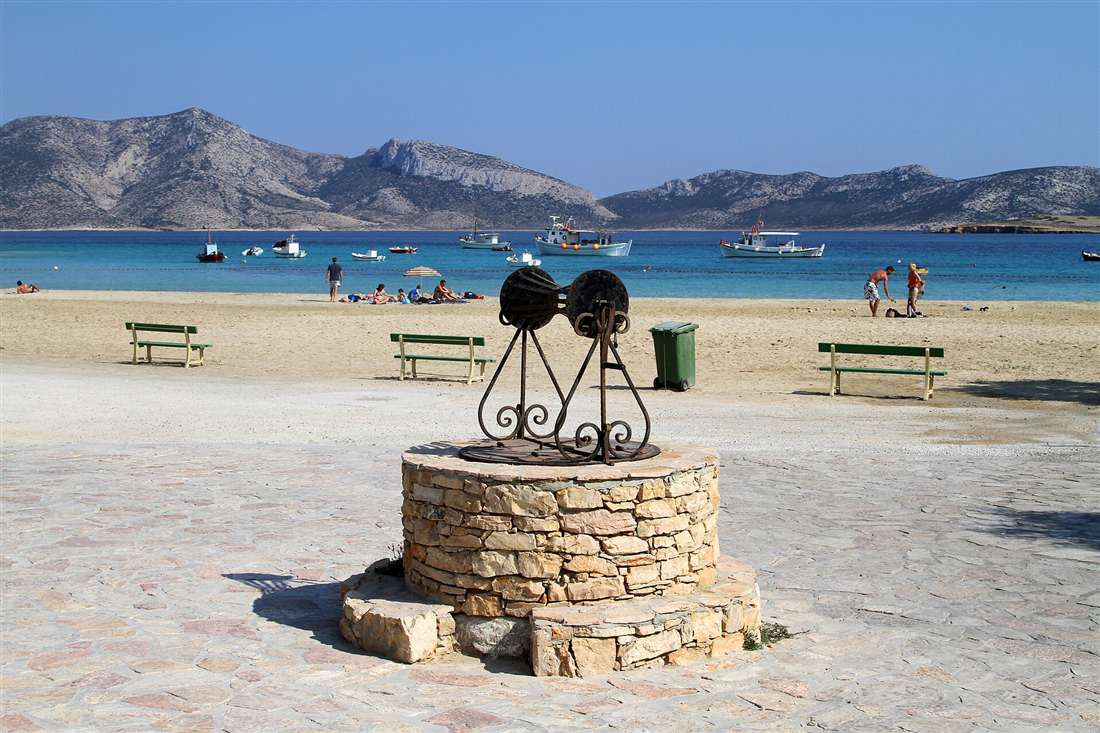
Koufonisi is part of the Koufonisia, a small island group. The group lies south-south-east of Naxos. It also sits west-north-west of Amorgos. On a map, the Koufonisia lie in the stretch of sea between those two islands. Seen from Naxos, Amorgos lies on the far side of the group.
Since a local government reform, the Koufonisia belong to the Municipality of Naxos and Lesser Cyclades. Within that municipality, the group forms one unit of 26 square km. This means the Naxos and Koufonisi stops of the 8-day Cyclades tour fall inside one municipality. The islands share local government with Naxos, not with Amorgos.
The group includes Ano Koufonisi and Kato Koufonisi. In Greek, Ano means Upper and Kato means Lower. People call the upper island simply Koufonisi. It has the largest population in the Small Cyclades, with 399 people at a census.
The name Koufonisia, with its plural ending, covers the whole group. Both Ano and Kato Koufonisi count among the main islands of the Small Cyclades. The 8-day Cyclades tour listing uses the singular name, Koufonisi, for its island stop.
Two ideas explain the name. The first ties it to “Koufos Limin”, a sheltered port where ships anchor. A sheltered port is a harbour where the land blocks wind and waves. The second idea ties the name to the caves and hollows on the island. Both ideas link the name to the island’s coast and rock.
Koufonisia has been lived on since prehistoric times. Prehistoric means the time before written records. Digs at Epano Mili found remains from the first years of Cycladic civilisation. This gives the Koufonisi stop on the 8-day Cyclades tour a link to early Cycladic history.
Which other Small Cyclades sit near Naxos?
Irakleia, Schoinoussa, Donousa and Keros are the other main Small Cyclades near Naxos. Irakleia is the largest island of the group, at 18 square km. The 8-day Cyclades tour explores Koufonisi, and these four islands belong to the same group.
The Small Cyclades, also called the Lesser Cyclades, are a set of 32 islands and rocks. Only four of them are inhabited: Ano Koufonisi, Irakleia, Donousa and Schoinoussa. A rock, in this count, is a small outcrop of stone in the sea.
Three of the four neighbours compare as follows:
- Schoinoussa: 8.5 square km of land, home to 229 people
- Donousa: 13.75 square km of land, home to 213 people
- Keros: 15 square km of land, with no residents
Schoinoussa lies between Irakleia and the Koufonisia. It has three settlements: Chora, Mesaria and the port of Mersini. The island holds the ruins of a Byzantine church and of a small medieval castle. From the 11th century, Schoinoussa belonged to the Hozoviotissa Monastery on Amorgos.
Donousa lies furthest east in the group. It covers more land than Schoinoussa but has a smaller population. Myth says Dionysus hid Ariadne on Donousa to keep her from Theseus. In Roman times, exiles were sent to the island. So Donousa served as a place of punishment under Rome.
Keros was a major site of Cycladic culture. The Early Cycladic II “Keros-Syros culture” takes its name from this island. Early Cycladic II is the second phase of the Early Cycladic period. Guests on the 8-day Cyclades tour who visit Koufonisi stay within the same island group as Keros.
The “Keros Hoard” is a large deposit of broken Cycladic marble figurines. A figurine is a small carved figure. Excavations at Kavos, on the west coast of Keros, found figurines and vessels. These objects were broken elsewhere and then brought to the site. A Cycladic settlement also came to light on Daskalio, a nearby islet.
Height also differs across the group. Keros rises to 432 m, while Donousa tops out at 385 m. This 8-day Cyclades tour page covers Koufonisi in depth. The Small Cyclades from Naxos page covers trips from Naxos to the other islands of the group.


How do the islands of the 8-day Cyclades tour connect by sea?
The islands of the 8-day Cyclades tour connect across open stretches of sea. Paros lies 8 km west of Naxos, across a narrow channel. The Small Cyclades lie south-east of Naxos. The tour listing includes transfers.
The sea inside the Small Cyclades has not always been there. In the last ice age, the group formed one landmass. A landmass is one unbroken area of land. The rising sea later split that land into separate islands. So the water around Koufonisi on the 8-day Cyclades tour covers land that once joined these islands.
The strait between Paros and Naxos has a strong, steady wind. A strait is a narrow sea passage between two areas of land. Steady means the wind keeps blowing rather than coming in short gusts. Anyone crossing the strait meets that wind on open water. Details for the crossing sit on the Naxos to Paros ferry page.
Naxos is the first place named in the tour title. Its harbour sits at Chora. The Portara islet stands at the northern end of that harbour. An islet is a small island, and this one marks the harbour’s north side.
On Paros, the main port is Parikia. A second crossing point sits at Pounda. From there, a car-carrying shuttle ferry links Paros with Antiparos all day. A shuttle ferry runs back and forth on one fixed route. This one takes cars on board, so drivers can bring a vehicle across.
The list below gives distances for Keros and Donousa. Each figure shows how close the Small Cyclades sit to Naxos and Amorgos.
- Keros: about 10 km south-east of Naxos
- Donousa: 16 km east of Naxos
- Amorgos: about 25 km south of Donousa
Keros sits closer to Naxos than Donousa does, by about 6 km. Donousa, in turn, lies closer to Naxos than to Amorgos. Paros sits closer to Naxos than either island.
For the crossing to the Koufonisia, see the Naxos to Koufonisia ferry page. The ferry page sits apart from this 8-day Cyclades tour page, which covers the islands themselves.
Which season suits the 8-day Cyclades tour?
Spring and autumn suit the 8-day Cyclades tour for travellers who want milder days. Summer brings the hottest days and the meltemi wind. Choose summer for beach heat, and choose spring or autumn for gentler weather on excursion days.
On a summer 8-day Cyclades tour, the meltemi shapes each day. This strong, dry north wind of the Aegean blows from about late spring to the middle of September. It is strongest in the afternoon and tends to drop at night. In clear weather, it can reach force 7 to 8 on the Beaufort scale. Plan swims and beach time for the morning, when the wind is lighter.
The strait between Paros and Naxos has a strong, steady wind that suits windsurfing. Windsurfers get reliable conditions there in the meltemi months. Afternoon crossings take the full force of that wind. Windsurfing is not part of the tour summary, so plan it during free beach time.
The Small Cyclades have a hot semi-arid climate, with mild winters and hot summers. Donousa, one island in the group, averages about 19 °C across the year. It gets about 260 mm of rain a year, so dry days are the rule. Outdoor plans on the tour hold up well in that climate.
Summer fits a beach-first 8-day Cyclades tour, with heat for swims and sunbathing. Expect strong sun at midday, so plan shade breaks. In spring and autumn, milder days make long walks and site visits easier. Early spring and late autumn also fall outside the main meltemi stretch. Those shoulder weeks spare you the peak midday heat of summer.
Check the Naxos weather page and the Paros weather by month page before you pick your dates. Both pages cover islands that the tour visits over the eight days. For summer, pack a hat, sun cream and a windproof layer. For spring and autumn, add a light sweater and closed walking shoes.
How do you book and cancel the 8-day Cyclades tour?
Book the 8-day Cyclades tour online through its GetYourGuide listing, and the confirmation arrives by email. Free cancellation runs up to 24 hours before the start on listings that show it. Read the terms on the listing before you pay.
The whole booking runs on the GetYourGuide listing page, from date choice to payment. No phone call or office visit is needed. Have your travel dates and party size ready before you start. Then follow these steps in order:
- Open the GetYourGuide listing for the tour on your phone or laptop.
- Choose your start date in the booking calendar.
- Set the number of travellers in your party.
- Check the pickup details and the inclusions.
- Read the terms, including the free cancellation window.
- Pay online to complete the booking.
After payment, look for the confirmation email, and check the spam folder if it does not show. Check that the date and traveller count match your choices. Save it on your phone for the pickup, and forward it to the others in your party. Keep the booking reference number close at hand.
The 8-day Cyclades tour carries free cancellation on its listing. On GetYourGuide, that window closes 24 hours before the start time. Count back one full day from the start to find your deadline. After that point, the free option no longer applies. Set a phone reminder two days before that deadline.
Pickup is available on this tour, so note the pickup details on the listing. Match them to your own arrival plans before you pay. Copy them into your phone calendar. Then read the full terms on the same page. Take a screenshot of them for your records. A clear record helps if a detail changes later.
Frequently Asked Questions
How long is the 8-day Cyclades tour?
The 8-day Cyclades tour runs for eight days in total. The summary sets out the plan: explore Naxos, Paros and Koufonisi on tours and excursions. Leisure time on the beach is part of the schedule too. Eight days leaves room for both set outings and free hours. Check the full plan on the listing before you commit to a start date.
Does the 8-day Cyclades tour include a hotel?
Yes. The 8-day Cyclades tour includes a hotel stay, named in both the listing title and the summary. Transfers are part of the package as well. Read the full listing page to see which transfers it covers. Look there for the hotel name and the room type too. Send any open question to GetYourGuide before you book, so nothing surprises you on arrival.
Is the 8-day Cyclades tour a small-group tour?
Yes. GetYourGuide lists the activity as a small group. The summary does not give a head count, so check the full listing for the group limit. A small group shares each excursion with a limited number of other travellers. That setup suits solo travellers, couples and friends who want a quieter pace on the islands. Book your date early, as a small group has a set number of places.
Which is the highest mountain of the Cyclades?
Mount Zas on Naxos is the highest mountain of the Cyclades. Its peak rises 1,001 m, just over one kilometre above sea level. No other island in the group reaches that height. The tour summary does not name a climb up Zas. Check the full listing if a mountain walk matters to you. Milder spring and autumn days suit a climb more than summer heat.
How far is Paros from Naxos?
Paros lies 8 km west of Naxos, across a narrow channel. That gap is about five miles of open water. The short distance lets one trip cover both islands with little travel time between them. Check the listing to see how the tour links the two islands.
Does the tour have reviews yet?
No. GetYourGuide marks the tour as a new activity, and it has no reviews yet. For now, the listing page is the main source of detail. Read its summary and inclusions line by line. Reviews from past guests appear on the same page once travellers post them. Check back closer to your date to read the first reports. Your own review after the trip helps the next travellers choose.