
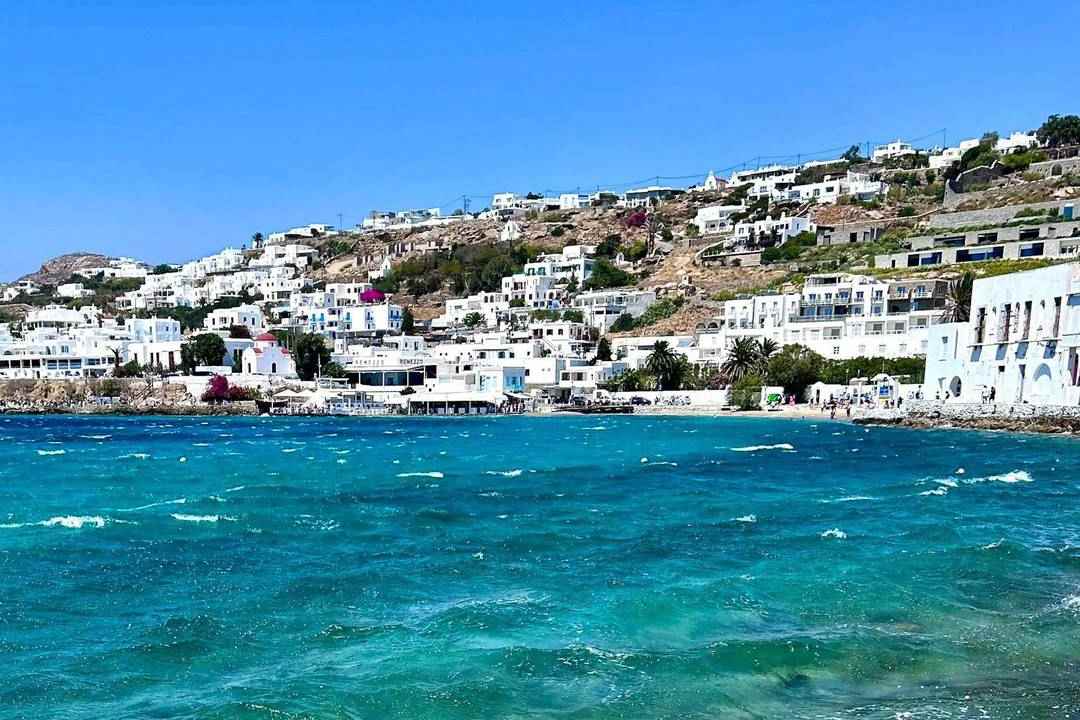
The 8-day Greece tour from Athens joins the capital with Mykonos and Santorini, two islands of the Cyclades, in one booking. Tours across the rest of the country are listed on Greece Tours.
The sections below cover what the 8-day Greece tour listing includes, Athens, Mykonos town, Delos, the ports and airports, the Santorini villages, hot springs, beaches, Ancient Thera, wine, packing and booking, with links into the Mykonos pages. The tours shown are checked on GetYourGuide and Viator.
What is the 8-day Greece tour with Santorini and Mykonos?
This GetYourGuide product is called Athens: 8-Day Greece Tour with Santorini & Mykonos. It runs for eight days and begins in Athens. The 8-day Greece tour covers the Greek capital and two Cycladic islands in one booking.
The listing text invites travellers to discover the beauty and history of Greece on an 8-day tour from Athens. It names three places to visit during the trip. Each place adds a different kind of experience to the route.
Athens is the capital of Greece. Mykonos is an island of the Cyclades. Santorini is the southernmost island of the Cyclades. Both islands belong to the Cyclades island group in the Aegean Sea.
The listing says travellers visit the Acropolis in Athens. It also mentions Santorini’s hot springs and the nightlife and beaches of Mykonos. Those details show how the days are split between culture and island time.
One booking covers the capital and two islands together. That saves the work of planning separate trips for each place. The 8-day Greece tour keeps the whole route under a single reservation.
The 8-day Greece tour mixes a capital city with two islands. Athens brings ancient sites and museums. Mykonos and Santorini bring beaches, villages and volcanic scenery.
What does the 8-day Greece tour listing include?
The listing states clear features for travellers to check before booking. It offers private group and small group formats, pickup is available, and free cancellation is included. Bookings must be made at least 10 hours in advance.
The activity is marked as new, with no reviews yet. That means past traveller feedback is not available on the page. Reading the full listing text helps set expectations for the 8-day Greece tour.
Private group and small group options suggest different travel styles. Pickup available removes the need to reach a start point alone. Free cancellation gives room to change plans if dates shift.
The 10-hour advance rule matters for late decisions. A booking made too close to departure will not go through. Planning a little ahead keeps the process simple.
Since the activity is new, the page holds no traveller reviews yet. That makes the listing text the main source of detail. Travellers can read it closely before deciding.
The listing text promises visits to the Acropolis, Santorini’s hot springs, and the nightlife and beaches of Mykonos. Those are the highlights named on the page. They show what the days are built around.
Checking these features before booking avoids surprises later. Travellers know how the group is sized and how pickup works. The 8-day Greece tour then starts with clear expectations.
Free cancellation is worth noting when dates are not fixed. It gives travellers a way out if plans change. Pickup available also saves time on the first morning.
- Private group format
- Small group format
- Pickup available
- Free cancellation
- Must be booked at least 10 hours in advance
- Marked as a new activity with no reviews yet
Which other multi-day tours link Athens, Mykonos and Santorini?
GetYourGuide lists From Athens: Santorini & Mykonos 7-Day Island-Hopping Tour, a private tour to Mykonos and Santorini lasting seven days. The 7-day tour is one day shorter than the main option.
Another GetYourGuide product is 8-Day Highlights Tour: Athens, Delphi, Meteora & Santorini. It lasts eight days and adds Delphi and Meteora to the route. It has no Mykonos stop, so it swaps Mykonos for Delphi and Meteora.
Travellers can read more in the 8-day highlights tour with Delphi and Meteora page. That option suits travellers who want mainland sites alongside Santorini.
Shorter GetYourGuide trips also start from Athens. From Athens: 2-Day Santorini & Mykonos Island-Hopping Trip lasts two days. From Athens: 2-Day Trip to Santorini with Accommodation also lasts two days.
Viator lists four more options, all departing from Athens. These are 2 Day Mykonos Experience, 3 Day Mykonos Experience, 2 Day Santorini Island Hopping, and 3 Day Santorini Adventure. The 2-day and 3-day trips suit travellers with less time.
Comparing length and stops makes the choice clearer. Longer tours cover more places in one reservation. Shorter ones fit tight schedules and leave the rest of the trip open.
The 7-day island-hopping option is a private tour to Mykonos and Santorini. It covers the two islands without the capital leg. Travellers wanting city time can look at the 8-day Greece tour instead.
Island-hopping between the two Cyclades islands is also covered on our Mykonos island hopping page. That page explains the island route in more detail.
Choosing between these options comes down to time and stops. Travellers with less time can pick the 2-day or 3-day trips. Those with a full week can compare the longer routes.
- From Athens: Santorini & Mykonos 7-Day Island-Hopping Tour — 7 days
- 8-Day Highlights Tour: Athens, Delphi, Meteora & Santorini — 8 days
- From Athens: 2-Day Santorini & Mykonos Island-Hopping Trip — 2 days
- From Athens: 2-Day Trip to Santorini with Accommodation — 2 days
- 2 Day Mykonos Experience — 2 days
- 3 Day Mykonos Experience — 3 days
- 2 Day Santorini Island Hopping — 2 days
- 3 Day Santorini Adventure — 3 days


What do you see in Athens on the 8-day Greece tour?
The 8-day Greece tour names a visit to the Acropolis in Athens. Around it sit Plaka, the Ancient Agora, and central squares. These places sit close together, so walking links them without long transfers.
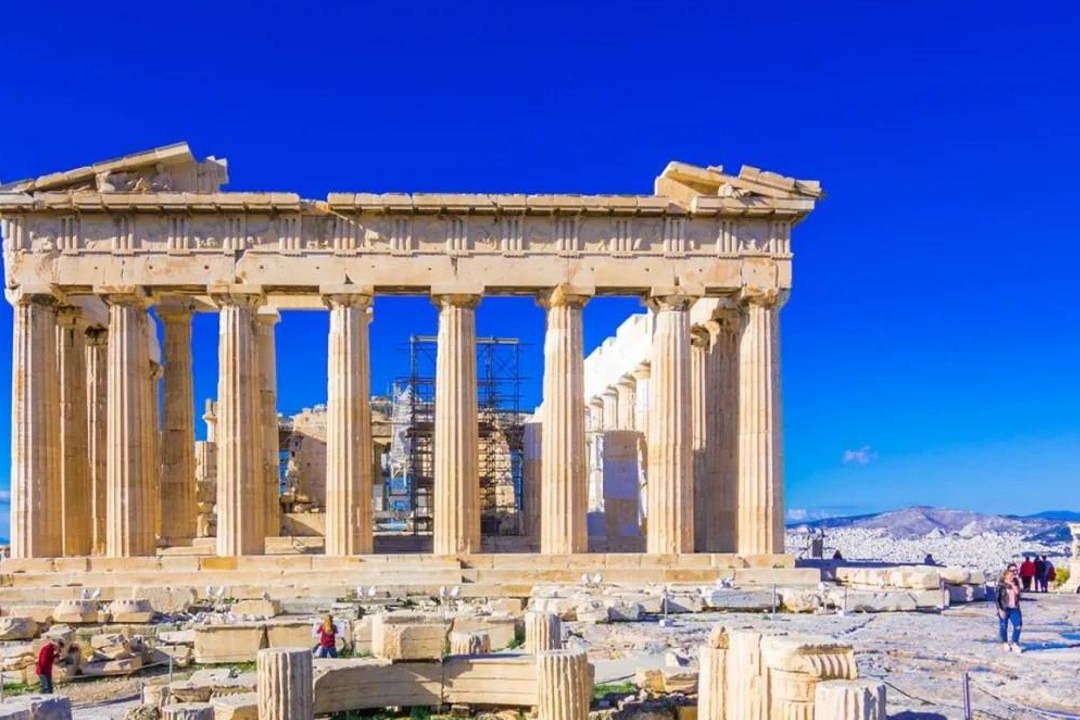
Plaka climbs the northern and eastern slopes of the Acropolis. Its maze-like streets hold neoclassical houses. People call it the Neighbourhood of the Gods. It is the oldest district of Athens, lived in from the Neolithic age to today.
Adrianou Street is the largest street in Plaka. Adrianou and Tripodon streets trace back to ancient times. Plaka lies between Syntagma and Monastiraki squares. Read more about Plaka in Athens before walking its lanes.
North-west of the Acropolis stands the Ancient Agora. The Areopagus hill bounds it to the south. Market Hill, called Agoraios Kolonos, bounds it to the west. The Bema was a speakers’ platform near the Stoa of Attalos.
The Stoa of Attalos was lined with shops in the 2nd century BC. It was rebuilt and now holds the Museum of the Ancient Agora. The Stoa Poikile, or Painted Stoa, dates from the 5th century BC.
The 8-day Greece tour keeps these places within one walking area. Start at the Acropolis, then drop into Plaka for its lanes. Continue north-west to the Agora and its stoas. Each step follows the shape of the ancient city.
Plaka splits into two levels along Adrianou Street. Ano Plaka sits right under the Acropolis. Kato Plaka lies lower down, between Syntagma and Monastiraki. On the 8-day Greece tour, the upper lanes give the closest views of the hill.
The Agora held more than shops. The Square Peristyle served as a law court under the north end of the Stoa of Attalos. The Library of Pantainos later framed the official entrance. An East Stoa, a Nymphaeum and a temple stood in the south-east corner.
- Acropolis, named in the tour listing
- Plaka, on the Acropolis slopes
- Adrianou Street, Plaka’s largest street
- Tripodon Street, traced to ancient times
- Ancient Agora, north-west of the Acropolis
- Stoa of Attalos, rebuilt with its museum
Which Athens museums hold the finds from the ancient sites?
The Acropolis Museum holds finds from the Acropolis. The National Archaeological Museum holds artefacts from across Greece. The Museum of the Ancient Agora keeps objects from the Agora. Together they cover the sites visited in Athens.
The Acropolis Museum shows more than 4,250 objects. It spreads over 14,000 square metres. It stands 280 m from the Parthenon, a 400 m walk. A gallery for the Parthenon sculptures was central to its design.
Architect Bernard Tschumi designed the Acropolis Museum with Greek architect Michael Photiadis. Tickets and entry details sit on the Acropolis Museum entry and prices page. Plan the museum after the hill visit, since the walk is short.
The Tschumi design won the fourth design competition for the museum. Greek officials expressed the hope that the building will help the campaign for the return of the Parthenon Marbles. The 8-day Greece tour reaches the museum on foot from the Acropolis.
The National Archaeological Museum also shows a collection of Egyptian antiquities. The collection of Eleni and Antonis Stathatos has its own rooms there. Both add finds from outside the main Greek sites to a museum day on the 8-day Greece tour.
The National Archaeological Museum holds the richest collection of ancient Greek artefacts in the world. Its prehistoric collection covers the Neolithic age, the Bronze Age, Cycladic art and Mycenaean art. See the National Archaeological Museum for its layout and halls.
The south wing of that museum houses the Epigraphical Museum. It holds the richest collection of inscriptions in the world. Inscriptions record names, laws, and decrees cut into stone. They give detail that objects alone cannot show.
The Museum of the Ancient Agora sits inside the rebuilt Stoa of Attalos. Objects there come from the Agora ground around it. The 8-day Greece tour pairs the site and its museum in one area.
What else stands in central Athens?
Central Athens holds the Panathenaic Stadium, Syntagma Square, the National Gardens, and Mount Lycabettus. Each sits within reach of the old centre. They add sport, state, green space, and a high viewpoint to the days in the city.
The Panathenaic Stadium is the only stadium in the world built entirely of marble. Herodes Atticus, an Athenian Roman senator, rebuilt it in marble by the 2nd century AD. It hosted the opening and closing ceremonies of the first modern Olympic Games. Read the Panathenaic Stadium page for its story.
Syntagma Square faces the Old Royal Palace, home of the Greek Parliament. Every hour the Presidential Guard, called the Evzones, changes guard at the Tomb of the Unknown Soldier. The tomb lies between the square and the Parliament. Details sit on the Syntagma guard change page.
The National Gardens stand beside the square and open to the public. They give shade and quiet after the marble and stone of the centre on the 8-day Greece tour. Paths link the gardens back toward Plaka and the Agora side of the city.
Mount Lycabettus rises 277 m, the highest point in central Athens. A funicular railway climbs it from Aristippou Street in Kolonaki. The ride saves the steep walk and leaves energy for the view at the top.
Pine trees cover the base of Lycabettus. One of its two peaks holds the 19th-century Chapel of Saint George. The summit gives the widest view over the city on the 8-day Greece tour.
On certain days a ceremonial change of guard takes place at 11 am at Syntagma. An army band plays, and the larger part of the 120 Evzones take part. The Parliament building itself stays closed to the public.
The Panathenaic Stadium was dug out in the 19th century. It hosted the Zappas Olympics before the first modern Games. It served as an Olympic venue again in the 21st century, when the Games returned to Athens.
The 8-day Greece tour leaves room for these central sights after the ancient sites. Plan the stadium and the square in one walk. Save the gardens for a rest, then take the funicular up Lycabettus.
- Panathenaic Stadium, built entirely of marble
- Syntagma Square, facing the Greek Parliament
- Tomb of the Unknown Soldier, by the Parliament
- National Gardens, open to the public
- Mount Lycabettus, 277 m high
- Funicular railway from Aristippou Street
What is Mykonos like on the 8-day Greece tour?
Mykonos is a Cycladic island of wind, granite and whitewashed towns. The 8-day Greece tour gives time to feel its character. Expect strong breezes, dry sunny days, busy beaches and lively nights, all set against rocky terrain shaped by the wind.
Mykonos sits in the Cyclades, between Tinos, Syros, Paros and Naxos. Its nickname is “The Island of the Winds” because strong winds blow there. The ground is rocky granite, with places worn smooth by the wind. That wind shapes both the land and the days spent outside.
Nearly 12,500 people live on the island, mainly in Chora. The municipality also includes Delos, Rineia and uninhabited islets, covering 105 square km in total. Knowing the population sits in one town helps plan walks and short trips around the coast.
The island makes 4,500 cubic metres of water each day by removing salt from sea water. That means fresh water is made locally, so the island can host visitors even in dry months. It shows how islanders work with the sea to keep daily life going.
Summer days stay cool, dry and sunny. The seasonal meltemi wind and the nearby sea keep the heat down. Walking and swimming feel easy during the day. Plan outdoor time on the 8-day Greece tour in daylight, when the air feels fresh.
Mykonos is known for beaches, nightlife and traditional Cycladic architecture. The tour listing promises the nightlife and beaches of Mykonos, so plan evenings out and lazy days by the sea. For sand and swimming, check the Mykonos beaches before you go.
On an 8-day Greece tour, Mykonos works well as a slower island stop after busier days. Use the time to walk the coast, watch the wind shape the land, and see how islanders live with it. The rocky ground and steady breezes make every short walk feel like part of the island story.
Mykonos played a part in the Greek War of Independence against the Ottoman Empire. The national heroine Manto Mavrogenous led the island in that struggle. The island airport now carries her name. Her story adds a modern history layer to the 8-day Greece tour.
Tourism grew with the French School of Archaeology, which began digging on nearby Delos in the late 19th century. Rainfall stays low because the Pindus mountains block the westerly winds. Both facts shape the dry, busy summers that the 8-day Greece tour meets on the island.
What do you see in Mykonos town?
Chora, the main town, holds the island’s key sights within easy walking distance. See the windmills, Little Venice, Panagia Paraportiani and Petros the Pelican. Then wander the lanes of whitewashed houses and small chapels.
Start at the windmills, a defining feature of Mykonos. The Venetians built them in the 16th century to mill flour. They worked until the early 20th century. Capped with wood and straw, the row at Kato Mili stands near Camel Rock, a rock formation off the coast. Read more about the Mykonos windmills.
Walk along the waterfront to Little Venice. Rows of fishing houses line the water, and their balconies hang right over the sea. People gather there to watch the sunset, so arrive early and stay for the light on the water. Details are on our Little Venice Mykonos page.
Look for Petros the Pelican on the town waterfront. Petros has been the official mascot of Mykonos for over 60 years, and lives by the harbour. Spotting the pelican is a simple, cheerful stop between the lanes and the sea. More on Petros the Pelican.
Then visit the Church of Panagia Paraportiani in the Kastro neighbourhood. Its name means “Our Lady of the Side Gate”, because the entrance stood at the side gate of the Kastro. Building began in the 15th century and finished in the 17th century. See the Church of Panagia Paraportiani.
The church is really five churches joined together. Four stand at ground level and carry a fifth church on top. The four are Saint Eustathios, Saint Sozon, Saints Anargyroi and Saint Anastasia. Look at how the shapes stack, one above the other, near the old town walls. The church is a short walk from Little Venice on the 8-day Greece tour.
- The Mykonos windmills at Kato Mili, with wooden and straw caps
- Little Venice, where fishing house balconies hang over the sea
- The Church of Panagia Paraportiani in the Kastro neighbourhood
- Petros the Pelican on the town waterfront
- The Agricultural Museum (Bonis Mill) at Ano Myloi, above Chora
Above Chora, at Ano Myloi (Upper Windmills), the Agricultural Museum (Bonis Mill) shows old tools inside one windmill. Further out, the Armenistis Lighthouse is a working lighthouse that recalls the island’s sea history. Both sit away from the town centre, so plan extra time for the climb and the view back.
The Municipal Library stands on Ayia Kyriaki Square in Chora. The windmills of Kato Mili and Little Venice sit side by side on the western waterfront. An evening walk on the 8-day Greece tour can link them in one loop before the sunset.
What is Delos, the sacred island next to Mykonos?
Delos is a small island in the centre of the Cyclades, only 2 km from Mykonos. It covers just 3.43 square km yet ranks among the key mythological, historical and archaeological sites in Greece. Any 8-day Greece tour that includes Mykonos sits close to this major site.
Greek myth made Delos the birthplace of the twin gods Apollo and Artemis. By the time of the Odyssey it was already known for this story. Reading that myth before the visit helps the ruins make sense.
Between 900 BC and 100 AD, Delos was a major cult centre. Dionysus and Leto, mother of the twins, were also worshipped there. This long worship shaped the temples and sacred spaces found on the island today.
Stone huts show people lived on Delos from the third millennium BC. Delos was also the meeting ground of the Delian League. These layers of life and politics give visitors much to look at.
Athens carried out “purifications” of the island to keep it sacred. In the 6th century BC, the tyrant Pisistratus had graves within sight of the temple moved to a nearby island. This action shows how strict the rules were.
In the 5th century BC, on advice from the Delphic Oracle, all graves were removed. A decree then banned births and burials on the island. The first Delian games followed these changes.
UNESCO lists Delos as a World Heritage Site. It notes a site that “conveys the image of a great cosmopolitan Mediterranean port”. It also notes influence on Greek architecture and sacred importance. Delos lies close to the Mykonos stop of the 8-day Greece tour.
Excavations on Delos are among the largest in the Mediterranean. Finds are kept in the Archaeological Museum of Delos and the National Archaeological Museum in Athens. Read more on our Delos island page before the trip.
From the Sacred Harbour of Delos, three conical mounds stand in view. They mark landscapes once held sacred to a goddess, thought to be Athena. Look for them from the harbour, since they frame the whole site on a visit during the 8-day Greece tour.
How do travellers move between Athens, Mykonos and Santorini?
Travellers reach the islands by ferry or by plane. Piraeus and Rafina serve Athens by sea, while each island has its own airport. Weather can change plans in the Aegean. A well-planned 8-day Greece tour leaves room for these travel choices.
Piraeus is the chief sea port of Athens on the Saronic Gulf. It is the largest port in Greece and one of the largest in Europe. It has also been the busiest passenger port in Europe. Our Piraeus port transfers page covers the ride.
Rafina is a port town on the east coast of Attica, 25 km east of central Athens. It serves ferries to the larger part of the Cyclades. It also acts as the second port of Athens. See Rafina port transfers for the road link.
Each island also has an airport. Mykonos-Manto Mavrogenous Airport lies 4 km from Mykonos town. The transfer takes about 10 minutes. That short ride helps when time is tight on an 8-day Greece tour. The airport is one of 14 Greek regional airports run by a Fraport and Copelouzos joint venture for 40 years.
Santorini International Airport lies north of the village of Kamari. It serves both military and civil flights. Its main runway is 2,197 m long. Our Santorini airport transfers page explains the drive options.
Sea travel between the islands is a common choice. Check our Mykonos to Santorini page for the route details. Ferries link the Cyclades, and the wind decides how calm a crossing feels on an 8-day Greece tour.
The meltemi is a strong, dry north wind of the Aegean. It blows from about the middle of spring to the middle of September. It is strongest in the afternoon and tends to drop at night. It can reach force 7 to 8 and comes up in clear weather.
Sailors treat the meltemi with care, since it rises without warning in clear weather. Leisure sailors also value it as a steady sailing wind. Its old name, etesian, comes from the Greek word for year, because it returns each summer. Island days on the 8-day Greece tour feel its pull.
- Piraeus: chief sea port of Athens on the Saronic Gulf
- Rafina: second port of Athens, 25 km east of central Athens
- Mykonos-Manto Mavrogenous Airport: 4 km from Mykonos town
- Santorini International Airport: north of Kamari, runway 2,197 m
Which Santorini villages stand beyond Oia and Fira?
Pyrgos, Imerovigli and Kamari sit away from the two main towns. Each one gives the 8-day Greece tour a different view of Santorini. Plan time for them when the route allows. They show a hill village, a caldera-rim village and a beach village.
Pyrgos Kallistis means “Beauty Tower.” This village holds 1,078 people and sits about 7 km from Fira. It spreads like an amphitheatre over a hill. From the top, the land falls away in almost every direction.
On the summit stand the ruins of Kasteli, a Venetian castle. It once served as the island’s administrative centre. Climbing up to it on the 8-day Greece tour shows how the village wraps around the slope. The Pyrgos village walking notes add detail.
The amphitheatre shape means the lanes climb in rings around the hill. Each ring gives a wider view than the one below. Walking upward is the way to read the layout of the village.
Imerovigli lies north of Fira, right on the caldera rim. Narrow paved paths cross the village. It has 469 permanent residents. Imerovigli shows the caldera from its rim, a view that sets Santorini apart on the 8-day Greece tour.
Its churches follow the Cycladic style. Ai-Stratis stands in the centre. The Monastery of Saint Nikolaos sits on the path from Imerovigli to Fira. Walking that path links the two places without a car.
Nearby Skaros Rock holds remains of a Venetian castle. Marco Sanudo built it in the 13th century. He ruled all the Cyclades at that time. The rock gives a clear point to aim for on foot.
Kamari lies on the south-east coast and holds 1,065 people. People from Episkopi Gonias built it after an earthquake in the middle of the 20th century. That quake nearly flattened their old village. Kamari also sits close to the island airport and to Ancient Thera on Mesa Vouno.
- Pyrgos Kallistis, the hill village with the Kasteli castle ruins
- Imerovigli, the caldera-rim village with Skaros Rock nearby
- Kamari, the south-east coastal village founded after an earthquake
What are the hot springs of Santorini?
The hot springs sit at Palea Kameni, a small volcanic island inside the flooded caldera. The tour listing names exploring Santorini’s hot springs. Swimmers reach the warm water from boats anchored near the shore.
Palea Kameni means “old burnt.” It lies beside Nea Kameni, “new burnt.” Both islands grew over the past two thousand years. Repeated eruptions of dacite lava and ash built them up from the sea.
The thermal waters there run warmer than the sea around them. That difference is what draws swimmers. The 8-day Greece tour includes this stop, so bring a towel and expect a wet landing.
Palea Kameni has no good harbour. Boats do not stop at the island itself. Instead, they anchor nearby. Swimmers climb down into the water and move toward the warm patch.
The caldera that holds these islands came from the Minoan eruption about 3,600 years ago. That event shaped the whole bay. Reading the Santorini volcano article helps make sense of the cliffs you see.
Santorini is the volcanic centre with the highest activity in the South Aegean Volcanic Arc. The two burnt islands are the newest parts of that system. Seeing them from the water shows how the land is still forming.
Nea Kameni is uninhabited, nearly round and about 2 km across. A gravel path climbs to the rim of its 130 m crater. An active sulfur vent there is named Jorgo, after King George I. Red succulents cover the thin soil in summer.
Scientists of the Institute for the Study and Monitoring of the Santorini Volcano watch both islands closely. Nea Kameni is a protected scientific site. Tourist boats visit it daily in summer. The hot springs stop on the 8-day Greece tour shares the bay with crater walkers.
Because the water is warmer than the sea, the swim feels mild even on cooler days. The 8-day Greece tour sets aside time for this stop. The hot springs page lists what to expect on site.
Which Santorini beaches have black and red sand?
Kamari and Red Beach show Santorini’s volcanic colours clearly. Kamari has black pebbles on the south-east coast, while Red Beach holds red volcanic sand. Both form part of an 8-day Greece tour that explores the island’s rocks and shores.
Volcanic soils and rocks shape these shores. They come from the caldera eruptions. The Minoan eruption about 3,600 years ago left ash deposits hundreds of metres deep. That ash is why the sand looks dark and red.
Kamari stretches along a beach of black pebbles on the south-east coast. The beach runs north-east to south-west from Monolithos to the foot of Mesa Vouno. Mesa Vouno is a mountain about 400 m high. It is the second highest peak of Santorini.
The village name comes from a small arch called a kamara. That arch sits at the south end of the beach. It is the remains of an old customs house. Read more on Kamari Beach before walking the shore. The arch belonged to a customs house built between the 16th and 17th centuries.
Red Beach is a volcanic sand beach on Santorini. Its sand is red from oxidised iron. The sand is made of black and red crushed volcanic rock from the nearby caldera. The colours are easy to see against the sea on the 8-day Greece tour.
Red Beach is reached from nearby Akrotiri. The area is prone to landslides. Parts of the beach have been closed because of them. Check access before setting out. Our Red Beach on Santorini page covers the walk down.
Plan time on the island to see both shores. The 8-day Greece tour names exploring the island, so beach days fit the plan. Akrotiri, the Bronze Age town buried by the eruption, lies near Red Beach.
The ash that coloured Red Beach also buried Akrotiri in the 16th century BC. Houses up to three storeys, painted walls and water pipes survived under it. A stop there pairs well with the beach on the 8-day Greece tour, since the two sit side by side.
- Kamari: black pebbles on the south-east coast, running from Monolithos to Mesa Vouno.
- Red Beach: red volcanic sand near Akrotiri, with black and red crushed rock.
- Mesa Vouno: the mountain at the south-west end of Kamari beach.
- Monolithos: the point where the black pebble beach begins.
What is Ancient Thera on the Mesa Vouno ridge?
Ancient Thera is an archaeological site of classical antiquity on top of Mesa Vouno, a limestone hill. Doric colonists from Sparta founded it on a rocky ridge with strategic value. It anchors the history side of an 8-day Greece tour.
The site sits high above the coast, on a ridge that controls views across the sea. That position gave the city strategic value. Doric colonists from Sparta chose the spot for that reason.
Legend says their leader Theras gave the island and the city his name. The island was earlier called Kalliste. Archaeological evidence for the city dates from the 9th century BC. The story links the place to its settlers.
Trade shaped the city’s growth. 760 coins from the 6th century BC show trade with Athens and Corinth to the west. They also show links with Ionia and Rhodes to the east. Coins reveal how far the city reached.
Naval power mattered here too. In the second half of the 3rd century BC, the Ptolemaic war fleet was based in the city’s harbour. That fleet served the whole Aegean. The harbour made the ridge a base for the fleet.
From the middle of the 1st century BC the island belonged to the Roman province of Asia. Thera stayed prosperous, with building projects. Therans twice held the office of provincial high priest. The city kept its standing under Roman rule.
Visitors reach the site on top of Mesa Vouno, above the black pebble shore of Kamari. The climb rewards with wide views and stone remains. See details on our Ancient Thera page. Pair the visit with Akrotiri tickets.
Reports about Thera fade in the first third of the 3rd century AD, as the Roman Empire weakened. The ruins on Mesa Vouno record that long rise and fall for visitors on the 8-day Greece tour.
What wine grows on Santorini?
Santorini grows native grapes in volcanic soil, and Assyrtiko is the flagship white. An 8-day Greece tour leaves time to taste it. Athiri and Aidani are the other whites, while Mandilaria and Mavrotragano are the island’s red grapes.
The vineyard soils are very poor. They consist of volcanic ash and rock. Look at the ground as you walk between rows on the 8-day Greece tour.
Santorini is immune to phylloxera, a vine pest. The volcanic soils contain none of the clay the pest needs. Ask about vine age when you taste.
Growers weave the vines into baskets. The grapes face the inside of the ring. Watch for these low rings as you cross the island.
Classified wines carry clear names. “Santorini” means at least 75% Assyrtiko, with the rest Athiri and/or Aidani. Wineries age it without oak, apart from a small oaked portion at certain estates. This is the dry white to order first.
Nykteri means “night wine”. Vinsanto is the island’s sweet wine. Its label tells it apart from the Tuscan Vin Santo. Read more about Santorini Vinsanto.
Santorini also makes blended and rosé wines. Tasting these shows how the same volcanic land can change style. An 8-day Greece tour leaves room for a relaxed tasting stop. Compare a rosé with the dry white.
Italian influence still marks Santorini winemaking. The Tuscan sweet wine Vin Santo shares its name with the island’s Vinsanto. Old accounts describe two kinds of Nykteri, called Kalliste and Elia, the first one stronger and richer. A tasting on the 8-day Greece tour links these names to the glass.
- Assyrtiko
- Athiri
- Aidani
- Mandilaria
- Mavrotragano
What do you pack for the 8-day Greece tour?
Pack light layers, grip shoes, sun care, swimwear and your passport or ID. An 8-day Greece tour mixes city walks, boat time and beach days. A small day bag keeps hands free on narrow lanes and steps.
The meltemi north wind blows from the middle of spring to the middle of September. It is strongest in the afternoon. A wind layer helps on deck and on the caldera rim. Keep that layer on top of your day bag.
Mykonos summer days are dry and sunny. Sun hat, sunscreen and water cover long walks and waits. Refill bottles at your stay to cut plastic waste. The 8-day Greece tour keeps you outdoors for long stretches.
Plaka, Mykonos town and the Santorini villages have narrow paved lanes and steps. Shoes with grip help on smooth stone. Save flat sandals for easy, level ground. Check your soles before the first island day.
Pack swimwear and a towel for beaches. Bring the same for the warm-water swim at the hot springs. A quick-dry towel saves space in your bag. Keep swimwear ready in the day bag.
The listing promises the nightlife of Mykonos, so pack one smart outfit for the evenings. Light fabrics suit the warm nights. Keep the outfit rolled to save space for the next island on the 8-day Greece tour.
Carry a passport or ID card for ferry tickets and flights. Keep it in a zip pocket within reach. A light bag suits island days and short walks. On an 8-day Greece tour, less weight means easier steps.
Check the full Mykonos packing list before you leave. The Santorini Assyrtiko page helps with wine plans. Visit Santorini wineries for tasting stops.
- Wind layer
- Shoes with grip
- Sun hat, sunscreen and water
- Swimwear and towel
- Passport or ID card
- Light day bag
How do you book and cancel the 8-day Greece tour?
Booking happens on the GetYourGuide listing, where you pick a date and traveller count and pay online. Confirmation arrives by email. The 8-day Greece tour must be booked at least 10 hours before the start. Free cancellation runs up to 24 hours before the start on listings that show it.
Read the terms on the listing before paying. The listing states whether free cancellation applies to your date. Cancellation rules can change between listings. Checking the terms first avoids surprises later.
The listing page is the main source of detail. This is a new activity with no reviews yet. The page holds the current facts about dates, group size and what is included. Look there before you decide anything.
Pickup is available for the 8-day Greece tour. Check the pickup details on the listing before you pay. The listing states where and when the pickup happens. This helps you plan your first morning in Athens.
Book at least 10 hours before the start time. Booking early gives you more date choices. It also gives you time to sort out your stay in Athens.
After paying, watch for the confirmation email. It holds your booking details. Keep it handy during the trip. It shows what you booked and helps with any questions on the road.
The free cancellation window runs up to 24 hours before the start on listings that show it. That window gives you room to change plans. Read the terms on the listing to see if it applies to your date.
- Open the GetYourGuide listing and pick your travel date.
- Enter the number of travellers in your group.
- Read the terms and the cancellation rules on the listing.
- Check the pickup details shown on the listing page.
- Pay online and wait for the email confirmation.
Frequently Asked Questions
Does the 8-day Greece tour start in Athens?
Yes, this trip starts from Athens and lasts 8 days. Athens is the starting point for the whole route. From there the trip moves on to the islands. Plan to be in Athens before the start date so the first day runs smoothly. Pickup is available, and the listing shows the pickup details.
Is the 8-day Greece tour private or shared?
Both options are offered. There is a private group option and a small group option. The private option suits travellers who want their own party. The small group option suits travellers who are happy to share. Pick the one that fits your plans on the listing page before you pay.
How far is Delos from Mykonos?
Delos lies 2 km from Mykonos. That is a short hop across the water. The two sit close together in the Cyclades. This short distance makes the pair easy to link on one trip. The Delos tour from Mykonos covers the crossing.
Why is Mykonos called the Island of the Winds?
Strong winds blow across Mykonos, which is why it holds that name. The meltemi north wind blows there from about the middle of spring to the middle of September. That wind shapes how the island feels in summer. It also affects boat trips and outdoor plans. Check the wind season when you pick your travel dates.
Which island has the hot springs on this tour?
The hot springs are on Santorini. They sit at Palea Kameni, a volcanic islet in the caldera. The warm waters there are warmer than the surrounding sea. This stop adds a swim in warm volcanic water to the trip. Read our Santorini travel page for more island detail.
Is the 8-day Greece tour a new listing?
Yes. GetYourGuide marks the 8-day Greece tour as a new activity, and the page shows no reviews yet. That makes the listing text the main source of detail. Read the inclusions, the pickup notes and the cancellation terms before you pay.
How far ahead do you book the 8-day Greece tour?
Book the 8-day Greece tour at least 10 hours before the start. Free cancellation then runs up to 24 hours before the start, on listings that show it. Booking weeks ahead gives you a wider choice of dates and time to arrange your stay in Athens.
How does the 8-day Greece tour differ from the 8-day highlights tour?
Both trips last 8 days and start in Athens. The highlights tour visits Delphi and Meteora but has no Mykonos. This trip adds Mykonos and leaves out Delphi and Meteora. So the choice comes down to islands or mainland sites. Pick the route that matches what you want to see.