
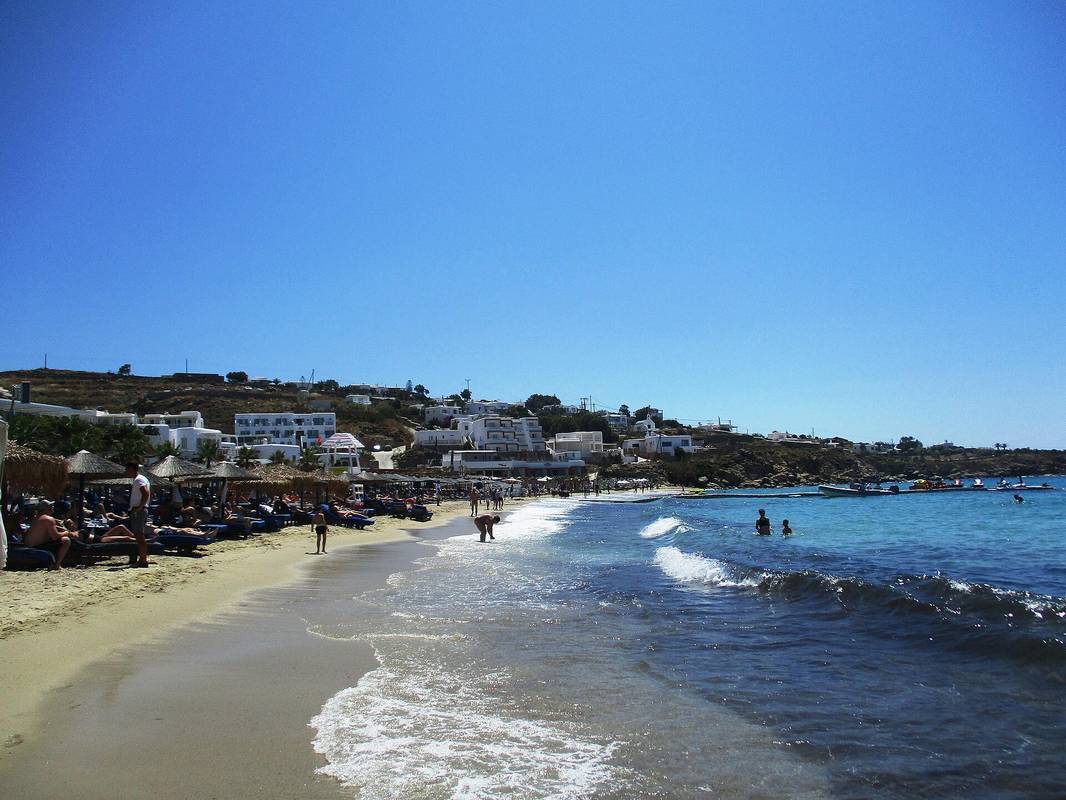
The best Mykonos beaches line the sheltered south coast, from family-friendly Ornos and Platis Gialos to celebrity Psarou, party-loving Paradise and the long sands of Elia, with wilder, quieter beaches on the windy north. This guide covers the best beaches by vibe, the family beaches, the party beaches, the luxury beaches, the north coast, the quiet beaches, the beach clubs, the wind and how to get there. Plan the whole trip with Greece Tours.
Beaches are central to the Mykonos travel guide, and there is one for every mood and crowd. The sections below cover them in full.
What are the best beaches in Mykonos?
The best Mykonos beaches sit on the south coast. Psarou and Platis Gialos deliver glamour and swimming, Ornos suits families, Paradise and Super Paradise host parties, and Elia is the island’s longest beach. Each has golden sand and clear water.
Mykonos has a beach for every kind of traveller. The most popular ones cluster along the protected south coast, which stays calm even when the meltemi wind blows. Psarou is the trendiest, a glamorous bay of emerald water, the famous Nammos beach club and moored superyachts. Neighbouring Platis Gialos beach is a lively, well-organised resort beach that suits all-rounders.
Ornos beach is the most family-friendly, with calm, shallow water and restaurants along the shore. For partying, Paradise and Super Paradise host day-long beach parties and a young crowd. Elia beach, the longest on the island, offers more space and a mix of beach clubs and room to spread out. Beyond these headline names, the island has dozens of beaches, so the choice comes down to atmosphere and crowd, set within the wider list of things to do in Mykonos.
Which beaches are best for families?
The best family beaches are Ornos and Platis Gialos on the south coast. Both have calm, shallow, sheltered water, sandy shores, sunbeds, restaurants and good bus links. Agios Stefanos and Agios Ioannis are also gentle bays, while Ornos feels the most family-friendly.
Families are best served by the sheltered, well-organised south-coast beaches. Ornos is the standout, a calm, shallow bay a short drive from Mykonos Town, with safe swimming and a wide choice of restaurants, cafes and beach bars along the sand. Sunbeds are available for hire, and the bus service beats most beaches, giving it a relaxed, everyday beach-town feel. Nearby Platis Gialos is a popular resort beach on a gorgeous stretch of white sand, with palm trees, clear water and every amenity, family-friendly but a touch more upscale and lively.
For something quieter, Agios Sostis beach to the north and Agios Ioannis, the famous Shirley Valentine sunset beach, both have calm water and a gentle feel. Agios Stefanos, close to the new port, is another easy, shallow bay for young children. All the main family beaches have easy road access and water-taxi links along the south coast, making it simple to beach-hop with children. Plan around the guides to where to stay and the best time to visit.
Which beaches are best for parties?
The best party beaches are Paradise and Super Paradise on the south coast, known for day-long beach parties, beach clubs and a young, lively crowd. Paradise hosts the famous Paradise Beach Club and Cavo Paradiso, while Super Paradise has a relaxed, inclusive scene.
Mykonos is famous for its beach parties, and two beaches lead the scene. Paradise beach, a golden crescent south of Mykonos Town, has been the island’s party hub for decades. The open-air Paradise Beach Club throws day and night events, and the legendary Cavo Paradiso clubbing venue sits on the cliff above.
Neighbouring Super Paradise beach has a long, lively party reputation of its own, historically known as a liberal, LGBTQ-friendly beach. Beach bars and DJs keep the energy high through the afternoon, drawing a mixed crowd. Both beaches have golden sand and clear, sheltered water for swimming between dances, plus sunbeds and a buzzy, social atmosphere built around music rather than relaxation. They suit a younger, party-minded crowd rather than families seeking peace, set alongside the guides to Mykonos nightlife.
Which are the luxury and glamour beaches?
The most glamorous beach is Psarou, home to the world-famous Nammos beach club, emerald water and moored superyachts. Platis Gialos and Ornos also have upscale beach clubs, while Elia and Kalo Livadi offer chic clubs with more space. Expect high prices.
Mykonos is one of the most glamorous islands in Greece, and several beaches are devoted to luxury. Psarou beach is the undisputed leader, a small, chic bay of golden sand and emerald water dominated by Nammos, one of the most prestigious beach clubs in the world, drawing celebrities, fashion crowds and superyachts. Beside it, Platis Gialos has its own row of smart beachfront restaurants and clubs, and Ornos blends family-friendliness with upscale dining.
Further east, the long sands of Elia and Kalo Livadi host stylish beach clubs such as SantAnna, with pools, fine food and DJ sets. These deliver the glamour with more room than tiny Psarou. Across all of these beaches, sunbeds, cabanas and dining command premium prices and benefit from booking ahead in peak season. Pair them with the guides to Psarou and the beach clubs.
What are the north-coast beaches like?
The north-coast beaches, including Ftelia, Panormos, Agios Sostis and Houlakia, are wilder, quieter and more natural than the south, but exposed to the meltemi wind. Ftelia is a top windsurfing spot, and Houlakia is a pretty pebble cove. Best on calm days.
The north coast offers a different, more rugged side of Mykonos, away from the resort crowds. Its beaches are generally quieter, more natural and less developed than the south, but they catch the full force of the meltemi wind, so they are best visited on calmer days. Ftelia beach is a long, sandy, windswept bay that ranks among Greece’s prime windsurfing and kitesurfing spots, with a relaxed, alternative feel.
Panormos and the adjacent Agios Sostis have become fashionable in recent years, with a chic beach club at Panormos and the rustic, undeveloped Agios Sostis loved for its raw beauty and a well-known taverna. Both keep a low-key vibe. The pebbly cove of Houlakia, near the new port, is pretty for a swim, while Fokos and Mersini are remote, beautiful and almost untouched. Panormos sits in a wide sandy bay about a fifteen-minute drive north of Mykonos Town, close enough for an easy half-day yet far enough to feel a world apart from the resort strip. These beaches sit alongside the wider list of things to do in Mykonos.
Which are the quietest, most natural beaches?
The quietest, most natural beaches are Fokos, Mersini and Kapari, plus the less-developed coves reached by boat or rough track. Fokos and Mersini are remote and unspoilt with a single taverna, and the boat-access beaches near Super Paradise stay secluded.
For travellers who want to escape the crowds and the music, Mykonos still has wild, peaceful beaches worth the effort. On the north coast, Fokos and Mersini are remote, undeveloped bays reached by rough roads, with little more than a single excellent taverna, clear water and a strong sense of seclusion. Kapari, a small cove near Agios Ioannis on the west, is a quiet, scenic spot beloved for the sunset and its calm, shallow water.
Several coves are best reached by boat or water taxi, keeping them secluded even in high summer. The eastern stretches around Kalafatis and Lia offer a calmer, more low-key scene with watersports but fewer crowds. These beaches show that, beyond the glamour, Mykonos still keeps its quiet, natural corners, set alongside the guides to boat trips and the best time to visit.
How do you get between the beaches?
You move between Mykonos beaches by KTEL bus from Mykonos Town, by water taxi along the south coast, or by hired ATV, quad, car or taxi. Buses serve the main south beaches, and an ATV reaches the remote north.
Getting between the beaches is straightforward, and most visitors mix several methods. Frequent KTEL buses run from the two terminals in Mykonos Town, Fabrika and the old port, out to Ornos, Platis Gialos, Paradise, Super Paradise, Elia and Kalo Livadi. Fares are low, and some buses run late to suit the nightlife. For a scenic alternative, summer water taxis shuttle along the south coast between Platis Gialos, Paradise, Paraga, Super Paradise, Elia and Agrari, letting you hop from bay to bay by sea.
A rented ATV or quad is the classic Mykonos choice for independence, handy for the wilder north beaches such as Ftelia and Fokos that buses do not serve. A hire car or taxi covers the same ground with more comfort and shade. Road distances are short, so even the far beaches sit within a half-hour drive of town. A single ATV or car can string together several south-coast beaches in one day, while the water taxi turns the same run into a relaxed sea journey with a swim stop at each stage. Combine the transport options with the guides to getting around Mykonos and a Mykonos itinerary.
Are there nudist and LGBT-friendly beaches?
Yes. Mykonos has a long tradition of nudist and LGBT-friendly beaches. Super Paradise and Elia are historically the best known LGBTQ-friendly beaches, and both have naturist areas, while Agrari and parts of Paradise are also relaxed about swimwear and welcoming to all.
Mykonos has been one of the most open, inclusive islands in the Mediterranean for generations, and its beaches reflect that. Super Paradise built its reputation as a gay-friendly beach, and it remains a favourite, with beach bars and a mixed, celebratory crowd. Elia, the island’s longest beach, has a well-established LGBTQ-friendly and naturist section at its far end, reached along the sand and by water taxi.
Nude and clothing-optional swimming is accepted at the quieter ends of several beaches rather than signposted formally. Agrari, next to Elia, and the eastern reaches of Paradise are relaxed and low-key, and remote north-coast coves such as Fokos see naturists on calm days. As anywhere, the naturist areas tend to be the less crowded stretches, so walking a little from the main sunbed rows finds them. These beaches pair with the wider Mykonos nightlife and social scene.
What are the beach clubs?
The beach clubs are a Mykonos institution, blending sunbathing, dining, cocktails and DJ sets by the sea. Famous names include Nammos at Psarou, Scorpios at Paraga and Principote at Panormos, where the party builds from afternoon into evening. They are glamorous and pricey.
Mykonos pioneered the luxury beach club, where a day at the beach becomes a glamorous, all-day party. These venues combine sunbeds and cabanas, fine dining, cocktails and DJ sets that build from a relaxed lunch into a full party as the afternoon wears on. The most prestigious is Nammos at Psarou Beach, a magnet for celebrities and superyachts, while Scorpios at Paraga is known for its bohemian-chic sunset gatherings.
SantAnna at Elia is among the largest, with a huge pool and stage, and Principote brings the same energy to Panormos on the north coast. Sunbeds, cabanas and bottle service command high prices, so reservations are advisable weeks ahead for peak July and August. For a beach day with a side of party, the clubs are a quintessential Mykonos experience, set alongside the guide to Mykonos nightlife.
Which beaches are best for sunset?
The best sunset beaches face west. Agios Ioannis, the Shirley Valentine beach, and nearby Kapari have the classic Mykonos sunset over the sea toward Delos. Ornos and Platis Gialos also catch the evening light, and several beach clubs turn sunset into the day’s highlight.
Most of the famous beaches face south or east, so the finest sunset spots sit on the western side of the island. Agios Ioannis, made famous by the film Shirley Valentine, looks straight across the water to the sacred island of Delos, and its tavernas fill at golden hour. The small neighbouring cove of Kapari shares the same view with far fewer people, making it a quiet choice for the evening.
Ornos and Platis Gialos, both on the southwest coast, also glow in the late light and stay lively into the evening for a sundowner. At the beach clubs, sunset is the pivot of the day, when the music lifts and the crowd gathers. For the widest panorama, though, many visitors pair a beach afternoon with sunset in Little Venice back in town, covered in the things to do in Mykonos guide.
Which beaches are best for swimming and watersports?
For calm swimming, choose the sheltered south-coast bays: Platis Gialos, Ornos, Psarou and Elia have clear, shallow water. For watersports, Kalafatis on the east and Ftelia on the north are the top spots, with windsurfing, kitesurfing, diving and sailing schools.
Swimming is easy and safe on the organised south coast, where the water is clear, the entry is gentle and the meltemi rarely reaches. Platis Gialos, Ornos, Psarou, Agios Ioannis and Elia all shelve gradually into shallow, warm water, which makes them reliable for a long, relaxed swim. Kalo Livadi, a wide bay further east, adds space and the same calm conditions with fewer crowds than the headline beaches near town. Agrari, next to Elia, is another sheltered sandy stretch with gentle water, reached by road or by the south-coast water taxi. Most of these bays hold their calm through the morning even in a stiff meltemi, which makes early swims the most reliable.
Watersports concentrate where the wind and the setup meet. Ftelia beach on the north is the windsurfing and kitesurfing centre, while Kalafatis on the east coast runs a long-established watersports base with windsurf hire, diving and boat trips. The south-coast resort beaches offer gentler activities such as paddleboards, pedalos, jet skis and parasailing from their beach bars. Match the beach to the sport, and pair it with the wider things to do in Mykonos.
How does the wind affect the beaches?
The strong northerly meltemi keeps the south-coast beaches like Platis Gialos, Psarou, Ornos and Paradise sheltered and calm in summer, while the north-coast beaches such as Ftelia and Panormos turn windy. Head south for the calmest water on windy days.
The wind is a genuine factor in choosing a Mykonos beach. The island is nicknamed the Island of the Winds for the meltemi, the strong, dry northerly wind that blows across the Cyclades through much of the summer, strongest from late June through August. When it is up, the north-coast beaches become breezy and choppy with blown sand. Ftelia is the exception that windsurfers love precisely for this reason.
The south-coast beaches, Platis Gialos, Psarou, Ornos, Paradise and Super Paradise, are protected by the hills and stay calm and swimmable. The simple rule is to head to the south coast on windy days and save the more exposed north for when the meltemi drops, often in the morning or in September. Checking the forecast and asking locally helps you pick the right beach each day, set alongside the guide to the best time to visit Mykonos.
What facilities and sunbeds should you expect?
Most organised Mykonos beaches offer sunbeds and umbrellas for hire, beach bars, restaurants, showers and watersports. Prices run high at the glamour beaches, moderate at family beaches like Ornos, and minimal at wild coves, where you bring your own supplies.
Facilities vary sharply by beach, so it pays to match your plan to the shore. The organised south-coast beaches, Platis Gialos, Ornos, Paradise, Elia and Kalo Livadi, have full sunbed and umbrella hire, beach bars, tavernas, showers and watersports centres. At the glamour beaches such as Psarou, a front-row sunbed pair with service can cost a small fortune in peak season, so many visitors book ahead or arrive early for a spot.
At the wild beaches, expect little or nothing. Fokos and Mersini have a single taverna, and boat-access coves have none, so carry water, snacks, shade and sun protection. A useful habit is to reach the most popular beaches early in the peak months of July and August, when the front-row sunbeds tend to sell out well before mid-morning. Free public stretches still exist beside most organised sections for those who prefer a towel on the sand, and even the busiest beaches keep an unmanaged strip at one end where no charge applies. These practical points complete the picture set out in the wider Mykonos travel guide.
Frequently Asked Questions
What are the best beaches in Mykonos?
The best Mykonos beaches are on the south coast: Psarou and Platis Gialos for glamour and swimming, Ornos for families, Paradise and Super Paradise for parties, and Elia, the island’s longest beach. The wilder north coast has quieter, more natural beaches such as Ftelia and Agios Sostis.
Which Mykonos beaches are best for families?
The best family beaches are Ornos and Platis Gialos, both on the south coast with calm, shallow, sheltered water, sandy shores, sunbeds, restaurants and good bus links. Agios Stefanos and Agios Ioannis are also gentle, easy bays. Ornos is the most family-friendly, with an everyday beach-town feel.
Which Mykonos beaches are sheltered from the wind?
The south-coast beaches, including Platis Gialos, Psarou, Ornos, Paradise and Super Paradise, are sheltered by the hills and stay calm when the strong northerly meltemi wind blows. The north-coast beaches like Ftelia and Panormos become windy, so head south on breezy days for the calmest water.
How do you get to Mykonos beaches without a car?
Frequent KTEL buses run from Mykonos Town to Ornos, Platis Gialos, Paradise, Super Paradise, Elia and Kalo Livadi cheaply in summer. Water taxis link the south-coast beaches, and taxis reach the rest. A car, quad or ATV is only really needed for the remote north-coast and boat-access coves.
Are there nudist beaches in Mykonos?
Yes. Mykonos has a long naturist and LGBTQ-friendly tradition. Elia has a well-known naturist section at its far end, Super Paradise is historically the best-known gay-friendly beach, and quieter stretches of Agrari, Paradise and remote coves such as Fokos are relaxed about swimwear.