
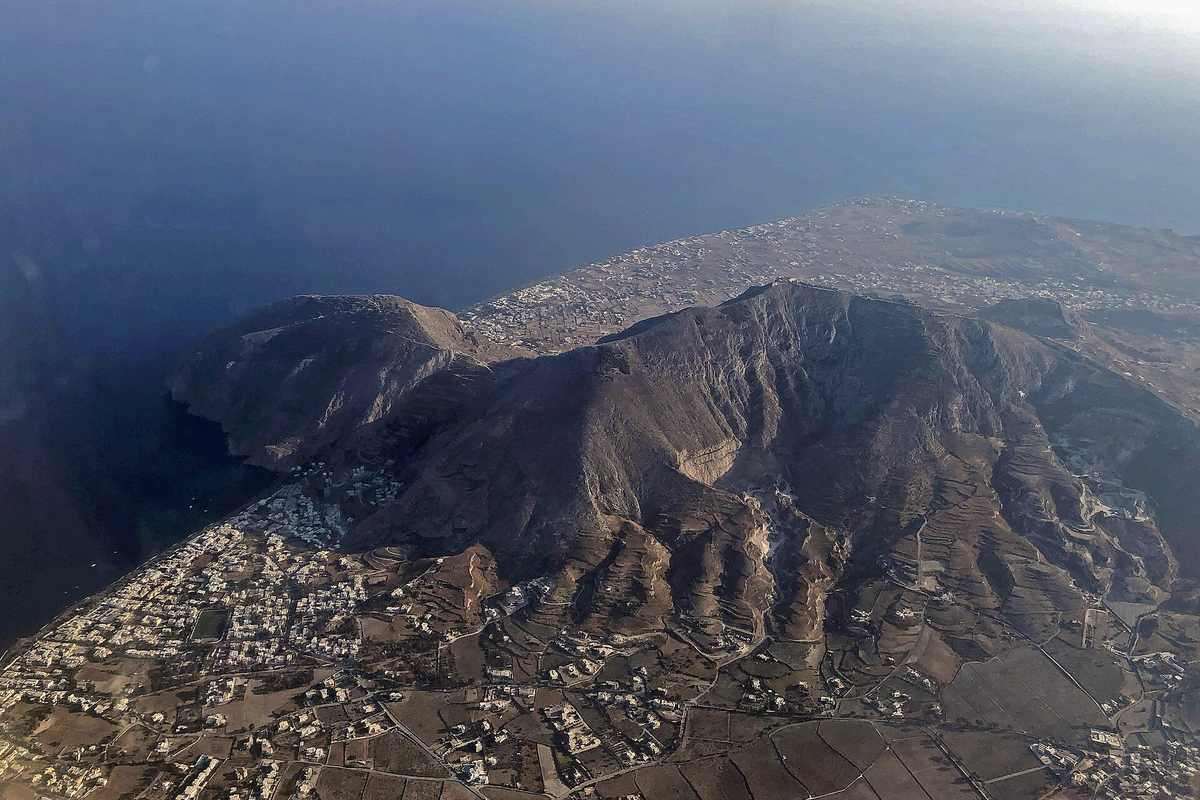
Ancient Thera is Santorini’s dramatic clifftop classical city, perched on the rocky ridge of Mesa Vouno between Kamari and Perissa, with temples, an agora, Roman houses and breathtaking views. It is the island’s second great archaeological site after Akrotiri. This guide covers the history, what to see, tickets and how to visit. Plan the whole trip with Greece Tours.
Ancient Thera is a spectacular and lesser-visited sight in the wider Santorini travel guide. It crowns the headland on the south-east coast. The sections below cover the site.
What is Ancient Thera?
Ancient Thera is the ruined classical and Roman city of Santorini, set high on the rocky headland of Mesa Vouno between Kamari and Perissa. The island’s second most important archaeological site after Akrotiri, it spreads along a dramatic ridge.
Ancient Thera is the great hilltop city of Santorini. Occupying the long, rocky spine of Mesa Vouno, which rises sheer between the black-sand beaches of Kamari and Perissa, it was the island’s main settlement in classical times, quite distinct from the much older Bronze Age Akrotiri. After Akrotiri, it is the most important archaeological site on the island.
The city is an extensive ancient town strung along a windswept ridge some 350 metres above the sea, its long axis running north to south, with spectacular views in every direction that make the visit as much about the setting as the stones. The ruins are open to the sky rather than roofed or reconstructed, so you walk the original streets past temple platforms, house walls and cisterns, set within the wider things to do in Santorini and the island’s history. Its history spans a thousand years.
What is its history?
Ancient Thera was founded by Dorian Greek colonists in the ninth century before Christ and inhabited into the Byzantine period. The island and city take their name from the Dorian leader Theras, and the visible ruins date mainly to the Hellenistic and Roman eras.
The city’s story stretches across a millennium. It was first settled by Dorian Greek colonists in the ninth century before Christ, and both the city and the island, Thera, were named after their leader, Theras. From this hilltop the Dorians and their successors governed the island, and the settlement remained inhabited through the Hellenistic, Roman and into the early Byzantine period before being abandoned.
The site was uncovered in large excavations at the close of the nineteenth century by the German archaeologist Friedrich Hiller von Gaertringen, who worked the ridge over several seasons and published its inscriptions, with later Greek work continuing through the twentieth century. Most of the ruins you see today belong to the city’s prosperous Hellenistic and Roman phases, when it served as a naval base for the Ptolemies of Egypt. The ridge also holds rock-cut inscriptions among the oldest Greek writing known, set out alongside the guide to Akrotiri, the older site. There is much to explore.
What can you see at Ancient Thera?
At Ancient Thera you can see open-air sanctuaries and temples, the agora, public buildings, private houses, a theatre and a planned road network with drainage, all spread along the ridge. Greek and English signs explain the ruins, and the coastal views are stunning.
The site rewards a wander along its ancient main street. Stretching the length of the ridge, the city reveals open-air sanctuaries and temples to the gods, the agora that was its commercial and civic heart, public buildings, gymnasia and a small theatre carved to face the sea, along with the foundations of private houses and a sophisticated network of paved roads and drainage.
Highlights include the sanctuary of Apollo Karneios, the terrace of the festivals where dancers once performed, and the ancient graffiti carved into the rock nearby. The theatre still frames the sea in its backdrop, and the market square and gymnasium give a clear sense of daily civic life. Cisterns cut into the rock caught the rainwater that kept the waterless ridge supplied. Well-written descriptions in Greek and English throughout help bring the ruins to life. Throughout, the position is breathtaking, with the black beaches of Kamari and Perissa far below and the Aegean stretching to the horizon, set out alongside the guides to Kamari, Perissa and the Museum of Prehistoric Thera. Practical details are simple.
What are the tickets and hours?
Entry to Ancient Thera is around 6 euros, or 3 reduced, with a 15-euro combined ticket also covering Akrotiri and the Museum of Prehistoric Thera, valid three days. It opens Thursday to Tuesday, roughly 8.30am to 3.30pm.
Visiting is inexpensive and easy to plan. A standard ticket costs around 6 euros, with a reduced rate of about 3, while a combined ticket of roughly 15 euros, valid for three days, also admits you to Akrotiri and the Prehistoric Thera museum in Fira, excellent value for anyone exploring the island’s archaeology.
The site is open year-round but, unusually, closes on Wednesdays, opening Thursday to Tuesday from about 8.30am to 3.30pm, so check the day before going. Because the ridge is exposed and shadeless, an early start avoids the worst of the midday heat, and there is no cafe on site, so carry water and a snack. Allow at least an hour and a half to walk the ruins, and longer if you want to read every panel and reach the far southern tip. Spring and autumn are the kindest seasons for the climb, set out alongside the guide to the best time to visit Santorini. Getting up there takes some effort.
How do you get to Ancient Thera?
You reach Ancient Thera by car up the winding road from Kamari, or on foot by a steep hour-long trail from Kamari or Perissa. There is no bus to the top, so a car, quad or guided tour is easiest.
Reaching the hilltop city is part of the adventure. By car or quad, a steep, winding road climbs from Kamari village to a car park near the entrance, the easiest option. On foot, energetic walkers can hike up a zig-zag trail from Kamari or a steeper path from Perissa, each taking around an hour to an hour and a half in the heat, or follow the trekking route from the Prophet Elias monastery on the island’s highest peak.
There is no public bus to the summit, so a hire car, quad or an organised tour is the practical choice. Taxis will drive up but can be hard to find for the return, so arranging a pickup helps. Sturdy shoes, water and sun protection are essential whichever way you go, set out alongside the guides to a Santorini quad rental, the Prophet Elias monastery and getting around. The questions below cover the points travellers ask most.
How does Ancient Thera fit with Santorini’s other sites?
Ancient Thera is the classical city, while Akrotiri is the older Bronze Age town buried by the eruption, and the two museums in Fira hold the finds. Together they tell the island’s story across three thousand years of settlement.
Ancient Thera is one piece of a larger archaeological picture. Akrotiri, on the south coast, is the prehistoric town frozen in ash by the great eruption, far older than Thera and famous for its frescoes and multi-storey houses. Ancient Thera, by contrast, is the Greek and Roman city that grew up long after, and comparing the two shows how island life changed from the Bronze Age to classical antiquity.
The portable finds have moved to Fira. The Museum of Prehistoric Thera displays the frescoes and pottery from Akrotiri, while the Archaeological Museum holds sculpture and inscriptions from Ancient Thera itself. Seeing the sites and the museums together makes the most sense, and the combined ticket is built for exactly that circuit, set out alongside the guides to Akrotiri and Fira. The questions below add the practical detail.
Frequently Asked Questions
What is Ancient Thera in Santorini?
Ancient Thera is the ruined classical and Roman city of Santorini, set high on the rocky ridge of Mesa Vouno between Kamari and Perissa. Founded by Dorian colonists in the ninth century before Christ, it is the island’s second most important archaeological site after Akrotiri.
How do you get to Ancient Thera?
You reach Ancient Thera by car or quad up the winding road from Kamari to a car park near the entrance, or on foot by a steep hour-long trail from Kamari or Perissa. There is no bus to the top, so a car, quad or guided tour is the easiest way to visit.
How much does Ancient Thera cost?
Entry to Ancient Thera is around 6 euros, or 3 reduced, with a 15-euro combined ticket also covering Akrotiri and the Museum of Prehistoric Thera over three days. It opens Thursday to Tuesday, roughly 8.30am to 3.30pm, and closes on Wednesdays.
Is Ancient Thera worth visiting?
Ancient Thera is worth visiting for the ruins and the setting alike, a classical and Roman city spread along a ridge with sweeping views over Kamari, Perissa and the Aegean. It is far quieter than Akrotiri, so history lovers and walkers who enjoy a climb will find it rewarding.