
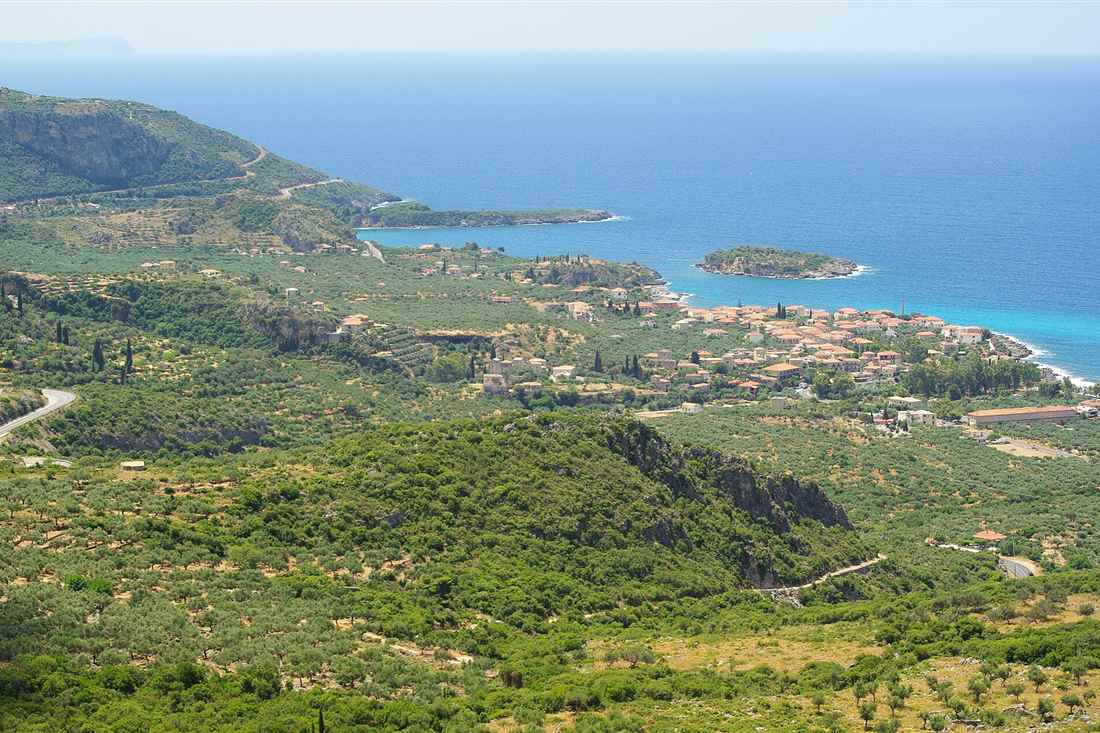
The 2-day Mani peninsula tour starts with an airport transfer at Kalamata and a guided visit to Kardamyli and Stoupa on the Messenian coast. Tours across the rest of the country are listed on Greece Tours.
The sections below cover what the 2-day Mani peninsula tour includes, how it compares with day trips, the Homeric cities of the coast, the Free Laconians, Taygetos, the castles, the laments and vendettas, dry-stone building, the Maniots of Corsica, season and booking, with links into the Mani tours pages. The tours shown are checked on GetYourGuide and Viator.
What is the 2-day Mani peninsula tour?
On arrival at Kalamata, the 2-day Mani peninsula tour starts with an airport transfer. A guided tour of the Mani follows, with stops in Kardamyli and Stoupa. Both villages sit on the west coast of the peninsula.
The Mani is the middle of the three southern peninsulas of the Peloponnese. The Messenian Gulf lies to its west, and the Laconian Gulf lies to its east. It is the southern extension of the Taygetos range, which forms its spine. The 2-day Mani peninsula tour explores a peninsula about 45 km long, with a rocky, rugged interior.
The Mani divides into three traditional parts. Outer Mani covers the northwest, Lower Mani the east, and Inner Mani the southwest. Locals call Outer Mani aposkiaderi, meaning shady. West Mani belongs to the Messenia regional unit, and East Mani belongs to Laconia. On the 2-day Mani peninsula tour, Kardamyli and Stoupa both sit in Outer Mani.
Kalamata is the gateway city for the Mani. It ranks second in population among the cities of the Peloponnese, after Patras. The city is the capital and chief port of Messenia, and it lies along the Nedon River. It sits at the head of the Messenian Gulf, where the 2-day Mani peninsula tour begins.
Kalamata International Airport carries the name Captain Vassilis Constantakopoulos. It lies between Kalamata and Messini, on the EO82 road. It stands in the Pamisos River plain, west of the railway. A Hellenic Air Force base also operates there. Guests on a 2-day Mani peninsula tour land here before the airport transfer.
Kardamyli lies about 36 km south of Kalamata by road. It is the nearer of the two villages on the 2-day Mani peninsula tour. The village sits at the foot of the Taygetos range, on the Messenian Gulf coast. It serves as the seat of the West Mani municipality. Other trips from the village appear on the Kardamyli tours page.
Stoupa, the other village on the 2-day Mani peninsula tour, lies about 45 km south of Kalamata. By road, it sits about 9 km beyond Kardamyli. Its shore holds the coves of Stoupa and Kalogria. Agios Nikolaos, a working fishing village, lies about 4 km away. More trips from the village appear on the Stoupa tours page.
- Peninsula neighbours: the Messenia peninsula lies to the west, and the Cape Maleas peninsula lies to the east.
- Greek names of the three parts: Exo Mani, Kato Mani and Mesa Mani.
- West Mani municipality: about 403 square kilometres and 5,875 residents at the last census.
- Kalamata: 58,816 residents in the city proper and 72,906 in the wider municipality.
- Airport codes: KLX on passenger tickets and LGKL for air traffic control.
- Airport runway: about 2.7 km of asphalt.
- Kardamyli: 391 residents at the last census, at 21 m above sea level.
- Stoupa: 638 residents at the last census, inside the community of Neochori.
- Kardamyli neighbours: Kampos to the north and Proastio to the south-east.
What does the 2-day Mani peninsula tour include?
On its listing page, the 2-day Mani peninsula tour names two parts. The first is an airport transfer on arrival at Kalamata. The second is a guided tour of the Mani that visits the villages of Kardamyli and Stoupa.
The listing title opens with Kalamata and closes with the words Airport Transfer. That wording fixes the arrival transfer as a named part of the package. The 2-day Mani peninsula tour keeps its hotel, meal and day-two details on that same page. Any stop beyond Kardamyli and Stoupa needs a check there before booking.
The hotel line is the first item to read. It shows whether a night of lodging belongs to the package. On the 2-day Mani peninsula tour, check whether that line names the village or town of the stay. Note the hotel name and the check-in time before landing at Kalamata. Solo travellers check the room-sharing terms in the same place.
Meals form the second check. The listing states which meals the package covers. Breakfast, lunch and dinner each need a separate look on that list. For a 2-day Mani peninsula tour, any meal missing from that list counts as a separate cost. Drinks with meals, such as water, coffee and wine, need the same check.
Transport on day two is the third check. Read how guests travel on the second day and where the tour ends. The airport transfer in the title covers the arrival leg at Kalamata. Confirm whether the 2-day Mani peninsula tour also includes a return drive to the airport. Flight times for departure need to fit that end point.
Group or private is the fourth check. A group format shares the guide and vehicle with other travellers. A private format keeps the guide and the vehicle for one party alone. Check which format the 2-day Mani peninsula tour uses, plus the language of the guide. A private format lets one party set its own pace at each village.
Separate costs cover anything the listing leaves out. Flights to Kalamata, travel insurance and tips fall in that group unless the listing names them. Entry tickets and personal shopping in Kardamyli or Stoupa follow the same rule. Snacks between meals also count as extras. Extra nights in Kalamata before or after the tour form a separate cost too.
- Hotel: lodging status, hotel name, village or town, and check-in time.
- Meals: breakfast, lunch and dinner, each marked as included or extra.
- Drinks: water, coffee and wine with meals, each marked as included or extra.
- Day two: transport, start time and the end point of the tour.
- Return leg: a drive back to Kalamata airport, or no return transfer.
- Format: a group tour or a private tour, plus the group size limit.
- Guide language: the language of the guided tour of the Mani.
- Meeting point: the spot at Kalamata airport where the transfer starts.
- Extras: flights, travel insurance, tips, entry tickets and personal shopping.

How does it compare with a Mani day trip from Kalamata?
The 2-day Mani peninsula tour pairs a Kalamata airport transfer with a guided Mani tour over two days. The 5-hour and 8-hour day tours visit Kardamyli and Stoupa from Kalamata. Both shorter tours return to Kalamata on the same day, with no night away.
Three Mani tours leave from Kalamata on GetYourGuide. Two run as day trips, at 5 and 8 hours. Kardamyli and Stoupa feature on all three routes. The 2-day Mani peninsula tour alone names an airport transfer in its title.
The 5-hour tour is titled “Peloponnese: 5-hour tour exploring Mani.” It stops in Kardamyli and then allows one hour of free time by the sea in Stoupa. Stoupa sits 45 km from Kalamata by road, so the round trip covers about 90 km. The 2-day Mani peninsula tour visits the same two villages without a same-day turnaround.
The 8-hour option is titled “From Kalamata: Tour of Kardamyli, Stoupa & Agios Nikolaos.” Agios Nikolaos is a working fishing village south of Stoupa. That third village is the clear extra over the 2-day Mani peninsula tour, which names two villages. The longer day also stretches the drive past Stoupa before the return north to Kalamata.
- Overnight: the 2-day format spans two days and one night. The 5-hour and 8-hour tours end back in Kalamata on the departure day.
- Villages: the 2-day and 5-hour tours name Kardamyli and Stoupa. The 8-hour tour adds Agios Nikolaos as a third stop.
- Time in each place: the 5-hour tour gives one hour of free time in Stoupa. The 2-day format spreads two villages across two days.
- Airport transfer: only the 2-day format includes the transfer at Kalamata airport. Both day tours start from Kalamata itself.
- Clock time: the day tours run 5 and 8 hours from start to finish. The 2-day format covers two calendar days.
Travellers already staying in Kalamata need no airport pickup. For them, the day tours keep Kalamata as the base. The 2-day Mani peninsula tour shifts the focus from the city to the villages of West Mani. That suits an arrival by air with little time spent in Kalamata itself.
On the 2-day Mani peninsula tour, the transfer links the arriving flight to the guided stops. The day tours skip this leg, since they start and return in Kalamata. Day-tour travellers arrange their own ride from the airport into the city before the tour day.
Stop-by-stop details for the same-day route appear on the page for a Mani day trip from Kalamata. That route suits a short stay based in the city. The 2-day Mani peninsula tour suits an arrival by air with two days for the Mani coast.
How do two days divide between Kalamata, Kardamyli and Stoupa?
One sample split of the 2-day Mani peninsula tour gives day one to the airport transfer and Kardamyli. Day two then covers Stoupa and the seaside village of Agios Nikolaos further south. Evenings fit either the Kalamata seafront or the villages on the coast.
The split below is a sample, not a fixed schedule from the operator. The title confirms only a Kalamata airport transfer and a guided Mani tour with Kardamyli and Stoupa. The operator sets the exact pickup times and stop order for the 2-day Mani peninsula tour. Agios Nikolaos enters the sample because the 8-hour day tour names it.
The coast road runs southeast from Kalamata along the Messenian Gulf. Kardamyli lies 36 km from the city, on the eastern shore. Stoupa follows about 9 km further south. Agios Nikolaos sits about 4 km beyond Stoupa. The full run measures about 49 km. All three villages lie in Outer Mani, the Messenian side of the peninsula.
In this sample, day one starts with the pickup at Kalamata airport. The route then runs to Kardamyli, the seat of the West Mani municipality. A first-day stop there splits the 2-day Mani peninsula tour into two shorter drives along the coast. That leaves Stoupa for day two.
Day two in the sample continues to Stoupa and its two sandy coves. Agios Nikolaos follows, a seaside community of about 425 residents with a small fishing harbour. In the sample, the 2-day Mani peninsula tour ends with the drive back north along the gulf.
- Day one, arrival: pickup at Kalamata airport, then the airport transfer that opens the 2-day route.
- Day one, coast: the drive southeast along the Messenian Gulf to Kardamyli, the nearest of the three villages.
- Day one, evening: the Kardamyli seafront or the Kalamata marina, set by the overnight base.
- Day two, morning: Stoupa, the larger village, with time on its seafront before the next stop south.
- Day two, midday: Agios Nikolaos, the next fishing village down the coast.
- Day two, close: the drive back north to Kalamata on the same coast road, past Kardamyli again.
Kalamata’s marina lies southwest of the city centre, beside the largest port in Messenia. The Railway Park sits on a disused line to the port and displays old steam engines. An evening walk between the two suits either end of a 2-day Mani peninsula tour. The city also hosts the Kalamata International Dance Festival each year.
A village evening keeps the night on the Mani coast. Kardamyli’s seafront faces west across the gulf, so the sunset falls over the water. Spare-day trips from the city appear among the Kalamata tours, next to the 2-day Mani peninsula tour.

Which Homeric cities stood on the Messenian Mani coast?
Homer names seven coastal cities that Agamemnon offers Achilles in Book 9 of the Iliad. The first is Kardamyle, today’s Kardamyli, a guided stop on a 2-day Mani peninsula tour. Kalamata, the tour’s starting city, stands on Homeric Pherae.
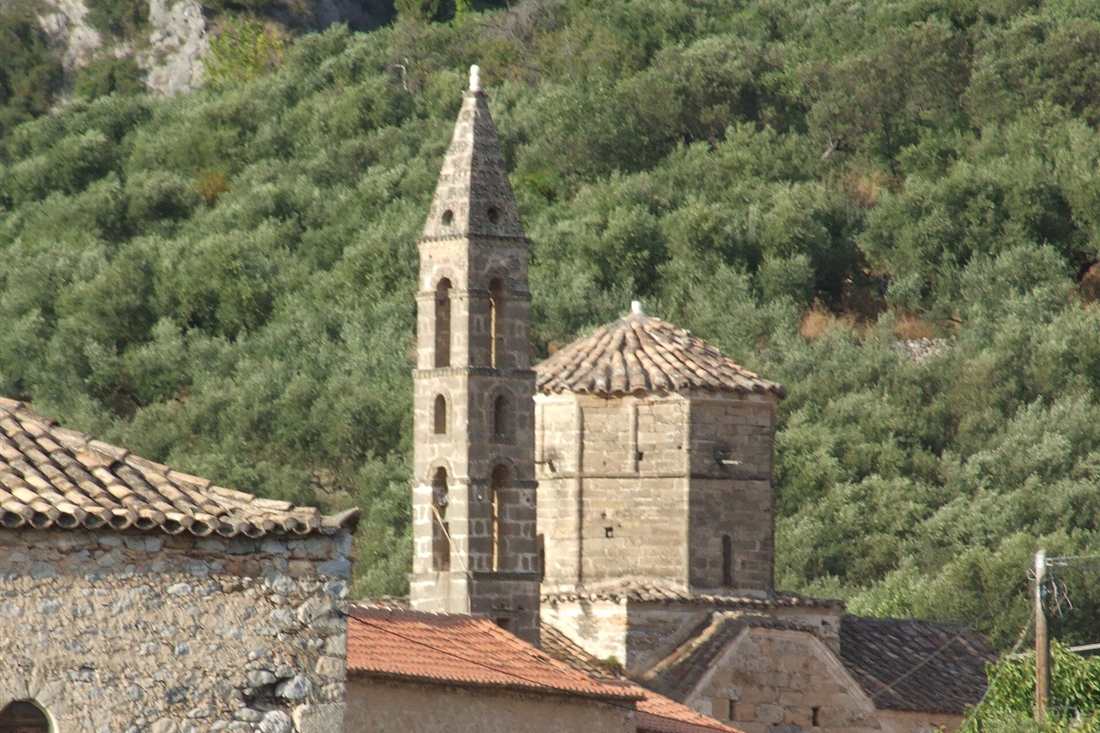
Agamemnon makes the offer to end his quarrel with Achilles. He adds a daughter in marriage, with the seven cities as her dowry. Odysseus carries the offer to the hero’s tent, and Achilles turns it down. Each city below is paired with its modern place and Homer’s label, where he gives one.
- Kardamyle: the modern village of Kardamyli, in West Mani
- Enope: Gerenia, with Pellana as a rival site
- Hire, “grassy”: Avia, on the eastern shore of the gulf
- Pherae, “holy”: Kalamata, capital of Messenia
- Antheia, “deep-meadowed”: Thouria or Asine in later writers
- Aipeia, “fair”: Koroni for Pausanias, Thouria for Strabo
- Pedasos, “vine-covered”: Methoni, in southwest Messenia
Homer says all seven cities lie near the sea, at the far edge of sandy Pylos. Their people are rich in sheep and cattle and will honour Achilles with gifts like a god. Three cities stood on the Mani shore of the Messenian Gulf, and Pherae at its head. The rest lay inland or on the western peninsula.
Pausanias records that King Cresphontes of Messene renamed Hire as Abia. A temple of Asclepius stood in the town, and a church of the Dormition now covers its site. The old settlement of Paliochora took the name Avia in the 20th century. Avia faces the same gulf as Kardamyli, the Homeric town on a 2-day Mani peninsula tour.
Ancient Pherae stood on a hill by the Nedon river, 1.5 km from the gulf. In the Odyssey, Telemachus spends a night there at the house of Diocles. He sleeps there again on the ride home from Menelaus in Sparta. The Nedon still flows through Kalamata, the base for a 2-day Mani peninsula tour.
Kardamyle’s acropolis crowned a fortified rocky height, 1.3 km from the sea and northeast of today’s village. Pausanias lists sanctuaries of Athena and Apollo Carneius there, and a Nereid precinct by the beach. The same coast now hosts sea kayaking at Kardamyli. The coastal village visited on a 2-day Mani peninsula tour lies below this hill.
Rock-cut chamber tombs above the old town carry the name of the Dioscuri, Castor and Pollux. These Hellenistic tombs sit near a hiking trail by Upper Kardamyli. Pausanias places their birth on Pephnos, an islet near Agios Dimitrios. That islet lies south of Stoupa, the other guided stop on a 2-day Mani peninsula tour.
Gerenia stood on a promontory above modern Kampos. Pausanias records a shrine of the nymph Claea on Mount Calathium there. Myth says Nestor grew up at Gerenia after Pylos was destroyed. Homer calls him Gerenian Nestor in the Iliad and the Odyssey. Its ruins lie 6 km northwest of the Kardamyli stop on a 2-day Mani peninsula tour.
Who were the Free Laconians of the Roman Mani?
The Free Laconians, or Eleutherolakones, were coastal towns of Laconia freed from Spartan rule. Augustus gave them a formal league in the late 1st century BC. A 2-day Mani peninsula tour visits Stoupa, beside the member town of Leuktra.
The towns first broke away in the early 2nd century BC, after Rome defeated the Spartan king Nabis. Las was one of them. The Roman general Flamininus placed them under the protection of the Achaean League. When that league ended in the mid-2nd century BC, the towns joined a Lacedaemonian league under Roman rule.
Augustus refounded the group as the Koinon of the Eleutherolakones. At its height the league counted 24 towns, a number that later fell to 18. Pausanias names those 18 in the 2nd century AD. Ten of the 18 stood on the Mani, the setting of a 2-day Mani peninsula tour.
- Gytheio, 40 km south of Sparta
- Las, 10 stadia from the sea and 40 from Gytheio
- Teuthrone, near the village of Kotronas
- Pyrrichos, near Kavalos in the central Mani
- Kainepolis, on the site of Kyparissos
- Oitylo, on the site of the modern village
- Thalamai, 80 stadia north of Oitylo
- Leuktra, on the Messenian Gulf shore
- Alagonia, 30 stadia from Gerenia
- Gerenia, the league’s town farthest north
A general called the strategos led the league, with a treasurer at his side. Gytheio, the old port of Sparta, became its leading member and prospered as a Roman harbour. Its Roman theatre survives, along with buildings now partly under the sea. Excavators cleared the theatre and the acropolis in the late 19th century.
Pausanias puts Leuktra 60 stadia south of Kardamyle. That distance roughly matches the gap between the two villages on a 2-day Mani peninsula tour. On Leuktra’s acropolis he saw a temple and statue of Cassandra, called Alexandra there. Thalamai, now Thalames, held an oracle of Ino or Pasiphae. Visitors slept in its temple to learn the future, Spartan kings among them.
Oitylo and Las appear in Homer’s Catalogue of Ships. At Oitylo, Pausanias saw a temple of Sarapis and a wooden statue of Apollo Carneius in the agora. Kainepolis, near Cape Tainaron, had temples of Demeter and Aphrodite. Its inscriptions link it to the league. Oitylo and Kainepolis lie south of the Stoupa stop on a 2-day Mani peninsula tour.
Teuthrone, on the eastern shore, claimed the Athenian Teuthras as its founder. Its people honoured Artemis Issoria and used a fountain called Naia. At Pyrrichos, French surveyors of the 19th century found the well that Pausanias describes. These towns face the Laconian Gulf, opposite the guided stops of a 2-day Mani peninsula tour.
Kardamyle belonged to the group from the mid-2nd century BC. Augustus then handed it to Sparta as a harbour, and Pausanias still finds it under Spartan control. The Kardamyli stop on a 2-day Mani peninsula tour lies at Sparta’s former Roman harbour. The inland city itself is the goal of a separate Sparta day trip from Kalamata.
The other eight members, including Asopos, Boiai and Epidauros Limera, lay east of the Mani. Coins and inscriptions from member towns show the league at work into the 3rd century AD. It ended at the close of that century, when Emperor Diocletian reformed the provincial system.
What is Mount Taygetos, the spine of the Mani?
Mount Taygetos is the limestone range that forms the backbone of the Mani in the southern Peloponnese. Its top, Profitis Ilias, rises to about 2,407 m. The coast road of a 2-day Mani peninsula tour from Kalamata to Stoupa runs along its western foot.
The range runs about 100 km north to south and spreads up to 30 km wide. It covers roughly 2,500 square kilometres across Messenia, Laconia and Arcadia. Its southern ridge runs on down the Mani under the local name Saggias. National Road 82 crosses it between Sparta and Kalamata, the starting point of a 2-day Mani peninsula tour.
Profitis Ilias, also called Agiolias, is the highest point in the Peloponnese. Byzantine Greeks named the range Pentadaktylos, meaning “five-fingered,” after the five peaks of its central massif. Arrivals at Kalamata Airport on a 2-day Mani peninsula tour see that skyline to the east. The central range, Skoteini Plevra or “the dark side,” gets less morning and evening sun.
Greek fir and black pine form the main forests, from about 800 to 1,800 m. Lower down, lentisk and kermes oak maquis covers the hills along the 2-day Mani peninsula tour coast. The Vyros Gorge drains the western slopes into the sea at Kardamyli. Wildfires in the 21st century left about half of the central western forest standing.
Over 1,000 plant species grow on Taygetos, and 33 of them grow nowhere else. Another 100 species here are found only in Greece. Three plants carry the mountain’s name in Latin: Astragalus taygeteus, Hypericum taygeteum and Jurinea taygetea. The range also holds 100 butterfly species, including the endemic Polyommatus menelaos.
- Name: taken from Taygete, a nymph of Greek myth
- Rindomo Gorge: splits the central range from Southern Taygetos
- High summits: Sidirokastro at 2,340 m, Chalasmeno Vouno at 2,204 m and Goupata at 2,031 m
- Earthquakes: a slip on the Sparta fault ruined ancient Sparta in the 5th century BC
- Mammals: the golden jackal, badger, marten, weasel, hedgehog and fox
- Birds: 87 species, among them the golden eagle and the short-toed snake eagle
- Reptiles: the marginated tortoise, the Greek rock lizard and the Peloponnese wall lizard
- Protection: a Natura network site and an Important Bird Area
The European walking route E4 runs along the lower slopes of the range. From Profitis Ilias, the view takes in the Evrotas Valley and Mount Parnon to the east. To the west, the summit looks over the Messenian Gulf, the coastline of a 2-day Mani peninsula tour. Shorter trails closer to the city are covered in hiking near Kalamata.
In ancient times, Taleton, a peak of the range, was sacred to Helios, the sun god. Today a small chapel of the Prophet Elias stands near the summit. Each year, a large bonfire burns beside it for his feast on 20 July. Kardamyli, a guided stop of the 2-day Mani peninsula tour, looks up at the range from the coast.
Which castles guard the Mani?
Kelefa, Zarnata and Passavas are three forts that once guarded the main routes into the Mani. Franks built the oldest in the 13th century, Ottomans the newest in the 17th. Their ruins frame the coast villages of a 2-day Mani peninsula tour on three sides.
- Kelefa: Ottoman, 17th century, on a hill above Neo Oitylo and its bay on the Messenian Gulf
- Zarnata: walls of the 15th to 17th centuries at Kampos, once a metropolitan bishop’s seat
- Passavas: Frankish, 13th century, seat of the barony of John of Nully, near Gytheio
- Grand Magne (Maina): Frankish, built by William II of Villehardouin, Prince of Achaea, in the mid-13th century
- Kastro tis Orias: a hilltop near the village of Dryalos, a second proposed site of Grand Magne
Kelefa sits halfway between its namesake village and the bay of Oitylo. Its walls enclose about 13,000 square metres, with a round tower at each corner. A half-round bastion guards the east side. The fort watched Oitylo harbour and held down the Maniot clans. It lies south of Stoupa, beyond the guided stops of a 2-day Mani peninsula tour.
In the late 17th century, Maniot fighters besieged Kelefa and asked Venice for help. A Venetian fleet under Francesco Morosini arrived, and the Ottoman garrison surrendered. A year later, an Ottoman counterattack failed. Venice held the fort for about 30 years, until the Ottomans retook the Peloponnese. Nearby Oitylo sits on the main road south to the Diros caves.
Zarnata crowns a small, isolated hill between Kampos and Stavropigio. Round and square towers stud its stone-and-brick walls, which still reach about 9 m in places. Its garrison resisted the Venetians hard in the late 17th century. Cisterns and a ruined windmill stand inside. Kampos sits on the main road from Kalamata to the 2-day Mani peninsula tour villages.
Passavas sits on the Laconian side, across Taygetos from the 2-day Mani peninsula tour coast. Its Frankish name was Passavant, and the walls measure about 180 m by 90 m. Byzantine forces seized it in the 13th century. A Spanish fleet sacked it in the early 17th century. Venetians and Maniots took and wrecked it in the late 17th century.
Grand Magne, French for “Great Maina,” was raised against the Melingoi, a Slavic tribe of Taygetos. After the Byzantines captured its builder at Pelagonia, he gave up the castle as ransom. Its exact site is still unknown, and the Tigani headland is one candidate. Every proposed site lies south of the coast villages of a 2-day Mani peninsula tour.
The name Kastro tis Orias means “Castle of the Fair Maiden.” The hilltop rises about 300 m on the Cavo Grosso headland. The French Expédition scientifique de Morée recorded walls there in the 19th century. No castle remains show on the hilltop today. Cavo Grosso sits on the same western shore as the 2-day Mani peninsula tour villages.
What are the Maniot laments?
The Maniot laments, or moirologia, are funeral songs that women improvise beside the dead in eight-syllable lines. They voice grief, blame the killer and call for revenge. A 2-day Mani peninsula tour crosses the region where these songs took shape.
The word moirologi joins moira, meaning fate, with logos, meaning speech. A lament therefore speaks the fate of the dead. In Mani the singer is called the mirologhistra, a role held by women. No lament is written down in advance, so each one fits a single death and a single family.
Maniot laments run in lines of eight syllables. Greek folk ballads favour the 15-syllable political verse, so each Mani line is seven syllables shorter. Folklorist Konstantinos Romaios devoted a separate study to this eight-syllable line. A 2-day Mani peninsula tour passes through the land where this short verse form took root.
The laments dwell on the pain of the living more than on praise of the dead. They name the person to blame for a death and urge vengeance on the killers. Family honour outranks loyalty to the Greek state. These themes run through the villages that a 2-day Mani peninsula tour reaches from Kalamata.
A Mani couplet mourns the last boy of a feuding family. Female kin raised him for revenge, but he fell ill and died at eight. An Inner Mani tale recalls Paraski, who poisoned three male relatives at Easter to avenge her brother. Inner Mani lies south of the Outer Mani coast on a 2-day Mani peninsula tour.
A lead lamenter opens with a solo verse, and the women around the body reply. Anthropologist Nadia Seremetakis describes this solo-and-chorus exchange, with stylised sobbing between verses. The singers on a 2-day Mani peninsula tour’s coast once gathered the same way at every village funeral.
The tradition survives at funerals in Inner Mani villages. Seremetakis documented improvised laments there in the late 20th century. The third Funeral Songs of Mani volume, by Kyriakos Kassis, holds laments from the Axis occupation. Others mourn the civil war dead. Visitors on a 2-day Mani peninsula tour cross a region where sung grief still marks a death.
- Stilpon Kyriakides studied the improvisation and verse of the Mani laments in the early 20th century.
- Gareth Morgan published The Laments of Mani in the journal Folklore in the late 20th century.
- Margaret Alexiou’s Cambridge study traced similar lament forms from ancient Greece to modern times.
- Kyriakos Kassis, a poet and painter born in Mani, published Funeral Songs of Mani in three volumes.
- Gail Holst-Warhaft studied duty, honour and revenge in Inner Mani laments in her book Dangerous Voices.
- C. Nadia Seremetakis wrote The Last Word: Women, Death, and Divination in Inner Mani.
How did the Mani vendetta work?
The Mani vendetta, called gdikiomos, bound each clan to repay a killing with a killing. Truces paused it for farm work and feasts, and feuds ended through extermination, exile, surrender or army force. A 2-day Mani peninsula tour enters the land where they raged.
Gdikiomos comes from the Greek word for vengeance. Maniot society rested on patrilineal clans, formed mainly in the 14th and 15th centuries. The strong clans, the megalogenites, held the better land and dominated the weaker ahamnoteroi. Kardamyli, a stop on a 2-day Mani peninsula tour, was the seat of the Troupakis-Mourtzinos clan.
A killing obliged the victim’s family to take the blood back. Relatives agreed on the feud at a family gathering, and church bells announced it. The whole offending family shared the guilt, so the avengers picked its leading man as the target. Kalamata, the starting point of a 2-day Mani peninsula tour, lies just north of this feud country.
Both families shut themselves in their towers once a feud began, and supplies came in after dark. The treva, a truce, paused the killing for ploughing, sowing, harvest, threshing and olive picking. Religious feasts brought the same pause. Fighting resumed at an agreed dawn. Farms along the coast of a 2-day Mani peninsula tour once ran on this truce calendar.
A universal treva stopped every feud whenever the Ottoman Turks threatened Mani. A legend says the Virgin warned two feuding clans, the Mavromichalis and Troupakis-Mourtzinos, of a Turkish army. They set their feud aside. The same clan country features on a Mani day trip from Athens, built for a shorter visit.
A feud ended when one family was wiped out or left the village. Other feuds closed with the killing of the guilty man, agreed terms or an exchange of property. Scattered families founded new villages elsewhere in the Peloponnese. Stoupa, the second stop on a 2-day Mani peninsula tour, lies south of Kardamyli.
King Otto’s regency sent Bavarian troops to disarm the Maniots, but the feuds outlived the campaign. In the late 19th century, the army used artillery to halt one vendetta. One of the last large feuds on record needed police, 1,000 soldiers and 200 sailors. The clan order around a 2-day Mani peninsula tour lasted until the Second World War.
- Psychiko: the defeated family came unarmed and asked pardon, and the winners set the terms of peace.
- Psychadelphosyne: after an accidental killing, the killer became the sworn protector of the victim’s family.
- Agape: the final reconciliation, sealed with an embrace and a shared cup in a courtyard.
- Xevgaltis: a neutral armed escort who led one person across enemy ground for a baptism, wedding or funeral.
- Gerontiki: the council of elders that settled disputes between Maniot families.
- Regency order: the Bavarian-led government of King Otto tried to have every fortified Mani tower demolished, and failed.
- Siege rule: neither feuding family left its tower by daylight, for years at a stretch.
- Women in the feud: Maniot women fought beside the men and suffered heavy losses.
What is the dry-stone building tradition of the Mani?
Dry-stone building in the Mani stacks local grey limestone without any mortar or cement. The craft shaped terraces, threshing floors, field walls and huts across the peninsula. Terraced slopes of this kind surround Kardamyli and Stoupa, both visited on the 2-day Mani peninsula tour.
The Mani sits on Mesozoic limestone. Thin soils cover this bedrock, so farmers cleared stones from each plot before planting. Those stones went straight into the nearest wall. The same grey limestone lines the road from Kalamata on a 2-day Mani peninsula tour.
Hillside terraces turn steep slopes into strips of farmland. Each wall holds back soil and stops rain from washing it downhill. Terra rossa, a red clay that holds water, covers the cultivated strips. Olive groves fill the terraces around Kardamyli on a 2-day Mani peninsula tour. Messinian groves like these supply each olive oil tasting in Kalamata.
Maniots grew wheat and barley on stone-walled fields, rotating both with lupins. The harvest went to threshing floors, called alonia, on open, windy ground. Donkeys or horses circled over the sheaves to loosen the grain. Workers tossed it into the air, and the wind took the chaff. Old alonia still sit on slopes along the 2-day Mani peninsula tour.
No mortar holds a dry wall together; weight and friction keep each stone in place. Rainwater drains through the gaps, so pressure never builds up behind a terrace. Lizards shelter in the same gaps. A damaged section can be rebuilt stone by stone without cement. Such walls climb the slopes above Stoupa on a 2-day Mani peninsula tour.
Masons choose each stone for a set job. The largest stones form the foundation. Medium stones with one flat face build the outer courses. Long binding stones run deep to tie both faces together. Small stones fill the core, and a row of capping stones seals the top. Walls seen on a 2-day Mani peninsula tour follow this five-part order.
UNESCO lists the art of dry stone walling as Intangible Cultural Heritage of Humanity. Greece entered the first listing with Croatia, Cyprus, France, Italy, Slovenia, Spain and Switzerland. The listing later grew to 13 countries, Ireland among them. Masons pass the skill down to the next generation. The walls along a 2-day Mani peninsula tour belong to this listed craft.
- Terrace walls: retaining walls built in steps up a hillside, one level above the other.
- Threshing floors (alonia): round stone-paved floors ringed by a low wall that keeps the surface level.
- Field walls: boundary walls that mark each plot and act as fences against goats and sheep.
- Stone huts: small field shelters built from the same limestone, used for rest, tools and stored harvests.
- Stepped paths: stone steps with edging walls that link hill villages to their fields and to the coast.
Why did Maniots sail to Corsica in the 17th century?
Maniots sailed to Corsica to leave Ottoman pressure and poor farmland behind. In the late 17th century, the Stephanopoli family led about 730 settlers from Oitylo to Genoese Corsica. Oitylo lies south of Stoupa, the last stop of the 2-day Mani peninsula tour.
The Ottomans pressed for full control of the Mani and its taxes. Arable land was scarce on the rocky slopes around Oitylo bay, leaving little room for new fields. The Maniot bey Limberakis Gerakaris also used his post to persecute the Stephanopoulos clan. The peninsula begins just south of Kalamata, the starting point of a 2-day Mani peninsula tour.
In Italian, the clan’s name became Stephanopoli. Its leaders struck a deal with the Republic of Genoa, which ruled Corsica. Genoa offered three sites in the Province of Vico, in the west of the island. The settlers pledged loyalty to Genoa and recognised the spiritual authority of the Pope.
The settlers built Paomia, about 4 km east of today’s Cargèse. The village stood around 450 m up, above the Gulf of Sagone. By contrast, Stoupa and Kardamyli on a 2-day Mani peninsula tour sit beside the sea. They rebuilt five hamlets: Pancone, Corone, Rondolino, Salici and Monte-Rosso. Seven small churches and a monastery at Salici served them.
Corsican neighbours attacked the colony more than once. In the early 18th century, an armed band from Vico raided Paomia and was beaten off. When Corsica rose against Genoa, the Greeks stayed loyal to the Genoese. Rebels then raided their hamlets again and again. In April, 55 years after landing, the settlers left Paomia for Ajaccio.
After France took Corsica, Governor Comte de Marbeuf had a new village built on the Puntiglione headland. The site lies between the Gulf of Sagone and the Gulf of Peru. George-Marie Stephanopoli led the move from Ajaccio to Cargèse in the late 18th century. Travellers who finish a 2-day Mani peninsula tour can follow this story to Corsica.
The Greek Catholic church of Saint Spyridon in Cargèse still follows the Byzantine rite. It was finished in the 19th century. Four icons that arrived with the settlers in the 17th century hang inside. One is paraded through the village streets on feast days. Kardamyli, on a 2-day Mani peninsula tour, has its own 18th-century Church of Saint Spyridon.
- Sailing: the settlers boarded a Genoese ship at Oitylo in October and stopped briefly in Genoa.
- Landing: the ship reached Corsica on 14 March of the following year.
- First count: a July census at Paomia listed 520 people, with a bishop, 5 priests and 11 monks.
- Ajaccio: about 700 Greeks settled there, roughly one fifth of the town’s 3,200 residents.
- Greek chapel: the Ajaccio church of La Madonna del Carmine became known as the Chapelle des Grecs.
- Population: 386 Greeks lived in Cargèse nine years after the move from Ajaccio.
- Last speakers: the last native Greek speaker of Cargèse died in the late 20th century.


Which season suits the 2-day Mani peninsula tour?
Late spring and early autumn suit the 2-day Mani peninsula tour on the Messinian coast. Both seasons pair warm sea water with under 7 rainy days a month. Winter brings the heaviest rain of the year to Kalamata and the Mani coast.
The Kalamata airport weather station records about 780 mm of rain a year over 108 rainy days. The seasons below give the average daily highs at Kalamata and the sea temperature in the Messinian Gulf. Kardamyli and Stoupa sit on the same gulf. These sea figures hold for both stops of the 2-day Mani peninsula tour.
- Spring, March to late spring: highs climb from 17 to 25°C, and the sea reaches 16 to 19°C. Rain falls on 7 to 12 days a month.
- Summer, June to August: highs reach 29 to 31°C, and the sea warms from 23 to 27°C. Each month gets under 11 mm of rain.
- Autumn, September to November: highs fall from 28 to 20°C, and the sea cools from 26 to 21°C. November rain reaches 142 mm, the top monthly total.
- Winter, December to February: highs stay near 15 to 16°C, and lows drop to 5 to 7°C. The sea sits at 16 to 19°C.
Summer at Kalamata runs hot and dry, with just 1.5 rainy days in an average July. The airport station logged a record high of 45°C on 24 June. Midday sun on the 2-day Mani peninsula tour calls for a hat, sunscreen and a full water bottle. The Mani coast faces west, so the afternoon sun shines straight onto the shore.
September keeps summer warmth on the Mani coast, with rain on only 6 days in the month. October brings the first heavy rain of the season, about 86 mm over 10 days. October highs still reach 24°C at Kalamata. A 2-day Mani peninsula tour in September meets sea water near its yearly peak. Highs stay 3°C below the July average.
Olive picking across Messinia starts in late autumn and runs into winter. Kalamata olives cannot be harvested green, and pickers gather them by hand to avoid bruising. Nets spread under the trees mark the harvest on the slopes around Kardamyli and Stoupa. A late-autumn 2-day Mani peninsula tour passes these groves during the picking season.
December brings 141 mm of rain over 16 rainy days, the top count of the year. Heavy snow falls on the upper slopes of Taygetos in winter. A 2-day Mani peninsula tour from December to February needs a waterproof jacket, warm layers and closed shoes.
Spring brings wildflowers to the slopes of Taygetos above the coast. Orchids, crocuses and bellflowers bloom on its lower hills. Plane trees line its streams and gorges at every height. A spring 2-day Mani peninsula tour sees the mountain above Kardamyli at its greenest.
Kalamata International Airport, code KLX, mainly receives flights in summer. Seasonal routes link it with cities in Germany, the United Kingdom, Austria and France. Domestic flights connect it with Athens. In the cooler months, a Mystras day trip from Kalamata crosses Taygetos into Laconia.
How do you book and cancel the 2-day Mani peninsula tour?
Book the 2-day Mani peninsula tour on GetYourGuide by picking a date and the traveller count. Add the flight number and arrival time for the Kalamata airport pickup. Where the listing shows free cancellation, it applies up to 24 hours before the start.
The listing runs on GetYourGuide under the title Kalamata: 2-Day Mani Peninsula Tour with Airport Transfer. Its calendar shows the open start dates for the coming months. Choosing a date first confirms that the 2-day Mani peninsula tour runs on that day. The traveller count follows, with adults and children set apart where the listing offers both.
- Open the listing and pick a start date in the calendar.
- Set the number of travellers in the group.
- Enter the flight number and the scheduled arrival time at Kalamata.
- Read the inclusions on hotel, meals and the second day.
- Check the free cancellation label and its deadline before paying.
- Pay at checkout and wait for the confirmation email.
- Save the voucher in the GetYourGuide app before the flight to Kalamata.
The airport transfer depends on two booking entries: the flight number and the scheduled landing time. Both entries tie the transfer to the right arrival at Kalamata International Airport. A change of flight needs an update to these entries through the booking page. Travellers landing on another day can compare Kalamata airport transfer options for a separate ride.
Payment runs through the GetYourGuide checkout, with card and wallet options shown on the page. A confirmation email follows with the booking reference for the 2-day Mani peninsula tour. The same booking appears under Bookings in the GetYourGuide app, once signed in with the same email address. The checkout also shows the cancellation terms once more before payment.
The voucher sits in the app and in the confirmation email. The voucher shows the booking reference, the date and the number of travellers. The GetYourGuide app keeps vouchers offline. A weak phone signal in the arrivals hall then does not block access. Keep the voucher open on landing for the start of the 2-day Mani peninsula tour.
Free cancellation, where the listing shows that label, closes 24 hours before the start time. For a 14:00 start on a Friday, the free window ends at 14:00 on Thursday. Cancelling runs through the booking in the app or on the website. The refund for a 2-day Mani peninsula tour cancelled in time returns to the original payment method.
Three details need a close read before payment: the hotel, the meals and the second day. The Includes block and the itinerary cover these points. Kardamyli and Stoupa are the two stops the listing names for the guided 2-day Mani peninsula tour. Any other stop needs confirming on the itinerary itself. Airport pickup details sit on the same page.
Frequently Asked Questions
How long does the Mani tour from Kalamata last?
It lasts two days, as the name of the 2-day Mani peninsula tour states. Day one starts with the airport transfer on arrival at Kalamata. The guided part of the trip covers the villages of Kardamyli and Stoupa. The plan for day two sits on the GetYourGuide listing, so read that section before booking.
Where does the tour start?
Kalamata International Airport is the starting point, with a transfer on arrival. Kalamata itself lies at the head of the Messenian Gulf, on the Nedon River. Travellers flying in from Athens or abroad land there before the 2-day Mani peninsula tour begins. The exact meeting point and pickup time appear on the listing, so check both against the flight.
Is the airport transfer included?
Yes. The listing names an airport transfer on arrival at Kalamata as part of the 2-day Mani peninsula tour. That removes the taxi ride or the airport bus into the city. Free cancellation up to 24 hours before the start applies on listings that show that label. Match the booked start time to the landing time before paying.
How far is Kalamata airport from the city?
Kalamata International Airport lies about 9 km west of the city. It sits on National Road 82, between Kalamata and the town of Messini. The public bus from the terminal into Kalamata takes about 20 to 25 minutes. The 2-day Mani peninsula tour replaces that bus with an arrival transfer.
Which villages does the tour visit?
The guided route visits Kardamyli and Stoupa, two coastal villages in Outer Mani. Both belong to the municipality of West Mani, in the regional unit of Messenia. Kardamyli serves as the seat of that municipality. Any further stops on the 2-day Mani peninsula tour appear in the itinerary section of the listing.
How far is Kardamyli from Kalamata?
Kardamyli, one of the two villages on the 2-day Mani peninsula tour, lies 36 km southeast of Kalamata. It stands on the eastern shore of the Messenian Gulf. The village sits at the foot of the Taygetus mountains. The Viros Gorge, about 20 km long, opens next to the village.
How far is Stoupa from Kardamyli?
Stoupa lies 45 km from Kalamata, against 36 km for Kardamyli. That puts the two villages about 9 km apart on the coast road. Stoupa sits about 10 m above sea level. The short gap keeps road time between the two stops low on the 2-day Mani peninsula tour.
Is a hotel included?
Hotel details for the 2-day Mani peninsula tour sit on the GetYourGuide listing. Read the inclusions list to see whether a night’s stay, its location and its room type are covered. Two days on the road mean one overnight stay, so confirm where it is.
Are meals included?
Meal details sit on the listing, so read its inclusions and exclusions lists before booking. The 2-day Mani peninsula tour starts in Messenia, the home of Kalamata black olives and olive oil. Pack water and a snack for the arrival day if the listing excludes meals. Note any food allergy in the booking message to the provider.
Is the tour private or shared?
The group size and the private or shared format appear on the GetYourGuide listing. Look for the group size line and any private group label on the listing page. A private format means the guide and vehicle serve one booking only. Compare the format of the 2-day Mani peninsula tour with the number of travellers before paying.
Does the tour run in winter?
Check the date calendar of the 2-day Mani peninsula tour on the listing for winter departures. Kalamata airport mainly receives flights during the summer season, so winter arrivals take more planning. The Mani has mild to cool, wet winters. The Viros Gorge near Kardamyli floods in winter after heavy rain.
Is a car needed for the tour?
No car is needed for the parts named on the listing. The airport transfer covers the ride from Kalamata airport, and the guided tour covers Kardamyli and Stoupa. A rental car helps only for extra stops, like the fishing village of Agios Nikolaos, 4 km away. Check the listing for the drop-off point on day two.
Can children join the tour?
Age rules and child limits sit on the listing, so read them before adding children to a booking. Count each child as a traveller, so the airport transfer has a seat for everyone. Ask the provider about child seats through the listing before the trip. Shallow sandy water at Kalogria suits younger swimmers.
What do travellers need to pack?
Pack swimwear and a towel for the sea at Stoupa and Kardamyli. Bring a sun hat, sunscreen and a water bottle for hot, dry summer days. Carry the booking voucher and a passport for the airport transfer and any hotel check-in. Add a light rain jacket in winter, when Outer Mani gets more rain than Inner Mani.
Is swimming possible at Stoupa?
Yes. Stoupa has its own beach. Kalogria, a sandy beach sheltered from the wind, lies just outside the village. Underground freshwater springs feed both beaches, so the water feels cold in spots. Check the listing for beach time on the 2-day Mani peninsula tour.
How far is Areopoli from Stoupa by road?
Areopoli lies about 40 km from Stoupa by road. The drive south passes Oitylo at 32 km and Limeni at 36 km from Stoupa. Areopoli sits in Inner Mani, across the regional border in Laconia. The listing names Kardamyli and Stoupa only, so check it for any stop at Areopoli before booking.
Which language does the guide speak?
The listing shows the guide’s language near the top of the page. When it names more than one language, select the one needed at checkout. A missing language means messaging the provider through GetYourGuide before booking. Confirm the chosen language in the booking voucher, which arrives by email after payment. Keep that voucher on a phone for the airport pickup.
How does the Mani differ from the Messenian plain around Kalamata?
The Messenian plain around Kalamata is fertile, with olive groves across its coastal belt. The Mani rises as the southern arm of the Taygetus range, whose top, Profitis Ilias, passes 2,400 m. Its rock is limestone, with karst caves and thin soils. Maquis and garrigue scrub cover the lower slopes seen on the 2-day Mani peninsula tour.
Can the tour start in Athens instead of Kalamata?
The listing starts at Kalamata airport, not in Athens. Travellers from Athens reach Kalamata by the Moreas motorway, about 240 km, or by domestic flight. KTEL coaches link the Kifissos bus station in Athens with Kalamata in about three hours. The 2-day Mani peninsula tour then begins with the pickup in Kalamata.
How long is the drive from Kalamata to Kardamyli?
The drive takes about 45 minutes on the coast road. The road climbs over the hills south of Kalamata and passes the village of Kampos. It then drops to the sea at Kardamyli. The Messenian Gulf stays in view below the road on the 2-day Mani peninsula tour.
Do Kardamyli and Stoupa have beaches?
Yes. Kardamyli has pebble beaches, among them Ritsa, just north of the village harbour. Stoupa has a sandy bay in the village and the sandy beach of Kalogria next door. The two villages on the 2-day Mani peninsula tour sit about 9 km apart.
Is the Viros Gorge part of the tour?
The listing names Kardamyli and Stoupa, not the gorge. The Viros Gorge opens just behind Kardamyli and climbs into the Taygetos range. Marked paths lead into it from the village. Check the itinerary of the 2-day Mani peninsula tour for any walk. Plan a separate hike if the gorge matters.
Where can travellers stay an extra night?
Kalamata, Kardamyli and Stoupa all have hotels, guesthouses and rooms to rent. A night in Kalamata before the tour suits a late flight. A night in Stoupa after the 2-day Mani peninsula tour adds a slow morning by the sea. Book extra nights separately from the listing.
Can the tour be combined with Mystras or Sparta?
Yes, as a separate trip. Mystras and Sparta lie across Taygetos, about 60 km from Kalamata via the Langada pass. Day trips from Kalamata cover both sites. Plan that day before or after the 2-day Mani peninsula tour. The listing stays on the Messenian coast.
Does the tour suit cruise passengers at Kalamata?
The 2-day format suits travellers arriving by air, since it opens with an airport transfer. Cruise ships calling at Kalamata stay for one day. A same-day shore excursion to the Mani fits that schedule better. The 2-day Mani peninsula tour needs one night ashore.
What is the Mani known for?
The Mani is known for stone tower houses, Byzantine chapels and the sea caves of Diros. Its people kept their own laws and resisted Ottoman control for centuries. The Taygetos range runs down its middle to Cape Tainaron. The 2-day Mani peninsula tour covers its gentler northwestern coast.
Is the tour suitable for older travellers?
The guided visits stay in two coastal villages with short walks. Old Kardamyli and the harbour lanes have stone steps and uneven paving. Comfortable shoes with grip help on both. Ask the provider about the walking load on the 2-day Mani peninsula tour before booking.
Which language is spoken in Kardamyli and Stoupa?
Greek is the local language in both villages. Hotels, tavernas and shops on the coast serve guests in English as well. Signs on the coast road appear in Greek and in Latin letters. The guide on the 2-day Mani peninsula tour speaks the language named on the listing.