
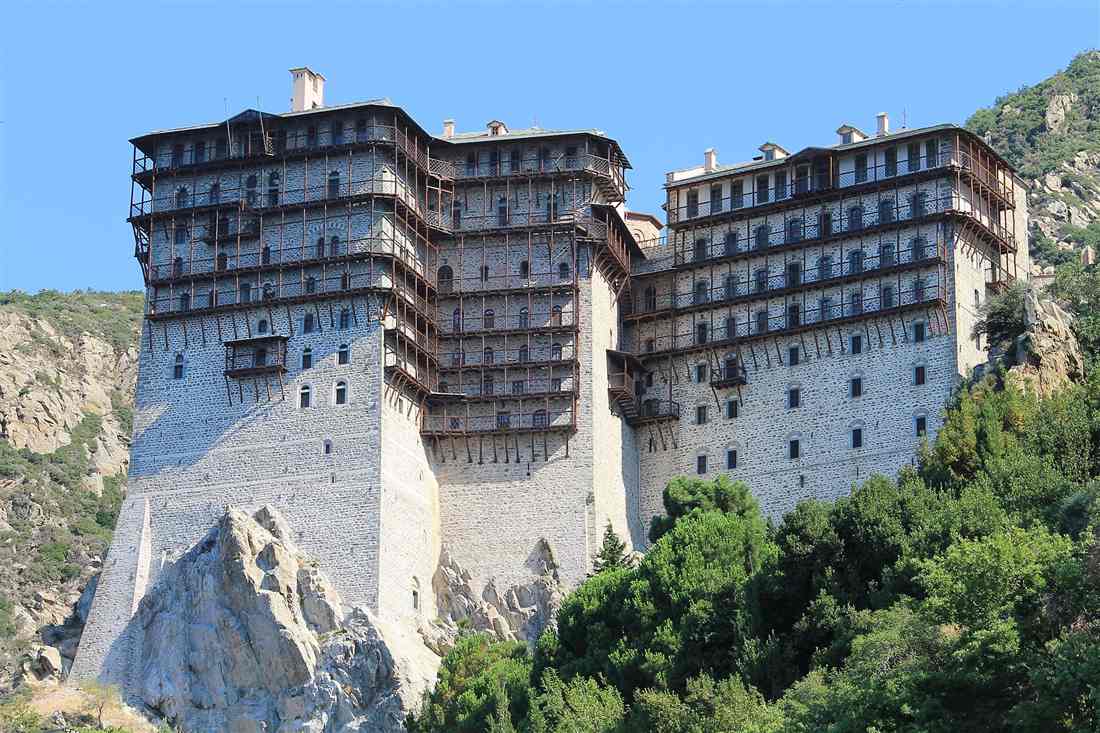
The 5-day Mount Athos hiking tour is a private hike from Ouranoupoli across the monastic peninsula of Athos, with nights in monastery guest houses and the entry permit included. Tours across the rest of the country are listed on Greece Tours.
The sections below cover what the 5-day Mount Athos hiking tour includes, how it compares with a cruise, how five days divide, the old stone paths, the peak, the twenty monasteries and sketes, Karyes, Byzantine time, the treasures, the Xerxes canal, season and booking, with links into the Ouranoupoli tours pages. The tours shown are checked on GetYourGuide and Viator.
What is the 5-day Mount Athos hiking tour?
The 5-day Mount Athos hiking tour is a private hike across UNESCO-listed Mount Athos in Halkidiki. It starts in Ouranoupoli, the last village before the monastic border. The peninsula holds 20 monasteries, thick forests, sea cliffs and centuries of religious art.
Athos is the eastern of the three legs of Halkidiki, next to Kassandra and Sithonia. The peninsula runs about 50 km into the Aegean Sea, with a width of 7 to 12 km. This narrow strip lies between the Singitic Gulf and the Strymonian Gulf. Every day of the 5-day Mount Athos hiking tour stays on this strip.
A forested ridge runs down the middle of the peninsula like a spine. It climbs from low hills at the border to the peak of Mount Athos in the south. The southern end drops into the Aegean in steep cliffs. Forest and cliff scenery runs through the walking days of the 5-day Mount Athos hiking tour.
The Greek constitution calls Athos a self-governed part of the Greek State. Greek sovereignty over the peninsula stays intact. The 20 monasteries run daily affairs, and a civil administrator represents the state. Church matters fall under the Ecumenical Patriarch of Constantinople. Hikers on the 5-day Mount Athos hiking tour cross into a monastic state with its own rules.
UNESCO added Mount Athos to its World Heritage List in the late 20th century. It is a mixed site, listed for both cultural and natural value. The cultural side covers monastery buildings, icons and wall paintings. The natural side covers forests the monks have protected. Walkers on the 5-day Mount Athos hiking tour see both sides of that listing.
Ouranoupoli sits at the northwest start of the Athos peninsula, about 140 km from Thessaloniki. Its name means Sky City in Greek. Alexarchus, brother of King Cassander, founded the ancient town of Uranopolis here in the late 4th century BC. The 5-day Mount Athos hiking tour sets out from this village of about 800 people.
Pilgrims enter the monastic state by sea, since no public road crosses its land border. Daily boats leave Ouranoupoli for Dafni, the main port on the west coast. A second ferry route starts at Ierissos, on the opposite coast of the peninsula. The village belongs to the municipality of Aristotelis, named after Aristotle of nearby Stagira.
- Region: northern Greece, on the Aegean coast of Halkidiki
- Area: 335.6 square kilometres of mountain, forest and coast
- Highest point: the peak of Mount Athos at 2,033 metres
- Residents: around 2,000 monks living in 20 monasteries
- EU status: inside the European Union and the Schengen Area
- Tax status: outside the EU value-added tax area
What does the 5-day Mount Athos hiking tour include?
The 5-day Mount Athos hiking tour includes a private hike for one group, with no other guests added. Nights are spent in shared monastery accommodation reserved for the group. The entry permit, called the diamonitirion, comes with the package.
Booking sites list the 5-day Mount Athos hiking tour under two titles. The first reads From Ouranoupoli: 5-Day Private Holy Mt. Athos Hiking Tour. The second reads Holy Mount Athos Private 5-Day Hiking Tour From Ouranoupoli. Both name a private group, a start in Ouranoupoli and five days on the Holy Mountain.
The diamonitirion is the written entry permit for the monastic state. The Mount Athos Pilgrims’ Bureau issues it to each named visitor. Pilgrims show it at the port before boarding the ferry. Daily entry stays capped at 100 Orthodox and 10 non-Orthodox pilgrims. The permit fixes the date each pilgrim crosses.
Independent pilgrims arrange each part on their own. They request the diamonitirion from the Pilgrims’ Bureau in advance and reserve a bed at each monastery directly. On the 5-day Mount Athos hiking tour, the permit and the monastery beds come in one booking.
Only adult men can enter the monastic state. Greek law and an 11th-century imperial decree bar women, under a rule called the avaton. The 5-day Mount Athos hiking tour is therefore open to all-male groups only. Mixed groups can see the peninsula from the sea on a Mount Athos cruise from Thessaloniki.
Before booking, hikers read the full listing page line by line. Six points decide how each day runs between monasteries, from meals and guiding to luggage. Any point left blank goes to the operator as a written question before payment. Clear answers on these six points set the pace and the packing list for five days.
- Meals: which meals the package covers on each of the five days
- Guide: whether a guide walks with the group, and in which language
- Daily distances: the kilometres and walking hours set for each stage
- Luggage: whether bags move ahead by vehicle or stay on each hiker’s back
- Fitness level: the climbing and hours on foot the operator expects
- Meeting point: the place and hour in Ouranoupoli on the first day
Each guest on the 5-day Mount Athos hiking tour checks which costs sit outside the package. The road transfer from Thessaloniki to Ouranoupoli and the ferry fare come first on that list. Hotel nights in Ouranoupoli before or after the hike fall outside the monastery stay. Travel insurance and personal purchases stay separate.

How does it compare with a Mount Athos cruise?
Only men join the 5-day Mount Athos hiking tour, which lands with a permit and spends nights ashore. A coast cruise from Ouranoupoli takes women and men along the shore. It never lands, so every monastery on the route stays a view from the deck.
Women are barred from the whole monastic territory under Greek law and religious tradition. That rule limits the 5-day Mount Athos hiking tour to male walkers. A couple or a mixed family can share the cruise, since its deck takes every passenger. Mixed groups can also split, with the women on the cruise and the men on the trails.
Entry onto Athos needs a permit called the diamonitirion. Visitors collect it at the Pilgrims’ Office in Ouranoupoli before the morning ferry leaves. The 5-day Mount Athos hiking tour includes that permit. Cruise passengers need no permit, since their boat stays at sea. Ouranoupoli itself lies outside the monastic territory, so its streets and harbour are open to all.
Nights mark the clearest gap. The 5-day Mount Athos hiking tour spends its nights in shared monastery accommodation reserved for the group. A cruise returns to the Ouranoupoli harbour with no night ashore. Its passengers sleep back on the mainland, in Ouranoupoli or elsewhere in Chalkidiki. Only walkers see the Athos coast at dawn, after a night inside a monastery.
From the deck, the shore shows monastery walls and small harbours called arsanas. Walkers on the 5-day Mount Athos hiking tour reach forest paths and inner valleys hidden from boats. Their paths link the west and east coasts across the forested spine of Athos.
Pace is the last gap. A Mount Athos cruise from Ouranoupoli follows the west coast in one seated outing. Its passengers need no walking fitness at all. On the 5-day Mount Athos hiking tour, the trail sets the speed, one stage at a time. Each stage climbs or drops on stone and earth paths between the coast and the ridge.
- Access: the hike admits men only. The cruise takes women and men together on the same deck from Ouranoupoli.
- Permit: the hike includes the diamonitirion from the Pilgrims’ Office. The cruise needs no permit at all.
- Nights: the hike spends its nights in shared monastery accommodation. The cruise returns to Ouranoupoli with no night ashore.
- Pace: the hike moves on foot from monastery to monastery. The cruise views the west coast from the sea, seated on deck.


How do five days divide across the Athos trails?
A sample 5-day Mount Athos hiking tour opens with the boat and a day through Karyes. Days three and four link monasteries on old stone paths, with an optional climb toward the peak. Day five takes the boat back to Ouranoupoli or to Ierissos.
Day one of the 5-day Mount Athos hiking tour starts at the Ouranoupoli harbour. The ferry Axion Esti takes about two hours down the west coast to Daphni. It calls at the landings of Zografou, Konstamonitou, Docheiariou and Xenophontos. At Daphni, a bus timed to the ferry climbs to Karyes. Its seats fill fast, so walkers board at once.
The east-coast landings take a different boat, a daily speedboat from Ierissos. Its run calls at Hilandar, Esphigmenou, Vatopedi, Pantokratoros, Stavronikita, Iviron, Philotheou and Karakalou. The last stop is Morfonou, the landing for the monastery of Great Lavra. Rough sea can end the run early at Vatopedi or Iviron. Walkers starting on the east coast skip the Daphni bus entirely.
Day two of the 5-day Mount Athos hiking tour passes through Karyes, which sits above 300 m. A stone-paved path leaves the village past Koutloumousiou and follows a river valley down to Iviron. The stage covers 4.9 km in 1.5 to 2 hours on foot. Iviron stands on the east coast, so the walk ends close to sea level.
Day three of the 5-day Mount Athos hiking tour links east-side monasteries on the old paths. The stage from Iviron to Philotheou runs 5.6 km in about 2 hours. Philotheou to Karakalou adds 2.3 km in about 45 minutes, largely through woods. A northern variant drops from Karyes to Pantokratoros instead, covering 5.7 km in 1.5 to 2 hours.
Day four of the 5-day Mount Athos hiking tour adds more stages or a climb toward the peak. The climb starts from the southern sketes and needs a full day with an early start. Stage times for that ascent appear in the section on the peak below.
- Day 1: ferry from Ouranoupoli to Daphni and the bus to Karyes. The Ierissos speedboat serves the east coast instead.
- Day 2: Karyes past Koutloumousiou down to Iviron. The stone-paved valley path covers 4.9 km to the sea.
- Day 3: Iviron to Philotheou and on to Karakalou. The two stages total 7.9 km in under 3 hours.
- Day 4: more monastery stages, or the optional climb toward the peak.
- Day 5: boat back to Ouranoupoli from Daphni. East-coast walkers return to Ierissos from their landing on the speedboat.
What are the kalderimia, the old stone paths of Athos?
The kalderimia are old cobbled mule paths that link the monasteries of Athos across forests and cliffs. A 5-day Mount Athos hiking tour follows these stone tracks over ridges and coves. They are too narrow for cars and were built for walkers and pack mules.
Builders laid flat cobblestones side by side to carry walkers and mules over mud and rock. On steep slopes, the paving rises in rows of low stone steps. The Greek name for such a cobbled path is kalderimi. Plain dirt trails, called monopatia, make up the larger share of the Athos network.
In the second half of the 20th century, dirt forest roads began to cut across the slopes. Forestry work and track building changed the line of older routes. Long stretches of stone path fell into disrepair or vanished under scrub. Walkers on a 5-day Mount Athos hiking tour still cross these roads between stone sections.
The Friends of Mount Athos, an international society, began yearly path-clearing trips early in the 21st century. Each late spring, a team of 25 to 30 volunteers spends about two weeks on the mountain. They cut back overgrowth, clear debris and fix new signs. Their work keeps the 5-day Mount Athos hiking tour on open, signed paths.
The society also records GPX tracks and keeps a table of path conditions and walking times. A detailed map by Peter Howorth shows the trails in English, Greek and Russian. Mobile signal drops out in parts of the peninsula. Pack a waterproof paper map for a 5-day Mount Athos hiking tour.
One named trail, the Way of the Bey, runs from Esphigmenou monastery to Dionysiou monastery. It reaches its highest point on Antiathonas, at 1,042 m. The western coast is steeper and more rugged than the eastern coast. Its sea cliffs are part of the scenery on a 5-day Mount Athos hiking tour.
Mixed broadleaf forest, deciduous and evergreen, covers the larger part of Athos. The paths climb through its belts from coastal scrub to fir woods. Grey wolves, wild boar and jackals live in the woods of a 5-day Mount Athos hiking tour. Old monk paths also climb between the rock-top monasteries of Thessaly, on the hiking trails of Meteora.
- Sweet chestnut and holm oak along the middle slopes
- Hungarian oak in the deciduous woods
- Pine and fir stands on the upper slopes
- Broadleaf maquis and hard-leaved scrub further south
- Small springs beside the paths in the chestnut and oak woods
- Walking times on Athos maps set at the traditional Athonite pace
How high is the peak of Athos, and what stands on the summit?
The peak of Athos rises 2,033 m straight from the Aegean Sea. A chapel of the Transfiguration and a tall iron cross stand on its bare top. A 5-day Mount Athos hiking tour crosses the forests below this white pyramid of rock.
Climbers gain nearly the full height, since the paths start close to sea level. The top cone is pale limestone and marble, bare above the tree line. The peak marks the southern end of the peninsula, a landmark for any 5-day Mount Athos hiking tour. Deep snow patches cover the cone in winter and early spring.
The chapel of the Panagia sits at about 1,500 m on a grassy slope. That is higher than any monastery on a 5-day Mount Athos hiking tour. It doubles as a refuge, the last shelter below the top. Climbers leave spare gear there before the final ascent.
From the Panagia, a steep path gains about 500 m to the top. It crosses bare rock far above the chestnut woods of a 5-day Mount Athos hiking tour. On top, a narrow rock holds the chapel of the Transfiguration. A tall iron cross on the summit dates from the late 19th century.
The usual climb starts at the Skete of Agia Anna on the southwest coast. An old mule track carries the route, with stairs on the lower slopes. Kerasia, a settlement at 581 m on the southwestern slopes, is a stop on the way. From the Stavros crossroads, the Panagia path is the only path to the summit.
Athos keeps the Julian calendar. Its feast of the Transfiguration on 6 August falls on 19 August of the civil calendar. Before the feast, monks set out from the Great Lavra with vestments and sacred vessels on pack animals. Pilgrims from other parts of Athos join them on the way. At the summit chapel, they serve an all-night vigil.
From the top, the whole peninsula spreads out below. The monasteries of a 5-day Mount Athos hiking tour show along both coasts. On clear days, Mount Olympus rises on the mainland to the west. The Turkish coast shows to the east. The summit can sit inside the clouds or high above them.
- Skete of Agia Anna to Kerasia: 5 km, about 2 hours 30 minutes
- Kafsokalyvia to Kerasia: 1.5 km, about 1 hour 30 minutes
- Kerasia to the Panagia chapel: 3.2 km, about 3 hours
- Panagia chapel to the summit: 1.5 km, about 1 hour 20 minutes
Which are the twenty monasteries of Athos?
Athos has twenty ruling monasteries, ranked in a fixed order from the Great Lavra to Konstamonitou. Together they own the whole peninsula and all its dependent settlements. The nights of a 5-day Mount Athos hiking tour are spent in shared rooms at these monasteries.
The Great Lavra holds first place. Athanasios the Athonite founded it in the 10th century. Vatopedi ranks second and Iviron third, and both also date from the 10th century. Georgian monks founded Iviron, and its name recalls Iberia, an old name for Georgia. The list below shows the rank order that every 5-day Mount Athos hiking tour meets.
- 1st: Great Lavra
- 2nd: Vatopedi
- 3rd: Iviron
- 4th: Hilandar
- 5th: Dionysiou
- 6th: Koutloumousiou
- 7th: Pantokratoros
- 8th: Xiropotamou
- 9th: Zograf
- 10th: Docheiariou
- 11th: Karakallou
- 12th: Philotheou
- 13th: Simonopetra
- 14th: St Paul
- 15th: Stavronikita
- 16th: Xenophontos
- 17th: Grigoriou
- 18th: Esphigmenou
- 19th: St Panteleimon
- 20th: Konstamonitou
Three ruling houses belong to Orthodox nations beyond Greece. Saint Sava and his father, Stefan Nemanja, founded Serbian Hilandar in the 12th century. Zograf is the Bulgarian house, and St Panteleimon is the Russian one. The other seventeen houses are Greek. A 5-day Mount Athos hiking tour therefore enters a peninsula shared by four national traditions.
Nine houses stand on the northeast side of the peninsula. Esphigmenou, Vatopedi, Pantokratoros, Stavronikita and Iviron sit right on the shore. Hilandar, Philotheou and Karakallou stand inland on the same side. The Great Lavra closes this row near the southeast tip. This side faces the open Aegean, the eastern edge of a 5-day Mount Athos hiking tour.
Ten houses line the southwest side, on the Singitic Gulf. Zograf and Konstamonitou stand inland in the north. Docheiariou, Xenophontos, St Panteleimon and Xiropotamou hold the middle stretch. Simonopetra, Grigoriou, Dionysiou and St Paul close the row in the south. Koutloumousiou alone stands in the centre. This gulf coast forms the western edge of a 5-day Mount Athos hiking tour.
The Greek Constitution forbids any change to the number of monasteries or to their order of rank. No twenty-first house can join, and none can lose its place. Stavronikita became a full monastery in the 16th century and was the last to join. As a result, every 5-day Mount Athos hiking tour meets the same twenty houses.
Rank does not follow founding age. Dionysiou, founded in the 14th century, ranks fifth. Karakallou dates from the 11th century, yet ranks eleventh. All twenty houses now follow the coenobitic rule, with common property under one abbot. Each brotherhood elects its abbot for life. Guests on a 5-day Mount Athos hiking tour therefore lodge with fully communal brotherhoods.
What are sketes, kellia and hermitages?
Sketes are monk villages around one central church, and kellia are farmhouse cells. Hermitages hold single monks in remote huts, caves and cliff cells, each tied to a ruling monastery. These settlements fill the ground between monasteries on a 5-day Mount Athos hiking tour.
Athos counts twelve official sketes, and each has a central church called the kyriakon. Eight are idiorrhythmic: small houses called kalyves stand around the kyriakon, each running its own life. The other four are coenobitic and live as one community, like small monasteries. Each skete stands on ruling-monastery land, the ground a 5-day Mount Athos hiking tour crosses.
- Great Lavra: St Anne, Kafsokalyvia and Timiou Prodromou
- Vatopedi: St Andrew and St Demetrios
- St Paul: New Skete and Lakkoskiti
- Iviron: Timiou Prodromou of Iviron
- Koutloumousiou: St Panteleimon Skete
- Pantokratoros: Prophet Elijah
- Xenophontos: Evangelismos, the Annunciation Skete
- St Panteleimon: Bogoroditsa
St Anne Skete lies on the Aegean shore, about 800 metres from New Skete. Its kyriakon church went up in the 17th century, under Patriarch Dionysios III. Kafsokalyvia, the Holy Trinity Skete, sits at the southern edge of the peninsula. Its name means burnt huts in Greek, after Maximos, a 14th-century hermit who burned each hut he left.
St Andrew Skete, also called Serai, stands at Karyes. It shares the coenobitic rule with Timiou Prodromou, Prophet Elijah and Bogoroditsa. Little St Anne and the Skete of St Basil use the word skete without official status. Learning the twelve official names before a 5-day Mount Athos hiking tour makes Athos maps easier to read.
A kellion, or cell, is a farmhouse with a small chapel, home to one to three monks. They work its land under a ruling monastery, which assigns it by a deed called an omologon. A kathisma is smaller: a single-monk house with a chapel near its monastery. The monastery supplies the kathisma with its daily needs.
Karoulia lies on the southernmost shore of Athos and belongs to the Great Lavra. Hermits live there in caves and huts 100 to 500 metres above the sea. Ladders and chains fixed to the rock lead up to the cells. This solitary life stands far from the shared monastery rooms of a 5-day Mount Athos hiking tour.
The name Karoulia means pulleys in Greek, after the baskets the hermits haul up on ropes. They practise hesychasm, a tradition of silent prayer in solitude. Thessaly’s Meteora monasteries once relied on ropes and ladders in the same way. Kerasia and Katounakia, two more small settlements, sit on the same southern slopes.
What is Karyes, the capital of the Holy Community?
Karyes is the small capital of Mount Athos, set near the middle of the peninsula. It holds the Protaton church, the Holy Community and the office of the civil governor. A 5-day Mount Athos hiking tour crosses the land governed from this town.
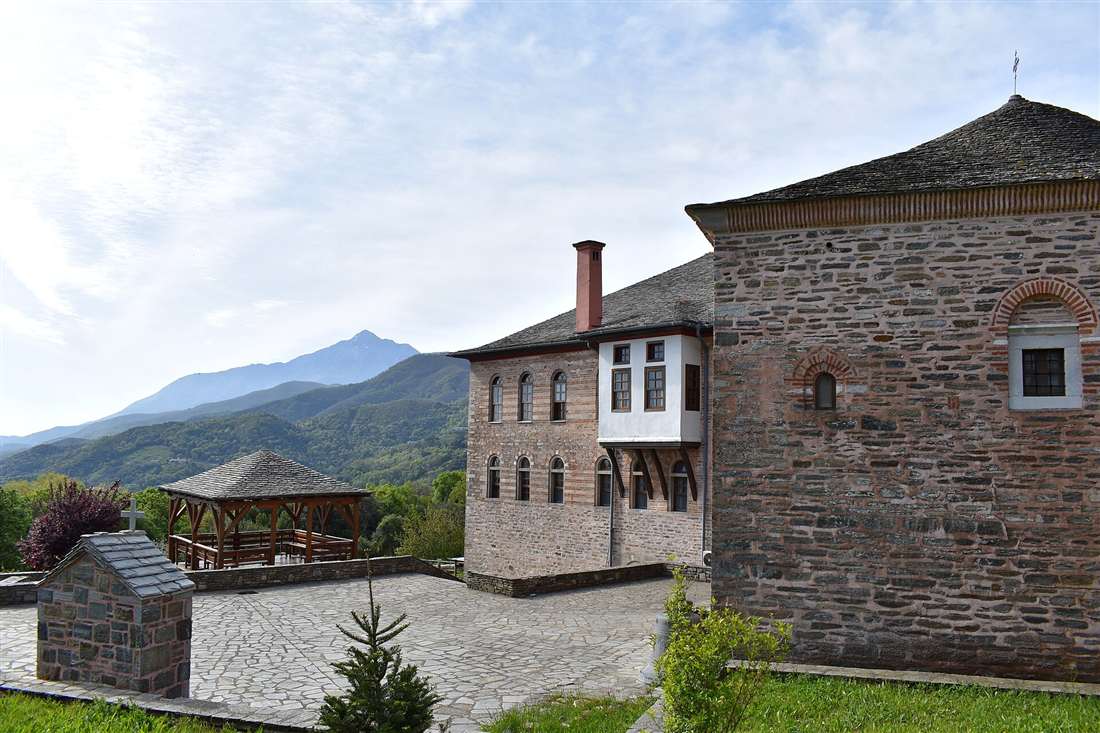
Karyes lies on a wooded slope, with Koutloumousiou Monastery just south of the town centre. The latest Greek census counted 135 residents, all of them men. A 5-day Mount Athos hiking tour that passes through Karyes meets the largest settlement on the mountain.
The Protaton is the main church of Karyes. It was founded in the early 10th century, before the Great Lavra was finished. It served as the seat of the Protos, the head of the early monastic community. Today it keeps the Axion Estin, the chief icon of the Virgin Mary on the mountain.
Its frescoes date from the late 13th century and are attributed to Manuel Panselinos. He came from Thessaloniki and is counted the chief painter of the Macedonian school. For anyone on a 5-day Mount Athos hiking tour, the Protaton is where to see his painting.
The Holy Community gathers twenty representatives, one from each monastery, in a hall in Karyes. They meet at regular intervals and decide matters for the whole Holy Mountain. In church matters, the peninsula answers directly to the Ecumenical Patriarch of Constantinople. Every monastery that hosts a 5-day Mount Athos hiking tour sends a delegate to this assembly.
The Holy Epistasia is the executive arm of the Holy Community. Four monks sit on it for a one-year term and carry out the assembly’s decisions. Their head, the Protepistatis, holds the office that replaced the old Protos. Each year a new board takes over in a ceremony at the Protaton.
The civil governor represents the Greek state from an office in Karyes. A presidential decree fills the post on the advice of the Ministry of Foreign Affairs. The role resembles a regional governor elsewhere in Greece, with a deputy and staff. State law and monastic rule both apply to every guest on a 5-day Mount Athos hiking tour.
- A post office, a police station and a health centre serve the town.
- Shops sell icons, crosses, carvings and komboskinia, the knotted prayer ropes of monks.
- The monasteries keep residences in the town, called konakia, for their delegates.
- Kellia, small monastic houses around the town, hold monks of Greek, Russian, Bulgarian, Romanian and Serbian origin.
How does Athos keep Byzantine time and the old calendar?
Athos keeps Byzantine time, so the monastery day begins at sunset. It also follows the Julian calendar, which runs 13 days behind the civil one. A 5-day Mount Athos hiking tour therefore moves between two clocks and two calendars.
In this count, the clock reads 12 as the sun goes down, and the next hour is 1. On a Byzantine dial, 12 means neither noon nor midnight. The night and dawn services follow this count. Guests on a 5-day Mount Athos hiking tour hear the wooden semantron call each service by this clock.
Because sunset moves through the year, the gap to Greek time never stays fixed. On Athos the sun sets close to 5 in the afternoon in midwinter. In midsummer it sets close to 9 in the evening, Greek summer time. The Byzantine 12 thus shifts by about four hours of Greek clock time across the year.
Monks reset the hands as the sunset hour moves, following tables printed in the church calendar. On a 5-day Mount Athos hiking tour, a monastery dial and a phone screen disagree by hours.
Not every monastery keeps the sunset count. Vatopedi sets its clocks to worldly Greek time. At Iviron, 12 on the dial marks sunrise instead. Where two wall clocks hang side by side, one shows secular time and the other Byzantine. Those paired dials let anyone on a 5-day Mount Athos hiking tour read both systems at a glance.
Athos never took up the Gregorian calendar of the Greek state. The Church of Greece moved its fixed feasts to a revised calendar, while Athos kept the Julian one. Easter falls on the same Sunday on Athos and across Greece. A guest on a 5-day Mount Athos hiking tour lives by two dates, the civil and the Julian.
- Christmas: 25 December on Athos, 7 January on the civil calendar.
- Theophany: 6 January on Athos, 19 January on the civil calendar.
- Annunciation: 25 March on Athos, 7 April on the civil calendar.
- Dormition of the Virgin: 15 August on Athos, 28 August on the civil calendar.
- Church new year: 1 September on Athos, 14 September on the civil calendar.
- Saint Nicholas: 6 December on Athos, 19 December on the civil calendar.
Each monastery marks its patron saint with an all-night vigil on the Julian date of the feast. Monastery gates close by sunset and open again by sunrise. On a sunset dial, the hour of 12 therefore also locks the doors. Each night of a 5-day Mount Athos hiking tour starts inside monastery walls before that hour.
What treasures do the Athos libraries and sacristies keep?
The 20 monasteries keep over 11,000 manuscripts, thousands of icons, holy relics and imperial charters. A 5-day Mount Athos hiking tour shows the religious art inside the monastery churches. Library and archive rooms stay locked to pilgrims and open only to approved scholars.
Each of the 20 monasteries on a 5-day Mount Athos hiking tour keeps its own library and archive. Great Lavra alone holds 2,116 Greek manuscripts, 165 codices and about 100 manuscripts in other languages. Over 20,000 printed books share its library behind the main church. Vatopedi stores 2,000 manuscripts and 35,000 printed books in its north-east tower.
Great Lavra’s vestry holds a gospel book in a gold cover, a gift from Emperor Nikephoros II Phokas. At Vatopedi, a silver reliquary set with jewels holds the skull of St John Chrysostom. Monks bring relics out after services for pilgrims, including guests on a 5-day Mount Athos hiking tour. The holdings fall into six groups.
- Manuscripts: gospel books, psalters and lectionaries, copied by hand on parchment and paper.
- Icons: 2,500 panels in the Great Lavra vestry alone.
- Relics: the Cincture of the Theotokos at Vatopedi, the belt of the Virgin Mary in Orthodox tradition.
- Liturgical objects: chalices, crosses and book covers, such as a chalice cut from one piece of jasper.
- Embroideries: silk vestments, altar cloths and processional cloths stitched with gold and silver thread.
- Imperial charters: chrysobulls, decrees with gold seals that granted the monasteries land and privileges.
At the end of the 20th century, Thessaloniki’s Museum of Byzantine Culture showed 589 loans from 17 monasteries. The show marked the city’s year as European Capital of Culture. The loans included 131 documents, 120 manuscripts and 108 icons. Charters and manuscripts of this rank stay out of sight on a 5-day Mount Athos hiking tour.
Spyridon Lambros catalogued the Athos Greek manuscripts in two volumes at the end of the 19th century. The Library of Congress filmed Athonite manuscripts in the mid-20th century. Those films are now digitised, so readers can study pages before a 5-day Mount Athos hiking tour. The Holy Community later signed a digitising deal with the telecom firm OTE.
Every guest on a 5-day Mount Athos hiking tour follows the monks’ rules on sacred art. Frescoes and icons in the katholikon, the main church, stay on view to all guests. Vatopedi keeps seven icons of the Virgin held to work miracles, among them the Paramythia. Cameras and filming are banned inside the churches.
What is the Xerxes canal at the neck of the peninsula?
In the 5th century BC, Xerxes I of Persia cut a ship canal across the Athos isthmus. It linked the north coast at Nea Roda with the south coast near Tripiti. A 5-day Mount Athos hiking tour starts on the peninsula south-east of this line.
In the early 5th century BC, a storm off the Athos cliffs wrecked the Persian fleet of Mardonius. About 300 ships and 20,000 men were lost. Xerxes ordered the canal to keep his next fleet away from that cape. A 5-day Mount Athos hiking tour crosses a peninsula that runs about 50 km past this neck.
Herodotus describes the dig in his Histories. Two Persians, Bubares and Artachaees, ran the work for three years. Forced local labour dug beside Egyptian and Phoenician crews. Diggers handed the soil up to men standing on steps above. The Phoenicians cut their stretch twice as wide at the top, so its sides held.
Herodotus saw pride behind the plan, since crews had the option to haul ships over the neck. Xerxes wanted to display his power and leave a memorial. His order called for a cut wide enough for two triremes rowed side by side. Travellers heading to a 5-day Mount Athos hiking tour now cross that neck by road.
Herodotus gave the width of the isthmus as 12 stadia, about 2 km. Modern surveys measured the canal at about 2 km long, 30 m wide and 3 m deep. Sediment now fills the channel, but its line shows on aerial photos. The cut lies north of the area a 5-day Mount Athos hiking tour crosses.
- End of the 5th century BC: Thucydides mentioned the canal in his history of the Peloponnesian War.
- 18th century: the French envoy Choiseul-Gouffier found traces in the middle of the isthmus.
- 19th century: the English naval officer Thomas Spratt found traces in the same central stretch.
- Start of the 20th century: the German researcher Adolf Struck confirmed those traces.
- End of the 20th century: British and Greek seismic surveys showed a fast build and brief use.
The Persian fleet used the canal on its way to the battles of Artemisium and Salamis. The channel then silted up. Its north end opens on the Gulf of Ierissos. Its south end opens on the Singitic Gulf, where Halkidiki boat tours now sail. Ouranoupoli, the base for a 5-day Mount Athos hiking tour, faces the same gulf.
Which season suits the 5-day Mount Athos hiking tour?
Late spring, September and October suit the 5-day Mount Athos hiking tour, with mild days on forest paths. Summer brings highs of 29 to 32 °C on open slopes. Winter brings heavy rain, snow on the peak and rough sea.
The Athos peninsula shares the Mediterranean climate of Chalkidiki, with hot, dry summers and cool, wet winters. Mean winter temperatures sit at 9 to 11 °C on the coast. December and January bring the heaviest rain, at about 60 mm a month. August stays the driest month, with about 12 mm of rain.
Walking days on the 5-day Mount Athos hiking tour feel mildest in April, late spring, September and October. Chestnut, oak and pine forest shades the slopes of the peninsula in both seasons. Rain picks up again in November, at the start of the wet season.
Summer heat turns open, stony paths into hard work by midday. Walkers on a 5-day Mount Athos hiking tour in July or August need early starts. A sun hat and two litres of water per walker cover the hottest hours. June, July and August also fill the monastery guest houses to capacity.
Winter storms halt the Athos ferries on rough-sea days. Orthodox Easter, in April or late spring, draws large crowds of pilgrims and fills the guest houses. The feast day of each monastery does the same on its own date.
- Spring: mild walking days, green forest and Easter crowds in the guest houses
- Summer: highs of 29 to 32 °C, dry paths and full guest houses
- Autumn: mild days in September and October, with rain returning in November
- Winter: cool, wet days, snow on the peak and ferry stops in storms
Kassandra and Sithonia, the other two peninsulas of Chalkidiki, hold long sandy beaches. A Halkidiki day trip from Thessaloniki adds a beach day after the 5-day Mount Athos hiking tour.
How do you book and cancel the 5-day Mount Athos hiking tour?
GetYourGuide and Viator both list the 5-day Mount Athos hiking tour from Ouranoupoli. Each order needs a date, a group size and passport details for the entry permit. Free cancellation runs up to 24 hours before the start on listings that show that label.
GetYourGuide sells it as “From Ouranoupoli: 5-Day Private Holy Mt. Athos Hiking Tour”. Viator sells it as “Holy Mount Athos Private 5-Day Hiking Tour From Ouranoupoli”. Both titles mark it as private, so no other bookings join the group.
The entry permit, called the diamonitirion, comes from the Mount Athos Pilgrims’ Bureau. Foreign visitors need a valid passport, and the bureau needs each walker’s passport details. Greek law bars women from Athos, so only men can book the 5-day Mount Athos hiking tour.
Payment goes through the checkout of the chosen site, and the confirmation email carries the voucher. The voucher works on a phone or on paper at the meeting point in Ouranoupoli. A private Halkidiki transfer links Thessaloniki airport and city hotels with the village.
Cancellations go through the same GetYourGuide or Viator account that holds the booking. Inside the last 24 hours, free cancellation no longer covers the 5-day Mount Athos hiking tour.
- Pick the GetYourGuide or Viator listing
- Choose the start date and the number of walkers
- Enter each walker’s passport details for the permit
- Pay at checkout and save the voucher
- Show the voucher at the meeting point in Ouranoupoli
Frequently Asked Questions
How long does the tour last?
Both listings set the length at five days, with the start in Ouranoupoli. GetYourGuide and Viator each put the five-day span in the tour title. The 5-day Mount Athos hiking tour spends all five days on the Athos peninsula. The listing page sets out the daily stages.
Where does the tour start?
Both listing titles name Ouranoupoli as the start. The village sits on the northwest coast of the Athos peninsula, in Chalkidiki. It is the last settlement before the border of the monastic state. The Mount Athos Pilgrims’ Bureau keeps an office there, and daily ferries leave its port for Dafni.
Can women join the tour?
No. Greek law and monastic tradition bar women from the whole territory of the monastic community. Tradition ties the rule to a legend in which the Virgin Mary blessed the peninsula as her garden. The 5-day Mount Athos hiking tour therefore takes men only, and permits go to men alone.
Is the entry permit included?
Yes. The GetYourGuide listing includes the entry permit, the diamonitirion, in the 5-day Mount Athos hiking tour. The Mount Athos Pilgrims’ Bureau issues it against each walker’s passport details. The tour operator files the request before the start date.
Where are the nights spent?
Nights on the 5-day Mount Athos hiking tour are spent in monasteries. GetYourGuide lists shared monastery accommodation, reserved for the private group. Each monastery runs a guest house, the archontariki, for pilgrims. Guest houses take in pilgrims only with a valid diamonitirion. Monastery gates close at sunset, so pilgrims arrive before dark.
How far is Ouranoupoli from Thessaloniki, and which bus runs there?
Ouranoupoli lies southeast of Thessaloniki, at the end of the road into the Athos peninsula. KTEL Chalkidiki runs daily buses from its Thessaloniki station to the village. Athos ferries leave early in the morning, so pilgrims spend the night before in Ouranoupoli. An evening arrival puts walkers in the village before the 5-day Mount Athos hiking tour.
What is the dress code in the monasteries?
Monasteries ask for long trousers and long-sleeved shirts, and shorts are refused. Dark, plain clothes fit the church services. Men remove their hats inside churches. Boots with grip suit the paths of the 5-day Mount Athos hiking tour. A clean long-sleeved shirt stays packed for the evening services.